My favourite story of Diablo's development (as relayed by David Brevik in the Diablo Postmortem - see below) is the part where Diablo was made real-time. He passionately championed that it should be more like Rogue or Moria purely turn-based and permadeath. That was until he implemented real-time movement in an afternoon and attacked a skeleton. This was a directive from Blizzard, and it effectively created the ARPG genre.
A trivial aside, and for which I apologise in advance - not least because it may have been merely a typo - but the correct phrase is "averse [to Google]", not adverse. "Averse to Google" == "disinclined to Google"; "Adverse to Google" == "has negative effects upon Google". I am assuming you meant the former.
It was an honest typo, but it did make me think that at some point with the heat of the idea of the "Metaverse" in some circles, that Google could roll out a competing "Adverse".
I think it is pretty fair to say that Diablo 1 did effectively create the genre as far as the history of gaming is concerned. The commercial and mainstream impact of that game vs anything prior to that is on a different magnitude.
A similar comparison is saying that Apple didn't invent touchscreen phones - sure, but the iPhone had such an overwhelming impact that it shook up the entire industry. Relevant phone comparison image: https://www.cultofmac.com/145083/what-phones-looked-like-bef...
> I think it is pretty fair to say that Diablo 1 did effectively create the genre as far as the history of gaming is concerned.
Definitely not, there were many successful Japanese ARPGs long before that, like Dragon Slayer, Hydlide, The Legend of Zelda, Final Fantasy Adventure, Secret of Mana etc. Diablo may have created its own subgenre.
> Diablo's effect on the market was significant, inspiring many imitators. Its impact was such that the term "action RPG" has come to be more commonly used for Diablo-style games, with The Legend of Zelda itself slowly recategorized as an action-adventure.
Zelda-type games were popular before Diablo-type games became the standard for the genre. Ys is an action RPG but I don’t think Ys is the type of game the average person means when they say ARPG.
Zelda didn't have experience points and levelling (except Zelda II) but there were many other games that were clearly RPGs and that had real time combat. Secret of Mana would be a classical action RPG. I never heard the term being restricted to Diablo.
Zelda II even had experience points, and Wikipedia counts all the other games I named as ARPGs. There is no way in which Diablo was the first ARPG.
Edit: Maybe the influence of Diablo is more that it effectively ended the era of Western/PC turn-based RPGs. For Japanese RPGs, turn-based (non-action) RPGs did hang on for longer, e.g. in form of Final Fantasy.
Fact of the matter is that ARPG today generally means a Diablo-like game. It defined the genre that we know today as ARPGs. You can name other games ARPGs if you want, but it has nothing to do with Diablo or the genre that Diablo defined.
I'm not sure why this sort of thing is so difficult to understand.
Pretty much all modern Open World RPGs have real time combat and are therefore called action RPGs, e.g. by Wikipedia. But a game like Elden Ring doesn't seem to me particularly Diablo-like.
There are extensive skill trees and itemization choices. The roleplaying is choosing which skills and items you wish to use in your quest to vanquish demons.
> Diablo 1 did effectively create the genre as far as the history of gaming is concerned
Ha, no. Legend (1992), Tower of Souls (1995), Dragonstone (1994),... And that was just on the Amiga/Atari/PC. I guess people more familar with consoles have many more examples.
> Diablo 1 did effectively create the genre as far as the history of gaming is concerned
> Ha no.
This is unceremoniously ungracious and an obvious misinterpretation. Being the first is not the same as genre creation^. The games prior to Diablo 1 shared features, but weren't considered a formula for generating revenue beyond the novel mechanics.
^Herzog Zwei had elements of the modern RTS, but it is not considered genre defining.
I went to one of his talks at an NZGDC ages ago and it was super great.
Not only did he cover that they wrote the whole damn thing in assembly, but also exactly as you say: everyone else there thought that making it real-time instead of turn-based was a great idea, but David wasn't convinced.
So he instead spent a weekend (I think it was less than one day even) changing it so that it ran a "turn" per "tick" of time to experiment and I remember him saying something along the lines of "after I finished making the change, that first time I clicked on a skeleton and my character just walked over and smashed his sword into the skeleton I was convinced".
I have no clue why, but the Diablo style dungeon-crawler ARPGs are literally the only subgenre of game that I have not found a single game from which I like.
I keep trying examples because it's such a strange (and popular) hole in my tastes.
I historically have not been a major fan of ARPGs and share with you the list of games that haven’t moved the needle for me.
Path of Exile fundamentally changed my view on the genre and enabled me to retrospectively re-evaluate many of the ARPGs I had played to this point.
The granular level of control you have over your playstyle and strategy is incredible; it is insane how rewarding it is to be the first person to create a new approach to playing a character and have this build succeed in combat.
I highly recommend giving it a shot if you at all enjoy the cerebral, long term planning aspects of gaming.
That is, until you reach the end game and you realize how much you have to grind because of their completely random crafting system.
PoE is the game that weaned me off "but the microtransactions are cosmetic". It's simply designed to keep you ingame for so long that you get bored and buy a few hideout skins and character skins.
If you mean the skill tree, most people just follow a guide.
<< If you mean the skill tree, most people just follow a guide.
At the beginning? Sure. Eventually though a boredom does set it and a player seeks their own fun be it lore, own builds or something else like gauntlet. I am saying this as a person, who spent too much time on it already.
You really didn't understand crafting then. It's an optimization problem that you have to solve.
Analogy: You don't try to brute force passwords as it takes far too long, you look for smarter options. Same in PoE - you NEVER roll your gear with chaos orbs, you look for vectors to increase your chances.
The whole game is one optimization simulator and it tingles that part of my brain.
Thank you. I was trying to find the words for why it seems so addictive and this captures it. I am now playing ruthless ( ssf hc btw ) and even though I keep getting smacked down, I keep trying to get back up. The mode forces you to work with what you have and optimize at all times.
I'm actually a huge fan of ARPGs (e.g. Seiken Densetsu), just not the kind that are in the Diablo line. I definitely have unusual sensibilities for RPGs in general because I didn't like Planescape Tormet either (though I enjoyed the SSI Gold Box games when I was younger).
Which part is it that you're not vibing with? For me personally, I think the story of e.g. Diablo 3 is gash, but it's when you're higher level, get a great gearset and can just whirlwind through levels and zone out where it comes into play.
But I get what you mean; I've tried PoE and didn't get very far at all, just lost interest. I've spent a bit more time with Grim Dawn, but that game seems to just drag on, I've tried two playthroughs and didn't get behond the second chapter/act I think. I don't know what it's missing, I'm sure it's a great game if people are into that kind of game.
Doesn't this just show the fundamental problem with the genre? In the time it takes to get a high level character with good gear in DIII you could have played another, shorter, game to completion. If you have to play through an entire game's worth of bad content to get to the good bits, why not just play a game that's good from the start?
The good bits are also very short lived. Basically once you get all items you need for a build it's fun for an hour, but from then you only get marginal improvements in grinding to get even better versions of the same items.
For me that's when i get bored and lose interest. The problem with D3 is that you can skip pretty much all the boring prep and just hit max. lvl in minutes and then play a couple hours to get the needed items.
Same here, after a bit of thought I think it is because I bounce hard off the control scheme. the controls are for a rts, which would be fine if I was controlling a bunch of units but I am not. I am controlling only one unit. I keep concentrating on how much the controls suck and how much fun it would be as a run and gun(or twin stick shooter if you prefer that terminology).
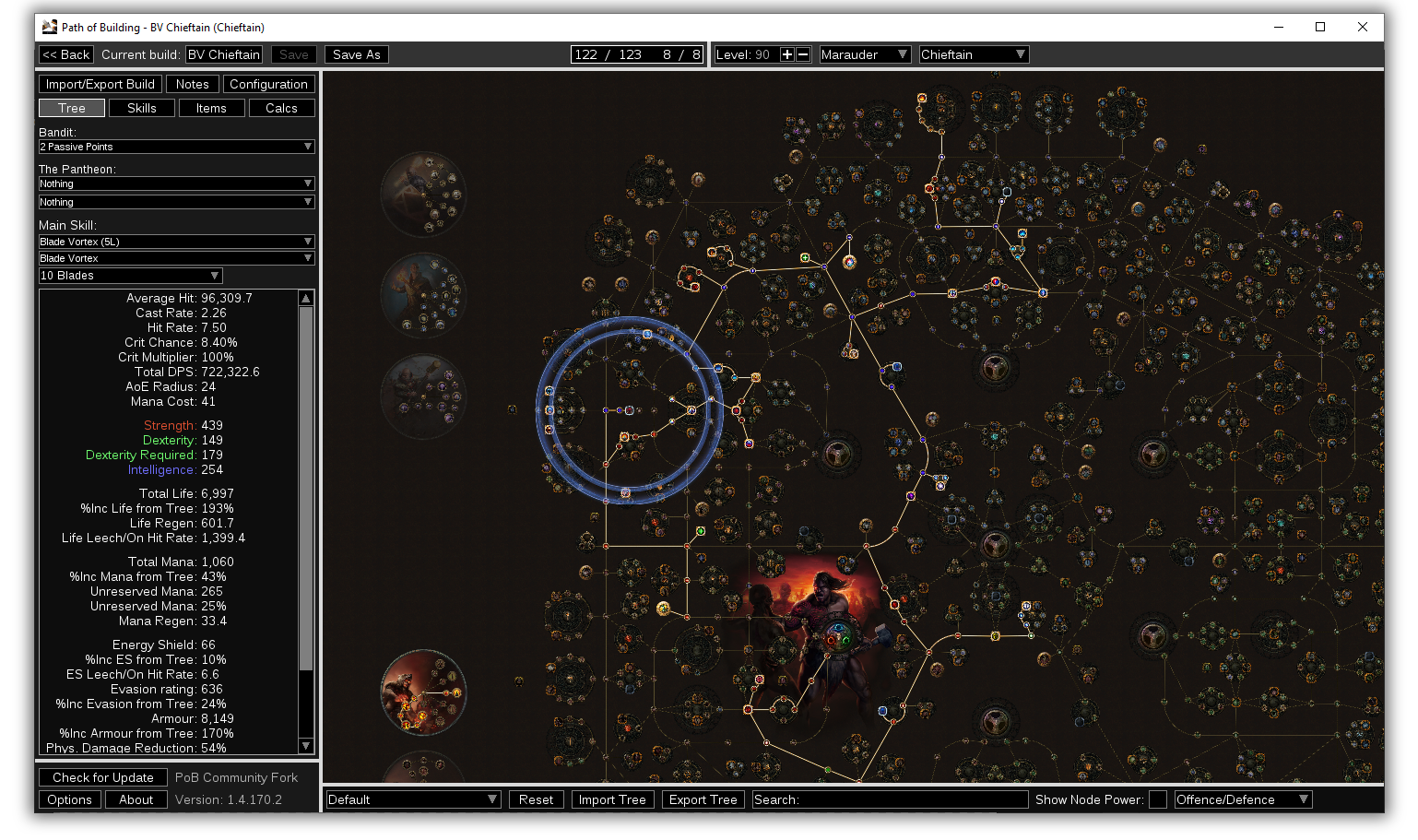
Diablo and PoE differ in tone and gameplay. One is darker and more story/world focused, which is what people tend to love about it, while the other is about management of extreme complexity. Path of Exile (and by extension the upcoming path of exile 2) is all about sinking thousands of hours into understanding game mechanics. The level of depth in that game is unmatched while the story is a complete clusterfuck. For example: you need third party programs to just help you understand how much damage you´re doing due to the number of variables that need to be accounted for https://pathofbuilding.community/images/pob_overview.png
Reason I say this is because if the parent comment is looking for something to try, it is important to keep in mind that PoE is really difficult for beginners to get into and play casually.
PoE isn't too hard to play in the beginning, as long as you learn the skill gem system (takes 5 min?)
But yeah it gets immensely complicated in the endgame. I've been playing for about a year now and am barely just starting to understand it.
That said, it's still a lot of fun. It took me a while to get over the frustration but once I did, it became one of my all time favorite ARPGs... and games, period.
It's totally free too. You only pay for cosmetics and optional extra bank (stash) space. A really fair monetization model that doesn't sacrifice the player experience, so on that front I totally support what they're hilding. (They are, however, owned by Tencent now sadly.)
Indeed, i remember that anecdote. I experienced the reverse first hand: multiplayer Angband has a clock/ticks and it completely transforms the game - but IMNHO ends up ruining the fun.
It was a different time:
“Condor plans to spend one year in the development of Diablo. Personnel will consist of: one designer, one chief programmer, 2 junior programmer, 2 art director/artists, 1 illustrator/sculptor, 3 pixel artists, and 1 sound FX person”
So, 11 people for a year for Diablo. Meanwhile Diablo 4 took 300+ people 6+ years. So over 150x the cost, not accounting for the fact that game developers are paid much more now as well. People pretend it’s the same industry but it’s evolved dramatically.
Diablo 2 is pretty great. My only complaints about it surround harder difficulties. Those of us with accessibility issues (like me with a gimped hand) found hell to be super challenging.
Diablo 3 sucked when it launched, however, right now, it is absolutely amazing. Blizzard has absolute gold with the tiered difficulty/rift/season design. Unsure why they didn't improve upon it...
Diablo 4 has potential, but many of the great systems developed in 1-3 are gone.
What made previous diablo games great:
A fixed level/difficulty system
Randomly generated levels
A way to measure yourself against both yourself and others.
Potential for multiple unique build paths for every class.
An awesome loot/gear system that eventually makes you feel overpowered until you aren't.
This is the central aspect of fun for me in an ARPG. When I come back through that starting story area at level 40, I expect to absolutely melt the enemies I run into. If I get super fucking lucky on a roll and pick up a legendary (i.e. against the story/balance team's wishes), I should be able to have a goddamn romp through the world for quite a bit. This emergence of potentially-unintended gameplay outcomes in an ARPG results in the fun for me.
Maybe there's a way to do the multiplayer-friendly scaling thing that my dopamine loop would enjoy but I haven't seen it yet. Ultimately, it feels like Blizzard tried to solve a cursed problem and walked right into the predictable outcome.
Diablo 4 has no sense of progression because enemies level up as you do. In fact they increase in power faster than you, under the assumption you'll be itemising optimally, so if you level up but don't update your items fast enough, you'll find that mobs actually get harder and harder to defeat as you increase in level.
The level scaling is a really bizarre design choice. Every game with this feels bad. There is no sense of progression as your character gets punished for levelling up.
Some game designers think it’s a great idea though - hence it’s in D4. I’d love to hear their take.
Even though it still feels weird I can see why they did it: since the game is not linear at all (I think you can even do the first 3 acts in any order) compared to other Diablo games (didn't play 3) they kinda need to do this so you don't breeze through zones. It also helps when playing with under/over leveled friends since they just use the same system to prevent you from rushing them.
Personally I prefer linear narrative and gameplay for Diablo (it's like making linear games is a sin nowadays) but it's probably a wise choice given other design choices? Or at least understandable. It allows them to send you back and forth across regions and still present a challenge.
Anyways: I'm liking D4 (I'm surprised to say this of a Blizzard game in 2023) so not the worst design ever.
Level scaling isn't necessary for a nonlinear game. Plenty of games have nonlinear areas and no level scaling because they have relatively flat progression curves. D4 only 'needs' level scaling because it also 'needs' to be Cookie Clicker and Lootbox Simulator with an ARPG wrapped around it, and neither of those systems work with flat progression curves.
By not making level 70s cut through level 15 enemies like butter. If your level 70 is only 50% stronger than a level 15, if the enemies were challenging for a level 15, they won't be trivial for the level 70.
Thinking about it more, one cool thing about level scaling is I can play with my friends at whatever level they are. It doesn't really matter for the endgame at all, but when you're leveling up early on it is pretty nice.
It's the lazy way out to world design for non linear games.
Why put any effort in making sure player locality influences the surrounding quest level, if player can go anywhere, let's put level appropriate enemy everywhere.
Dungeon siege approach was so much better, even if the game was not as solid: minibosses or higher difficulties quests barred the access to higher difficulties areas. Within a zone, progression and choices were non linear. Item and enemies and xp reward were leveled to the zone, so the player had an incentive to not stick around in low level zones farming aimlessly.
To a degree you can also "hide" it in places where it is logical. E.g. if a game has an enemy faction that goes out of its way to attack the player, it does make sense that these attacks get stronger - if someone causes a faction more trouble, he gets more attention and stronger assets are sent to take them out, guards are reinforced, ... And maybe in reverse, weaker intelligent enemies make a point of avoiding the player (would some badly-equipped bandits really ambush a party that's clearly better prepared for combat than them?). That's then somewhat satisfying: clearly those enemies are stronger, and you now can beat them!
What makes little sense is if wildlife you've encountered before suddenly can take 4x more damage, or the same badly equipped guard suddenly fights back a lot better.
> Why put any effort in making sure player locality influences the surrounding quest level, if player can go anywhere, let's put level appropriate enemy everywhere.
That's not how it works in Diablo 4, enemy scaling only comes into play if you go to an area that is naturally lower level than yours. Looking at the world map and hovering over areas shows their minimum "recommended" level, and enemies there will start at that level.
So you absolutely can go as a lvl 10 character to an area that expects you to be 40+ and get smacked down in a few hits by a basic lvl 40 minion.
I believe (with zero supporting evidence) that Blizzard implemented level scaling reluctantly, in order to better facilitate ad-hoc group play. Unfortunately, they kind of screwed it up.
When you move around in the overworld, you sometimes run into another player. They're fighting some enemies, you jump in to help (or vice versa) and it's amazing. Those are some of my favourite moments in the game, and the only reason it works is because of the level scaling. Even if my character is only level 10 and theirs is level 40, we can fight the same enemies and have roughly equal impact, because for me those enemies are level 10, and for them those same enemies are level 40! It's really clever, and I think they felt the sense of progression was an necessary sacrifice to enable that kind of improvised cooperative play.
"But ordinary, you said they screwed it up!" Yeah, they did. Because what happens when the enemies are dead? You continue towards your quest, and they continue towards theirs, and poof, you're all alone again. These brief moments are tantalizingly close to true pick-up experience: you start playing, meet a few people, team up, and have a blast together for an hour or so, just like you could in Diablo 2.
Oh, and even if you do happen to have the same quest, unless you took the relatively scary step of formally inviting them to your (1-person) party, the moment you enter a dungeon, you each get your own instance, and you're torn apart.
And finally, there's no global chat, so the only real way you have of communicating with people you meet prior to inviting them to a party is a Hearthstone-style emote wheel. There are at least 3 quests that require you to use the emote wheel, so they really wanted you to know it's there and to learn to use it, but in practice no one does and it's useless.
Taken together, it just barely doesn't work and it's really unfortunate. And counterintuitively those brief moments of comradery make the game feel more lonely than if you never met anyone at all. Because time and again, you're confronted with the fact that people are out there! Having fun, kicking ass, taking names. Just... you know, not with you.
The only thing I can't quite figure out is why they didn't attempt to 'matchmake' players of similar levels together. There are literally millions of people playing Diablo 4 at any one time, surely there's someone who's doing the same quest at about the same level as me? Why don't I meet those people? Or maybe the odds just don't work out, even at that scale.
This combined with a few other balance issues is what makes hardcore entirely pointless for D4 in my view. The second you find respite, the balancing mechanics will take it all away from you. Anything that moves will be able to kill you in approximately the same amount of time no matter what.
D4 HC mode might as well just be a waterboarding simulator with regard to the player's experience.
That’s what great I think. Levels give you skill and paragon points which eventually makes you stronger so you can go to higher tiers where better gear drops. They give you many ways to customize your gear (affix modifications, aspects, gems) with your build and paragon board. That’s what it’s all about.
> Levels give you skill and paragon points which eventually makes you stronger so you can go to higher tiers where better gear drops
Paragon points are only granted around level 50, and skill points stop making much difference around level 20-30 when all the core skills are unlocked. I got so bored of combat I stopped playing at around level 40. Particularly annoying is after getting a few items with good aspects, it's rare to find another item with the same or better aspect, so I have a choice of either sticking with the old item with bad stats and the good aspect (and dying really quickly due to low armor), or picking a new item with better stats but no good aspect. Yes it's possible to extract the aspect from an item and use it on another, but that can only be done once.
You can change the stats too. There’s a lot of room for customizing. Also you need to play on nightmare or higher and you’ll see legendary items far more frequently. The game opens up big time then. The story gets you into the endgame and the endgame opens it all up.
Can't say D3 had any sense of progression either because you simply did the same rifts with a bigger number attached to them. You got bigger numbers on your gear and then added some numbers to the rift level.
Compare that to finally reaching hell Diablo in Diablo 2... or scratch that... finally getting past the blacksmith in act 1 hell :)
I just can't agree. There is clear progression from first reaching the level cap and clearing T6 and eventually getting good enough gear to finally clear T16. Then continuing to improve your build and gear until you do GR70, 100, 130. Like, I'm never wondering if I'm actually getting stronger, because I know that if I try T6 on a fresh capped character, I'm going to get demolished. If I clear T6 successfully, I know that I've gotten stronger and the stronger I get, the easier T6 will continue to become and the easier it'll be to clear higher difficulties.
Nothing ever automatically matches your power level. You choose what difficulty to challenge yourself with. You choose whether you just want something easy (for your power level) to farm, or something difficult to see if you can clear it or how long it takes you. You always know the challenge you're going to get and how strong you are compared to it over time. That's something that level scaling fundamentally breaks and there's no way to avoid that.
I don't know how you can equate D3 with D4 in any way and say that D3's system had no progression or was in any way worse than what's in D4. It's just false, a complete misrepresentation of what the game is like.
So you're happy with bigger numbers? Because the content is absolutely identical from T1 to T2484... and there's absolutely no other way to increase the x in Tx except grinding lower levels to increase some stat on your gear by a small amount.
Like my other comments about PoE, I'm talking about what passes for endgame. Where you have all the recommended gear and can do mostly everything.
I know that you first need to acquire the epic set that matches what build you want to play and matching non set items. I've done it a couple seasons.
> So you're happy with bigger numbers? Because the content is absolutely identical from T1 to T2484... and there's absolutely no other way to increase the x in Tx except grinding lower levels to increase some stat on your gear by a small amount.
So ... like PoE? I'm not sure what you want here. Every game in the genre is like this. PoE doesn't do it any better. What you described is just wrong.
Diablo 2 didn't. Felt more satisfying to play it thrice on different distinguishable levels of difficulty than doing rifts or whatever poe calls those (i forgot) for 0.000001% improvements per run.
And there's a massive trickle-down in terms of what very small teams are able to accomplish now by leveraging modern tools, engines, and art pipelines. It astonishes me to this day that Hollow Knight was basically developed by three people, including all the writing, art, design, and programming— there's definitely more content in that game than what passed for triple-A in the PSX era, maybe even PS2.
It's easy to say "oh this modern indie game was made by only X people!" forgetting that the [open source] stack it was developed on has hundreds if not thousands of contributors.
So no, Hollow Knight wasn't developed by three people "including all the programming". It uses Unity. Unity is worth billions and employs thousands of people, many of them certainly programmers.
I agree though that very few people are needed nowadays for the art. With generative AI, even less. (But that's also sort of an [open source] giant to stand on the shoulders of with countless contributing artists.)
Definitely. This complexity creep is very visible with certain franchises which churned out a new game steadily every 3-4 years but not a peep for 10+ years now. (Elder Scrolls, Grand Theft Auto etc)
Said franchises - well, mainly GTA and now D4 - also are a live service though, in that they have recurring income from in-game purchases - in the case of GTA 5, it paid off to spend hundreds of millions on development, given it's earned the company billions ($6bn according to wikipedia).
Elder Scrolls kinda falls under that umbrella, given that Elder Scrolls Online is a subscription-based MMO that I believe is still receiving content updates. Unfortunately that's probably a lot more profitable and safe than developing a new single-player game that has to surpass the bar set by previous games.
Counterpoint: indie games, they will often have similar sized teams or smaller and come out with great games. AAA games build on top of gameplay mechanics from either older games or indie games, but need the extra staff and investment due to higher quality (and quantity) assets.
To generalize, indie games focus on the core gameplay loop, AAA games on high effort visuals.
This is why I've been playing indie ges almost exclusively lately. The core game play is just so much tighter in a small game vs. AAA games where they implement a huge amount of features.
They may pay for consistency, but they're not really getting it. There hasn't been a year since 'AAA games' were a concept that hasn't had multiple high-profile titles that failed to deliver.
An underrated choice of the original diablo is that it would only show you a subset of story quests and boss monsters in a single play-through. A few (like the butcher) would always show up, but for most others there'd be multiple options for which story quest would be in the game.
A lot of games since include every quest in every playthrough (or change it based on what choices you make), and games like the Witcher 3 nailed having really well written side quests that weren't just filler. But enough players are completionists that it can feel exhausting to play those, and if you're a completionist the game often becomes less challenging because you're earning extra experience/gold.
The Butcher did not always show up. It just had a 2/3 chance of showing up. It’s easy to test for yourself, because you can restart the game and you only have to walk as far as the cathedral entrance to see if the quest appeared. It always appeared in multiplayer, but the quests are not randomized in multiplayer.
There are 16 quests in 6 groups, and 1 random quest from each of the first five groups is removed.
Diablo (and much more so its sequels) was focused pretty hard on replayability. After beating the game once, the player is encouraged to play the again with the same character, continuing to level it up. Keeping some content back for those later playthroughs is a way to make the second or third trip through more interesting. The very nature of the randomly generated levels is a big part of this.
Games like Witcher 3 or Skyrim, on the other hand, are focused on one single, giant play session, chock full of content. You should be able to do nearly everything (except perhaps choosing a build) the first time. The exceptions are choices in particular quests, which need to have different results so that the players have a feeling of agency.
My memory is very blurry about it but IIRC in Skyrim you can reset your build with a spell or something, and even change class with a side quest (possibly even appearance, or even race, but that one may have been a mod), so you can really do everything in one playthrough with one character (Ship of Theseus notwithstanding)
IIRC a couple of quests had branches that were mutually exclusive on some conditions though (mostly either you get reward A xor B)
Oh man. I remember playing the paladin/knight character and I was 6 years old, didn’t know English. Spent maybe 100 hours trying to kill a monster. Bugger just wouldn’t die. Couldn’t complete the game and had to play on other characters. A few years later I returned, now knowing some English, and turns out the monster was immune to swords. I think I bought a rinkydink bow or staff and killed the monster in a few seconds.
I do remember slight confusion as some things were the same and others weren’t.
If you're a completionist you'd have to do multiple play throughs.
But honestly, its a bit of a catch-22. No one wants to "roll a bad playthrough" and devs don't want to work on content that only a subset of players will be able to experience.
Anecdotally, "unique custom experiences" like this sound great on paper but fall apart in practice. This is not just true for games but also for other digital media:
I remember reading about various techniques to adapt online trainings to each learner's performance by offering additional exercises and content when certain performance thresholds weren't met and from a technological standpoint this seemed exciting but in practice it meant learners could not be reliably expected to have received the same knowledge (which is bad for any form of compliance) and their results might be difficult if not impossible to compare (which is bad for any form of analytics, not to mention actual conclusions about individual performance).
It's cool and flashy and you can make great demos but when it comes to actual hands-on experience, the drawbacks usually outweigh the benefits, plus you end up creating a lot of content most people don't actually ever get to see.
For games the only counter-example I can think of is cosmetic changes like Zelda TOTK's dialog lines changing to take weather, time of day and sequences of events (e.g. getting a fetch quest for an item you already have in your inventory) into account. But those are fairly cheap to implement, add minimal extra code paths (which is important for QA) and don't change the overall experience.
In hindsight, I'd call it a roguelite; it's got the RNG and different playthroughs, but it's focused more on combat and you don't have to start from scratch when you die.
> If one of those arrows ends up killing the fighter, that character will be erased completely from the hard-drive and the player must start from scratch.
Love the choice of words here. This sounds so very retro today; it's reminiscent of the early days of computing on several levels.
Before savegames, before checkpoints, before cloud... there was simply the hard-drive, and you erased stuff from it. Fascinating.
The "Marketing" section practically describes modern DLC.
Fortunately, they weren't able to implement any of it -- probably, among other reasons, because the logistics of physical disc distribution and merchandising were too complicated -- but perhaps it could be said that they were 15 years ahead of their time.
Certain games do have "content pack" DLCs like that though. I remember "horse armor" being somewhat of a running joke when DLCs were a fairly new concept because the game "Oblivion" released a DLC merely containing visible armor for the player character's horse.
I'd say loot boxes are closer to Magic booster packs than what the document describes as they both contain random content and may yield duplicates of what you already have, whereas the document describes themed sets of items and cosmetics. This is closer to the DLCs from publishers like Ubisoft that typically contain a small set of mostly cosmetic extra content and maybe some related side missions.
It’s always nice to see humble beginnings like this. It can be hard at the start of a greenfield project to get ideas out without feeling like it’s amateur hour having to explain basic concepts that may or may not be novel to the people who need to be convinced to let the project move forward.
Now Diablo is one of the biggest franchises in gaming, and its early pitch document looks quaint compared to what it’s become.
Also neat to see what made it in, what didn’t, and when things that seem essential to Diablo were being discussed that early.
Just reading this description makes it sound like a really generic dungeon crawler; somewhere during development they came up with things that made it click for a lot of people. Probably moving away from being turn-based, and / or the loot system.
Thanks! I loved reading the first of these books, years ago, but this sequel has slipped past me! It feels like a good time to read it. Very nice format too, feels good in your hands, big pages, lot of quotes and optional reading paths.
Thanks for posting that, I didn't know these books existed. I bumped them to the front of my reading backlog. I'm always fascinated by the human stories behind these software efforts.
This is interesting to me, because I always figured the Diablo series was prized for its moment-to-moment gameplay, rather than for its story or cinematics.
But why should I do that? I don't get that argument. I've never went back to a low level zone in any game just for the purpose of "obliterating everything". If there is a quest I missed, sure. But what's the point doing that?
Diablo 4 makes you go back and forth across zones, GTA-style. Not only for sidequests, but also the main storyline. D2 solved this by artificially constraining you to one region per act in a linear fashion.
In D4 when you pass through or go back to a zone you've been in, and the monsters are tougher, it feels awful.
AFAIK D4 does that in some capacity. There are zones that scale from 50-100 for example and if you are below 50 you'll have a bad time. It's correct that once you visit a former zone the monster scale with your level but as soon as you have the mount you don't have to put up with them. And because of the game design (a lot of dungeons, world bosses, legion events etc.) it's a welcome thing that they happen all over the zones and are not restricted to some high level area.
That has not been my experience. Yes, at certain moments, I am pressed to optimize. However, I'm currently wrecking WT3 with my necro. I know it won't last forever as I scale up, but that's fine with me, otherwise I'd have nothing to look forward to.
What about compared to PoE in the first week it came out? D4 will get better as they iterate on it based on gameplay and feedback just like they did with D3 and D2.
I'm sure they will expand on gameplay but there's no indication they'll come close to scratching the surface of PoE's depth, and I don't think they're trying to. D4 is supposed to be a simpler game with a lower barrier to entry that is more accommodating to casual players. You can't get a whole lot out of PoE as a beginner without third-party resources, there's certainly a tradeoff to its many layers of complexity.
D3 and D4 are games made for people in their 30s who grew up playing D1 and D2 and now only have a couple of hours a day to play, and that's fine
It's interesting of course to see such outlandish features as the complex race/sub-class system for character creation (which was replaced with a handful of predefined distinct archetypes) or the turn-based combat system.
But what strikes me most is the sales pitch: it's not intended to simply be another game, it's basically a game generator and players would be expected to buy expansion packs (what we would now call DLCs) which add a handful of things to the generator. The document even compares this to Magic The Gathering.
Considering the actual game only received one (rushed) expansion and that expansion was very different in scope (offering two additional, smaller, dungeons, one new character class (including two unfinished ones left in the source code) and a handful of new features and content) this seems honestly the most surprising to me.
This design document is pretty much built to sell the idea of content pack DLCs a decade ahead of their time. I wonder what finally caused the change of heart.
It was planned to be a totally 2D game in the vein of Diablo, but as this brief lays out, the amount of 2D assets required for all the rotations of the characters gets out of hand extremely quickly. After we started development we figured this out and decided to switch the characters to 3D and keep the backgrounds 2D. So I had to write a whole 3D engine and toolchain from scratch in two weeks. Those were the days.
Still, took three years to get that pig out of the door.
I like the way Diablo 2 did it, where they created 3D models then had a script render to create the animation frames at all the different angles. I did something similar for my very amateurish attempt at a game, and it saved a massive amount of time.
Just insane amounts of work and data. There's a cool video they did about the part of the process that comes before that - creating the models from the character artist's 2D art. https://www.youtube.com/watch?v=cYJ6d1ifSqA
We actually had it set up like that to start as we had some creatures built in Max, but the sheer amount of graphic data was far too much for the available RAM once you started added more beasties and some of them were the size of the screen.
Switching to 3D gave us unlimited movement but bought us multiple other problems like low poly count, lack of solid integration with 2D backgrounds, and difficulties in combining huge 2D and 3D rendering pipelines.
Yeah the Gantt chart almost feels amateurish with how simple and optimistic it is. I would love to know how development actually went. I can't imagine building an entire game from scratch in just a year like that with such a small team.
Game development once you have the core technology in place is mostly iterative with content and play testing .. but requires a lot of waterfall foundational work - production design, sound , engine , core gameplay and graphical design ideas aren't really something that evolves from requirements discovered from a customer or PM that come at you gradually.
It's more like lean product development of a car or other product: you have design targets and may do concurrent engineering / spikes to explore the design space iteratively, but eventually you converge on what will be achievable (or you get stuck in game development hell), which point its a matter of bug fix triage and endless tweaks from game testing feedback. It's iterative but not what one would call "agile"
Way too modest by today standards. Also, I would say chief programmer will spend most of the time teaching juniors, unless then "junior" was what we call senior today.
What always bemuses me is how, if I were evaluating this pitch in 1994 and had absolutely zero future knowledge, I could very easily have brushed this aside with a "meh." And Diablo is one of my favorite franchises ever.
It really could have flopped or just barely breezed by as a passing game. You'd never really know for sure. Leap of faith.
> The world of Diablo will have a dark, evil tone. Initial levels will be set in an abandoned Gothic church. A marble mausoleum and progressively darker, dingier crypts and catacombs follow.
As someone who has been down in the crypt of an abandoned Victorian Gothic church, I can confirm that they definitely do not look like the level in Diablo does!
What's astounding to me is how well the Diablo and Diablo II team took the design decisions that Angband made (and Brevik based Diablo on Angband, not Moria) and were able to fix almost all of them.
It's actually kind of sad, that Brevik effectively stole the basic design of a FOSS game and commercialized it, but the end result is very much a better game for it.
To wit, Angband is supposedly the fortress of Morgoth, but it's an empty mine where the enemies are blobs and ants for any n levels. Diablo fixed this by actually gradating the dungeon as strata rather than the same level type over and over again. They likewise reduced the monster types to thematically fit. In Angband you can still encounter level 1 monsters on the 100th dungeon level
Angband had one set of artifacts (random artifact sets came later). There were and are very few that actually appear before well into mid-game. Diablo I did this, discovered that it was pretty boring and added in rares and sets in Diablo II that were accessible immediately.
Angband decided to have big loot that was dropped by unique monsters, but because the drop rate was too low and the unique list too small, made "vaults" of rooms that are loaded with artifacts. Diablo II just allowed you to grind uniques with decaying drop rates, as well as adding in super monsters and chests.
Angband is 100 levels of sameness. Diablo I cut it down to 16, if I remember correctly, whereas Diablo II took the 100 level formula and broke it up into three difficulties and made it a linear adventure rather than only a descent. And even though you repeat it three times, there's enough time between repetition that it feels fresh.
Diablo II did the exact same thing with base items as well. In Angband, there's a dagger (1d4). From dungeon level 1 to 100, a dagger will only be 1d4. Diablo II gave you three tiers of base items that actually made using them feasible.
In Angband, gold becomes useless because the stuff you can buy in town is pegged to level 1 beginner gear. Diablo I had level scaled gear gambling and Diablo II made tiers of cities with scaled equipment and also included gambling.
In Angband, you can haul around 99 potions of various tiers of healing. In Diablo I/II, you are capped to what can reasonably fit into your inventory, with rapid access limited to belt size.
There are dozens if not hundreds of other decisions that were the right ones to make that Diablo I/II made that Angband didn't that makes Angband look like an archaic dinosaur that deserved to have its lunch eaten.
Now, Angband is still being updated, but instead of making the type of choices that Diablo made, they've been just "streamlining" it and bugfixing. The ID game is almost completely gone, you no longer sell gear in town by default, and the majority of players skip the middle 70 levels of the game.
I recently added in needed quality of life improvements to a fork of Angband like DCSS-style autoexplore and tab-combat (no one seemed to actually try it) but the game needs a drastic overhaul to coopt all the improvements that Diablo I/II made on the town-dungeon-sell-loop game so that the game's player base doesn't die off completely. Currently, the only two *band games with sizable player bases are Sil-Q (a tightly designed "modern" and Tolkien-faithful Angband) and FrogComPosBand (a kitchen-sink variant), but Angband's is all but dead.
Unfortunately, the current maintainer and grognard player base want to keep the design fixed roughly at the norms of 1992 with a cleaner code base. So it goes I guess.


https://www.youtube.com/watch?v=VscdPA6sUkc
and for those averse to Google: https://www.gdcvault.com/play/1023469/Classic-Game-Postmorte...