When I'm sitting in my chair and reading about bakeries throwing out day-old bread, it sounds wasteful; when I actually go to buy bread, I'm looking for the freshest, warmest loaf I can get. And thanks to privileged, illogical, fresh-bread-seeking bourgeois like me, the bakery's inclined to toss perfectly good bread.
Thinking about this, I'm convinced it's all just because we have enough resources to allow this waste. Nobody weeps over the trillions of dollars that mutely vanish under a "Obsolete Inventory" accounting line item every year; when plentiful, food is just a particularly charismatic inventory item.
Morality aside, food in San Francisco physically cannot feed people anywhere else! Personally I try to clean my plate when I eat. But your values may vary, and as we live in an affluent area, there's no objective reason why you shouldn't toss half your food, if you felt like it. So the thinly-veiled finger wagging in this article is a little silly... Americans wasting/not wasting some of their surplus food (in America!) is not going to affect starving people elsewhere, aside from making us look bad.
Morality aside, food in San Francisco physically cannot feed people anywhere else! Personally I try to clean my plate when I eat. But your values may vary, and as we live in an affluent area, there's no objective reason why you shouldn't toss half your food, if you felt like it.
That may be true when you talk of food in its final state - obviously you can't ship your half eaten stale sandwich halfway across the country to feed a hungry child. At a different scale though, by buying food you don't need, but can afford in your affluence, you are driving up the cost of the ingredients for those poorer and in other locations by needlessly reducing supply.
Waste by the rich /does/ affect the poor's ability to buy food whether you like it or not.
Only on products that can be exported or are otherwise fungible, primarily grains. But you'd also have to calculate the costs of shipping excess grain to the comparison of global grain prices, because it's a tad bit expensive to ship tons of grain around the world.
And then you'd also have to calculate the effects of a smaller market on the produce sellers of the world. I'm sure that farmers who export food to the US do so because the prices they get are better; otherwise, they'd be selling it locally. So, if they sold less to America, they wouldn't be making as much money, which wouldn't be feeding into their local economies. And that will hurt people as well.
It isn't as simple of a problem as what you're trying to make it. True, Americans - in general - should probably eat less. But the reason isn't to help global food prices. But, if you're talking about trying to feed under-nourished Americans, that's a different argument.
If you really want to help lower global food prices, the first step would be to stop turning corn into ethanol fuel (ethanol for human consumption is fine). Linking the prices of a cereal grain to the cost of energy is a dumb move.
The economies are inter connected. So you don't really need to export to lower the price abroad. A lower demand for a food item in a big consumer country like US is enough to reduce the food price around the globe.
The surplus thrown away food if saved could be money that could have funded another venture or at the very least spent on holiday shopping in the US. So this is a loss to the American economy.
In general, wasting is a loss to the economy, loss the environment and to mankind.
Waste is bad, true. But where is it happening? The article is thin on that detail. It could be that people are buying food and throwing it away, but how would you even begin to evaluate/validate that number? So I think the study must focus on food thrown out by businesses due to spoilage or other reasons, which might actually generate accounting records to work with.
But think about the food-service industry - it's one of the thinnest-margin industries in the world. They have every incentive to manage inventory as well as possible. So yes, waste is happening, but it's coming from the necessities of operating a business, not scumbag rich people throwing their sandwiches away.
Americans wasting/not wasting some of their surplus food (in America!) is not going to affect starving people elsewhere
The money used to buy (and then waste) surplus food could be donated to the most effective charities[1][2], thereby saving lives. You could donate directly to charities which feed starving people although these may not do the most good (in terms of lives saved per dollar donated).
How are they calculating the value of food thrown away? Are they assuming you could deconstruct the uneaten portion into its ingredients then resell them at their retail price? Perhaps pro-rating the menu price of a restaurant dish?
Or are they using the actual street value of a half-eaten Applebee's chicken fried steak?
If they're doing the latter then yeah, that's pretty wasteful. If not, they're just doing bad math based on bad assumptions. Might as well talk about the trillions of dollars in used cars going to junkyards, assuming that every 1978 Ford Cutlass is still worth its inflation-adjusted showroom price.
I think that's rather the cost of actually producing and delivering the food to people, and therefore the theoretical saving made by not producing it in the first place.
Everyone reading this forum has probably never come close to actually dealing with the poverty levels that afflict a surprisingly large amount of people in America. The level of accepted inequality with almost no social welfare net is atrocious.
Food insecurity is not starvation -- it is a metric created to justify ongoing concern, because starvation went up against science/capitalism/etc and lost, badly. I literally count as food insecure unless I attempt to defeat that conclusion by lying to the survey. You don't have to worry too much about me, and if you knew my situation when I was a kid (and squarely within the intention of the definition, in those days), you could be excused for not worrying all that much.
I'm about to say something which is indelicate, but probably true.
Poor Somalis look like poor Chinese look like poor Brazilians look like poor peasants from the Middle Ages, because human physiology reacts to starvation in predictable ways. Poor Americans do not resemble any of the above, because to the extent they have a problem with food, it is that they consume far too much of it. You can measure the nutritional consumption of poor Americans. We have. It is statistically virtually indistinguishable from that of rich Americans. Poor American kids? Same story.
(Some people might phrase poor folks' food problems as "too much of the wrong food", but I think this conflates the problem with a moral judgment about food-as-values-signaling. One of the reasons we stigmatize e.g. Coke over e.g. fresh squeezed orange juice is precisely because poor people drink Coke and rich people drink fresh squeezed orange juice. Both would be better off with switching more of their beverage consumption to tap water.)
Pointless pedantic distinction from the well-fed. Try it for a month and then we can talk. I have some friends in MS that beg to differ. Not to mention that it comes with tons of other stuff like lack of health coverage, housing, bad sanitation, etc.
>* -- it is a metric created to justify ongoing concern, because starvation went up against science/capitalism/etc and lost, badly.*
You have to see the TCO, so to speak. Because capitalism (as practiced, not some theoretical model) in the US and Europe also created massive famines, lack of development and poverty elsewhere, on societies forced to structure themselves and produce for the benefit and under the design of their colonial overlords. The western economy, for example, feeds on cheap oil, which it gets by preying on oil producing countries.
A 6' man eating a consistent 1900 cals/day is hungry. His equilibrium weight at age 30 is 135lb. He likely suffers serious health problems due to malnourishment.
Now consider a different man, who eats 3500 cals on a typical day. However, he is bad at budgeting, so one day out of every 7 he eats nothing (averaging 3000 cals/day). This man is food insecure. He also weighs 250lb and is morbidly obese.
The latter case is far more common in the US.
Incidentally, doing the latter mode of "starvation" deliberately is called intermittent fasting and many people do it.
I strongly suggest divorcing your argument that, e.g., "concern over food insecurity is important" from "patio11 was not food insecure." In addition to improving the quality of the discussion, debating the second argument will be mildly embarrassing for me and very, very embarrassing for you, so let's skip it.
Well, you got a point there. It's not being X is a necessary conclusion of you stating Y --you can take them apart and answer any of them you like.
I just assumed that it is so, because that's how privileged people I know talk (conversely, having had days searching for scraps myself --mainly as a self-employed student--, I wouldn't even think of dismissing the importance of food insecurity).
How is 1.5 USD per day "a small amount of waste"? In a month, that's about 90 USD for a two person household, which buys you a shopping cart full of food. Please mind that your number is an average, not a median. I would assume that poorer households, for whom food is a much larger percentage of their spending, cannot afford to waste much, and thus more affluent people actually waste much more, giving them a bigger potential of cutting waste.
I'm a little bit dumbfounded at this, that's $1.45 per day, per person in a family. Do you really consider this an insignificant sum? I'm pretty comfortable these days but there have been times in my life where that represented half my food budget for the week(student days in England).
It makes me curious about food habbits. In America, if you have food remaining at the end of the meal do you automatically throw it straight in the bin or would you keep the leftovers to use for lunch or whatever the next day?
We don't automatically throw it away. It depends on the food. Is it something that would keep well, or would it be better to just throw it away? Sometimes, food kept in the fridge is neglected or forgotten about and just ends up being thrown away a few days later.
OK, the day/week distinction could have been clearer, $1.45 per day = $10.15 per week = half of my weekly food budget, which was about $20. What did I eat, well, lots of jacket potatos and pasta :)
I suspect a HUGE amount of the waste is industrial - events, parties, weddings, restaurants, things like that.
It's the same with virtually all resource usage in this country (water, energy, etc) industry uses so much compared to the average house that it's pointless to even try to conserve at home.
On a positive note it means if you actually want to conserve it's easier: There are far fewer targets to work with, and they are strongly motivated once you get them past short term thinking.
It is never pointless to conserve. If anything it benefits you.
As for businesses, giving away expired or unused food has liability and tax concerns. The liability is probably the primary reason for not doing so. Having worked in a bakery over twenty years ago they used to give expired bread to a local charity until they were blocked by county health officials. Mind you, nothing was wrong with the bread, it was merely too old for them to sell.
Then you top it off with the fact many charities want money, not old food - even canned food that is not expired is not wanted except by select charities or at certain times of the year.
$1.45 per person x day is not a "small" amount; for a family of four it's $174 per month: twice or thrice the price of a typical Internet subscription which everyone finds expensive...
But of course what the article doesn't say is where this waste happens: in the home or in food-processing plants, or as unsold inventory in supermarkets, etc.
Even 500 dollars a year ($1.45 for one person) income puts you in the "top 80%" of the world, which means there's a billion people that make LESS than that.
$1,000 a year puts you in the 50% of the world per income.
The issue is, it's a long supply chain (farm to fork) with waste occurring all the way.
Overall, fruit and veg is the worst (52%), then seafood (50%), then grain (38%), then meat (22%), then milk (20%). Of course, meat "wastes" a lot more, because it requires lots of inputs, as vegetarians are keen to point out.
It's also broken down according to where the loss happens- farm, post-farm handling, processing and packaging, distribution and retail, and consumer loss.
The appendix (pages 22-23) provides an excellent summary of various forms of waste, and suggested methods for reducing waste, all along the supply chain.
Some of that cost (just some of it now, don't freak out on me) is the price we pay for sanitation and hygiene. Sure we could make more efficient use of food by handing that half-eaten Big Mac to the guy behind us in line, but that might end up costing more in the long run. Like filesystems, we lose some food to partitioning, clustering and fragmentation.
I've only travelled to America once, Florida. One of my lasting impressions was the size of portions when eating out. You ask for an individual salad and you're given a bowl that's twice as big as a salad you might share between a table where I currently live(Spain). Maybe salad isn't the best example, but it extended to every meal I ordered, chips, meat, pasta, whatever. Whenever an order arrived the eyebrows around my table would go up, followed by some gentle laughing about how we're going to finish it all...
Smaller portions would go a long way towards reducing waste. You can always order more food, but as you say, once food has been delivered on a plate it can only really go in the bin.
For years, I've been behind the 'stop at the grocery store every day on the way home' way of not wasting food. My wife and I have a routine that is IM around 4pm, decide on dinner, one of us stops for ingredients on our way home. At first, it seems like a pain to go every day but when you realize how little you throw away, it's fantastic. (Granted, we live in a city where hopping off of public transit to stop at the store is no big deal.)
Something else I discovered very late in life: when buying fancy cheeses, you can select a pre-cut/pre-priced piece that is bigger than you need and ask to have it cut in half, a third, whatever and the store will open the cheese, cut it, re-weigh it and re-price it. Then you don't end up with too much five-year Gouda.
For years, I've been a stop at the grocery store every day person, and it is a disaster for me! I spend way more money, and waste more, because I buy for that meal in small quantities, and don't necessarily re-use the tail-end of the ingredients.
Back when I was poor, I used to plan 3 meals a day for 7 days plus snacks, optimising re-use of ingredients that I would purchase for that week.
This is likely just a case of penny wise, pound foolish.
You make a great point of: penny wise, pound foolish. At first, shopping for the day can be like that. However, buying things like spices, oils, rice, etc, in bulk that do not go bad is a part of it. Ingredients you buy daily are exactly enough tomatoes, exactly enough ground turkey, just one small onion, etc, items that are priced per pound rather than cheaper in bulk.
I think that buying your perishables daily (if you can) can save you a lot of money and wasted food.
I do the same thing (sans the wife part) - it's a great way to always have fresh ingredients! Plus you never get stuck cooking something because it's about to go bad.
If a person treats the volume of trash going into a landfill as a problem worthy of the slightest consideration, this is a good sign that they have no sense of scale and are unlikely to be worth listening to.
Depends on where you are. States like NY, IL, and MA are running quite short on landfill space. E.g. the Chicago area has a little over a dozen years of landfill space left at current rates. As a result they have to ship the waste to places like West Virginia and Ohio, which have a lot of available space. However, this creates a lot of greenhouse gas emissions in the process, and of course costs money.
On behalf of everyone in your country younger than you: cheers for not giving a fuck. Don't expect much sympathy when you all have alzheimer's.
This is what I mean when I talk about the death of inter-generational good faith.
Unless of course you're working on some sort of synthetic biology to eat trash, in which case, carry on I guess. We're all (desperately) rooting for you.
It's not specifically about landfills. It's the wilful ignorance of the consequences of exponential growth curves, just because we personally happen to live on the left side of the graph where things are kind of OK.
It's the same kind of thinking that caused the financial crisis, it's the same kind of thinking that will probably cause the death of our species, if that happens. It's utterly morally reprehensible, and we're all guilty of it. Our entire modern civilisation is founded on it.
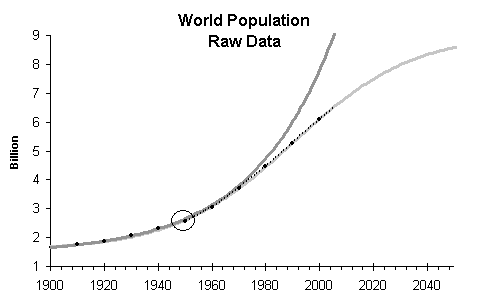
What "exponential growth curves"? People used to think population was exponential back in 1798 [0] before they had enough data. Now we know population is logistic [1], which looks like an exponential on the left side of the curve but flattens out on the right; you can see a very clear divergence from the exponential if you look at real data [2]. Human population growth passed its peak (annual growth of 1.1% down from 2.2% in the 60s; numerical growth of 75 mil down from 88 mil in the 80s [3]) and is on the way to leveling out at around 9 billion, or about 20% more than today's population [4]. Things that go along with population -- like waste production -- are, obviously, also not exponential.
Worrying about the consequences of exponential growth curves is like worrying that a potted plant is going to consume your entire house by the end of the month because it went from seed to sprout in just a few days. The only reason the "exponential" myth persists is scaremongering and willful ignorance.
I think it would be great if we could somehow keep track of food that was about to expire and decide to donate it before it goes to waste. Things like eggs and old cans of soup (not half chewed slices of pizza).
Of course, the amount of resources expended to handle the logistics would probably be a huge waste of your time. Its probably cheaper to donate some cash to a food bank.
I'm sure it will be cheaper to do when robots start doing everything. But since robots will be growing food on the side of every building, food is probably going to be a lot cheaper too.
I think part of the problem is that it is considered to demonstrate wealth to have a full fridge. People feel good knowing that there is always enough to eat in their homes.
Another problem is the sheer distance to the next supplier of food. Supermarkets move outside of towns, so people feel it is best to go shop for a longer period of time when, in fact, they can't possibly plan their food needs. So a lot of stuff gets thrown away because it has gone bad or doesn't look as nice any more.
In Germany, we have organizations like "Die Tafel", that take food that is near it's best-before date out of supermarkets and distribute it to homeless and poor people. That to me looks like a much better use of the over-supply on food.
Hate to be blunt but that is a really small amount of the total food consumed. No system, no matter how perfect, is 100 percent efficient. There will always be waste.
A $7 turky and a $400 iPad to Christmas this year?
Well maybe people should overthink what they shove into their machine what has to keep them running their whole life.
We need a new culture concerning the consumption of food. People should be more aware of where their food comes from and under which circumstances its "produced". Beeing selective will keep us from throwing away so much in the future.
In 2010, Americans generated 34 million tons of food waste. [1] Does anyone want to help me build a smarter refrigerator that automates food storage and notifies the household when something is about to go bad?
I have read elsewhere that Americans throw out proportionally less of what they buy than do persons in the Third World. Americans can afford more, but refrigeration, canning, etc. keep the purchases edible longer. Sorry; I can't give a source.
But every time the topic of food wastage comes up. People really talk about hungry people across the world and how it can be delivered to them instead of being wasted here. The reason why most people don't get food is because they can't afford it, not because food is in short supply.
The solution to these problems really is to improve their living conditions by giving them jobs by which they can buy food.
The reason why most people don't get food is because they can't afford it, not because food is in short supply.
Seriously? Do you think the market is a magical and mystical unicorn we shall never understand?
The reason they can't afford it is because of supply and demand. When the rich have a high demand for food, the prices go up. THAT is why they can't eat.


Thinking about this, I'm convinced it's all just because we have enough resources to allow this waste. Nobody weeps over the trillions of dollars that mutely vanish under a "Obsolete Inventory" accounting line item every year; when plentiful, food is just a particularly charismatic inventory item.
Morality aside, food in San Francisco physically cannot feed people anywhere else! Personally I try to clean my plate when I eat. But your values may vary, and as we live in an affluent area, there's no objective reason why you shouldn't toss half your food, if you felt like it. So the thinly-veiled finger wagging in this article is a little silly... Americans wasting/not wasting some of their surplus food (in America!) is not going to affect starving people elsewhere, aside from making us look bad.