Depends on where you are. States like NY, IL, and MA are running quite short on landfill space. E.g. the Chicago area has a little over a dozen years of landfill space left at current rates. As a result they have to ship the waste to places like West Virginia and Ohio, which have a lot of available space. However, this creates a lot of greenhouse gas emissions in the process, and of course costs money.
On behalf of everyone in your country younger than you: cheers for not giving a fuck. Don't expect much sympathy when you all have alzheimer's.
This is what I mean when I talk about the death of inter-generational good faith.
Unless of course you're working on some sort of synthetic biology to eat trash, in which case, carry on I guess. We're all (desperately) rooting for you.
It's not specifically about landfills. It's the wilful ignorance of the consequences of exponential growth curves, just because we personally happen to live on the left side of the graph where things are kind of OK.
It's the same kind of thinking that caused the financial crisis, it's the same kind of thinking that will probably cause the death of our species, if that happens. It's utterly morally reprehensible, and we're all guilty of it. Our entire modern civilisation is founded on it.
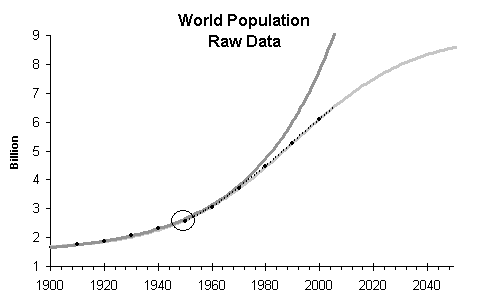
What "exponential growth curves"? People used to think population was exponential back in 1798 [0] before they had enough data. Now we know population is logistic [1], which looks like an exponential on the left side of the curve but flattens out on the right; you can see a very clear divergence from the exponential if you look at real data [2]. Human population growth passed its peak (annual growth of 1.1% down from 2.2% in the 60s; numerical growth of 75 mil down from 88 mil in the 80s [3]) and is on the way to leveling out at around 9 billion, or about 20% more than today's population [4]. Things that go along with population -- like waste production -- are, obviously, also not exponential.
Worrying about the consequences of exponential growth curves is like worrying that a potted plant is going to consume your entire house by the end of the month because it went from seed to sprout in just a few days. The only reason the "exponential" myth persists is scaremongering and willful ignorance.


The waste involved is a different story, but worrying about space in landfills is laughable.