Didn't both Seattle and Portland try Portugal-style decriminalization + treatment incentives, only to see a massive spike in drug overdose deaths, even compared to similar US cities which did not pass such policies?
It seems relevant that the background and current context in the US is much different: we are fresh off two decades or so of big pharma and consulting firms attempting to "turbocharge" prescription opiate sales (and succeeding). The current turn to heroin adulterated with fentanyl is certainly downstream of that.
>Didn't both Seattle and Portland try Portugal-style decriminalization + treatment incentives, only to see a massive spike in drug overdose deaths
They didn't do 'Portugal-style' decriminalization/treatment because in Portugal a drug addict can be forced into drug treatment, fined or mandated community service. Open drug use is also not allowed.
> a drug addict can be forced into drug treatment, fined or mandated community service. Open drug use is also not allowed.
Was this always the case ( I would assume so), or did it come with the decriminalization changes?
These policies seem not only reasonable but obvious. But I don’t think the motivations in the US for decriminalizing are consistent with committing addicts and stopping open drug use. And unfortunately they arent standards in Portland, Seattle, or anywhere else with this problem in the US really.
So basically, i dont see that happening in the US. Its the same story for mental and behavioral health. People that were dangers to themselves and society used to be committed to institutions but we decided it was more humane to empty these institutions out on the streets.
> Was this always the case ( I would assume so), or did it come with the decriminalization changes?
    I can bring a bit of context. I'm Portuguese, I know the history well.

    The intervention was centered in the SNS (our national health service), and soft touch. No mandatory treatments, no punitive approach.

    Fundamentally, we approached addicts. Safe consumption spaces, with free syringes, drug testing kits, and staffed with personnel who got to know the addicts personally.
This staff, slowly but effectively, pushed those who accepted treatment onto SNS programs. It turns out addicts want to get better, as a general trend in the medium term. Give it time, this technique works.
Decriminalization is a part of it. Essential to allow the rest of the program, but a small part of it, effort-wise.
We also decided it was cheaper. It was expensive to keep whole institutional systems, and it was expensive to keep them in jail.
A lot of recent sentencing reform was motivated by the desire to lower the cost of running prisons, and started off Republican-led. Whenever people talk about solving mental health crises with jail time, no one is willing to put up the money.
>Whenever people talk about solving mental health crises with jail time, no one is willing to put up the money.
This is not a question of resources but of political will. There is no appetite, especially on the left, for any kind of forced institutionalization. There is an ideological aspect to this as well, where it is more ideologically aligned to pretend that homelessness is mainly (or wholly) caused by a lack of affordable housing, and therefore _only_ affordable housing polices are put forth as a solution.
> because in Portugal a drug addict can be forced into drug treatment, fined or mandated community service.
Each of these things seems more reasonable than US's two options 1) ignore them or 2) dispense varying lengths of the same punishment that brutally awful convicts get.
The problem, and why we will never get these programs, is that no one actually wants to put up the resources to help drug addicts. If you've actually talked to the gen-x population that has control over these cities, you'll find someone that likes to pretend they're an enlightened progressive hippie, that scoffs at southern and middle american conservatives, but is just as selfish and careless. They harbour deep resentment at having to pay so much in taxes, and sabotage any policy that could move resources away from them. This kind of hands-off policy is exactly the kind that the gen-x Hillary loving house wives can trick themselves into feeling good about, while not costing them anything substantial.
>The problem, and why we will never get these programs, is that no one actually wants to put up the resources to help drug addicts.
It's not a question of resources but politics. There is a segment of the left that links homelessness to housing policy (as in they don't consider homeless drug addicts as a drug addiction problem, but rather an affordable housing problem) and is also against any forced institutionalization.
I can bring a bit of context. I'm Portuguese, I know the history well.
The intervention was centered in the SNS (our national health service), and soft touch. No mandatory treatments, no punitive approach.
Fundamentally, we approached addicts. Safe consumption spaces, with free syringes, drug testing kits, and staffed with personnel who got to know the addicts personally.
Are they forced in? I thought they were given a choice of pursuing a treatment program funded by the state, or getting a more conventional punishment such as jail time.
No, they didn’t — we can’t build safe consumption sites in the US because of Federal law, neither city built the necessary treatment infrastructure to do “Portugal-style” treatment, and police in these US cities seem to resent the approach and don’t take it seriously enough to achieve Portugal’s outcomes.
We can’t just stop addressing drug use and not build the care and treatment infrastructure on the other end. People instinctively understand this, which is why “defund the police” failed as a slogan, but the abolitionist program was always meant to include building social infrastructure as an alternative to police.
Those alternative programs in the US are always an underfunded afterthought, even in cities where they have political support. For example, I still can’t call San Francisco’s crisis intervention team directly — I have to call the cops if I see someone on the street experiencing a crisis, and they still might send a poorly trained goon with a gun to deal with it, because the crisis intervention team doesn’t operate 24/7.
In other words, these policies haven’t failed, they’ve barely even been tried.
Seattle took a hands off approach. The prosecutor can't be bothered with drug related arrests, so the police don't bother responding. There is no diversion opportunity.
That’s garbage PR from the campaign of the current city attorney, who loved yelling that the incumbent never prosecuted drug felonies. Unfortunately she and her voters were all so flat ignorant that they didn’t know the city attorney cannot prosecute felonies, only misdemeanors - so she hasn’t done so either. But she has cancelled drug court programs and cut options for rehab and services! And she claims to have caught up on a backlog of cases, without mentioning that she did so by throwing all of them out.
You can't compare Portugal to Seattle or Portland. First of all it's a country, but more importantly they have free public health care and safety nets for homeless and jobless people.
Imho the number one driving factor of the US opioid epidemic is the stress of living in a country where you can literally end up on the streets if you don't have a job. A country where you can go bankrupt if you get sick.
You can't put band aids over the opioid epidemic, it's a systemic issue.
I wouldn't be surprised if a problem is that Seattle and Portland lack treatment capacity, because that's the big problem just north of the border in Vancouver, which also has a big problem with toxic drugs use.
Having safe drug use sites and replacing the illicit supply of toxic drugs with a safer known, prescribed source does a good job of preventing overdoses and preventing mass deaths, but beyond this there needs to be path ways to treatment.
Where some places have failed and come under criticism is that while they've done the necessary step of implementing some harm prevention policy to keep people alive until they can access treatment, there hasn't been the follow through in creating treatment options.
A major cause of the inability to create treatment options is that it's expensive and there's a severe shortage of doctors and nurses in general. Can't create treatment options if there's no one to work them.
supportive services are fairly minimal here. for instance the article opens with an interview at a safe consumption site, which is one of the most necessary and effective features of portugese policy that prevents overdose deaths - but such facilities are illegal in america
This is worth a watch if you want some background into why those type of measures have been less successful in the US and Canada, and how grifters have been taking advantage.
The US and Europe opiate situations can never be compared because in Europe opiates have always been drugs of last resort, used in palliative care or inpatient scenarios only.
Self-administered opiates just aren't part of the treatment regime, much as they weren't part of the US treatment regime in the 70s and 80s.
It's an entirely US problem created by the doctors-are-salesmen paradigm that is US healthcare, and it's only a problem because of the way the 'product' was 'marketed.'
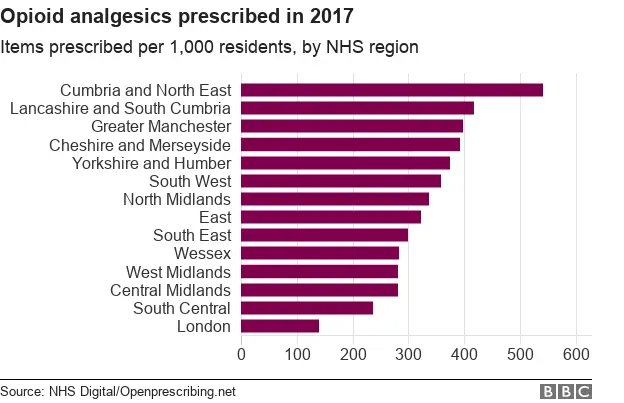
It's definitely not true to say they are the drugs of last resort in the UK. They may not be the drug of 'first resort' like they were in the US, but there is still an awful lot of people getting Oxycodone etc via the NHS, especially in certain areas (tend to be rural and deprived... very similar to the US): https://ichef.bbci.co.uk/news/976/cpsprodpb/166DF/production.... The top regions on that graph is actually higher than the US rate (https://www.cdc.gov/drugoverdose/rxrate-maps/index.html)


It seems relevant that the background and current context in the US is much different: we are fresh off two decades or so of big pharma and consulting firms attempting to "turbocharge" prescription opiate sales (and succeeding). The current turn to heroin adulterated with fentanyl is certainly downstream of that.