Didn't both Seattle and Portland try Portugal-style decriminalization + treatment incentives, only to see a massive spike in drug overdose deaths, even compared to similar US cities which did not pass such policies?
It seems relevant that the background and current context in the US is much different: we are fresh off two decades or so of big pharma and consulting firms attempting to "turbocharge" prescription opiate sales (and succeeding). The current turn to heroin adulterated with fentanyl is certainly downstream of that.
>Didn't both Seattle and Portland try Portugal-style decriminalization + treatment incentives, only to see a massive spike in drug overdose deaths
They didn't do 'Portugal-style' decriminalization/treatment because in Portugal a drug addict can be forced into drug treatment, fined or mandated community service. Open drug use is also not allowed.
> a drug addict can be forced into drug treatment, fined or mandated community service. Open drug use is also not allowed.
Was this always the case ( I would assume so), or did it come with the decriminalization changes?
These policies seem not only reasonable but obvious. But I don’t think the motivations in the US for decriminalizing are consistent with committing addicts and stopping open drug use. And unfortunately they arent standards in Portland, Seattle, or anywhere else with this problem in the US really.
So basically, i dont see that happening in the US. Its the same story for mental and behavioral health. People that were dangers to themselves and society used to be committed to institutions but we decided it was more humane to empty these institutions out on the streets.
> Was this always the case ( I would assume so), or did it come with the decriminalization changes?
    I can bring a bit of context. I'm Portuguese, I know the history well.

    The intervention was centered in the SNS (our national health service), and soft touch. No mandatory treatments, no punitive approach.

    Fundamentally, we approached addicts. Safe consumption spaces, with free syringes, drug testing kits, and staffed with personnel who got to know the addicts personally.
This staff, slowly but effectively, pushed those who accepted treatment onto SNS programs. It turns out addicts want to get better, as a general trend in the medium term. Give it time, this technique works.
Decriminalization is a part of it. Essential to allow the rest of the program, but a small part of it, effort-wise.
We also decided it was cheaper. It was expensive to keep whole institutional systems, and it was expensive to keep them in jail.
A lot of recent sentencing reform was motivated by the desire to lower the cost of running prisons, and started off Republican-led. Whenever people talk about solving mental health crises with jail time, no one is willing to put up the money.
>Whenever people talk about solving mental health crises with jail time, no one is willing to put up the money.
This is not a question of resources but of political will. There is no appetite, especially on the left, for any kind of forced institutionalization. There is an ideological aspect to this as well, where it is more ideologically aligned to pretend that homelessness is mainly (or wholly) caused by a lack of affordable housing, and therefore _only_ affordable housing polices are put forth as a solution.
> because in Portugal a drug addict can be forced into drug treatment, fined or mandated community service.
Each of these things seems more reasonable than US's two options 1) ignore them or 2) dispense varying lengths of the same punishment that brutally awful convicts get.
The problem, and why we will never get these programs, is that no one actually wants to put up the resources to help drug addicts. If you've actually talked to the gen-x population that has control over these cities, you'll find someone that likes to pretend they're an enlightened progressive hippie, that scoffs at southern and middle american conservatives, but is just as selfish and careless. They harbour deep resentment at having to pay so much in taxes, and sabotage any policy that could move resources away from them. This kind of hands-off policy is exactly the kind that the gen-x Hillary loving house wives can trick themselves into feeling good about, while not costing them anything substantial.
>The problem, and why we will never get these programs, is that no one actually wants to put up the resources to help drug addicts.
It's not a question of resources but politics. There is a segment of the left that links homelessness to housing policy (as in they don't consider homeless drug addicts as a drug addiction problem, but rather an affordable housing problem) and is also against any forced institutionalization.
I can bring a bit of context. I'm Portuguese, I know the history well.
The intervention was centered in the SNS (our national health service), and soft touch. No mandatory treatments, no punitive approach.
Fundamentally, we approached addicts. Safe consumption spaces, with free syringes, drug testing kits, and staffed with personnel who got to know the addicts personally.
Are they forced in? I thought they were given a choice of pursuing a treatment program funded by the state, or getting a more conventional punishment such as jail time.
No, they didn’t — we can’t build safe consumption sites in the US because of Federal law, neither city built the necessary treatment infrastructure to do “Portugal-style” treatment, and police in these US cities seem to resent the approach and don’t take it seriously enough to achieve Portugal’s outcomes.
We can’t just stop addressing drug use and not build the care and treatment infrastructure on the other end. People instinctively understand this, which is why “defund the police” failed as a slogan, but the abolitionist program was always meant to include building social infrastructure as an alternative to police.
Those alternative programs in the US are always an underfunded afterthought, even in cities where they have political support. For example, I still can’t call San Francisco’s crisis intervention team directly — I have to call the cops if I see someone on the street experiencing a crisis, and they still might send a poorly trained goon with a gun to deal with it, because the crisis intervention team doesn’t operate 24/7.
In other words, these policies haven’t failed, they’ve barely even been tried.
Seattle took a hands off approach. The prosecutor can't be bothered with drug related arrests, so the police don't bother responding. There is no diversion opportunity.
That’s garbage PR from the campaign of the current city attorney, who loved yelling that the incumbent never prosecuted drug felonies. Unfortunately she and her voters were all so flat ignorant that they didn’t know the city attorney cannot prosecute felonies, only misdemeanors - so she hasn’t done so either. But she has cancelled drug court programs and cut options for rehab and services! And she claims to have caught up on a backlog of cases, without mentioning that she did so by throwing all of them out.
You can't compare Portugal to Seattle or Portland. First of all it's a country, but more importantly they have free public health care and safety nets for homeless and jobless people.
Imho the number one driving factor of the US opioid epidemic is the stress of living in a country where you can literally end up on the streets if you don't have a job. A country where you can go bankrupt if you get sick.
You can't put band aids over the opioid epidemic, it's a systemic issue.
I wouldn't be surprised if a problem is that Seattle and Portland lack treatment capacity, because that's the big problem just north of the border in Vancouver, which also has a big problem with toxic drugs use.
Having safe drug use sites and replacing the illicit supply of toxic drugs with a safer known, prescribed source does a good job of preventing overdoses and preventing mass deaths, but beyond this there needs to be path ways to treatment.
Where some places have failed and come under criticism is that while they've done the necessary step of implementing some harm prevention policy to keep people alive until they can access treatment, there hasn't been the follow through in creating treatment options.
A major cause of the inability to create treatment options is that it's expensive and there's a severe shortage of doctors and nurses in general. Can't create treatment options if there's no one to work them.
supportive services are fairly minimal here. for instance the article opens with an interview at a safe consumption site, which is one of the most necessary and effective features of portugese policy that prevents overdose deaths - but such facilities are illegal in america
This is worth a watch if you want some background into why those type of measures have been less successful in the US and Canada, and how grifters have been taking advantage.
The US and Europe opiate situations can never be compared because in Europe opiates have always been drugs of last resort, used in palliative care or inpatient scenarios only.
Self-administered opiates just aren't part of the treatment regime, much as they weren't part of the US treatment regime in the 70s and 80s.
It's an entirely US problem created by the doctors-are-salesmen paradigm that is US healthcare, and it's only a problem because of the way the 'product' was 'marketed.'
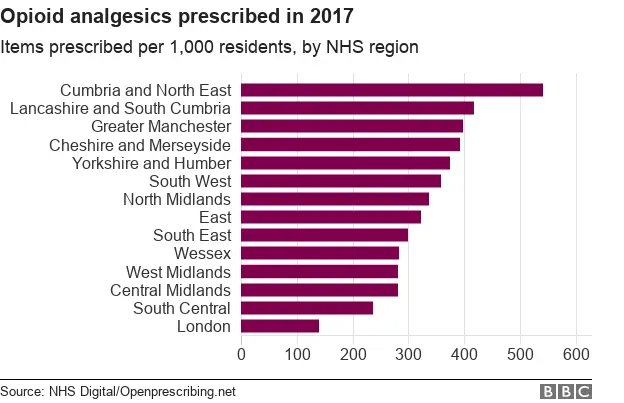
It's definitely not true to say they are the drugs of last resort in the UK. They may not be the drug of 'first resort' like they were in the US, but there is still an awful lot of people getting Oxycodone etc via the NHS, especially in certain areas (tend to be rural and deprived... very similar to the US): https://ichef.bbci.co.uk/news/976/cpsprodpb/166DF/production.... The top regions on that graph is actually higher than the US rate (https://www.cdc.gov/drugoverdose/rxrate-maps/index.html)
In Oregon, for example, where small amounts of drugs were decriminalized in 2020, police regularly hand out information cards referring people to a drug counseling hotline. Court data shows drug users rarely call.
In Portugal, by contrast, government data shows roughly 90% of people referred to drug counseling sessions by police do turn up, at least for an initial session.
This is quite different to giving someone an information card.
For what it's worth there is increasing problems in Portugal with drugs. The overdose rate is starting to really spike again, there was a good article somewhat recently about this which I can't find, but you can see the trend here: https://www.statista.com/statistics/911927/drug-overdose-dea...
It's a significant spike at 40%. But my guess is that this is due to the market being flooded with ultra potent opioids right now. Decriminalisation can't really prevent that, unfortunately. Only legalisation and regulation will.
That's not my point. The point is the trend is going the wrong way recently after dropping so sharply after decriminalization. I am/was in favour of that - it is clearly a healthcare problem; not a criminal justice problem.
However, I think it is still a big and growing problem regardless of where you sit on that spectrum, which has sharply been brought into focus with fentanyl and other synthetic opioids (which are themselves a byproduct of 'the war on drugs' in many ways, but the genie is out of the bottle now with them).
It's possible to put the genie back in the bottle with legalisation, I think. Other than a very small minority I know of that actively seeks them out, most opioid addicts are using fentanyl and other microgram potency opioids because that just happens to be what's available. Which is directly because the production and distribution side of things is unregulated.
I think you gave the big part of the reason why,its fentanyl. I've heard that the quality of care decreased, but fentanyl would explain an increment in fatalities if the total consumption do not increase.
It is not mandatory for consumption, but that is not the problem anyway. The problem is that actual crimes are done while under the influence and in that situation the court will give out mandatory participation in rehabilitation. If you fail to do so the court’s social services will advise the judge for other measures.
If you think of it nobody bothers with alcohol consumption but if you have an accident under the influence of alcohol it is pretty reasonable the judge prescribes AAA participation, instead of just punishing you. Failure to do so can then lead to the judge finding you guilty on more severe charges like involuntary manslaughter or just plain contempt.
Of course crimes related to heavy drugs are often much more severe so if you don’t play nice you will go to jail and not come out for some time. Portuguese prisons are also overbooked and known for being very miserable.
> The overdose rate is starting to really spike again
One of the issues is that when the number of drug addicts was significantly reduced, we saw investment in the programs being reduced year on year.
This tells you the effort against drugs never ends.
I believe this is now being re-evaluated by the Portuguese authorities (returning budget to these programs). It’s a lot more effort than one thinks to ensure the correct support at every stage.
I'm from Portugal and I've lived in the US (not Oregon).
Maybe related, maybe not, but I've noticed that people in the US seem to have a chronic distrust for the police, government, or generally any authority figure. Do you agree? In Portugal if you're asked to go talk to police/gov/drug counseling/etc, you show up because that's what you're supposed to do.
"Government is not the solution to our problem, government is the problem."
That's a very famous quote by one of our presidents. Like all other American pathologies that have festered since I was a child, I assume it will get worse before it gets worse.
I live in southern Portugal, and over the years I've observed big differences in how natives and foreigners react to Portuguese drug laws.
The native Portuguese feel that it's not ok to consume drugs, but that for those that do, the law provides a path of rehabilitation before resorting to punishment. And this is in fact the intention behind the decriminalization of drug consumption.
On the other hand, younger foreigners often seem to take the laws as a license to consume, some becoming unable to work and spending their days smoking pot. And their older counterparts similarly fall into alcoholism, wine and beer being very cheap here.
My point is that Portuguese laws are made for Portuguese people, who tend to do things in moderation. There is no universal solution, and no guarantee that the Portuguese model would work anywhere else.
Opinion pieces should present all their counters if they want to present themselves as unobjective, and not just the ones they think they have an answer for.
USA is not Portugal, transport, production, and distribution of drugs is not from the same sources. Wide scale economics are not the same either. People are also quite different.
For example, Portugal "solved" their problem, but their rates are annually far beyond what Singapore has in accumulation over decades. Why not aspire to be more like Singapore rather than Portugal, NPR's Brian Mann?
If you don't see what's objectionable with saying "lets be more like that police state in how they deal with drugs", then the things we're striving for are so fundamentally different that we probably won't have a very productive conversation. I was replying to the other guy. Have a nice day.
I see, so that gives you full credentials to insult me. Either way, there's more than 3 people here.
> "lets be more like that police state in how they deal with drugs", then the things we're striving for are so fundamentally different that we probably won't have a very productive conversation.
If that's how you solve problems then I agree, no discussion should ever be had when you're in the room. Singapore, Portugal, and USA, which two are similar than the other combination?
I also do not think Singapore is a "police state", and their government and people would also firmly disagree with you.
The governments of China, Myanmar, Russia, and Iran would also like to firmly disagree that they are police states. Oh, and North Korea would like to remind you that it's a Democratic Republic. It's in the name, see?
Your "definition" was that there is no such thing. If you're unwilling to concede that any of the above are "police states", let's just call them repressive authoritarian regimes which regularly violate their citizens' human rights as understood by democracies. If you don't see any difference, there's really no point in arguing it with you; you can keep saying 2+2=5, or asking people to explain it like you're a child, but your tiresome line of bad faith argumentation has already been dignified with more responses than it deserved.
He makes vague statements that insinuate an idea in your mind, you assume that's what he meant and respond to that, but then he claims that's not what he meant but doesn't clarify. He's just a bored troll, stop feeding him.
Let's define "police state" then instead of dancing around what it means then.
To me, quite a few qualities, but the most important is all that matter to me, e.g. multiple political parties, the official number of law enforcement is too low to the general population (~10k enforcers to ~6m gen.pop. in Singapore) and technology has not progressed to a level that would lead me to believe numbers don't matter.
From this definition, you might be (un)surprised to see that there are no countries that fall under "police state" to me. That is genuinely my belief. Governments are too weak to exert that much control such that they cannot be overwhelmed by just 10% of the population from wreaking havoc any singular random day.
"Police state bad" just does not mean a whole lot to me. Nor does "liberal democracy", its empty and more indicative of the person making the statement than anything.
With its Internal Security Act, the Singapore government can arrest and detain anyone it deems as a threat, even before any crime was committed. It can ban any political parties, other organizations, ban publications it deems as "subversive" or shut down entertainment venues with the same law.
The more recent Protection from Online Falsehoods and Manipulation Act allows the government, on the order of its minister, to shut down any publication or online content it deems as "fake news". Or ban the website hosting the content entirely if need be.
A police state is one in which the executive uses the police and other instruments of the state (from the bureaucracy, judiciary and other agencies and tools at its disposal, including a Stasi/secret police) to monitor and control civil and political activities of its citizens and others on its territory and even beyond.
To me the mere existence of a secret police means it's a police state, like east Germany, but I understand it isn't enough for others. I hope with this I've convinced you.
I'm not saying 'this is bad', I'm saying 'this exist'.
> government can arrest and detain anyone it deems as a threat, even before any crime was committed. It can ban any political parties, other organizations, ban publications it deems as "subversive" or shut down entertainment venues with the same law
I would say without the words before "government" being there, you would have been describing quite a few countries in the world.
Detainment, is as defined by the countries that have it, but specifically using US, a temporarily hold on an individual from travel to investigate from reasonable suspicion of a crime being committed, e.g. you can be an unlucky individual who matches a description of a person that has committed a crime and you would be legally detained, up to 48 hours or evidence is produced. I believe this is consistent with even with the definition of detainment in every state in the EU as well, I won't go personally check for the truth in that statement but detainment is specifically a thing I am almost very positively sure in saying that everyone disambiguate from arrest.
> The more recent Protection from Online Falsehoods and Manipulation Act allows the government, on the order of its minister, to shut down any publication or online content it deems as "fake news". Or ban the website hosting the content entirely if need be.
Also, see above list, these are legal declarations with backing + enforcement for decades.
> A police state is one in which the executive uses the police and other instruments of the state (from the bureaucracy, judiciary and other agencies and tools at its disposal, including a Stasi/secret police) to monitor and control civil and political activities of its citizens and others on its territory and even beyond.
Fully consistent with my definition as well, but its too weak of a definition, else we would have to reclassify many things as "police states", including our most favorite "liberal democracies". When its a comparison to, then people cannot cite "police state" as an opposition to my first comment and why I won't accept that as something resembling an "address".
> its too weak of a definition, else we would have to reclassify many things as "police states", including our most favorite "liberal democracies".
No, if the shoe fit...
Basically the US have a bureaucracy and part of its judiciary system that prevents it from matching 100% that definition, but it's a really close thing, and i think that calling it "mostly police state" or "half police state" is fair (and by the way, France, my country, is the same way, with exactly the same defense except the bureaucracy is a bit stronger thanks to internal unions, and the legislative branch a lot weaker than i thought it was 5 years ago).
Singapour match 100% of that definition, there is no branch of the government that work against the state in civil right cases.
Nobody asks to die from a fentanyl overdose, while the risks of drug trafficking in Singapore are told to you the moment you arrive in the country.
I do not feel bad for anyone caught with drugs in Singapore, but I sympathize with the addicts in America who have been constantly lied to by people who pretend to care about them.
> are told to you the moment you arrive in the country.
To be fair, American citizens and its visitors are also told what happens to them should they be caught with drugs and/or distributing them. Exactness notwithstanding about regional/local laws and grams, its the same story from when you're a kid all the way up to your first run in with the enforcement.
Singapore is just explicit about one thing more than anything else, you will die.
Which is the real issue. The US is very much built on the idea that it's fine to lie to people and pretend to care about them while aggressively exploiting them.
It's not a drug problem, it's a sociopathy problem.
The Sacklers were allowed to remain billionaires, CVS and other defendants have had to pay out billions - and all of this is considered cost of business instead of criminal activity, even though it has destroyed millions of lives.
To the best of my knowledge, Europe does not have a fentanyl problem comparable to that of the US with last I checked 50+% of overdoses in the US having traces of it in their system. Our wide open southern border [not a comment on immigration] allows this poison to spread far and wide.
OxyContin and similar prescription drug addictions are widespread, at one time (still?) heavily pushed by deep pocketed pharmaceutical companies. I think that was a uniquely American situation. I wonder how many of the people now addicted to other opioids in the US were initially exposed via these prescription drugs.
Fentanyl is smuggled into the United States by US citizens[1] and by closing the border may have accelerated its adoption. And yes, while it does come from our southern border, data suggests it's being carried over by US citizens who have the right to come and go across the border legally.
Or are we using the term "open border" to suggest freedom of US citizens to leave (and re-enter) the country?
Could be that it is easier and less risky to get into Mexico. Plus, the cartels there are a wholesale buyer and have established supply and distribution networks from Mexico into the US and within the US.
Ive seen plenty of European drug culture and heroin is only a last resort drug for lost souls, fentanyl is basically still unheard of as a street drug as far as I can tell.
Junkies even test their heroin more often because they don't want that dirty stuff to be here.
I for one don't understand at all what goes wrong in America. But those images are scary.
> "If we stopped arrests and did nothing else, that's a positive intervention because of the well-documented harms of incarceration [on people with addiction]," said Morgan Godvin, a former heroin user who now studies drug policy in Portland, Ore.
"Instead of fixing the system, let's just ignore it, then pretend it's actually a greater good to just degrade these people and let them die in the gutter."
I also don't buy that the Portuguese alternative is really any different:
> Experts here say people who use drugs are constantly nudged toward health care and addiction treatment, including methadone programs and housing.
Yet, they don't describe their conversion rate or their results in "successfully" getting people to trade one addiction for another and then accept welfare.
Meanwhile, drugs are the obvious issue in and of themselves. If you don't want to criminalize people for possession then you need to openly confiscate drugs and do as much as you can to prevent people from possessing and using them.
In my experience people who ruin their life with drugs have underlying mental health issues which are the cause of their self-destructive usage patterns.
What is the difference between a Wall Street banker and a homeless junkie? Not the regular use of hard drugs..
Pure addiction therapy thus almost never works. The homeless junkies have PTSDs, personality disorders, bipolar disorder, severe cases of ADHS etc. all of that needs to be treated together with the addiction for a reasonable chance of success.
While working for some years in the south bay tech hub (san jose), I knew a guy who was a VP at a tech company.
Everyday he would lock his office door at lunch and do a shot of heroin. He'd lay back at his desk and zone out for an hour or so, then wash his face and go back to work.
When I left the bay area and lost track of him, he was still in the same cycle and not spiraling into destruciton.
A big difference in outcomes is dictated by WHY a person is using drugs. Someone with mental health problems (and/or major life problems in general) is going to do far worse than someone who just wants a little temporary escape.
After growning up in the US souteast, I can athoritatively say that a big part of the US situation is due to the uneducated, uninformed, hateful, religous population that mmakes up a significant part of the total...
Do you have experiences which would give you good perspective and the wide range of drug abuse that occurs within our society? Do you have a sense of how much of it goes unnoticed? Who do you think paid rehabilitation clinics are for exactly?
I think drugs are the issue. People have plenty of other problems outside of the scope you mention. These typically provide negative feedback which leads the person towards solutions.
Drugs interfere with this and turn them into positive feedback loops which just drags the person further into addiction. And these problems are most definitely commonly experienced outside of the "homeless junkie" caste, which is a very recent problem in the grand scheme of this issue and _seems_ to be correlated with recent changes in drug policy and resulting availability.
I am with you though in that treating the _addiction_ is insane. The drugs are just a response to other conditions and unless you treat and examine those you stand no chance of improving someones life. The best you can hope for is they hurt themselves badly enough that the trauma causes them to recognize their circumstances for what they really are.
Which is why I think criminalization is also insane; however, that doesn't mean the state just has to stand by while massive quantities of illicit substances change hands freely across our country. That's a problem you can address without even having to jail anyone other than dealers and traffickers.
And at the end of the day, even this minor action would bring massive improvements, by preventing people from prolonging their problems with addictions that destroy their lives, health and wealth.
After years of lies from anti-drug and pro-drug guys, I simply don't believe this type of article with data to back it up.
For example, the opioid crisis in America is very different from drug use in Portugal. Do opioids in America kill more easily than the drugs used in Portugal?
The article contains a lot of feelings and no data.
I was in a serious road accident decades ago. I have been in pain ever since. This pain is not lessened by over the counter painkillers. Plus over the counter painkillers are harmful to take in large doses over a long term.
My nerves are damaged by something in my back. (it hasn't been determined what, just that the damage occurs) I am in a debilitating amount of pain.
So I take an opioid several times a day. Before the opioid crisis I was taking 10mg morphine twice a day. Now I take Suboxone, I'm in more pain but not a paralyzing amount.
To your question about what it's like: strong opioids bring a euphoric numb lightness. If you're in a vulnerable place in your life where you are not well supported and don't experience much joy, then that euphoria can be overwhelming. You might want to feel that again ASAP because compared to being in pain, depressed, anxious, you felt pretty good for a while.
I hope you're doing well as you can. I injured my back many years ago and I was worried about developing a habit. Surgery and PT have got me back to 95% though I occasionally use medical marijuana as a crutch for bad days. I count myself lucky, not everyone can deal with their symptoms with exercise and light medication.
I am doing OK, thank you. I have some useful exercises, like the piriformis stretch, that help me manage the pain level. Plus I am thankful to be able to walk my dog for 2 to 4 miles in one go, several times a week, so my physical fitness isn't completely in the toilet :)
Many years ago my wife fell down the stairs and suffered, what turned out to be, a broken fragment of bone that poked into a nerve. It took quite awhile to diagnose it because <medicine is hard>. Along that journey to diagnosis she was almost bedridden, and in excruciating pain, most of the time with with physio, chiropractors, muscle treatments, nerve pain meds, etc, all failing to help her function. The opioids she was prescribed made it so she could function. She was high, "dreamy" (for lack of a better word), reported still feeling the pain, but could function. The day after the neurosurgeon performed her spine surgery she voluntarily stopped the opioids and finished her healing from the procedure with ibuprofen. She never looked back and described never feeling an urge to take the meds again. I wish I could say that this experience gave us some great insight into the complexity of opioids but it didn't. In her case they did their job until she didn't need them anymore and that was that. I don't read anything more into it then that.
the way I've heard it described, faced with the ills of the world, heroin/opiate users just wanna crawl back into the womb. methamphetamine/stimulant users want to fix the world/their world.
There are tons of occasional recreational oxy users, and at that level the effect is basically a pure euphoria, blissful happiness.
Ironically addiction risk is also low if your usage pattern is 1-2 times per month, much much lower than someone who has been prescribed a small daily dose.
I just wish westerners who visit Asian cities like Singapore would stop gushing over the cleanliness and orderliness there while bashing the US/west if they're not willing to adopt Singaporean drug laws. You can't have it both ways. "Freedom" means accepting the consequences of people exercising it. Some people experiment and tap into massive creative potential(even Steve Jobs went through a phase), others fall into addictive traps.
I said nothing of what you’re saying, you don’t have to be a dictatorship to enforce the laws we have.
Crime has dropped every single year for the last 30 years until 2017. It’s like how progressives said the war on drugs failed but only as long as you ignore how well it did at reducing crime and drug use.
“Everyone else is stupid but me” is not an actual argument, dude. I’m talking about the uptick in drug abuse in Portugal while the article is just completely ignoring it.
By the way, the proposal excludes increase police enforcement. So yea, it is the Wild West even if it says it’s not.
Like all “drug reform” plans, there’s no actual plan for the people who don’t want to stop using drugs.
They’re not buying into it because it’s not an actual plan. Mental health care is optional, and it’s already free in America for the poor with Medicaid.
Couple that in with police reforms which discourage use of force (not saying this is good or bad, just info), and you’ve got thousands of court ordered therapy appointments that never actually take place.
Your plan is entirely just “legalize drugs”, and people are opposed to legalizing dangerous drugs, believe it or not.
> Cops still work aggressively to break up major drug gangs and arrest people committing drug-related crimes like theft. They also disrupt open-air drug markets like the ones that have emerged in some U.S. cities.
I’m an American living in Portugal. This paragraph does not ring true. You really (I’m being serious here) walk more than a block or two in a touristy area without being accosted by someone selling drugs. They even do it when I have my 3 year old daughter’s hand in mine.
I wonder if heroin is still obtainable there, unlike in the US where the only option is a bag of fentanyl cut with whatever the favorite local garbage substitue is. That alone would go a long way toward the differences in OD rates.
I have heard anecdotally that Europe still gets lots of heroin (someone in a similar thread recently said opium poppies come to the EU through Turkish black market trade). No clue how true this is.
It stands to reason that people cultivating opium poppies didn't throw up their hands in despair and decide to do something else with their lives when Chinese fentanyl (which is made in a lab without any opium) started taking over in the US. The opium is going to go somewhere.
In any case, an article using overdose death as the primary metric for success/failure of drug policy should not be ignoring the dramatic difference in fatalities between fentanyl and other opiates.


It seems relevant that the background and current context in the US is much different: we are fresh off two decades or so of big pharma and consulting firms attempting to "turbocharge" prescription opiate sales (and succeeding). The current turn to heroin adulterated with fentanyl is certainly downstream of that.