Vote out any policy maker who impedes the response to climate change.
This is not something we fix as individuals, with feel-good home solutions, recycling, or planting trees. Large industry is destroying our world, on purpose, because of greed.
This only gets fixed through policy and regulation. Vote.
You are implying there are candidates who do not impede response to climate change: even the Greens are against nuclear, which in my understanding, is totally unproductive.
They are also still debating "décroissance", that is "de-growth".
I find crazy that no one even mentionned the word "efficiency" as in "we might not need all the resources we consume to produce everything we do today. Let's set a realistic efficiency goals and try to achieve them"
I guess you could see de-growth as efficiency, lower useless production/necessary production for a good life-ratio.
If we just reduced the resources needed to produce todays consumption, why wouldn't the savings just go to producing more of the same stuff? Ie. growth?
If we reorganized our way of living to utilize tool libraries, maybe 1 large garage per x blocks, in it have power tools, cleaning supplies, outdoor tools, recreational vehicles etc.. if you don't use it 3 or more times per week do you really need to own it outright?
I think also using tiny homes and more insulated and cheaper earth bag homes could help but also would help with the housing crisis. There's a lot we could share, and if we did maybe we could also build smaller homes and lots as we wouldn't need as much storage.
Great point. Finding consensus on a solution is problematic.
I was referring to people who deny that climate change is even real. I would love to get to the stage of debating how to fix things, instead of being stuck in the stage of complete denial.
Climate change or anthropogenic climate change is a starting point for this issue.
We have had climate change since day one of earth. We can see it in the charts, data, etc. the issue is how much impact do the humans contribute?
If people were serious about carbon footprint, nuclear power plants would be built. But we are not serious, instead we have grifting policies that lead to wasted solutions: Solyndra, wind farms, solar farms, etc.
Then on top of all of this, the people in charge find ways to encourage coal, look at how Germany and the rest of the first worlds tried to bankrupt Pakistan by driving up the price of natural gas. Pakistan, China, and every country who saw that are going with coal.
The people who say climate denialism should not be tolerated are not serious about what they propose, because their solutions are not based in reality.
Voting will do nothing. Even if you could audit the voting system and prove it wasn't fraudulent, have you met any of your fellow humans on planet Earth? You are a teeny, tiny minority. They will continue to vote to destroy this planet.
You'll have to be more clever on solving this problem. I would suggest against parroting false feel good phrases that will result in absolutely nothing changing, and start thinking outside the box you and many others seem to have found themselves in, if you actually want to see our planet survive.
We are talking about the death of this entire planet being perpetrated by a specific group of people. What sort of solutions did our ancestors come up with for significantly smaller stakes, to simply safeguard things like freedom? When speaking of saving an entire world with the potential to spread life throughout a galaxy, there are few conceivable solutions which cannot be easily morally justified if they result in safeguarding that future.
We are a species with an infinite cosmic destiny. I might suggest we all start acting like it.
Understand the context first instead of believing the simplistic memes pushed by climate change denialists. For example, in India the reason is that there was a shortage of natural gas which became scarce and super expensive because of world events, so they had to build more coal power plants to not have blackouts. Solar is still growing fast, 82% of new capacity in 2022 was solar, and there's a lot more in the pipeline.
How is China a problem? The way of life and the energy intensity of a single individual living in the developed world is the problem. Do I have to point out the US and Europe? (I live in the UK).
India is emitting massively under their fair share of the world's CO2 emissions under any sane allocation. So the first thing to do is not vote for policy makers who try to deflect from their country emitting way more than its fair share by bringing up India.
By providing education and awareness, change can only come from within those countries. The citizens of China and India are probably on the same page as you.
Given this is a discussion forum with global reach your suggestion on implementing change to global industrial policy via voting may or may not be viable (not everyone gets to vote, and most of the countries lack global impac. US is really unique along with few other countries being able to influence global industry trends).
Policy won't change unless the two party gridlock does. Even when the Dems take power (like now), nothing really happens. It's just lip service at best.
Republicans are in favor of dismantling and eliminating the EPA and clean energy initiatives, for instance. Democrats aren’t great either, but Republican policies are measurably at least an order of magnitude worse.
I'm just being realistic here. Two decades of flip-flopping party power, and has the climate gotten any better?
Every single election cycle we have this discussion. "Well, at least the Dems are better than the Republicans. They're the best we can get." It's not enough. Hasn't been enough for a long time.
Large industry keeps a lot if people alive and provides abundance of a sort - nothing wrong with that. Mixing fighting climate change with some redesign of societies and creating the "new human" is an unproductive move, I think.
Are you a Chinese troll? If not, you're doing a great job of advocating for China.
At this point it's inevitable that solar power and EV's are going to win. They don't need any subsidies to win. But without the subsidies China will take the entire market and we'll be much more dependent on China in the future than we are on Saudi Arabia now.
Could you elaborate on your world view or are you just trolling?
Progress and capitalism optimize for value or $, and have no attention for the environmental cost as long as those are not put into regulations. You don't agree with that?
Capitalism could work, if the framework was setup to allocate the environmental impact to the company using that resource.
A 'credit' system worked to stop NOX and Acid Rain, no reason it couldn't be used to reduce CO2.
Have to separate "Capitalism" the concept, from the "I'm changing the rules just for me to profit".
"Capitalism" can work well with regulations. The people that are against regulations are not "pro-Capitalism", they are "pro-Greed". Nothing in capitalism says you can't have regulations to prevent things society doesn't wan to happen.
Just current interpretation of capitalism is wrong.
My understanding is that in US, they used Emissions Credits, and this allowed a 'market' for those credits. This was more palatable to the segment of the country that are against regulations of any kind. But once there is a market, then it is ok.
There are some good points to an emissions market, it does allow accountants and corporations to determine a 'cost' that can be used in budgeting, and they can then us that as justification to purchase equipment. And it does allow the shifting of the 'cost' to the worst polluting plants. So in some ways markets are good, they steer the allocation of funds. The anarcho-capitalist types just need to understand that capitalism can be guided in this way, we know it works.
Completely Agree, Capitalism combined with right boundary conditions ie. limits, regulations, credit systems, or whatever, have to be used. The current system rewards those that manage to make use of the 'commons', and by that way socializing the costs (pollution, waste, etc.) while privatizing gains.
Because the current climate spending is extremely inefficient and stupid. For example, if we put all this effort into making more energy, e.g. making nuclear actually work, we could soon make the climate do what we want, not the other way around.
And of course anything the government gets involved in will get screwed up, so just stop screwing it up and let the bright people do what they are passionate about.
Imagine regulatory asphyxiation disappears. Imagine energy tech gets its own Moore's law. Imagine cheap abundant energy, say 10 orders of magnitude from now in a few decades. Heating up or cooling down the planet at will doesn't sound impossible then.
So we should just hope this all away? That's a deeply childish viewpoint, and hoping is not a reliable plan. It will require many things: Carbon regulation plus geo-engineering plus improved power systems plus personal sacrifice. But where that starts is legislation. This is how we solved acid raid, the ozone layer, lead-based fuels and paints, and oh so many other environmental externalities. Individuals cannot solve this problem themselves. I could convert my house to solar and buy electric cars tomorrow and the problem is not solved, because I account personally (through my own choices) of only 20% of the issue.
https://www.epa.gov/ghgemissions/sources-greenhouse-gas-emis...
No, absolutely not! Where it starts is invention and invention is currently severely hindered by regulation, alarmism and skewed incentives. Why would a bright mind work on nuclear physics if you can make more money as a lawyer?
But that's not where we are. Without $$ incentive, nobody is going to build what is needed to remove the carbon or mitigate the effects of warming. The market is not magically going to solve anything if we simply remove regulation, that is a strawman. The market needs incentives, as well as restrictions. When we solved the ozone layer, we first restricted chloroflorocarbons to stop the bleeding, then we added incentives to create replacements. And it worked. It's not alarmism that's the issue here, it's heads in the sand.
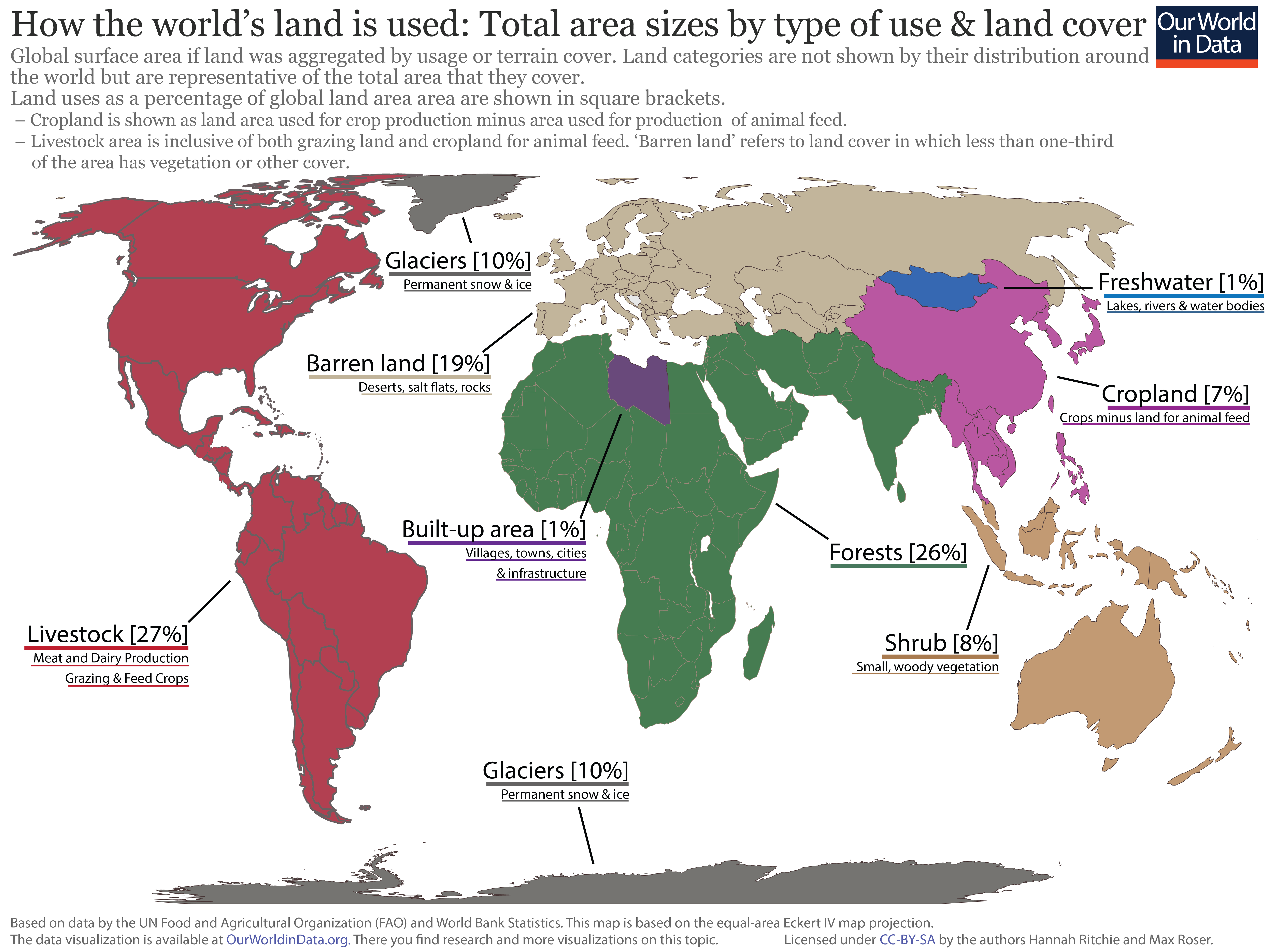
STOP thinking that planting trees will solve the problem.
We need to plan _forests_ not trees.
Trees are not tools to fix our CO2 problem, we need to restore ecosystems and think how we can regrow forests and not monocultures of a "super CO2 capture tree".
When we will start to understand that one problem != one solution, especially when it comes to things as intricate and complex than ecosystems we will start to understand the root of our issues properly.
Just a note that monoculture plantations don't function the same way as vast, diverse, multi-level primeval forests, with regards to a water cycle and biodiversity.
Also thinking about only the CO2 is such a narrow thing. We’ve disturbed natural ecosystems in so many ways- bees pollination, animal migration, natural predators and so on.
> Are trees the plants which capture most CO2 per hectare?
I'm struggling to find exact numbers per hectare, and it's only one of several important metrics (e.g. speed of capture, longevity, ecosystem effects).
From my readings I believe a combined strategy of species-diverse reforestation and algae breeding (perhaps GM, though I don't know enough) would be optimal.
Edit: as noted by others below, wetlands preservation and extension would also be great.
Undewater kelp forests are where we should be aiming. There's a lot of researching happening here atm. Seaweed can grow 40X faster than a tree because it doesn't have to fight as hard against gravity. So growing large biomass in the oceans seems like a great way to sink carbon.
I believe algae, and speifically Coccolithophores, have played a large part in capturing CO2 in the atmosphere. But I believe the efficiency per volume is low.
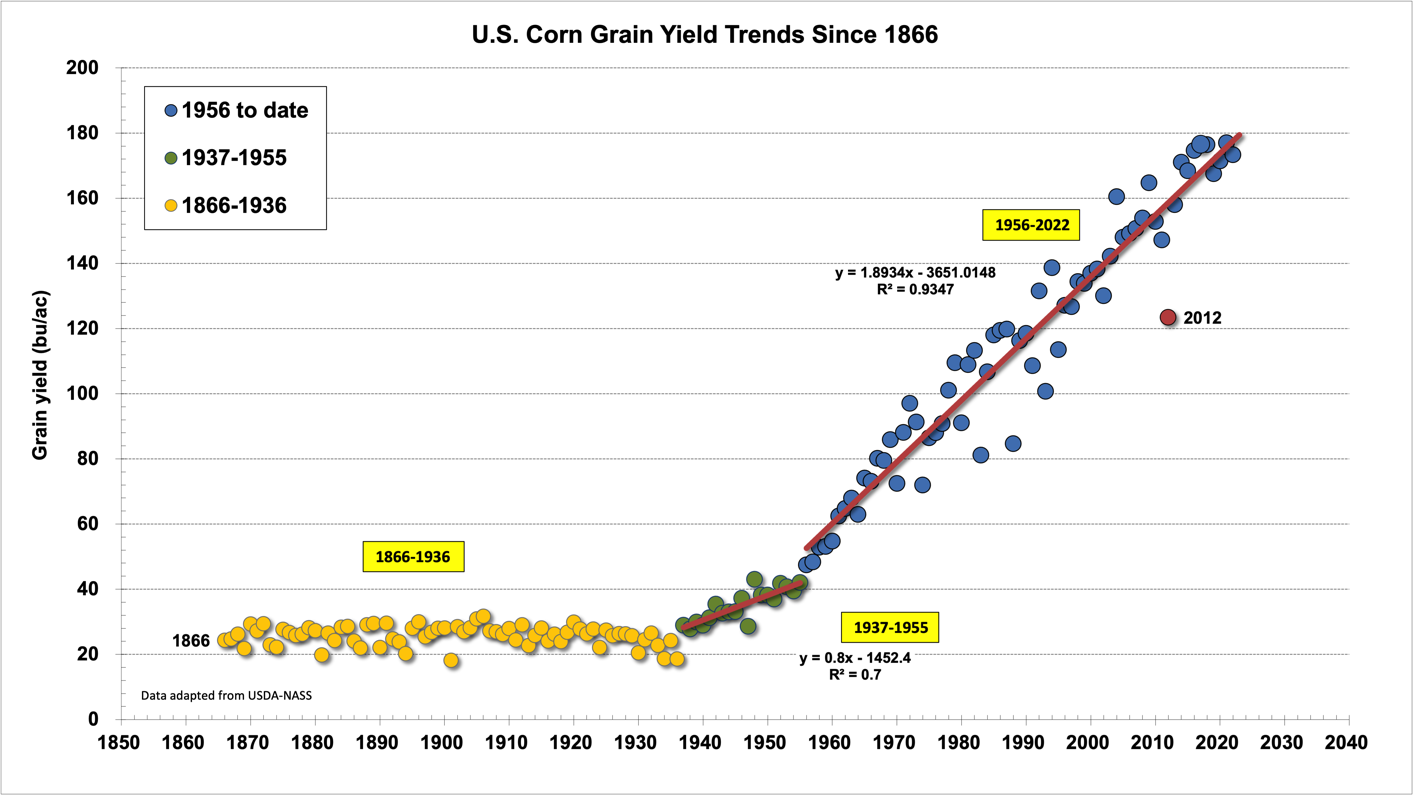
Crop yields have increased by use of fertilizers, modern farming machinery, and chemicals that prevent disease. Yields did NOT substantially increase due to higher photosynthetic rates which is how carbon is fixated.
On that land a regular primeval forest, Miyawayki/Amazon/Syntropic style would grow 10x faster than regular monocultures and that would also enable the biodiversity to rebound. We'd get ourselves out of overshoot in no time (given few decades, of course).
The overshoot threatens our civilization with crop failures. The only realistic way out of it is immediate phase-out of fossil fuels and plant-based diets.
See how corn yield has increased from around 20 bushels/acre to nearly 180?
That extra 160 bushels of corn per acre is due almost exclusively to fossil fuels and other modern agricultural practices.
That extra 160 bushels is also what feeds a substantial portion of the planet.
The same is true of other crops such as wheat. In the last hundred years or so, the Kansas wheat crop has gone from 12-13 bushels per acre to well over 30 (40 in a good year).
That didn't happen with a peasant poking animal manure into the ground with a digging stick. It happened with tractors, combine harvesters, and petrochemical-derived fertilizers.
> It happened with tractors, combine harvesters, and petrochemical-derived fertilizers.
Yes, that's the destructive part.
We should instead switch to local methods of regenerative farming, like syntropic/natural/permaculture farming, which might be more labour and knowledge intensive, but when done right have similar yields, while repairing soils and working with biodiversity, not against it.
I agree with most of what you wrote above. The ludicrous amount of resources used for growing animals for food is totally non-value adding and harmful to the environment as a whole. That said I'm not a vegetarian - my diet is based on industrila logistics - I eat the protein that the supermarket logistics chain provide to our neighbourhood.
"The only realistic way out of it is immediate phase-out of fossil fuels and plant-based diets."
The suggestion for a global plant based diet is not unfeasible. Only thing you need is to convince the elites to change to vegetarianism. One of the large scale "hari seldon" style rules of thumb are that the non-elites will generally imitate the perceived lifestyles of the elites to the best of their abilities. This is not a physics or engineering problem, but a marketing problem and hence not impossible to solve.
I disagree we can immediately phase-out fossil fuels. They are foundational to the whole global industry including agriculture. I agree we should, but this is an engineering problem that has not yet been solved.
> That said I'm not a vegetarian - my diet is based on industrila logistics - I eat the protein that the supermarket logistics chain provide to our neighbourhood.
Directly associating “protein” with animal products and implicitly assuming protein is something we should be at all worried about when there hasn’t been a report of “protein deficiency” ever are a big part of the problem.
I can’t assume this is your case but I’ve still to meet a person who brings this up and has no access to, for example, beans or lentils. A quick google search will offer many more alternatives, although it’ll also consistently bring up the fact protein is something that should hardly ever be on your mind.
You do have to actively and periodically watch your vitamins though, which we all tend to have less than what we need, and lower-than-healthy vitamins for long periods can do irreparable damage in the long term.
You do have to watch your B12 when switching to a vegetarian diet, not because animals naturally produce it but because they are generally supplemented with it; but low B12 is also pretty common in meat eaters. By the time you feel the symptoms it’s already dangerously low.
I’m not looking to attack you — I just don’t want random people reading unfounded reasons not to go vegetarian and unconsciously believing them.
> Only thing you need is to convince the elites to change to vegetarianism.
Maybe, but what others decide to do or not does not prevent individuals from doing their part. Just by changing your habits and living your life you’ll influence people. You’ll get to patiently answer honest questions, show off amazing recipes that will wipe away preconceived culinary notions, etc. Your friends, after years of seeing you well, will stop thinking “omg they must lack protein” or “they must be rich to be able to afford veggies”
Bottom-up works too, and I’d even think it’s usually the way to go with all society-scale changes. Waiting for someone else to do something generally leads nowhere good. Also, a ton of famous people are already openly vegan or vegetarian.
> Only thing you need is to convince the elites to change to vegetarianism
I think that abolisment of subsidies to most destructive and polluting sectors (fossil fuels, animal agriculture, fishing, ...) would get us a long way.
> They are foundational to the whole global industry including agriculture
Agree.
So we use what we have to expedite the switch to renewables and reform agriculture for sustainable production less dependent on chemicals and poisons.
I misread that at first too, but animal agriculture. i.e. stuff grown for fodder. It's more efficient to fuel a human on food grown in the ground than on an animal fed on food grown in the ground.
(I'm not vegan or otherwise promoting absolutes, it's just easier to explain/understand in the extreme I think.)
A significant influence on those increases was thanks to fertilizers, insecticides, and herbicides. This goes hand in hand with water pollution and biodiversity loss, exemplified by dead zones in oceans and an 80% decline in insect populations in the last few decades.
Improvements in irrigation systems have led to the depletion of our aquifers, which were filled over many millennia, and their renewal may take centuries.
Mechanization and soil management lead to soil erosion; maybe only a few decades of soil remain until we lose all of it.
Less than 50% of our crops are for human consumption; the rest is used as animal feed and biofuels.
There's part of me thinks just let the worst happen and let it end half of humanity, that way we might learn to live more in harmony with our environment. Currently we're a pox on this planet.
If we grow our resource use to such a point that we reach a ceiling, then we are exactly like a pox, or any other organism that breeds until its niche is filled.
Those who want to make us live sustainably now or previously are hoping that we can be smarter than that. We're supposed to be a smart species. Can we limit ourselves artificially to preserve a better quality of life?
You do realize that would be mostly the half whose nations had nothing to with this mess in the first place, right? The rich well of nations of northern hemisphere will not suffer dramatic population falls (just the slow, endemic kind from low birth rate).
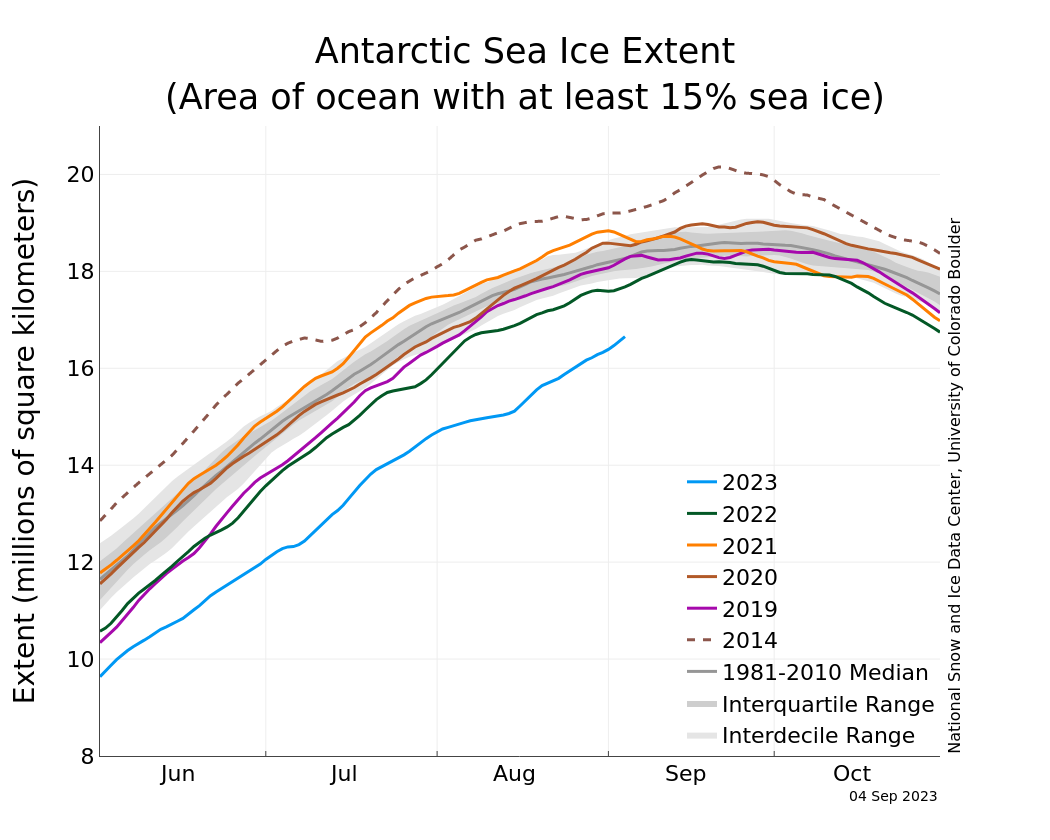
It’s essential to consider the multifaceted effects of our environmental interventions. For instance, the commendable move in 2020 to reduce sulfur dioxide emissions in shipping lanes had an unintended side effect. The decreased emissions meant fewer sulfur dioxide-based clouds in the atmosphere, which previously reflected a significant amount of sunlight and contributed to rain cloud formation. While reducing emissions is a positive change, the absence of these ‘reflective clouds’ might be inadvertently amplifying the heat, especially when combined with the current El Niño. This could partially explain the accelerated ice melt in Antarctica we’re observing just three years after the regulation change. It serves as a reminder that the Earth’s climate system is intricately interconnected, and actions in one area can have cascading effects.
At some point, we should probably stop calling it climate change and just start calling it climate abandonment. We're all so desensitized now that the more stories come out, the less people care... =/
That is not true, I think most people care dearly and are doing everything to slow down climate change, this includes participating in recycling and watching our own carbon footprints.
Ultimately its up to us to convince the policymakers and senior leadership in corporations to make the correct decision.
Huh, "most people"? Maybe in your community, but most of the planet probably don't care. And even if they do those things, only to a degree of inconvenience that they tolerate.. separating plastic/metal/etc? Easy. Missing out on European vacations? "But it's been my life dream to see Italy! It'll only be once in my lifetime!".
And the little plastic recycling they do has the effect of making them think "I'm helping!", when in reality it moves the needle very little...
> Ultimately its up to us to convince the policymakers and senior leadership in corporations to make the correct decision
Imagine a nation with the highest consumption of meat, where individual choices and habits have long shaped dietary preferences. In such a scenario, without widespread adoption of plant-based diets and a shift in societal norms driven by individuals, convincing policymakers and senior leadership in corporations to regulate and promote sustainable diets becomes an uphill battle.
It's through our own choices and advocacy that we can lay the foundation for systemic change and address the pressing issue of climate change effectively.
Sure - save for the geophysical fact that we're not seeing just variation .. underlying the usual flux we are seeing a steady increase in heat energy trapped in the near sea | land layer.
This is an inevitable physical consequence of human activity steadily increasing the insulating properties of the atmosphere in a demonstrable and measurable way.
Sure, right now we're going up faster than our new normal rate of increase due to ENSO flux, and in a few years we'll see our rate of increase drop below the current rate as ENSO swings back (fingers crossed) .. but overall on a ten year rolling average we're seeing steady increases in average global temp. as a direct result of human activity (hence AGW) and it'll stay that way until we reduce the insulation properties of the atmosphere.
It's hard to argue with someone who responds with links, but none of the content behind those links contradicts what I said.
There can be a day-to-day variation of 10+ degrees. If Monday is cold and Tuesday is warm, and I say "this is because of global warming", then if Wednesday is lukewarm then I discredited myself.
> this year above average by 3 degrees, 5 years later below average by 3 degrees
> There can be a day-to-day variation of 10+ degrees
You seem to be confusing weather with climate change.
Weather refers to short-term atmospheric conditions, such as daily temperature and precipitation variations, while climate change represents long-term shifts in average temperature, precipitation patterns, and other climatic factors over extended periods, often spanning decades (3+) to centuries.
If you want to show a trend, give us a diagram that shows a trend. A scatter plot with a trend line would be a start, maybe.
One can equally interpret the diagram from the article as showing a fairly constant level - somewhat varying within a limited range - with 2023 being an outlier. All it tells about is the variance and without at least more year labels there is no way to read anything about the trend from it.
[I'm not saying the article is wrong or right, just that it does a very bad job supporting its thesis.]
Be sure to click the Antarctic button. Arctic (the default) shows 2012 as the lowest record.
For Antarctica, last year was the previous minimum and was 2-sigma from the mean. Additional iso-sigma curves are not shown but I'd guess this year is at least one more sigma off the mean. I progressively activate past years and do not spot an obvious trend. So, last two years have deviated significantly with this year deviating yet more so.
On the other hand, given the number of measurements, we would expect about two measurements to be outside of 2-sigma. If we do not attribute anything to 2022 and 2023 being correlated, then this is just a fluctuation.
On the gripping hand, 2022 and 2023 may be the first two points of an explosive trend.
Thanks for pointing to the source data. As much as I would be careful eyeballing a trend I would be with eyeballing the absence of one. I really would love to see a proper analysis of this data, but I am in my phone right now.
Arctic doesn't really matter much in this regard because the arctic ice doesn't influence the sea level, which I think is the main (but not only) point of the article.
> Until 2016 Antarctica's winter sea-ice had actually been growing in size.
>"There is a chance that it's a really freak expression of natural variability," [Dr Mallet] says
There isn't an obvious trend. I'm pleased that they aren't trying to hide this and that the article is clear that we don't know everything about Antarctica (I'd imagine it's very hard to get data for annual sea ice maxima before we started measuring them). This isn't supposed to single-handedly convince anyone that climate change is happening, but show a piece of evidence that extreme weather events are becoming more frequent.
Comparing criticisms of data, (testing of data being a key part of science) to denying the Holocaust isn't going to win anyone over. We've heard many inaccurate predictions before, an easy one being "2 Weeks to flatten the curve" or "If you get vaccinated you'll have a 98% protection rate and can no longer catch Covid"
Funny you mention religion, the deniers also have their own religion, disputing facts with their own "facts" and "truth".
So what about 1981? Do you think it means it could've been lower than right now in, say, the 1970s, but the liars conveniently only started counting from the decade after? Given we have temperature data from further back and we know higher temperature = ice melts, the scientific mind would conclude there's a correlation. But oh nooo, jiofj knows better, there could be something else affecting it!
In that case the line would've been constantly on top in the article, like the current year is below it, but it isn't. While high it intermingles with the other lines, and is nowhere as much an outlier.
Also 2014 seems to've been more ice due to record snowfall, which is easier to freeze than the regular freezing of the sea. Seems to be in line with climate models predicting more erratic weather. Good example of why they weren't worried about that, since it's expected, but worried about this, since it isn't.
The article wants to convince you in something and naturally the visuals are adjusted to help that goal. Have a look at the raw data if you like.
So far, as much as I can see, the current climate models do not predict absolutely anything in advance, but are used to explain things afterwards to show that anything is caused by co2.


This is not something we fix as individuals, with feel-good home solutions, recycling, or planting trees. Large industry is destroying our world, on purpose, because of greed.
This only gets fixed through policy and regulation. Vote.