"Katie's got the low cut dress on today! I know where I'm sitting!"...As I'm getting older, I see how sexist and demeaning this is.
At the risk of revealing myself to be a chauvinistic jerk, is this kind of response sexist and demeaning, or just inappropriate for the workplace? Why do women wear low-cut dresses if not to attract male attention (in the majority of cases)? Would it be sexist and demeaning for me to notice and comment on a low-cut dress in another context (like a bar)? What about with my wife? Is it sexist and demeaning to find her sexually attractive?
I'm not disagreeing that the statement is offensive and inappropriate, but I'm not sure it's sexist.
> Why do women wear low-cut dresses if not to attract male attention (in the majority of cases)?
Yes, Virginia, this is sexist. Holy hell, is it sexist.
You are characterizing a woman's behavior in terms of how it makes you, as a man, feel. There are many reasons that a human might dress a particular way, but by characterizing it as a gender-based, "she wore that to make me do this" kind of transaction you have incorrectly emphasized a single way. This woman wore it for no other reason than to attract male attention? Really? Are you sure? Her decision is entirely based on how it would make a man feel?
  I'm a heterosexual man and I wear certain jeans because I
  like to show off my butt. That's fine. But am I doing it
  because I want to attract "female attention"? Not exactly.
  This turns on a subtle point, but it's very important: I
  wore them for me, not for anyone else. Feeling attractive
  is not the same as receiving attention. I don't want to be
  honked at, felt up, leered at, or even commented on. But I
  do want to look good. Does that make sense?
This situation is only exacerbated when you bring in gender dynamics: men and women are equal, yes, but women are the ones who've been oppressed for centuries and are struggling up the slope to reach equality. What a man says to a woman exists within this context, so simply reversing the roles and pointing out that it's okay HERE but not THERE is not sufficient.
Of course I'm not sure. But when you hear hoofbeats, think horses, not zebras. Why do all the waitresses in Hooters wear low-cut tops? Is it for comfort? Is it because they couldn't afford the other 30% of the shirt? Or is it because that's proven to be very effective at gaining male attention?
I wore them for me, not for anyone else.
This makes no sense. In a post-apocolyptic world where you're the only person on earth, would you dress the same way you do now? Would the last woman on earth wear low-cut dresses and mini-skirts? I doubt it. Being "attractive" specifically refers to other peoples' attention and emotions towards you.
I'm not saying that it's ok to leer at women, to verbally or physically harass them, etc. But it's incredibly ludicrous to me to think that someone dressed in a manner usually considered "provocative" probably did so without any intention, or that anyone responding to that mode of dress is automatically sexist.
Would it be appropriate for a woman to start coming into the office topless? Would it be sexist of me to find that sexually arousing? If so, I guess I'm a sexist. My only consolation is knowing that I'm not alone and that you (if you're a heterosexual male) are almost certainly right there with me :)
> Why do all the waitresses in Hooters wear low-cut tops?
Seriously, stop right there. Read what you just wrote. You're comparing a professional developer who chose to dress comfortably to women chosen for sex appeal by a restaurant which is only a step away from a strip club.
There is something seriously wrong with the way you are approaching this issue.
To answer your last question-- I'm a straight guy, and no, I wouldn't find it sexually arousing if a co-worker came in to work topless. Probably because I'm not fifteen, and I've seen boobs before.
Okay, I would be surprised at first, probably a little more so than if it was a male co-worker, but if it's what either of them wanted to be comfortable in their office I would get over it. And if a male co-worker couldn't restrain himself from making sexually suggestive comments, I would be pretty disgusted by his behavior.
(Don't forget, by the way, it's perfectly legal for women to be topless in public in both NYC and San Francisco, so this is certainly a possibility.)
You're comparing a professional developer who chose to dress comfortably to women chosen for sex appeal by a restaurant which is only a step away from a strip club.
You're arguing a straw man. I didn't say anything remotely close to that; my point was just that wearing low-cut tops and dressing for sex appeal are usually correlated.
I'm a straight guy, and no, I wouldn't find it sexually arousing if a co-worker came in to work topless.
Can you expand on this a little? It makes sense if the person was someone you didn't find attractive at all, but what if you did find that person attractive in normal work dress? Would you seriously not be aroused if they came into work topless? Or do you magically turn off your sense of attraction at work? I'm not sure I believe you, but even if that's true, it's clearly not for the vast majority of male society. Hence the plethora of advertising and marketing aimed at men that features scantily-clad attractive women.
Finally, it's obviously completely inappropriate to make those comments at work. But I don't think it's sexist.
> You're arguing a straw man. I didn't say anything remotely close to that; my point was just that wearing low-cut tops and dressing for sex appeal are usually correlated.
Oh, did I get that quote wrong? Let's play the tape:
> Why do all the waitresses in Hooters wear low-cut tops?
Huh. It sounds like you're saying there that, because women selected for their sex appeal by a restaurant which is only a step away from a strip club wear low-cut tops as part of their required work uniform, it is reasonable to assume that a professional developer who chooses to wear a low-cut top is doing so to attract male attention.
Which of these pictures (if not all) causes you sexual arousal? Am I really so bizarre in my ability to look at these images, think "That is an uncovered female breast," and have my next thought not be "I would like to have sex with that person"? Because, you know, breasts (like the women who own them) don't exist for my sexual pleasure? Because context matters?
(For the record, my next thoughts, in order: "Awww!", "Oh man, that looks like it sucks," and "Wait, do I know that guy?")
Lastly, if you make inappropriate sexual comments about women, and not men, you are being sexist full stop. You are treating people differently, in a damaging way, solely on the basis of their sex. That is the definition of sexism. The justification is not relevant; in fact a lot of sexist behavior stems ultimately from insufficiently mediated sexual desire. (If you make inappropriate comments about both men and women equally, you are excused from the charge of sexism, though not from that of being a creep.)
Alright, look...those are pictures of people who are topless and are taken in non-sexual environments. Biologically speaking, there is nothing more sexual about those photographs than photographs of the same people wearing shirts.
Physiologically speaking, though, there is a difference. For most of us, chemicals in our brain respond instantaneously to those pictures, virtually shouting, "this is a naked woman". And its not just a male response, either (http://list.msu.edu/cgi-bin/wa?A3=ind9710B&L=AEJMC&E...). Nudity sells, and not because naked people look different. It's because our brains are tuned into paying attention to them, both by nature and by nurture.
The point of what I'm saying is that anyone wearing things that make you look good will ALSO make those who would otherwise be attracted to you pay more attention. It's not a choice, it is literally hard wired into our brains. Our brains respond chemically (http://jn.physiology.org/content/98/3/1374.abstract) to the pleasant, attractive things that we see. You have to understand that although you wear your jeans for yourself, anyone who is chemically predispositioned to do so will ALSO have their brains respond chemically.
This is no excuse for anyone who acts improperly in response to something that they see. We're all fully capable of controlling ourselves. Some of us have more practice in it than others, but society couldn't function if we couldn't control these reactions. The chemical response doesn't go away, though, it's just mitigated by other chemical responses.
We can (and most of us do) control our responses, but it doesn't get us anywhere to pretend that it doesn't happen. .
Sorry, that's just factually inaccurate. Cf. Male nudists do not walk around all day with uncontrollable erections. I'm sure many do at first, but you get used to it rapidly and discover what anthropologists have known for some time, that nudity is not the same thing as sex appeal.
I'm sure there was a time in my adolescence when the mere appearance of a square inch of uncovered skin would have provoked a sudden involuntary orgasm like some Victorian gentleman, but I have seen enough breasts in enough contexts to realize that very rarely do they imply anything sexual.
For what it's worth, your sources do not support your point. They refer to sexual, erotic and romantic images, which I hope you would agree none of those pictures would be considered.
Sexism is one of those topics that invokes a lot of disingenuous statements. If the article being discussed was about human sexuality, people here would discuss in great detail how evolution has hard wired our brains for certain reactions, behaviors, etc, discuss documentaries they've seen, post links to articles, etc.
But if the article being posted is about the sexist treatment of a woman in the workplace, eventually the discussion will get to the absurd point where many of the men essentially claim that these biological sexual impulses literally don't even exist.
If treating people differently because of their gender is wrong, does it apply to both positive and negative treatment? Because judging by the comment count whenever this subject comes up, nothing seems to fire up the HN crowd more than sexual discrimination. Other more serious injustices in life never invoke this much passioned discussion.
>Other more serious injustices in life never invoke this much passioned discussion
I don't know if it's the case, but I imagine the more serious injustices are more black and white, where as sexism is almost all gray. One person's "I can't believe he said that" is another person's "You should have heard my daddy talk to my momma".
Pedantic. There is such a thing as sex appeal and dressing sexily. The entire fashion industry is built on it. I bet some of the people in those last pictures have been called "sexy" and liked it.
As a man I dress well because I want to be attractive. No, it doesn't mean women should feel free to whistle at me at work, but it's not outrageous to explore the boundaries and decision making process on this forum.
There is also such a thing as dressing well because it is comfortable, or makes one feel better about oneself, without the intention of attracting sexual attention, and the distinction between the two is not pedantic. It is at the core of the disagreement here.
Look at the original quote: "Oop, Katie's got the low cut dress on today! I know where I'm sitting!" A clear statement of sexual interest, which Katie clearly did not wish to receive.
The hypothesis we are being asked to entertain is that she probably was wearing the low-cut dress because she wanted to attract male attention, but that this comment was in some other way offensive. That is, she wanted this guy to think that, just not say it. Because women are touchy, or something. What an absurdly insulting proposal!
Is it really so hard to imagine that she might want to dress in a way which is gratifying to her, without intending to be the object of men's sexual fantasies?
I have a question, and this is a real question, I'm not trying to be a dick here.
Suppose that Katie is a very large, very unattractive woman, and the meaning behind the statement isn't, "I'm going to sit where I can take advantage of the low cut dress", but "I'm going to sit as far away from her as possible", is it still sexist?
Same statement applies: if you say that sort of thing only to women, yes, it is sexist. If you treat both men and women that way equally, you aren't sexist, just an asshole.
Sorry about the downvotes, it's a legitimate question to me.
There's worse out there (well, that's just about always true), but sure: that's sexism.
It's pretty obvious if you take it apart a little.
You're singling out the one woman in the room, commenting on her physical characteristics, and saying that (presumably because of those physical attributes) you're going to sit next to her.
Now, why would you want to do that? Sit next to this person purely based on her gender and physical attractiveness?
Well, obviously you're not singling her out as the most expert person in the room, or anything else remotely related to your actual purpose for being there (I'm imagining this in a work environment).
Nope, you're sitting there to hit on her. You've already started, with the compliment. Possibly only very politely, but will she trust you to stop there? And will she now have to assume you're casting sidelong glances at her breasts when she points up at the whiteboard during the discussion?
And since this is a work situation (not a social one), she doesn't even have the option to excuse herself and go talk with other people if your advances are unwelcome.
It would make me uncomfortable. I wouldn't say anything, because I'd be told to 'lighten up'.
Why would it make me uncomfortable? It would subtly remind everyone in the room, including me, that I'm different. And it would place an (unintended, I'm sure) emphasis on my physical attributes, which have nothing to do with my ability to design or program software.
It's bullying and harassment and would be covered in UK employment laws.
One can imagine such comments causing Katie distress or stress. Employers have a legal duty (which has been tested in courts many times) to protect their employees from harm (and that includes stress) in the workplace.
It is quite possibly sexist; there's not enough information to say.
Boohoo. If I come into work with a big pink sombrero on my head people would probably give me some unfavorable remarks. My reasons for wearing it are irrelevant. It wouldn't excuse violence or career repercussions, but it would be childish to expect that you can present yourself in any way you like without others reacting to it. That is a key purpose of presentation.
> I wouldn't find it sexually arousing if a co-worker came in to work topless.
Which is why I sometimes wish for a nudist society, exposing clothes can be much more distracting than none at all.
> Probably because I'm not fifteen, and I've seen boobs before.
I'm neither fifteen nor in dire need of breasts, and a mini skirt in summer can still be enough to keep me from thinking straight (I won't comment on it though). Some of us can't be fixed, looking down on me won't help.
I actually agree with both of you, you simply sound as if you had different women in mind all the time. There are girls in all environments that dress up with intentions. It sucks, they cause prejudice, but the OP really doesn't sound like it.
This has always sort of baffled me. That is, the fact that there has to be a specific law/rule allowing women to appear in public without some form of upper-body garment.
Obviously, regardless of gender, it's all about context. I wouldn't consider it appropriate for someone to get around without a shirt on while at work (I suppose there could be exceptions, eg. certain manual labour jobs where employees are comfortable shedding clothing in an effort to stay cool etc.).
But in a situation where its natural to take ones shirt off, such as swimming, I don't see why women shouldn't be allowed the same 'privilege' just because they may have visible deposits of fat and muscle on their chest.
I know there are all sorts of longstanding social preconceptions that a lot of people would hold on this sort of issue, but isn't that something most people would expect to change over time?
Companies often have specific dress code regarding clothing choices because of issues like this. So I believe his point is valid at least in a generalization point of view.
> ... Start wearing sweaters, even though my breasts feel like they're boiling in there (yup, that's one reason women like low tops, guys)? ...
Comfort is her reason for wearing low cut tops. No need to speculate further than that.
To flip this around to me, I know that at times, I've done the bare minimum in the clothing department. Sometimes this means getting into my clubbing attire when I'm low on laundry. Do I own this shirt for a certain kind of attention? Yes. Am I looking for that attention at work? No, it's just getting close to laundry day
Your response echoes the problems nearly every rights-movement runs up against. The issue is that such things are societally OK (or borderline), which does not imply that they're right.
In a post-apocalyptic world where there aren't enough men, would you allow women to vote? They aren't as educated, surely doing this would bring about yet another apocalypse. Imagine who they'd vote for!
What would happen if a woman were voted into congress? Surely her sexual appeal would distract the entire group of men there, lowering the overall quality of work.
The problem is that this is a problem, and that people don't yet see it. Say, in time, it becomes OK for a woman to come into an office topless. Imagine the reaction of people then who hear of our behavior now. Now think of your reaction when you think of the historical debates about whether or not black people had souls, which made it OK to use them as slaves because they weren't really human.
> Why do all the waitresses in Hooters wear low-cut tops?
Because they work in an industry that is primarily based on looks. Just like it's "okay" to stare at fashion models, it's "okay" to stare at waitresses at Hooters. Seeing as you don't work at Hooters (I'm guessing, ( ; ) then this doesn't apply here.
> In a post-apocolyptic world where you're the only person on earth, would you dress the same way you do now?
I'm not sure this hypothetical adds to the conversation. I also wouldn't dress the way I do now if the gender dynamics in Western culture were different. What's your point?
> Being "attractive" specifically refers to other peoples' attention and emotions towards you.
I would argue that being "attractive" is more a question of self-esteem than perception by others; see any interview with Megan Fox where she admits to not feeling attractive. It's not about how others feel about you, but about how you feel about yourself. How you feel about yourself is, partly, a product of the culture that contextualizes you, but that's more about the cultural aggregate than specific individuals (the hypothetical woman who is commenting about my great butt).
> I'm not saying that it's ok to leer at women, to verbally or physically harass them, etc. But it's incredibly ludicrous to me to think that someone dressed in a manner usually considered "provocative" probably did so without any intention, or that anyone responding to that mode of dress is automatically sexist.
Totally. I know you're not advocating horrible behavior, but sexism is not a flipped bit; it's a complex spectrum with multiple dimensions that is hard to quantify as "on" or "off". I tend to think that most people (me included) are sexist, and it's not categorically Bad and Evil, just something that I consider in my responses to certain situations and issues. It's okay to be sexist; it's not okay to make unwelcome remarks about a woman's appearance.
But you're asking the wrong question here: why is someone wearing a low-cut dress "provocative" at all? Provocative to whom? Why does how I dress necessarily have anything to do with anyone else? Every woman who wants to wear tight clothing wants to be looked at, otherwise they would wear burqas? It's incredibly ludicrous to me that you seem to be putting forth that supposition. It seems to lead to, "I'm sorry she was offended, but if she didn't want to be offended then she should've dressed differently." Which is a form of victim blaming: http://en.wikipedia.org/wiki/Victim_blaming
As to coming to work topless: no one is questioning whether or not being attracted to women is sexist. Of course not. But commenting about a female colleague's cleavage at work is sexist and demeaning. Be attracted all you want, fine. But don't cross the line.
This might be a ludicrous way to approach it, but would we be having this same conversation if a lesbian had made the comment, or better yet, a gay man to another man? I think it's still obviously inappropriate sexual harassment but it doesn't feel immediately "sexist" to me in the same way. Sexism is about discrimination or prejudice based on gender, and I think we too quickly view anything inappropriate from one gender to the other as being "sexist".
Good point; I think we would be having this conversation.
We would not call it sexism, as that's reserved for unwanted attention between the sexes, usually male-to-female, but sometimes reversed... but it would still be just as wrong.
I think we don't have more cases like that because LGTM people are in a minority, but that doesn't mean that an LGTM person can't make unwelcome advances upon another person; why would it? Of course they can.
Can you name something inappropriate from one gender to another that isn't sexist? Consensual sex with your wife is appropriate. Getting slapped on the ass by your SO is appropriate. Getting fondled at a concert by a member of the opposite sex..? Did you want that to happen? You did? Great! Appropriate. You didn't? Inappropriate. Clean and simple.
What else do you feel is sexual harassment but not sexist? Where is your line?
sexism, as that's reserved for unwanted attention between the sexes
That's harassment. Sexism is believing or acting as though one sex is intrinsically better than the other, as racism is the same with race. Sexism is not directly related to sexuality in the "having sex" sense, any more than racism has to do with sprinting.
That's not what sexism or racism is. Racism is not statements like "black people dance better," it is only when a negative statement is made about a race in a perceived inferior statement (e.g. vis-a-vis white people).
Racism and sexism are, respectively, stereotyping someone based on their perceived race or sex. Yes, even positive stereotyping ("pracism") like "black people dance better", "asians are great at math", or "girls are better note-takes".
The negative effects of this form of racism & sexism are fairly well documented.
Maybe the downmodders are right in a "by the books" sense, but try to accuse someone of sexism when they say "men don't make good homekeepers" and see how far you get. Practically speaking, it doesn't work. Also I'll add that this weird feature seems only to exist for white people in Western countries.
I don't think you'll find any arguments that the US government doesn't have insane double standards and sexist laws. But I doubt you can make that kind of claim for any government, really, since they're constructed by people - to get rid of it, you'd have to get rid of it in people, and I'm not aware of that ever having happened.
The definition on sexism has already been addressed, so I will leave that alone.
Do you not think there are grey areas? Areas where a comment might seem harmless but end up insulting someone?
To me the only way addressing this is to speak up when it happens. If you don't then the grey area remains grey and it is likely a behavior to be repeated.
Mmm, I guess this doesn't have to make sense to you, but there are people who enjoy being fashionable. I don't understand them either, but it seems to be a form of self-expression, not an invitation to flirt.
I'm a heterosexual man and I wear certain jeans because I
like to show off my butt. That's fine. But am I doing it
because I want to attract "female attention"? Not exactly.
This turns on a subtle point, but it's very important: I
wore them for me, not for anyone else. Feeling attractive
is not the same as receiving attention. I don't want to be
honked at, felt up, leered at, or even commented on. But I
do want to look good. Does that make sense?
No, it doesn't make any sense. It completely disingenuous and you don't even realize it. The question you need to address is: why do you want your butt to look good? And the answer is: for the women. Because you want to attract 'female attention'. There is no other reason to care about whether your butt looks good. You could wear any decent pair of trousers that does not show off your butt and the only thing that would change is how much attention you would get from women.
And as for 'being commented on': the only reason you even know it looks good, is because people have commented on it, in whatever way.
Everything we do, everything, is infused with a desire to mate. You can try to deny that, but that doesn't make it go away. That is exactly what leads to the "lighten up" attitude: trying to defend you acting out on your desire to mate. The only way to reduce the influence of that desire is by acknowledging it and actively attempting to diminish its influence.
Yah, well. He could also be doing it for attention from men. For a uber-politically correct thread, there's an awful lot of heterosexism going on here. #JustSaying
You're mentioning behaviour that is inappropriate overall (i.e. with strangers/acquaintances), but this post was more about the behaviour that is inappropriate only at the workplace (at least I read it this way). Unless you're saying that the sets of inappropriate behaviours are equal, in which case I wholeheartedly agree.
Personally, I would enjoy getting compliments about my ass. Being grabbed/honked at, not so much. But plain compliments, sure! Even at the workplace. At least, I believe that getting compliments beats not getting compliments, and I tend to believe that most people, men and women, would agree.
It totally depends on the compliment. If someone complimented me on my crotch ("Nice package, man! You're really filling it out nicely there!")... then, no. ( =
Otherwise, though, yeah, I like getting compliments about my hair, eyes, whatever, sure. But commenting about sexual characteristics, specifically, is a line that one shouldn't cross. Just like complimenting someone every single day for weeks on end is another line.
If the other person indicates that the compliments are welcome, then you're probably good. If they give no indication in any way, then they're probably not welcome.
Besides, a single compliment isn't the issue: a whole system of behaviors taken across a wide sample size of more than just one man, is.
And I'm not sure what your first paragraph means. 'Splain? ( =
This is always where geeks run off the rails in discussions like this. We want to come up with rules for things: either this statement is "sexist" or it is not, and here is the objective reason for that decision.
But it misses the point. Context matters. In a utopian environment where women felt equally respected, sure, a sideways/slightly-inappropriate comment would be fine. In some workplaces today that might even be true. But it's not the norm, and in the real world people feel disrespected by this kind of treatment. Not everyone (but some, sure, as I'm sure someone will point out needlessly) likes the fact that their perfectly "normal" clothing choice can make them "attractive" in one context but the butt of a joke in another. Men, on the whole, don't deal with that.
Oh bullshit. If I'm hanging out with my boss at a barbegue and does something stupid and I say "you're such a dumbass", it's a fun jab. If my boss says incorrect or misinformed in front of customers, and I say the exact same thing, in the exact same tones with the exact same stupid grin, it could be a lost sale, and a reprimand. Context does matter, and it's not some whimsical flight of fancy by fickle and capricious women.
The rule is: don't assert your situational power. A woman alone or outnumbered among men is going to feel pressured. Comments you make won't be well received even if she is worried enough by the pressure to smile and hide her discomfort. She'll just curse your name to her friends after work.
Contrast: if you're the only man in a room of women, and the boss is a woman, would you dare speak up with your "nice dress" type comment? That's what it feels like to be on the downside of a power gap.
Yeah, why not? In a room full of men, the comment would be made to the other men, but for the benefit of that woman. It would be flippant and funny. In a room full of women, the comment would be more personal, and I would have to keep the tone extremely light because the more serious I am, the more vulnerable I am.
Seriously? You're saying that standing alone in a room full of women of uniformly equal or higher social standing (suggestion: if you have kids, take a day off and bring them to any local parent/child activity -- it's likely to be 100% mothers) you'd feel comfortable blurting out "You're wearing a low cut dress! I know where I'm sitting!".
Please (please!) try this. And bring a camera. I suspect you'll be very surprised at the results.
Of course I've done it. I was at an all-mothers event mostly by accident. She glared at me and kind of laughed. My mother gave me a dirty look lol. Pretty much expected. Did you expect something bad to happen? Maybe it would be different if she were single and available?
So I guess the lesson is that because sp332 feels no shame in deeply embarrassing situations that no one else would. Yikes. I'd be bright red and backing slowly toward the door if that came out of my mouth. You, sir, are weird.
Well I felt pretty bad about it at the time, and left the room after a minute. But later she told me (when I asked her about it) that it wasn't a big deal and I shouldn't have taken it so hard. My mom doesn't remember the incident but she tells me that no one would have cared much.
OK, but that's a really telling detail: she was gracious about it, because she could be (she was in a position of social power), and because you were visibly embarrassed. In the anecdote above, the guy wasn't apparently embarrassed, and Katie didn't have the social power to tell him "it's OK" even if he was (and why should she have to, if she was the one who was embarassed?).
See the point? These are critical details, and they change the moral calculus. You can't wave away an incident like this just because you can imagine something similar which wasn't a problem.
Like I said way up-thread: someone (you) is going to point out that not all women would react like Katie did. So what? Context matters!
I totally agree with you. I think JulianMorrison missed that point. Being on the "downside of a power gap" doesn't always mean that speaking up will have bad consequences. It's up to the person who has power. The men in the original scenario need to explicitly give the woman room to speak up if she's feeling uncomfortable.
Missing the point still. Everything done by the person on the downside of a power gap is done in the context of the predicted consequences for doing otherwise. This is a sexist society, full of such concepts as "humourless ice bitch". Actually showing a discomfort which is felt inside might be dangerous. A room entirely full of women is enough to counterbalance this and allow communal frowns to speak loudly. Merely "explicitly giv[ing] the woman room to speak up" is liable to get a response that means "don't hate me" more than it means "here is what I honestly feel". Power has to work harder to blunt its bad effects than just saying "so please ignore the power gap".
A young woman of a specified kind or having a specified job
- a career girl
Women who mix socially or belong to a particular group, team, or profession
- I look forward to having lunch with the girls
Perhaps this is a language issue, but it's just as common for me to call my male friends 'boys' as my female friends 'girls', even though all are adults. Not sure what the issue here is.
If you're calling any female co-workers "girls" in conversations at or about the workplace, you're doing it wrong.
There is a long history of society downplaying women's contributions in the workforce by using cutesy terms like "girls", and some of the definitions you've cited here reflect that. But just because a term like "career girl" was once in wide use doesn't mean that it's still appropriate today. (Or for that matter that it ever was: can you imagine anyone ever having used the term "career boy"?) Much like the ridiculous term "co-ed" for "woman who we decided to allow into college", its time has thankfully come and gone.
I guess the words I use are closer to guys/gals then boys/girls then, except that it's used commonly the language (as opposed to gal in english, which is fairly rare - at least from my experience).
There can be a lot of hang overs in languages that aim to demean and diminish people. Calling a black man "boy", or a woman "girl" is a way to belittle them.
"Boy" vs "Girl" is an interesting one. It's not uncommon, as you pointed out, to call adult women "girl". However you rarely in the straight male world do people refer to adult men as "boy". However in the gay male world, sometimes "boy" is used (e.g. this collection of gay short films 'Boys on Film': http://www.amazon.co.uk/Boys-Film-Hard-Love-DVD/dp/B001L5JMQ... ). This shows that "boy" (and hence "girl") is a slightly sexualised way to talk about someone. Should you be using sexualised terms in a professional environment? No, so say "women".
(BTW: Just because your google search found some results that back up what you say, but might be a bit misogynistic doesn't mean google is right. "Jew Watch" still shows up above the fold if I search for "Jew", but it would be wrong of me to excuse anti-Semitism based on that reasoning)
For men: I'm hanging with the "guys" or "bros."
For women: I'm hanging with the "girls." (you can't say "ladies" in this context, you can't use "sisters," you could use "gals" but it would sound like you were from Texas).
We want to come up with rules for things: either this statement is "sexist" or it is not, and here is the objective reason for that decision.
Um, yes - geeks want objective rules which allow us to figure out that an activity is either legitimate or not. This principle is called the "rule of law".
Are you advocating that we should abandon the rule of law in cases of sexism?
Laws are the bare minimum set of rules for your moral behaviour - the stuff that's so bad we have to punish you if you do it. If you can't do better than the bare minimum, then you're doing very poorly at morality.
Not all good behaviour can be written down as clear-cut rules. I sure wish you could, but you can't. It's a bit like the story of what happens if you try to measure programmer productivity: whatever measurement you use (eg. lines of code), someone will find a way to game the system. Yet people can still be "obviously" more productive even if we don't have a numerical way to prove it.
What apenwarr said. Also the "rule of law" is nowhere near as objective in the geek sense as you seem to think. It's filled with concepts like "the reasonable person" and "mens rea" which are heavily contextual and subjective.
Sexism is endemic to the society and to the relationships which generate that comment.
So, right. Imagine that you're a woman. You're told from a very young age that you have to watch what you wear, and where you wear it, and how you walk in it, how well-lit it is -- you don't want that sort of Attention. And wear high heels, they make you more attractive -- but don't wear high heels because they might be clumsy if you have to flee from Unwanted Attention.
The problem isn't the clothes. The problem is the Unwanted Attention. As a man, your defenses against sexual assault -- at least the ones that you're taught by the culture -- are chiefly, "don't go to jail." That's because that's the only major place you have to worry about Unwanted Attention. There are maybe some Bad Neighborhoods which you're asked to memorize and route around in addition.
"I know where I'm sitting!" paints women as the objects of your sexual indulgence, and commits to undressing them with your eyes. That's probably Unwanted Attention, but it is not the Problem.
The Problem is "Why do women wear low-cut dresses if not to attract male attention?" -- where you imply that the woman is ultimately responsible for the sad state of affairs culminating in the Unwanted Attention, rather than the males thus attendant and the culture thus pervasive.
A female friend who worked in an office setting described it this way to me:
"I can't wear anything too revealing, because I'm perceived as easy or slutty. I can't wear anything too modest, because it makes me seem prudish or not fun. I have to find that perfect middle ground -- between professional and cute. Every single day."
There's a kernel of truth to this, but it's also somewhat disingenuous.
At work, as a male, I can't wear anything too casual because it's unprofessional or might mark me as a hipster, but I also can't suit up every day unless I want to be seen as a corporate drone. I have to find that perfect middle ground -- between professional and hip. Every single day.
Woah, not the same at all. If you wear a low cut top in a room full of guys and are seen by some as a sexual object, it's taken on a new dimension. I appreciate the subtleties of male dress (I deal with the same issues you raised), but the pressure isn't the same.
But who's putting all this pressure on women? As a professional geek, I couldn't care less what my colleagues are wearing -- male or female alike. At my previous job, most managers (including mine) were women; do you think they were judging their "badly-dressed" female subordinates more harshly than their male subordinates? If yes, why would they do that, knowing all too well how hard it is to strike that "perfect middle ground"?
Most of this pressure is self-inflicted. These problems won't go away until women stop listening to the idiotic fashion industry; if they don't, it's because their issues are less rational than they make them out to be.
Of course, my point was mainly that "having to go through something every single day" can be a huge burden or a slight inconvenience, and I'd be much more interested to hear from women where on that spectrum picking work attire falls for them rather than assuming it reduces their quality of life to zero based on a dramatized quote. Again, not trying to discount your friend's experience and I sure as hell don't think men have exactly the same issue, it's just low on context.
I completely agree. This thread is full of guys like me hypothesizing about what it's like to be a woman in the workplace. I'd love to hear more examples. I could be completely wrong.
That does sound like a pain in the ass, but surely the problem is that the range is too narrow, not that there is a range in the first place. If a female coworker showed up at work one day in lingerie, is that really not supposed to mean anything and we're all supposed to go around like little asexual robots and completely ignore it? Ditto for the other end of the spectrum and for the male gender.
Why do we have dress standards in the first place? Why not just wear a speedo to work if that's what you find comfortable?
I agree that there is such a thing as dressing inappropriately. Let's further assume that they are doing so for the express purpose of attracting your attention. (In my experience, men are usually deluding themselves about how much women dress to seduce them, but whatever).
The question is, how are you going to react to it?
Because one person dresses inappropriately, do you have to react to it like a 14-year-old boy? Are you going to comment on it in a way that implies that women are there for your personal entertainment? Are you, by opening your mouth, going to encourage others to get even cruder? And what about all the other women you work with, or will potentially work with (who probably resent the woman who overdoes the cleavage too)?
I understand that you feel that it's unrealistic to ban sexuality from the workplace. But it's not prudishness that is called for, but judgment. Consider that your actions take place in an existing context. In 2012, it doesn't take too many comments like that before your workplace or your open source project or whatever turns into a hostile space for women.
Now, I've worked on volunteer projects with people who knew each other really well, and things are considerably looser with regards to sexual humor.
The point is, you have to create an environment where women have a secure status. In the typical workplace, people barely know each other, and women are just barely holding onto whatever status they've earned. This probably means refraining from the more puerile jokes and observations.
P.S. In the interests of full disclosure, I've failed at this sometimes myself. I had a colleague who was a great programmer, but I was distracted by her body. She wore shapeless t-shirts covered in shapeless hoodies most of the time, in part, I'm sure, to hide this. But more's the pity that she basically has to dress in a tent in order to have her colleagues look her in the eye.
So, what is the solution? Work uniforms for everyone?
But more to the point, doesn't this suggest a desire on one hand to seem cute, feminine, and romantically attractive, but not to get too much attention? If this is the case, then are there bright lines at all in this area?
Sexual assault is no joke. But so what if someone gives you "unwanted attention"? We have become a culture of whiners and rationalisers. It would be like me, as a man, going on and on about how unfair it is that I'm expected to hide fear and put the safety of females before my own. Of course, we're well along the way to destroying that tradition. People ignore the myriad of subtle advantages to this "sexist" approach, starting with the fact that in an emergency no thought needs to be exercised - men know reflexively that they are to put themselves between danger and other people. Maybe we can weaken this a bit and use some different criteria like "the best and bravest should protect others". But if we let the more fantatical egalitarians run the show it will end up with unworkable madness like demanding equal representation in self-sacrifice between men and women.
Well, the "so what" is everything: Unwanted Attention is Unwanted because it embraces some sort of threat or menace or unreasonable expectation or social tension or unease. To say that we should stop giving women this sort of unwanted attention is not whining or rationalizing, nor is it fanatical egalitarianism. It's just demanding a culture where we men know that it's dangerous to control, frightening to objectify, and despicable to rape. The problem is that we accidentally think of these things as "you know, just a thing we do." We just casually say "I totally owned you at TF2" or "he used to be my boss but then I was promoted and I made him my bitch" -- and if you were asked about the slavery and rape metaphors there you just say "Lighten up, I wasn't being literal about it."
Power doesn't have to pervade the society, and it's a bit bizarre how it does. Only last year I joined up with an Ultimate club in Delft, after a childhood in the US. I hated sports in the US because it was cutthroat and antisocial. In the Netherlands there is a big difference, "what sport do you play?" is actually, like, an everyday question. You're expected to have one. And I liked Ultimate here, at least, because people were immediately giving me tips on how to throw cleaner, how to run better, how to stop faster, how to jump higher. It isn't about someone being Team Captain and you wondering whether you'll get Picked Last. I don't know where we learned that as children, but it was part of this bizarre Culture of Power.
And it's the same Power Culture which Joel Spolsky warns entrepreneurs about: don't try to dictate what your artists do; instead try to facilitate, let them express themselves as artists.
Power Culture might have "subtle advantages" as you say. It probably means that we can hire fewer teachers for larger classrooms, because kids are scared that they might be sent to The Principal's Office. But the social repercussions are pretty amazing. In a couple centuries I wonder whether this sort of culture will seem as foreign to them as owning slaves seems to us.
Today I learned: "I owned you at <x>" is a slavery metaphor. It was always just something I said. Now I know, and therefore probably can't say it anymore...
If no one in the context of the discussion finds it offensive, I would say it is fine to say it. If the original meaning of a word has become archaic, then I cannot see a rational reason why one cannot say it. If someone becomes offended by usage of the word, then maybe your position should be re-evaluated, but most insults have their history in bigotry, and trying to cleanse yourself that way is not productive. The word "git" comes from the word "beget", insinuating that they are a forgotten offspring: a bastard. Some people would be offended by being called a bastard, because of it's meaning of being born out of wedlock. But I cannot see anyone being offended by being called a git for it's original meaning. The term no longer means what it does, and censuring it as such does not make sense to me. The same might apply to "I owned you", though I don't know the term so well, so I can't really comment.
Though it is my example, I would add that I don't think that it started out as a slavery-of-others metaphor.
So, before there was "pwned" there was "ownership." You "owned at the game" rather than "owning the other players." The ownership was to entitle that your mastery of the game was so complete that you transcended mere "participation" in the game and instead cultivated "belonging."
Unfortunately, etymology is something of a footnote in real life.
Sorry, I can't talk to someone who says that rape is "accepted" as something that we just do. There are some idiots trying to justify it for sure. Not once did I try to justify rape. You talk nonsense about "power culture" that I never even brought up. I believe in small, resilient entities. This is the opposite of a "power culture". Centuries ago it would have been inconceivable that we would eliminate smallpox. The fact that we might eliminate the flu and other small-harm diseases in the future is not a reason to laud the idea as a good one.
I'm sure all of your coworkers are very thankful to have a super-hero like you around to protect them from all the mortal dangers that pop up in the office on a daily basis.
If I heard you going on and on about how it's unfair that your expected to hid fear and put the safety of all the women-folk before your own, I wouldn't think you were a whiner, I'd think you have a damned screw loose.
Read what you wrote, man. We're not talking about the wilderness of Afghanistan, we're talking about a cube farm. Your macho baggage has no place in that setting. If you can't get rid of it, at least suppress it long enough to not burden your co-workers with it.
What is your problem? I don't ever talk about this in that setting. I'm illustrating an idea, and you try to bully me with things I never did. I don't have "macho" baggage. Where did you get this information from? How would you even know if it was true? I'm pointing out that society imposes some limitations on people and that it's pointless to complain over every single little thing. Your admission that these impositions on men are no big deal just serves to illustrate my point: that there's nothing serious going on here. Just first-worlders complaining over every little perceived disadvantage. And yes I would say something if I witnessed someone bullying a coworker as the OP describes. That doesn't mean I'd be sympathetic to whining about it.
Public perception (as judged by art, which usually represents a slightly caricatured version of reality) seems to imply that your attractiveness and the appropriateness of your comments are inversely correlated.
That is to say, if you tell a woman she looks good, it will be a compliment if she likes you, a sexist remark if she doesn't.
There's some truth in this, I have observed women who will happily let some strange guy basically feel them up in a club if he is good looking and call him "cheeky".
Whereas an ugly looking guy who makes eye contact or smiles at them is regarded as a creep or potential rapist.
In fact I remember reading somewhere that a persons physical attractiveness had a fairly significant affect on the likely verdict where they to be the defendant in a trial.
I've generally found that when it comes to matters of gender and sexuality, the more "enlightened" one claims to be, the far less actual experience in life, with real people, one actually has. The college/twenty-something years in particular are wonderful for many things, and universities are wonderful for many things, but one thing they're bad at is giving you a realistic view of the world as it actually is, and people as they actually are, rather than as how one ideally might like them to be. A view less based on reality than based on theory or political agenda.
The next time I have to sit through an HR-and-Legal mandated harassment course for work, and I catch myself thinking "Is anyone actually this clueless to think saying such things is okay?" I'll make sure to remind myself, yes, some people are.
Yeah, the number of "this is how things should be" type comments here is silly. As if we can wish away the neurological aspects of human beings we don't like or that don't fit with whatever utopian ideology they espouse.
It's naive but I did expect at least a little pragmatism from this group.
There's much more to this... A totally attractive guy (model-like) that emanates low self-confidence (shyness, bad posture, ...) could still have his comments perceived in a negative way (i.e. as being sexist, not compliments). So, I believe that we tend to judge this from the perspective of the perceived intent of the person making the comments. A self confident gut -> he's probably just being sincere -> cure. A not-self-confident guy -> he's trying to get something from her -> looser. (Probably applies with the sex roles reversed, but I have no actual experience to lean on).
At the workplace, the label looser is just switched for the label creepy/sexist.
I have always believed that confidence has a huge effect on what a person looks like. The most beautiful person can look like a mess if they do not believe in themselves.
Do you mean directly correlated? If you are more attractive, your comments will be more appropriate. If you are less attractive, your comments will be less appropriate.
> That is to say, if you tell a woman she looks good, it will be a compliment if she likes you, a sexist remark if she doesn't.
this. nailed it. it depends way more on how she feels and what she thinks of you, than on whether the words/act itself is somehow inherently wrong or sexist. that doesn't mean it's wise to say things or do things like that in the workplace: it isn't. but based on decades of actual experience on this planet this, your observation, rings true to me.
Depending on your proportions, some necklines might work better for movement or fit. Like, high necklines on a rectangular t-shirt, if you're well-endowed, have a tendency to creep up and get all chokey. Scoop necks do a better job of this.
Some people might consider scoop neck to be "low cut" (because the collar bones are visible--something generally not accepted/expected of men) while others might not call something "low cut" til cleavage is visible.
Now, a button-up shirt does a nice job of leaving space for your throat so you don't feel like you're choking, but in case you haven't noticed, it can be difficult these days to find button-up shirts for women that have all the buttons. It has become extremely common to manufacture women's blouses without the second button, or rather, with the second button roughly 6 inches below the first one. I suspect this is due to rules in schools and workplaces allowing for the top button to be left unbuttoned. That way, you're following the rule and showing some decolletage. I once went through every button-up blouse I could find at Target. I came away with having found one rack that had shirts with an upper-chest button. (Oh, and if you button all the buttons on one that's missing that upper-chest one, it just gapes open)
If the shirt itself is not quite wide enough to accommodate being well-endowed, a lower neckline can allow the fabric to move horizontally to better fit around the girth involved by opening up a bit wider. On the one hand, you could get a bigger size (if that's even available--there are limits), but if you've got a small waist, there's a tailoring problem for you. And if you've got shoulders that are narrow but a chest that isn't, that's a much more difficult tailoring problem.
---
Re: bar. I'd rather be asked "read any good books lately?" than told "that dress makes your boobs look good." But then I'm someone commenting on Hacker News, so that might be to be expected.
---
Re: your wife. I suspect there's a standing agreement with her regarding how you interact in terms of expressing your sexuality. I doubt you'd comment to a male coworker on how his trousers make his lower half look, but if you were married to a man, you might to him.
Thank you for pointing out the nuances of female tops commonly available today and how they look on different body shapes.
With regard to button-up shirts, tailoring is a much bigger problem for women's shirt than men's shirt. Ready-made men's shirts are measured in collar size in 1/2" increments and sleeve length in 2" increments. This allow for much better fit, as men's shoulder and chest measurements tend to correlate with these two numbers.
For women's shirts, you're at the whim of the mythical "sizes" running usually in increments of 2 from 0 to 14 (larger if you're at the "plus" section). Each size up is usually scaled up at all measurements: chest, shoulder, waist, collar, shirt length and sleeve length.
In other words, even though there's a much wider variety in women's body shapes than in men's, men's shirts' come in much finer increments in terms of sizing.
In addition to the problems you've describe, I have a few more gripes regarding button-up shirts:
There's the problem of large gaps opening up in between buttons for the well-endowed, thus offering others glimpses of your undergarment (read: bra). Opting for a larger size would make the shirt too loose ("not fit") at the shoulders.
Another common problem with button-up shirts for women is, they tend to run much shorter than men's shirts, as they are intended to be worn not tugged in. Depending on body shape and the cut of the bottom garment, certain movements (such as raising the entire arm) may expose skin along and possible above the waistline.
Unfortunately, button-up shirts are part of the de facto business casual attire. Depending on the physical environment, adding a vest, cardigan, or jacket for cover-up may not be suitable or desirable. (Female jackets tend to hang above the hip bones anyway, so they're not offering much help in the regard of protecting skin from being exposed.)
In other words, no, I don't want to expose my skin or cleavage in the office, but sometimes it's unavoidable.
Mens' clothes are completely different from womens', though, particularly in what constitutes "sexually attractive" clothing (which the term "low-cut dress" seems to imply). Do women have a higher body temperature that they have to wear less clothing to account for?
Well, it's more subtle than that. A male may wear shorts to be comfortable, but he's wearing a sleeveless top because he wants to show off his biceps. Sauce for the goose is sauce for the gander.
At work, I wear polo shirts because it's hot, not because I want comments on my arms.
And no, I'm not presenting an absurd example as contrast. My hobbies are strength training and jiu jitsu. I have large arms. I also know what women with large breasts must feel like, because the first few times I wore short-sleeved polo shirts to work, I could literally watch people's eyes track my arms. I understood why - I had only previously worn long sleeve shirts, and my arms are larger than most, so they stand out. And I got no comments, but I would have felt uncomfortable if I had.
Sure it's possible, but I don't get to wear my pyjama at work. In fact in most places I would feel awkward with shorts, too. (Now we could argue if it is the work place or the pyjama wearer who is at fault, fair point).
Breasts, we are accounting for having two lumps of flesh directly on our rib cage. They get sweaty and they need to breathe sometimes--particularly because they require extra layers of clothing (ie. a bra and sometimes a camisole on top for instance).
I didn't say any such thing. What you wear projects a message, though. I didn't say that it gives people the right to treat you in whatever way, but it might be worth thinking about.
I'm not saying that it's their fault, but there certainly are ways to prevent what they're experiencing. We men have to deal with another type of assault, physical assault. Most of my male friends were assaulted in one way or another (in clubs, on the street, ...) before the age of 20, in Slovenia. Yes, we could blame other people, but a matter of fact is that we are more likely targets than women, and it pays off to avoid situations that could result in physical violence.
Because there are a lot of things she could do. She could flap her arms and make chicken noises. She could read a newspaper. She could tazer somebody. She could fold everybody paper hats. There are pretty much an infinite number of things she could do, and we all know that. So when you focus on some small set of those, you're not just saying "could".
When you say, "Oh gosh, if only those women could learn from my youth and just avoid situations where people might be sexist (say, by staying home and making babies)," then you're shifting the burden of action from the culprit to the victim. It's bullshit. Everybody has the right to go to work without having to deal with sexual, sexist crap like this.
But suppose she followed your advice and wore only turtlenecks. Golly, then we've eliminated one symptom. But as she remarks in the article, she's just gone from "slut" to "ice queen". What do you recommend she wear to fix that? And what outfit keeps people from seeing her as the person to organize a potluck or take notes?
This is about to get massively downvoted... but oh well.
Of course it matters!
Would you say it's "complete account of my reasoning" if I wore t-shirts to work because they are comfortable?
But I wear a dress shirt and tie because my company is trying to project just that type of stuffy image. The tie is uncomfortable... but that's life.
The breast-comment in this story wasn't the appropriate way to tell her if she was dressing unprofessionally... but most of us sacrifice comfort to dress professionally every day we go to work.
Are you suggesting that she is an exception, and she should wear whatever is most comfortable?
You're the one that chose to work in an environment where a coat and tie are de rigueur, and the comment about a low-cut dress had fuck-all to do with whether she was dressed professionally or not. It was verbal leering, pure and simple.
She chose to work in an environment where wearing such a dress elicits leery comments. I guess her impression is that there are only such environments, but I seriously doubt that.
Erm.. Why does it have to be a low cut dress. I see plenty of light dresses that would be suitable for professional situations that wouldnt bring out these comments. Men should be allowed o have there shirts unbuttoned down to their chest because their chests are hot from all the hair?
I think most people in most modern societies would agree a line should be drawn somewhere.
If she wore a bikini to work, is it really fair to expect every guy to not say something? Now, that "something" should be closer to "you should change your outfit" than "I'd hit that", but still, the responsibility for the dress and generally accepted code of conduct falls on the woman in that case.
I don't see this stance as sexist because, as others have noted, we expect similar conduct from men.
But isn't saying "You're not dressed in line with our code for dress and appearance" the complaint here? I thought that with respect to low-cut/suggestive tops, the problem was never that they weren't professional clothing (with respect to the workplace in question) - which of course is an entirely independent and asexual issue - but that some people made inappropriate comments and thought it acceptable.
I think that a dress low-cut enough to be considered unprofessional is a sexual issue by default. Professional standards and decorum exist, in part, to prevent a sexualized environment.
How is it judged that a man's pants are too tight to be professional, or a woman's dress is too short, and what are the reasons? The reasons are sexual, and I might be wrong in this, but I would guess the line exists where people of either gender would begin commenting.
I see plenty of light dresses that would be suitable for professional situations that wouldnt bring out these comments
I think you might not be fully aware of the extent of body-related comments that women get. I know women with breasts of such a size that they ALWAYS get comments, regardless of what they're wearing.
Why do women wear low-cut dresses if not to attract male attention (in the majority of cases)?
Because they think it looks good or is comfortable or is fashionable or they didn't have anything clean or their sister bought it for them and they are seeing them for lunch.
Have you heard of the Bechdel Test[1]? It's a simple way of seeing gender bias in a movie: It has to have at least two women in it, Who talk to each other, About something other than a man.
By thinking the way a woman dresses is about men your comment shows the same bias.
Turn it around: why do men buy Ferraris if not attract female attention?
Bad example: we buy them for the thrill of driving fast. The #1 thing on my list when I was car shopping was how it felt on twisty roads and freeway entrance ramps - and I got a new Focus, not a 458.
Shirts don't cause adrenaline responses like that by wearing them.
It doesn't matter if the response to an attractive outfit is different from the response to a fast car. In both cases, it is possible that one is motivated by something other than gaining the attention of the desired sex. By providing your reason, you proved GP's point.
This is almost along the lines of the "if you don't want to get raped, don't dress like a whore" argument.
Low cut dress can be functional (as described by Katie). Or maybe she's out for a date after work (in which case there's feminism is appropriate, encouraged, and even sometimes needed for the benefit of the relationship). Or she just like that dress or the way the dress looks on her (in much the same way some really rip guys love to wear tight tops).
Most women do realize when they wear low cut dresses, she will attract attention, both positive and negative. At the same time, it doesn't give her coworkers free rein to make comments like that -- the comment was made to other male in the room but was directed at and objectified her.
I've never understood this question. "Why do women wear low-cut dresses if not to attract male attention?"
Women wear low cut dresses because they feel good in them, because they feel they look good in them. Showing off your breasts, if you consider them an attractive part of you, is like showing off your face, or arms, or legs. This question is like asking, "Why do women brush their hair, if not to attract male attention?" Feeling good gives you confidence, and that confidence occurs internally, not because a man can give you external validation of sexual appeal. (My cleavage may turn you on, but it doesn't turn me on, or make me feel sexual just because it's there.)
Women rarely get dressed with men in mind, and it's fascinating to me that men think otherwise.
And similarly, feeling good about oneself is not equivalent to feeling sexually attractive. And having someone point out my sexuality all day long, when it's not even on my mind, is extremely uncomfortable, invasive, and (for lack of a less cliched term, apologies in advance) objectifying.
Actually, women always get dressed with men in mind; it's just that it's so ingrained, they don't really think about it.
Their concept of "looking good" is shaped by magazines and tv shows (still much more so that men, on average); and if you look at your average magazine, you'll see oozes of sex emanating from advertising and content. The concept of "looking good" in western society is equivalent to "looking sexy/desiderable to the opposite sex". Why would women's skirts emphasize one's ass otherwise? When in a suit/tailleur (pardon me, I'm not a tailor), it's among the most professional attires a woman can wear, and it's been sexualized to high heaven. Why? Because it makes women feel powerful. And why do they feel powerful? Because they can attract men, and that's what society tells them their power should be.
So whoever tells herself that she wants to look good "to feel better" is, unconsciously, accepting sexism in society almost as much as one who'd crack a joke about it; she's just doing at a much deeper level, one which women still refuse to deal with (it would mean dropping the whole "fashion" industry like a hot potato).
"Why would women's skirts emphasize one's ass otherwise?"
See, that's the problem. You're sexualizing a woman's ass. A woman doesn't automatically consider her ass to be something sexual. Straight men do. An ass is an ass, and the fact that a man finds my ass sexual is not my concern. Nor do I want to be told about it. But I do like how that skirt looks on my ass. For me. My comfort is the focus, not somebody else's hard-on.
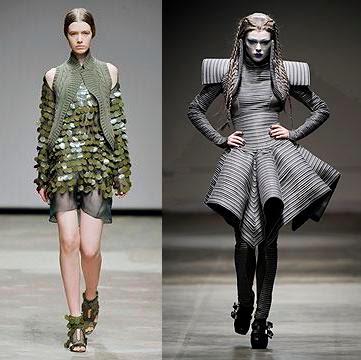
I clearly don't deny there's sexism ingrained in most aspects of society, but fashion was not the greatest one to cite on your part. Most high fashion is where risks are taken to challenge what "sexy" (heterosexual man's version of sexy) is, and has less to do with being "attractive" and more about being "artistically beautiful." Does this turn you on? http://2.bp.blogspot.com/_YPLSyaja5vU/R7Xqwvpw1YI/AAAAAAAAAh...
And lastly, to say that caring about your appearance for self-confidence's sake is really just latent sexism, and that women are unthinking enough to not know they do everything for men anyway is... well, first silly, second, offensive, and third, incorrect. We really need to get away from men telling women that their behavior is "ingrained."
When I say fashion, I include all the press and showbiz world that live on selling beauty products, clothes and the like. "High" fashion is a tiny niche: Conde'-Nast is the mainstream; advertising companies are the mainstream; Hollywood is the mainstream. And they sell primarily sex; they sell it to me as a male but they sell it even more to you as a woman. Compare the ads you find on men-oriented magazines: they sell big cars, big watches, gizmos and
Not true. We get dressed with other women in mind. We also shop off each other's bodies and generally take fashion cues from each other. This is why women in the Loop are wearing short skirts and strappy sandals and women in the far west suburbs wear print turtlenecks from Land's End.
Of course, because other women are competition. Or would you be so happy to meet three friends with the same exact dress, at some social occasion with other people in formal wear? Most males would love nothing better than to wear exactly what everybody else is.
- Why do women wear low-cut dresses if not to attract male attention (in the majority of cases)?
It's none of your concern why a woman dresses the way she does. As long as she isn't violating company policy, she is under no obligation to justify her wardrobe to anyone else. And if she is violating company policy, that's between her and HR, not you.
>> "Katie's got the low cut dress on today! I know where I'm sitting!"...As I'm getting older, I see how sexist and demeaning this is.
> At the risk of revealing myself to be a chauvinistic jerk, is this kind of response sexist and demeaning, or just inappropriate for the workplace?
Well since the quote essentially boils down to "damn look at dem titties" then yes it is very demeaning & disrespectful!
It's also sexist. Why? Because it's self-absorbed. Whoever spoke that quote wasn't thinking about how their words might make Katie feel in a room-full of people. "I'm a man I like titties and anyone else's thoughts and feelings don't matter." That's sexism in a nutshell: that the default and correct perspective is the male perspective. That anyone who doesn't hold this perspective just needs to "chill out".
>Why do women wear low-cut dresses if not to attract male attention (in the majority of cases)?
I would say for the most part it's not all that conscious. We buy the dress if we like it. In some cases we might not buy it if it looks too revealing, or buy it because it's especially sexy, but for the most part dresses are cut to the style of the day and it has little to do with the intentions of the woman wearing them.
Personally I've started consciously looking for low-cut tops and dresses for the first time in my life, because they're easier to breastfeed in. Most of my dresses and tops are cut too high to do that easily so I need to expand my wardrobe. So sorry, all that cleavage is not for you, it's for my baby :).
I think if you are Brad Pitt or George Clooney (or some other desirable man), that comment is fun and flirtatious, otherwise it is creepy. If you are not Brad Pitt or George Clooney, you should make yourself invisible in the presence of women. Or maybe you could offer foot massages.
Why do women wear low-cut dresses if not to attract male attention (in the majority of cases)?
So, I'm not going to agree or disagree with you, since I don't really know exactly what you're saying.
I will say this, though: there is professional attire for women. Generally speaking, this doesn't involve form-hugging clothing. A fitted women's dress shirt is not form-hugging, by the way.
Personally, I recognize that I have an unfortunate automatic physiological response to breasts. I've discussed this with female friends whom I've respected and liked strictly as friends. If exposed to low-cut tops, I find my eyes darting to them, particularly when I'm distracted or concentrating on some thought. If I were in a position where a well-endowed female coworker were wearing very snug or revealing clothing, I'm honestly not sure how I would handle the situation.
> Personally, I recognize that I have an unfortunate automatic physiological response to breasts. I've discussed this with female friends whom I've respected and liked strictly as friends. If exposed to low-cut tops, I find my eyes darting to them, particularly when I'm distracted or concentrating on some thought. If I were in a position where a well-endowed female coworker were wearing very snug or revealing clothing, I'm honestly not sure how I would handle the situation.
I have been in that situation years ago, and I remember it to this day. It didn't help that I was much younger then.
Anyway, I found it incredibly hard to concentrate on what she was saying, because I was concentrating on keeping my eyes away. It didn't help that she was absolutely gorgeous, well-endowed and was wearing a dress with a cleavage probably modeled after the Grand Canyon. Thankfully, she was not a coworker. But even worse, she was a potential client.
I don't want to be too quick to blame it on instinct, but it is there. I wonder if I were (proportionally) as well-endowed as she was, and wore tight shorts. Some female friends told me that they do look - but women seem to be more discreet, on average.
Your attraction is normal. How you choose to act, what conclusions you draw about the other person, are the important things in this context.
Sexism would be if your attraction influenced your professional behavior towards your prospective client in any way, negatively or positively.
As you hinted, being able to be less distracted by an attractive figure is a matter of self-mastery, which often comes more easily with maturity, and to some degree familiarity. But a modern gentleman knows to treat others as persons first, not as sexual beings, especially in a professional context.
> Personally, I recognize that I have an unfortunate automatic physiological response to breasts.
You've been programmed to think this is bad, unhealthy or unnatural by people with an agenda. There's another school of thought that says it's ok, normal, natural, and healthy. Humans are hard-wired for sex and we've been having sex like rabbits for millions of years otherwise we wouldn't be here. There are many situations and places and modes where we pretend it doesn't exist, but it's a lie, at best a convenient intellectual abstraction in order to focus on productive matters. But it's always there, lurking. Again, for most healthy people it is anyway.
Absolutely. But as ReneHurse above said, this type of automatic response can be controlled with age and practice. God knows it took me a long time to figure it out.
Now, if anything, I over-correct when I'm talking to someone who I find attractive and is wearing a very low cut shirt. Eyes. glued. to. eyes.
You've been programmed to think this is bad, unhealthy or unnatural by people with an agenda
No I haven't. I don't think it's the least bit bad or unhealthy. I simply want to engage my friend as a friend, not glance at her tits every ten seconds. Performing physical actions that imply attraction would introduce a power balance that I don't want in a friendship.


At the risk of revealing myself to be a chauvinistic jerk, is this kind of response sexist and demeaning, or just inappropriate for the workplace? Why do women wear low-cut dresses if not to attract male attention (in the majority of cases)? Would it be sexist and demeaning for me to notice and comment on a low-cut dress in another context (like a bar)? What about with my wife? Is it sexist and demeaning to find her sexually attractive?
I'm not disagreeing that the statement is offensive and inappropriate, but I'm not sure it's sexist.