Huh; so desalinated water costs between $0.001 to $0.008 depending on the cost of the power.
I pay about $0.0136 / gallon so almost 10x the cost of producing.
Seems like (for non-agricultural use) we will be able to afford desalination -- I guess the real issue will be agricultural uses which are predicated on free water.
Making desalinated water is relatively cheap. You can do it with a clear tarp and sunlight. Desalination at scale is less cheap. Almost all water is cheap.
One (there are several) problem with desalination is that it often has to compete with free.
In many parts of North America the water is actually free. Like New York City-- their water falls from the sky in upstate NY, for free, into reservoirs that are not free to maintain to be distributed by colossal public works projects which are 100% not free.
Pumping water, desalinated or not, to your house is not free.
Whoever is charging you $0.0136/gal for water may indeed (especially if you don't live in an arid region with strange water rights laws) be charging you $0.0136/gal to pump water to your house and $0.0000/gal for the actual water.
If they switch to a desalinated source it is highly likely they will charge you $0.0136/gal + ≥$0.0010/gal = ≥$0.0146/gal.
Of course, if you live near a source of salt water you can cut out the middleman and, after massive up-front capital outlays, desalinate your own water for ≥$0.001/gal assuming you live long enough to recoup the cost of the initial expense.
Does that price include wastewater treatment? In our old home waste water was billed separately but the usage was based on your water meter. So if you poured 1000 gallons into the storm drain you were charged 1000gals of fresh water + 1000gals of sewage. The freshwater cost almost nothing but treatment is where the real costs came in.
For what it's worth; `eslint-plugin-react` has been around for a long time and seems to support running in very old versions of Node.JS (back to v4[1] apparently! tho I can't find anything documenting that for sure.)
I was surprised to learn that Object.values is only supported in Node >v7, Object.fronEntries was added in v12, etc. So for this project maybe the polyfills are needed.
"Should libraries still be polyfilling to support ancient runtimes?" and "How should that polyfilling be implemented?"
Even if a library wants to maintain backwards compatibility, we can still argue this method of polyfilling (especially the phony polyfills) is damaging to the wider javascript ecosystem.
In an ideal world, the cost of polyfills for developers who don't need them should be zero.
For developers using bundlers, the bundler is expected to implement any required polyfills for the developer's targeted runtimes, and having the library ship with it's own polyfills is counterproductive at best. However, I suspect these libraries wish to maintain compatibility for developers not using bundlers.
Maybe npm should be upgraded to support multiple variants of packages? That way these libraries could ship both polyfilled and non-polyfilled versions of their packages in parallel.
Yeah, engines are a moving target. I'm all for backwards compatibility, but I'm worried about promoting old node versions with known unpatched security issues. Given that eslint itself only supports node >= 12.22.0 it seems like it's time to get rid of the polyfills.
I wish we as in the industry would find a better solution to adapt to this. It's a bit unfortunate that the polyfills as part of the library code itself, which makes it difficult to get rid of them once they're not needed anymore.
If the package.lock file gets deleted or someone runs a global npm-update then npm will update any packages while respecting semantic versioning.
It's possible an organisation forgot to include the package.lock file in their deployment image and they get updated npm packages every time they redeploy. It's also possible a developer making minor changes to a legacy system triggers packages to be updated, perhaps without even noticing.
My wife and I started a vegan diet 6mo ago and while there was a transition period, it wasn't nearly as difficult as I expected.
If you're feeling the egg prices I'd encourage you to find ways to limit or remove eggs from your diet. It's easier than you think! Egg replacers work wonders in baked goods and a tofu scramble is similar to scrambled eggs.
Also, if you examine your diet you will probably find that you don't need to replace eggs with tofu 1:1. There are plenty of other ways to get protein (e.g. lentils, nutritional yeast, even whole wheat bread has protein).
FWIW I am working on such a table library for React [0] which has a great tree plug-in. So you can use it either as tree table or tree list (if just having one column).
Storage will be a solved problem once everyone has an electric vehicle with a 65kWh battery sitting in their garage. Power your home overnight from your car, then recharge during the day when the sun comes out.
If you have a large home or need to always have a fully charged car, spend $15k on a home battery.
We need to get out of this mindset that electric utilities will provide unlimited power at a fixed price. With some investment from individual homeowners we can reduce peak to average ratios for utilities and make it much cheaper and possible to use intermittent green energy sources like wind and solar.
Then you get a separate battery. But the vast majority only drives their car back and forth to work, so most of the day the cars are just standing there and could be charged.
The shared-everything vision of the future ignores the extent to which people's cars serve as extensions of their home and storage. Having a bunch of stuff always available when you need it, and knowing that nobody else will stink up the place, means that personally owned cars will remain popular for a very long time.
For around two years I’m constantly using shared cars via apps. I’ve had almost zero issues. If the car is dirty or smells you can review it and one would assume repeat offenders get booted off.
Hotels have solved that problem by simply prohibiting smoking in most rooms, and if you get caught doing it anyway, they’ll charge you a high fee to sanitise the room.
Im all for having a more robust ecosystem of shared vehicles. But it does make me think of the rough physical state of shared scooters and bikes in my neighborhood...
It feels that people can get a bit unimaginative when talking about the future of cars or solar or, in this case, a combination of both. "What if I drive the car to work? I guess this whole solar-battery scheme falls apart."
FWIW, the people I know with EVs have solar panels and a home battery.
I hope to get an electric car soon, and it would be great to be able to charge at work - even if I had a home battery. And I'm sure there will be programs to encourage businesses to get chargers into car parks around here in the next few years - and since cars are parked for a fair while, it can just be slow charging like 7 kW single phase (I guess it would make sense to also have two or so fast charging spaces for when people need it)
Charging at work would be ideal - it would all basically happen 100% in solar hours. My work has solar on its roof itself, I'm sure more and more places will, so it all really makes sense. And that way I could basically run my house 100% off a battery, whereas charging an electric car from a home battery would probably mean I'd still have to buy a fair bit of power from the grid.
But yeah, the story basically is that it's all possible and not that hard.
The real idea is not using cars for storage but end of life car batteries AND simply using the same factories that make car batteries to make grid batteries. AND, since vehicles will be a significant source of our electricity demand, we can use them as "storage" simply by not charging them at some times.
I think most people don't realize that V2G tech is old (Chademo supported it, and older Leafs can already do it natively, and they're about a decade old), but it's expensive. You basically need a DC charger for every car that will be doing V2G. Look up how much a DC charger is, and you can get something like a dedicated Powerwall for the same price...
I think using the car batteries as storage also makes a lot of sense. Suppose technology improves so that cars have ~double the capacity they have now (~150kwh), then that’s super useful for long car journeys, but most people only do short journeys each day. So you could use the excess for storage. And they’d be plenty considering the average household in the uk only uses 10kwh a day (although admittedly that’s factoring in gas heating which will need to be replaced)
Hence why Tesla sells Powerwalls instead of supporting V2G. There are also subsidies for Powerwalls from a variety of entities, and they can be orchestrated in concert to create a virtual power plant. V2G for anything other than emergency power is unnecessary complexity.
How much variability do you see in spot prices? Are there any alternatives?
It looks like 90%+ of electricity produced in Norway is hydro, with fossil fuels only around 2% [1]. Hydroelectric plants are very quick to respond to changes in demand.
From what I can see, it probably isn't a huge surprise bill risk to the consumer compared to places like, say, Texas.
It's fun you ask, because for the first time in many years we have seen quite a interest in the spot price, because it has reached the record high of 0.35usd/kWh (but mostly it stays around 0.12usd/kWh). This has been a record dry automn, combined with very high prices in the UK and Europe (and we export/import power, which affects prices here). You can get all other kind of pricing schemes as well, but as with insurance in general, on average you are going to be best off with spot price if you can stomach the ups and downs.
>Storage will be a solved problem once everyone has an electric vehicle with a 65kWh battery sitting in their garage. Power your home overnight from your car, then recharge during the day when the sun comes out.
Too bad you'll be driving to the office on business days.
Those for whom that is the case probably live in a dense urban core which is surrounded by hundreds of thousands of detached single family homes for whom it is not.
In any case, it's not hard to imagine that XX kWh onsite battery reserves will end up as a standard condo feature in the future same as hot water or a weight room.
And in 15-20 years when it's replaced, it's likely the replacement will cost a tenth of current prices. Batteries are getting so much cheaper every year that I'm delaying purchasing only because I don't want to lock in today's prices, and I'm hoping for an aggregated demand response solution that can start paying me for battery usage as well. Just being able to island my house and ride out a blackout isn't as much of an incentive at the moment.
> everyone has an electric vehicle with a 65kWh battery sitting in their garage.
That's a solution I hope that neither I nor my children live to see. It's a solution I hope never happens unless a new battery technology arrives that for a start eliminates our need to once again fuck over some very poor countries in order to get our hands on rare resources. Lithium battery tech is quite miraculous, but it's also not appropriate as the basis for the entire electrification of human civilization.
Also, lots of people will have neither cars nor garages.
Compared to, say, steel or aluminum, what is the increased damage? I've read every single documentary news article, read reports from governmental agencies, and I still don't know what's so bad about lithium. Particularly compared to standard extraction of other resources that nobody ever talks about.
Especially oil. Oil and coal and natural gas have horrifying consequences for local environments all the time, and nobody ever talks about that. From fly ash ponds to spills to destroyed drinking water. If there was anything remotely as bad as that, wouldn't any of these articles I have read pointed out the damage? Literally the worst lithium story is political, not environmental, in that indigenous people are not being given enough compensation for their land, or not given enough input.
Cobalt has stories of child labor at artisanal mines, but again that is political, not environmental damage, and the environmental damage is the same as from all the other parts that go into the grid, or a car, and they don't have the horrifying consequences of fossil fuel extraction.
If I'm wrong, and there is something I don't know,I will be forever grateful for a pointer to clear documentation of this environmental damage you speak of. But I have been asking this question for years, and searching for years, and nobody, literally nobody, has pointed me to anything concrete. Just vague assertions at best. Which is not what environmental damage looks like. Environmental damage is specific, horrifying, and all too often swept under the rug as long as its wealthy fossil fuel companies doing it.
No they are not at all because you don't own the final product and the cost over the life of the project is just insane, users don't see that because it scales slowly and once you're hooked that's hard to escape...


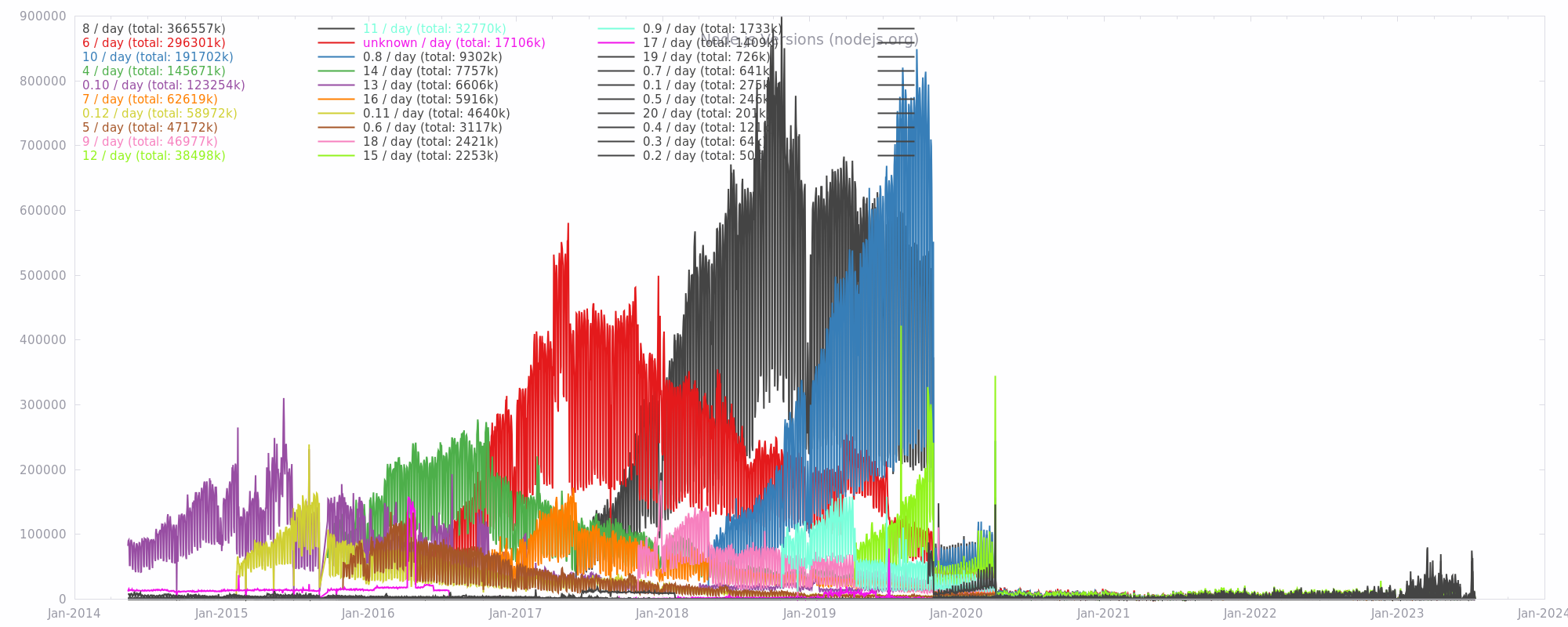
Kinda neat!