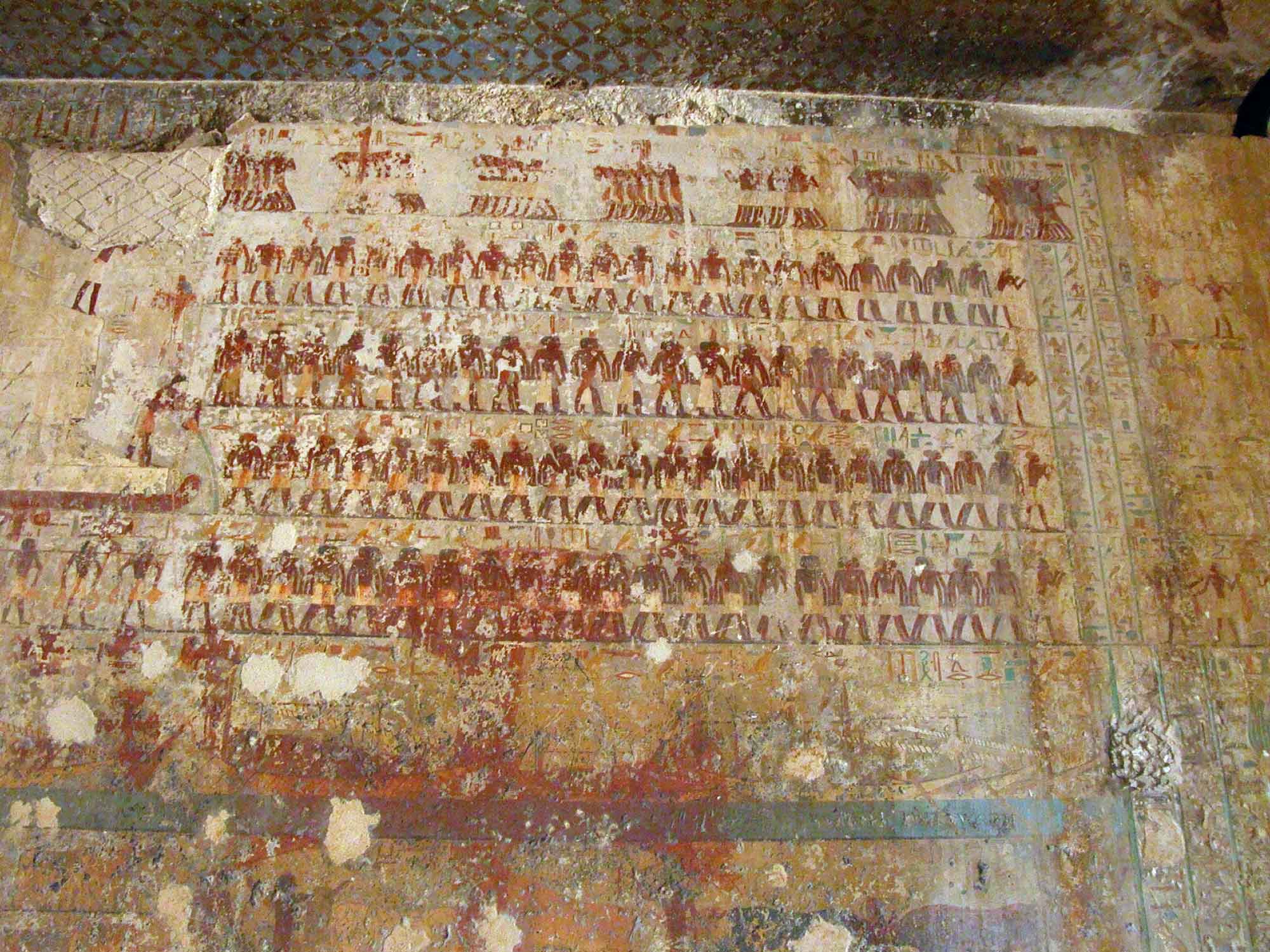
“Despite the seemingly obvious answer—tomb art discovered in the 19th century depicts laborers pouring water in front of a block-hauling team—debate over how the pyramids were built is almost as ancient as the pyramids themselves.”
In other words, people don't read comments. This is why the best practice is to build self-documenting pyramids.
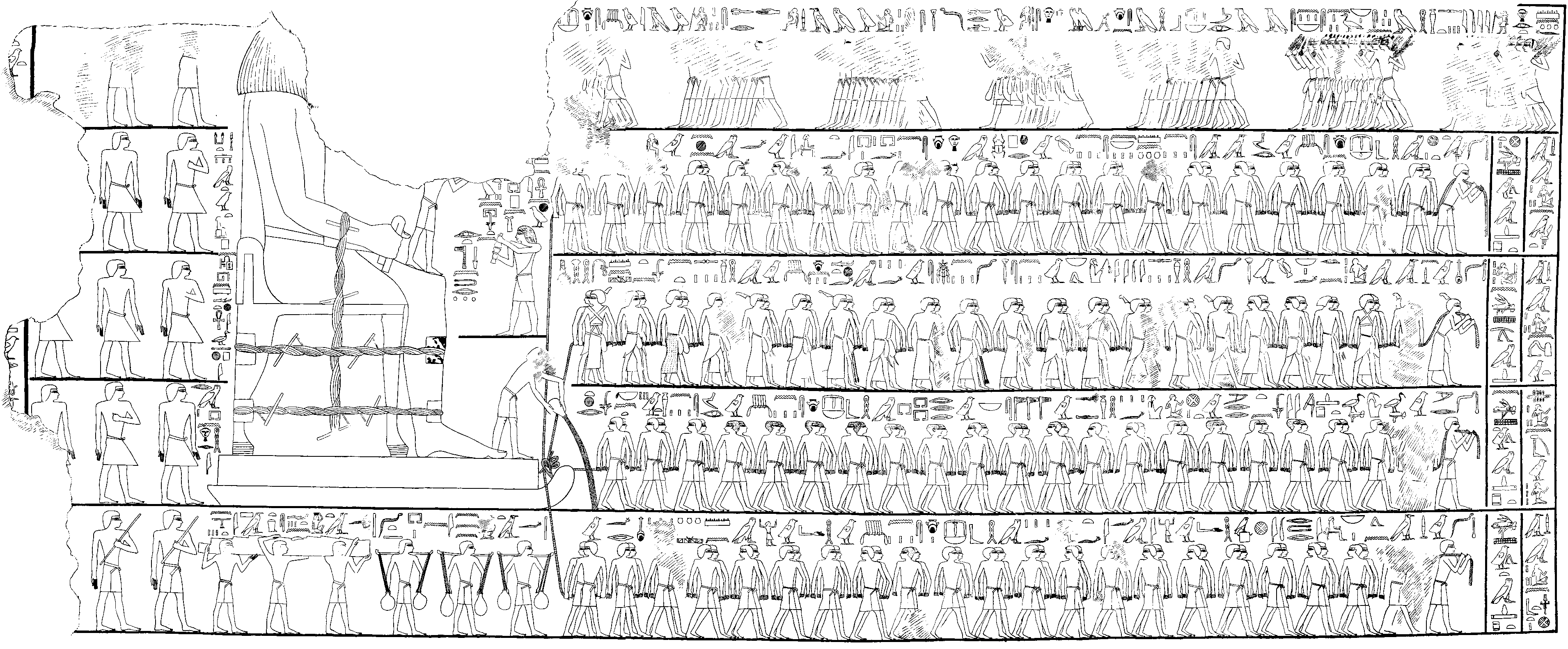
Fourth row down, far left, there is a guy standing on the sled pouring blue stuff in front of the sled, with dozens of others pulling the sled he stands on.
My guess is that the number of people in the picture will turn out to be exactly the right number needed to pull a full sized replica of the sled
And thank you HN - obscure reference to Pyramid tomb art, "oh here is a link to the very image, three minutes later."
Gotta love HN !
Edit
I expect water pourer was the cushy number right up until the sled got stuck because you poured wrong - whips were probably involved then.
I've seen this before and found it compelling. Partly I was interested as I came up with an experiment to look at static friction with and without water present for a high-school physics project many-many years ago.
However, that schematic appears strongly interpretative. In the original image I can't see any ropes [that could just be a bad photo]. Also if the slaves are pulling the sled to the right, why are half of them looking left?
The posture is all wrong for pulling on ropes, whilst the posture of the single person pouring water is more natural.
Would a single water pourer be enough. If not why wouldn't they have used the "stacked" technique they've used elsewhere to show there were more than one? At least there appear to be suppliers bringing water on yokes.
To me the figures to the right of the sled seem more like they're walking backwards and forwards, perhaps they're compressing the sand, but they don't seem to be pulling. Contrary to that the single figure on the far right appear to be holding a rope over their shoulder, which is weird if everyone else is holding it at waist height.
Lastly, what are all the "soldiers" doing at the top? They seem to be carrying beams or statues or somesuch in the original, quite different to the swords[?] in the schematic interpretation.
It would be nice to see a cleaned up processed image of the wall that perhaps had used some microscopic or other capture methods to ascertain pigment missing in blank areas.
Is there a reference for what the text on the original image says? That seems like it would be pretty pertinent to the point at hand? Would this whole system work on sloped sand?
I think the schematic is not accurate. Look at the 6th set of two people in the top pulling row. One of them is clearly facing back. This is the same with the 8th such set of two. A lot of the heads in these 4 rows are difficult to make out.
On the other hand the number of people looking back in the schematic is 0, 2, 11 and 8 for each row.
There was an article on this a while back that Egyptologists had interpreted it as depicting something ceremonial- something like breaking champagne bottles across ships' bows.
Having scientific evidence that wetting the sand ahead of the sledges -could- have eased transport is pretty nice evidence that that's what the picture depicts, but without something corroborating its efficacy, it was just a plausible interpretation.




In other words, people don't read comments. This is why the best practice is to build self-documenting pyramids.