The hilarious thing to note here is that -- over the short term -- this is barely different than Bitcoin's inflation rate. Bitcoin halves its inflation rate every 4 years, but 4 years is a long time in internet time. Here, let's lay them out side by side:
So while there is an important distinction between Bitcoin's and Dogecoin's inflation rates (Bitcoin's money supply is convergent; Dogecoin's is divergent despite a monotonically decreasing inflation rate), 8 years after their respective epochs, Dogecoin's inflation rate will be 5.2% higher than Bitcoin's. The horrors! The horrors!
This is misinformation, Shibes. Mean (random) block reward halves every 100k blocks for the first 600k blocks, after which it will be 10k reward indefinitely. The first halving will happen in less than two weeks, at that point, 50b doge will have been mined.
Within the year, it's estimated that nearly 100b doge will be mined. The block target is 1 block/minute, so it will take about 20 years to reach 200b coin in circulation, assuming no irreversible coin loss.
As such, this is nowhere near the "trolling" and otherwise apocalyptic event that the wolves on HN are claiming. It's actually surprisingly sensible economic policy.
Edit: I'm actually a bit disappointed that HN seems to be having such a hard time figuring out how this works.
Assuming this move doesn't completely kill the interest in Dogecoin, and that Dogecoin continues to thrive after this, then I doubt there will be any sort of "inflation effect".
Yes, in theory both Bitcoin and Dogecoin should have inflation until they reach their maximum number of coins, with or without any sort of "built-in" inflation rate. In practice, however, they are both highly deflationary, because they haven't reached their maximum ballpark cap market, which means the demand for them will make its value be highly deflationary, much more than this 5 percent per year figure.
Sorry; I was just working off the "5 billion coins a year" title.
I am just taking the number of new coins created in a year, and dividing it by the number of coins already in the money supply. So if Bitcoin was creating X bitcoins per year for the first four years, the inflation rate for year four was X / 3X = 33%. In year 5, they halved the reward rate, so the inflation rate for year 5 was X/2 / 4X = 12.5%, and for year 6 it was X/2 / (4X + X/2) = 11.1%.
If Dogecoin were minting a constant 5 billion coins per year, then the inflation rate is much simpler: it is always (100/N)%, which is the well-known harmonic series.
Accounting for the initial money supply of 100 billion Dogecoins, it basically just starts further down the harmonic series, and Dogecoin's inflation rate would be 100/(20+X)%, which looks like 5%, 4.8%, 4.5%, 4.3%, 4.2%...
Oh, but you conveniently omitted what happens after. 10, 20, 50 years.
The truly important difference is that Bitcoin has an absolute upper limit, but Doge doesn't anymore. It matters. Scarcity is an important factor for holding value.
Bitcoin will eventually become deflationary, and sooner than you think due to loss of bitcoins.
You must be speaking strictly in terms of monetary deflation. I could see dogecoin being deflationary as well, but in a "price deflation" sense.
Dogecoin could also become deflationary. If 6 billion dogecoins worth of value is created in a year and only 5 billion coins to match that increase in value, the economic value of goods created surpases that of the coins created. As a result, you have more goods chasing (relatively) fewer coins, increasing the value of the coin. In other words, less dogecoin gets you more stuff so you actually have (price) deflation.
In the US, during the stupidly-named "long depression" of the late 19th century, prices slowly dropped to about 60-65% of what they were at the start of the period while the total supply of money grew. That's because more goods were chasing (relatively) fewer gold-backed dollars. Monetary inflation coupled with price deflation.
I would also point out that Dogecoin's stated purpose in this move is to stabilize the currency at 100 billion coins. They believe that 5 billion coins fall out of circulation each year; therefore they intend to mint 5 billion new coins to keep the money supply constant at 100 billion coins.
Therefore the Dogecoin money supply after 2015 will be constant: the number of coins in circulation will remain approximately 100 billion, and the value will only increase or decrease as the demand for the currency moves.
Except that the price of doge was driven up by individuals believing they weren't buying into an inflatable currency. The fact that this article got upvotes and the comments around indicate that people are gonna pull out.
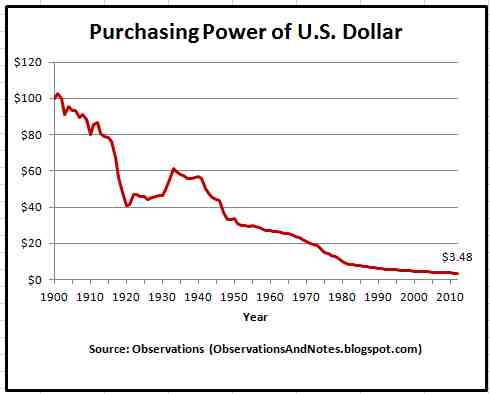
Your explanation doesn't make sense. If you actually do look at what happened with the inflationary dollar since the "late 19th century", it lost 96-97% of its purchasing power due to the monetary inflation.
Which means that if your grandma stored her wealth in dollars and wanted to pass it onto you, you can only enjoy 3-4% of what's left.
I was talking about the late 19th century. From 1860 to 1890, the USD gained roughly 50% in terms of purchasing power. Since the federal reserve got involved in open market operations in 1922 the USD has lost about 95% of its value.
Since 1928, the S&P has risen 5506%[1]. Over the same period, the dollar has lost 93% of its purchasing power. If you put a dollar on the market in 1928, it would be worth $808 (1928 dollars). A dollar under the mattress is instead worth $0.07 (1928 dollars). Investing had a return 11500-fold greater than hoarding cash.
I actually do feel that gold is too inflationary to store value. Many people simply don't realize at what scale it's being mined and how much of gold there's in the universe (hint: more than enough to build gold toilets for every human on the planet and not even scratch the surface).
I agree. people will prize a capped currency more than an infinite one even if the infinite currency "inflates" less over the next few years than the capped currency. at this point, it seems the only thing doge has over a traditional fiat currency is a cool and cute theme that is sure to be fleeting. the novelty of doge will get stale. I mean really, does anybody really think doge talk or the coin will be cool a couple of years from now? or that it will be serious? in the interim, the masses could send doge much higher only to have grade school "traders" get burned out of lunch money profits or grandmas lose bingo money. a good deal of the doge appeal is its inviting "my first coin" theme. litecoin and other "deflationary" crypto have the incentive to hold because the coin is ultimately capped and the usage and number of holders vastly outpaces the short term rise in coins. doge coin investor dynamics, however, are dependent on an ever expanding pie of unsophisticated crypto neophytes and an up sloping chart. Doge's demographic seems like a race to the bottom from my experience.


The hilarious thing to note here is that -- over the short term -- this is barely different than Bitcoin's inflation rate. Bitcoin halves its inflation rate every 4 years, but 4 years is a long time in internet time. Here, let's lay them out side by side:
So while there is an important distinction between Bitcoin's and Dogecoin's inflation rates (Bitcoin's money supply is convergent; Dogecoin's is divergent despite a monotonically decreasing inflation rate), 8 years after their respective epochs, Dogecoin's inflation rate will be 5.2% higher than Bitcoin's. The horrors! The horrors!