In particular, the article is edited to only show you reasonable predictions, rather than all his predictions. I thought his mistakes were just as interesting, because they give us a window into what life was like in 1964. Asimov predicted that moon colonies would be common by now, for example. The overoptimism may have been due to the rate of technological growth leading up to 1964. On the other hand, perhaps it was due to the times. People were abuzz with the possibilities of the future partly because Kennedy had recently (1961) set a national goal of "landing a man on the Moon and returning him safely to the Earth by the end of the 1960s." So it's pretty interesting to try to see the world through the eyes of someone 50 years ago and try to diff societal trends to the modern day.
(It's also fun to imagine someone 50 years from now looking back on us. I wonder which of our societal trends will survive 50 years? It's an interesting game to try to figure out which of our current beliefs are crazy even though no one presently thinks so.)
There are many interesting aspects of Asimov's piece, so it's well worth the read. For example, does this point about future societies sound familiar?
"The situation will have been made the more serious by the advances of automation. The world of A.D. 2014 will have few routine jobs that cannot be done better by some machine than by any human being. Mankind will therefore have become largely a race of machine tenders."
He's mistaken about 2014, but only time will tell whether this is temporary.
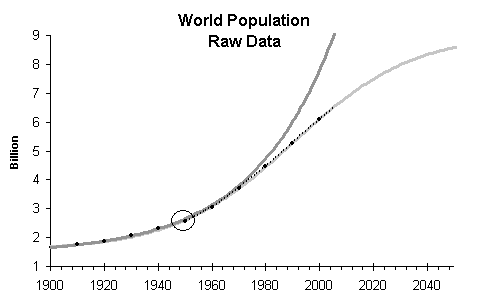
I was also surprised that there were fewer than half as many people in 1964 than 2014. Asimov mentioned that the population is predicted to double every 40 years. I wonder it that's still the case, or if growth has slowed?
I'm of the opinion that SF is a poor place to look for predictions about the future, and that it is primarily about the present it's written in, a playground for changing the fundamental assumptions of that mundane present.
But this one interests me: Mankind will therefore have become largely a race of machine tenders.
I think, by and large, this is true in western society. We, here on this site, mostly tend to machines, giving them instructions, altering their potentials and adjusting their parameters, as Asimov might have said (he had a quite analog conception of automated thinking). Almost all the people I meet in a day tend to machines, except for binmen, mailmen, shelf stackers and the like - and they too have machinery that forms a greater or lesser part of their job.
> But this one interests me: Mankind will therefore have become largely a race of machine tenders.
But that is not a new prediction. Socialism for example came about in the mid 1800's on the basis of an optimistic view of what would be possible thanks to the industrial revolution - the idea that machines could put us in a position able to eradicate poverty - but also pessimism about how it would turn workers into cogs in a machine.
This latter view came to shape a a lot of thinking and art for decades. In the cinema there are many obvious examples, such as Fritz Lang's Metropolis (1927) to Charlie Chaplins "Modern Times" (1936).
The latter makes it literal: Chaplin goes crazy due to the monotonous, high speed work and horrible treatment (including being used as a guinea pig for a machine designed to feed the workers lunch more efficiently). He starts seeing everything, such as buttons, as machine parts and nuts and bolts, and keeps trying to fasten them.
Eventually he gets pulled into the machine he is tending to and is shown as being moved along by the giant cogs.
Funny though how your language makes the "non-machine tender" positions sound very robotic and machine-like: binmen, shelf-stackers, mailmen.
All sound like roles easily ascribed to machines. In fact, my garbage man is a truck driven which has a giant hydrolic hand which grabs the bin and dumps it into the truck. The driver has to minimally tend to the mechanical arm only when the bin needs a slight relocation (moved away from a different class of bin) to allow his arm to grab the right bin.
I had a conversation with some friends earlier this week regarding the reduction of labor due to automation and artificial intelligence. What happens to our society when our Walmarts and McDonalds stop needing a significant human workforce?
My friend, who is a teacher, suggested that his field might be exempt from the trend. But, I imagine the purpose and methods of education will be radically different in the next few years/decades.
Look at what's going on in US public education with the move to Core Curriculum. The focus is on reading and math, with outcomes measured via computer based testing. You think when cash-strapped state legislatures realize they could reduce the number of teachers down to a single proctor watching over self-paced computer based instruction that they won't go for it, especially when "the test" (since that's what we're doing here... teaching to the test) is computer-delivered?
This isn't to say that teachers will go away anymore than retail clerks, or buggy-whip makers or barrel makers before them, will go away, but their ranks will thin and where they are employed will change. There will still be people willing to pay for personal instruction and there will still be courses that are difficult to deliver via CBT alone.
I always thought online / computer-based education, especially for grade school, sounded terrible. But once I saw how little my kids are actually getting in public school, and especially with federal meddling ala No Child Left Behind and Core Curriculum, I would actually embrace it - at least it would be self-paced and allow more advanced students to move ahead rather than sitting bored waiting on their peers.
Look what's happening at the university level with MOOCs already. That's only going to accelerate, and university professors are teachers by another name - maybe calling it "automation" isn't exactly right, but we'll certainly see a thinning of the ranks.
Judging by the mistakes my daughter's teachers make, I would happily have her class like you describe. self-paced and continually graded. She brings home 40 math problems, it's obvious she has no trouble with some of them, yet they all need to be done. Meanwhile she struggles on subtracting negative numbers, a smarter system would be for the software teacher to recognise when she has something understood and slowly transition to the weaker areas.
In the early years when teacher is more like supervised play I think teachers better serve the children, but middle school and beyond, I'd vote to kick out all the useless teachers, keep the few that are good and massively switch to computerised learning.
In California education has sunk so low that one of my daughter's teachers explained the common core standards now being taught as a last ditch attempt to get most of the children that leave school to be able to do something as basic as read an instruction manual. Half her class are children with parents that have no more than 3rd grade education themselves, and the other half have parents that work at google, twitter, oracle etc. When parents were recently surveyed how to improve the school district, less than 2% of the immigrant parents completed the survey citing they couldn't understand the questions, which had even been translated (at an unfathomable cost of $24k) into Spanish. While we have such a huge range of abilities, a self-paced learning computerised scheme would at least mean the children that are capable of learning will do so and not just sit twiddling their thumbs while the children struggling to do last years level work soak up the educators time.
The question is, if walmart and macdonalds sre run by robots, who will their customers be? At some point we'll need to decide whether we're happy to be a society comprising a few shareholders in Mom's Friemdly Robot Company living in an fortified compound and a vast multitude of impoverished rabble foraging in the surrounding landfill.
"Having to decide" assumes we'll be given a choice in the first place. Technological advances have a mind of their own, as it were, and simply deciding not to be affected by them is not a strategy.
Over a century ago, stop signs and traffic lights were optional for some locations / situations / vehicles, and traveling long distance without using roads was permissible. Now, whether you choose to use a car or not, you must obey traffic laws or else. You don't get a choice in the matter.
Kevin Kelly wrote pretty well about this, a few years back:
...except that Marx was concerned with "mere" capital while we're talking about automation, robotics, etc.. It turned out that capitalism on its own did not create the social unrest Marx predicted (at least in societies which didn't already suck for other reasons), but it may be that automating the workers out of being able to earn even a subsistence might in fact do so.
Another way of looking at it is that while Marx identified a real problem, his solution was essentially a bunch of wishful thinking which, when pitted against free market economics did rather poorly. But, free market economics is all about managing scarcity; automation points the way to a post-scarcity society (at least post-material-scarcity). Free market economics doesn't have anything to say about how to handle this -- so we're all in the dark.
It seems to me that as the marginal value of material goods diminishes relative to say the marginal value of not being beaten and robbed we should see a natural progression towards some kind of redistribution of wealth -- driven as much by enlightened self-interest as anything. ("We'll pay you welfare as long as you keep taking your contraceptive pills...")
Marx also treated capital as a way to control the means of production. One could argue that with automation, especially software automation, controlling the means of production is possible without a significant amount of capital.
Seems to me we're already seeing the natural progression you described in your last paragraph - basic income initiatives. This really looks to me like the anti-segregation movement from the 60s - a radical idea at the time, then 50 years later people don't understand how it was possible to have a society without it.
You may be right. Certainly the gay rights movement has succeeded beyond my wildest hopes or expectations during a period of generally right-wing dominance amd stalemate (the democrats have only had two years to pass legislation since 2000), and now it looks like the war on drugs might collapse. We seem to be enjoying one or two tectonic shifts in politics every decade right now. Amazing times.
I'm not from the U.S., so as an outsider it seems to me socialism, which is the prominent political stance in some parts of Europe and a respectable opposition stance in others, was/is constantly demonized there, similarly to how gay people were demonized decades ago ("recruiting" young children etc.).
So a not-unreasonable guess as to "what's next" might be socialism, regardless of whether we're post-scarcity or not, and regardless of the success of basic income initiatives. Maybe ACA will be considered the first sign 50 years from now...
Maybe the idea of shareholders and companies will vanish completely. I'm talking about the time when(if) working will not be required from the human being. When automation will be so widespread, that even occasional work from those who want to do something will be enough to sustain the system. Anyone would have access to any food they want. Anyone can go anywhere. There will be millions of free empty houses all around the world waiting for someone to check in (and all your stuff, or furniture you want will be there in couple of hours). So, there's plenty resources for everyone and nobody have to work. I wonder if it's possible and what will happen then.
The most interesting question to me is if/when all menial tasks (and each step in complexity thereafter) can be performed by robots/AI: are there people who aren't capable of performing any other useful tasks, and if so, what to do about that?
I would propose we are somewhat in that situation already, where many employees are nearly useless in the capacities they are supposed to be working because they just aren't capable, though in possibly all cases this is solely a temporary problem due to inefficiencies in the system. It is logical to assume that problem will only get worse though. Hopefully this will lead to advancements in education, and in means of organizing and developing the abilities of those whose skills are obsolete in addressing the many problems that we still need to tackle. Essentially, mining and engineering humanity for unrealized potential.
Moving beyond McDonalds workers, think about doctors even. Many of the tasks currently performed by doctors will be automated in the next 50 years (and many tasks earlier than later). So their job description will change drastically, which hopefully means their efforts will be redirected to the areas we are currently deficient, leading to better care and health for everyone.
Efficiency and productivity advancement is of course a large net positive, as long as the benefits do not go increasingly disproportionately to a smaller subset of humanity (as has been the case the last 20 years in the US for example), and that the obsoleted workers can be redirected effectively to other tasks. Similarly, I am concerned that many human skills could be increasingly devalued as natural resources become the limiting factor, as is already happening to some extent. I don't have an elegant solution, but we really need to find a better means of balancing rewards for shrewd trading/management with maintaining a high level of parity between contribution to society and consumption of goods and services (including capital accumulation for eventual consumption). If we don't, I could certainly see a future where, despite vast increases in efficiency, wealth/power is far more concentrated in the hands of a few: natural resource owners(which China seems to realize), shrewd businessmen/politicians, engineers/scientists in frontier fields that haven't been mastered yet like AI, biotech, etc. I suppose this is really just more of the same situation we have now, but I am concerned about it being exacerbated by this trend. Hopefully political/economic/social dynamics will keep this effect in check.
Up until recently the forces of natural selection have largely applied to the human race. Since we have become more civilized and are trying to live in harmony, we attempt to respect everyone's right to exist and ensure everyone is given opportunities to thrive. It will be very interesting how policies regarding reproduction evolve as we approach the manageable population limit. Certainly the current US policy cannot persist indefinitely, which offers substantial assistance in providing the basic needs and education for an unlimited number of offspring. How will this be limited? How will it be enforced? Will we enact an equal limitation as China did? Will we adjust policy to reintroduce elements of natural selection, such as requiring some proof of genetic utility to society (perhaps simply as ability to financially provide for the child without external support). If so, will this trend in automation etc play a role in shaping the genetic evolution of the human race? I expect it will in one way or another once population growth becomes a problem, just as societal changes had for centuries before our recent socialist policies (and in many ways still does globally). Perhaps this will be a part of how the question raised by parent comment is addressed (though I am certain it wouldn't be McDonald's workers in question, it would be many many years down the road, not to mention that "McDonald's workers" comprises a very non-homogenous set).
AI + substantial assumptions = almost free labour force
You are assuming:
- cost of materials and the energy consumed by an AI manual laborer or scientist would be negligible compared to a human for every n beneficial position, including the last position at the margin. That is, we would run out of resources to make AI scientists and laborers before we ran out of uses for scientists and laborers
- Zero R&D costs to build that AI, or that they have been sufficiently recooped so that the end-user cost is negligible
- AI can be equivalent (or superior) in every way to a human being in every possible task
- An AI scientist would be able to perform every function as well as a human, and yet would not demand an income, equal rights, etc. Essentially, disabling those parts of the human psyche would have no limiting effects on the capabilities of the AI system in any useful task. That seems unlikely, and at least is impossible to know at this point.
And then, if your assumptions hold, then given appropriate population controls so resource contention isn't an issue, I imagine it would be a pretty remarkable upgrade in quality of life for everyone across the board. In which case, the sentiment is not that no one is exempt, but that no one is left out.
Population growth has slowed fairly dramatically and for most of the 90's the concern was underpopulation, based on the finding that as economies develop fertility drops.
It's called the fertility transition (1), and the current below replacement fertility in countries like Spain and a few others were seen as the future. For a while the US was thought to be exempt from this trend, but recent headlines suggest otherwise (2).
for most of the 90's the concern was underpopulation
Among a rather select set of those interested in the subject.
Yes, a great deal of fairly short-term (on a civilization/species perspective) issues arise when your birthrate suddenly falls, especially if it had previously been rising markedly. But concerns over the Earth's carrying capacity and how many humans can be supported, sustainably, and at what level of per-capita resource consumption (and hence, at what standard of living) are, without exaggeration, the single biggest challenge of the next 50-100 years.
And all three factors come into play: population, per-capita resource consumption (PCRC), and sustainability.
You can get a large sustainable population at a low level of PCRC. Do you really want a world of 10 billion living in the conditions of Kolkotta, Bombay, Manilla, or a Brazilian favela?
You can get a large population and high PCRC ... but low sustainability. Do you really want modern technological civilization to run into a brick wall / off a cliff in 20, 40, 80 years? A fair number of people reading this can expect to be alive then.
You can get a sustainable but smaller population at a higher PCRC. At which point the questions become, what's the minimal level of consumption you want to support, how many people can it support, and how do you get from n(0) to n(t) where t is the end of the transition period. History shows that periods of depopulation tend not to be particularly tranquil.
For the HN twist: thinking about these sorts of problems seems rather more pertinent then trying to craft the next Uber for windsurfing or video ad pre-roll monetization scheme for Mexican K-Pop tweens.
But the problem's hardly easy. A bit posted a few weeks back on how Kleiner-Perkins has stumbled in trying to pursue a green strategy struck me as immensely sobering. A business whose business is making money hand over fist over commercializing new ideas losing money hand over fist failing to commercialize on new ideas suggests that cracking this nut is going to be really, really fucking hard.
John Doerr investing $200 million in green energy while simultaneously lobbying for California to cap carbon emissions? No conflict of interest there...
Both are worrying. Overpopulation obviously has problems with dividing up natural resources among more and more people and/or trying to find jobs for them all.
But too low birth rates mean there won't be enough kids to replace the current workers, and we will have fewer people supporting a larger population of retired people (though this might be possible with technology and of course, immigration.
As you can see here - http://www.zetterberg.org/Lectures/l96bTab/doubling.htm. More industrialized regions have slower growth rates. Africa will double in just over 20 years while North America will double after over 100 years, for example.
Many countries, like japan and Italy are finding their population is actually shrinking, this tends to be bad for economic reasons. The US gets a lot of population growth from immigrants which keeps the country growing despite having only about 2.0 children per family (2.1 is optimal for maintaining a steady population.)
Asimov was working off a population model proposed by Malthus in 1798 [0], which has long been known to be flawed. It's not just industrial human populations that have slowing growth rates; most populations creatures have slowing growth rates as they near the population level the environment supports. The most common model for this is called "logistic growth" [1].
The "current doubling time" is kind of a misnomer -- it's how long it would take the population to double given the current growth rate, but the rate itself is also shrinking. Human population growth reached its peak (percentage-wise) in the early 1960s [2] and most credible estimates now have the world population leveling off in the 9-12 billion range (less than a full doubling from current levels) [3].
And experimental fusion-power plant or two will already exist in 2014. (Even today, a small but genuine fusion explosion is demonstrated at frequent intervals in the G.E. exhibit at the 1964 fair.) Large solar-power stations will also be in operation in a number of desert and semi-desert areas -- Arizona, the Negev, Kazakhstan. In the more crowded, but cloudy and smoggy areas, solar power will be less practical. An exhibit at the 2014 fair will show models of power stations in space, collecting sunlight by means of huge parabolic focusing devices and radiating the energy thus collected down to earth.
Especially considering how people always get a little overexcited about how close we are to nuclear fusion.
This is depressing. I can imagine if I was living in 1964, all these predictions would look very reasonable to come true in 50 years. That's a long time considering it took only 10 years to go to moon from pretty much nothing. Little would I know that world would quickly change so that (1) governments focuses on defense cutting down on science and space (2) corporations focuses on increasing profits and shareholder value cutting down on risky technological bets.
World has produced lot more in terms of GDP than in 60s but our investment in science, research and technology bets haven't gone up in proportion. Looking forward to trends for next 50 years this only seem to getting worse. Governments are pretty much either bankrupt or would spend most of its resources for retirees or defense. Corporations would get even more vicious due to never ending expectation of that 10% increase in revenue each quarter. Most of these produces of human being would ultimately benefit few people to get even more rich instead of advancing science and technology. Those advances would eventually come through but the pace of it has been slown down so much that what is possible in 50 years would now be achieved in 200 years.
> Asimov predicted that moon colonies would be common by now, for example. The overoptimism may have been due to the rate of technological growth leading up to 1964.
I think it is more likely a sad indication of how we have moved away from spending money on space exploration, and instead spending it elsewhere. We certainly could have moon bases if we had continued spending and researching into space.
We could have moonbases but what use would they be? In general any futurist has been ridiculously optimistic about energy generation/storage, robots, and transportation, and hopelessly pessimistic about (or even oblivious to) computers, communication, and anything biological (except perhaps for sanguine predictions about curing cancer, ageing, or the common cold). Arthur C. Clarke, whose predictions are linked from the article, completely missed miniaturization. Asimov was one of the few who foresaw miniaturization but oddly, as a biologist, seemed completely oblivious to genetic engineering etc.
In general, futurists tends to overestimate trends from technologies that are at the middle of an s-curve and underestimate technologies at the beginning of the s-curve. I expect future predictions to shift along the same trends, overestimating trends that are currently skyrocketing.
And of course, which technologies the futurist is personally familiar with can vary widely. Asimov, for example, had a blind spot for robots.
I'm not sure as a general observation the "s-curve" turns out to work that well. E.g. futurists have (with Kurzweil and his crowd a notable exception) consistently underestimated progress in computer capabilities even in the 80s and 90s when progress was insanely rapid, while over-estimating advances in AI (which is, optimistically, at the beginning of its s-curve). You could almost include Asimov in that. Similarly, Arthur C. Clarke was oblivious to miniaturization while living in the thick of it.
I think one of the factors is romance -- SF writers want certain things to happen and just wish it into being, regardless of how plausible it really is (faster than light travel, time travel, anti-gravity, artificial gravity, laser pistols).
On the reverse side they tend to ignore technologies that are either unromantic or make stories more complicated or seem to fight against cliched dramatic opportunities. (Fast travel adds to romance and drama, but fast communications detract from romance and drama.)
I think over-estimation of AI comes less from the understanding the position of the technology on the s-curve, but more from easily conceivable vision of machine behaving just like human. Nobody wants to listen to people who predict AI in future being pattern-scanners, optimizers or programing languages, because that, as you said, isn't romantic or dramatic at all.
And I would dare to argue that the AI is at the beginning of the s-curve. The field of study have been around for many decades already, many applicable results found and it is used in the industry. It's kind of like saying that current transportation technology is at the beginning of the s-curve, because I am waiting for near light-speed transportation, and current speeds are very small compared to my arbitrary expectation.
Alternately, though this may be stretching the point, you could say that '60s AI-as-human was at the _end_ of its curve, shortly to be replaced by the more practical actual AI. While specific writers have different biases--and some end up way ahead of the curve--in the aggregate I think futurists tend to overestimate the technologies of their era.
Though you're definitely right that literary biases play into it. While not not all SF writers are futurists, most futurists are trying to tell stories. Even some who aren't primarily SF writers: Kurzweil has a narrative arc to his ideas.
I am sure that's true, but the problem is that the costs of space exploration haven't gone down the way that e.g. the costs of air travel have gone down over the same period. That, combined with the fact that none of the expected advantages of manufacturing and research in space have panned out means that it turns out there's not much for people on a Moon base to usefully do and it's a lot more expensive than expected for them to do it.
If SpaceX actually does manage to crack efficient rocket re-useability that will certainly help with the cost side of things. The potential there is really exciting, but since there are plenty of uninhabited bare rocks on Earth for people to establish colonies on if they want to, it's still hard to see why they'd choose to do so on the Moon.
Technologically a moon colony isn't much a stretch from a space station. I think Asimov wasn't wrong about technology, but of politics and economics. NASA funding has long shrunk as a percentage of GDP since the 80s.
It's also fun to imagine someone 50 years from now looking back on us. I wonder which of our societal trends will survive 50 years? It's an interesting game to try to figure out which of our current beliefs are crazy even though no one presently thinks so.
I think our current focus and bias will drive much of it. A lot of our worldview is apps, internet, computers and mobile devices. Most predictions will extrapolate this, perhaps with Moore's law. We'll probably miss the 1 or 2 huge leaps that will redefine society.
Much effort will be put into the designing of vehicles with "Robot-brains" vehicles that can be set for particular destinations and that will then proceed there without interference by the slow reflexes of a human driver. Wow!
A lot of it is really good, but the part about boredom is interesting:
“[M]ankind will suffer badly from the disease of boredom, a disease spreading more widely each year and growing in intensity. This will have serious mental, emotional and sociological consequences, and I dare say that psychiatry will be far and away the most important medical specialty in 2014.”
One thing we haven't had any trouble with in terms of advancement is how to entertain people. Facebook, Twitter, World of Warcraft, (ahem) Star Sonata, traveling, sports, German board games, ... The entertainment possibilities are endless. I think too many entertainment options is the problem, if anything.
I wouldn't say it's increased boredom. People still work about the same amount. It's just technology now makes video games and the like possible where they weren't before.
I'm worried about the increase in entertainment actually. Technology enables increasingly addictive games, and there is a large incentive to make them even more addicting and even more attractive, and find exploits in human psychology. Farmville is only the beginning.
    [M]ankind will suffer badly from the disease of boredom,
    a disease spreading more widely each year and growing in
    intensity. This will have serious mental, emotional and
    sociological consequences, and I dare say that psychiatry
    will be far and away the most important medical specialty
    in 2014.
Whilst psychiatry isn't yet the most important specialty in medicine, we are beginning to fall into boredom all too easily, most people can't go a few minutes without looking at their smartphones, most can't live in the moment – yesterday I watched the New Years Eve fireworks on the Thames in London, and the ground was lit up brighter with the screens of phones than the sky was with fireworks.
Here is a prediction: Over the next 50 years, mental health will become the primary affliction of humanity. The more discontinuity we have with the world we are evolved to inhabit, the less relevant we become to the world, the more mental health problems will loom in our lives. Suppressed by medications of all manor, perhaps. But an affliction nonetheless.
My prediction is that advances in neurology in the next 50 years will make our current understanding of mental health look like homeopathy. It is very difficult today to accurately diagnose people with mental diseases like ADD or depression when we don't understand how the brain works on that level of detail. My understanding is that it still depends largely on interview-style questions about what the person is feeling. Imagine what will happen when "How do you feel?" turns into "Please relax as I use this scanner/cap/whatever to observe how you feel," when mental diseases can be defined in precisely in terms of neurological functions (or malfunctions). If those kinds of advancements happen we'll be far more prepared to address boredom and other mental health problems.
Edit: Not to diminish what psychiatrists and doctors are doing today. They're doing the best they can with our current understanding and technology and probably helping a lot of people.
I don't know, it seems to me that such an "emotion scanner" is a long way off.
Today we still don't understand pain, the most basic neurological response, very much at all. Millions of people suffer from fibromyalgia, chronic pain whose exact cause is unknown. We don't even know if fibromyalgia is primarily of mental origin. If we can't measure pain and trace its origins, how are we ever going to get a quantifiable, actionable answer to "how do you feel"?
Maybe there will be a breakthrough that will solve these problems in one swoop -- sort of like the emergence of digital computing solved humanity's communications challenges almost as a convenient byproduct.
I am not convinced, but that is because I believe that genetics drive human behavior to a very high degree. Since we are genetically optimized for pre-history, but not living in pre-history, anything short of re-engineering our genes is just going to be a work around. Hence the discontinuity, and problems with mental health will expand as the distance from pre-history, in technological terms, increases.
I agree with you, except on the timescale. I'd say next 100 years. For your prediction to be right, we'd need a pretty good prototype of the 'brain cap/scanner' in about 20 years. I don't know if that's enough to be able to do this type of diagnosis, based of course on what we currently know.
One of the funny things is the video-phone. The technology is there for years, and we can't really say we don't do it at all - we do it sometimes. But mostly we don't - not because technology is not there but because it turned out it's not that great an idea after all. Turns out in most of the situations we don't actually need the video and voice only is good enough. It is fascinating how many people didn't think it would be the case.
I didn't realize at first that we had basically accomplished video-phones via Skype, Hangouts, and the internet. Seeing video chat was not very surprising for me, perhaps because it was such an obvious extension of the internet. It's funny how something that I had dreamed of as a kid, and always imagined as a dedicated hardware unit, became completely trivialized and overshadowed by the internet.
Infinite Jest actually covers this topic in a really comical way. The author talks about how people dislike the way they look on the video phones and therefore begin to wear masks that look like made-up versions of themselves. Eventually, they start putting up little pictures of themselves instead of actually attending to the video call, and video phones basically return to voice phones with a picture.
More than not needing, people don't want video in most situations. I remember people saying: "how could I tell to my wife that im at work and not at the bar?"
This is how innovation works in terms of reference dependence, we weight the new features versus the previous ones and decide if there is a gain, or several. Additionaly, loss aversion will be included in the formula and make it harder to change.
"There will be aircraft, of course, but even ground travel will increasingly take to the air a foot or two off the ground."
Curious as to why there is such an obsession with hovering vehicles in pop culture depictions in the future. It seems cool but that it would be inefficient even if we did develop it. (Using a crapload of power to suspend a heavy vehicle when it could be sitting on the ground just doesn't make much sense to me.)
Well, we do have maglev trains such as the ones in Shanghai. I could be wrong but I think the main benefit is the vehicle doesn't need to overcome rolling resistance, making it easier to accelerate and allowing faster travel.
It's lateral and vertical acceleration. You'd have to build rail tracks and roads surprisingly flat and straight to travel across them at above 100 m/s (200mph, 300 km/h). We're talking lateral accelerations of 5-10m/s², or above 0.5g. This can be achieved with very well maintained tracks only, which is a second limit to high speeds besides high power consumption. There was some discussion about this when Elon Musk published his railway ideas.
Because it looks so much cooler. And you never have to worry about bumpy roads or rocks or any of that ever again. You can go over water like it's nothing! It's something that seems amazing but not completely impossible.
When people romanticize this idea, they're never thinking about efficiency or practicality. Only how cool it seems.
Video phone calls are the same thing. As someone else pointed out here, the idea of it seems really cool and amazing. But we've had that ability now for years, and it turns out: it's actually less convenient and efficient than just sending a simple little text message. So it doesn't get used a lot.
Some of these are actually pretty prescient. Particularly this one
"Robots will neither be common nor very good in 2014, but they will be in existence."
Rest is pretty hilarious. E.g.
"Any number of simultaneous conversations between earth and moon can be handled by modulated laser beams, which are easy to manipulate in space. On earth, however, laser beams will have to be led through plastic pipes, to avoid material and atmospheric interference. Engineers will still be playing with that problem in 2014."
This has been a technology under development for a long time. The typical technology for deep space communications is radio. There are a few missions coming up that will require this bandwidth.
>I was specifically talking about the communication with moon. I find it funny how back in the day, futurologists were obsessed with it.
What's funny about it?
The President himself (JFK) had promised that the US will send "a man on the moon and return him safely to the earth" by the end of the sixties.
If the same amount of money and determination was continued post-1969, moon colonies (colonies of scientists, like in Alaska, not some kind of new state on the moon), would have been a very real possibility.
I think it's funny in a way that's symptomatic of us nerds' future predictions: much more focus on what's possible than on what's useful/enjoyable. We focus on extrapolating technological advances, at the expense of a basic marketing/human interest mindset.
In considering ceilings and walls that "glow softly, and in a variety of colors" the right observation is not that it will be feasible by 2014, but that nobody older than seven would genuinely want this in their home :)
I'm always fascinated when reading articles like this that no one predicted general purpose or networked computers, or the implications thereof. It's always a gadget for this and a gadget for that, but never a gadget for everything that communicates instantaneously with every other gadget for everything on Earth. It speaks to the limits that the society around us places on our imagination -- these things were, quite literally, unthinkable.
Even SF authors and thinkers familiar with computer technology missed the possibility of a truly open and universally accessible networked platform. The closest I'm aware of was Jerry Pournelle's prediction that people would subscribe to 'Information Utilities'. I suppose you could argue that Google and Facebook are information utilities of a kind, but not at all in the way that he described them.
Another technology I'm not really aware of any SF authors or futurists predicting in any meaningful way is autonomous aerial drones. It now looks like these things will eventually be everywhere handling postal deliveries, emergency response and surveillance.
If you'd asked a cross section of computer technologists in the 70s how long they thought Moore's Law would last, I wonder what they'd have said.
I like this one: “The appliances of 2014 will have no electric cords, of course, for they will be powered by long- lived batteries running on radioisotopes.”
I found that one particularly interesting, as That was a core theme of his "Foundation" novels. Those who were able to gadgetize nuclear energy were at a distinct advantage over others.
Wouldn't be surprised if something like that is coming soon. Maybe not radioisotopes exactly, but something. Battery technology has been one of the major bottlenecks in advancing electronics, mobile computing, and transportation. It's an area ripe for change, and the economic pressure/incentive is definitely there.
I look around me and see that everything to which a power cord is attached has evolved enormously since his prediction or didn't exist at all. Yet the cord remains as it was a couple centuries ago.
This has always amazed me and as I look at the incredible rats nest of them around me I do hope for a breakthrough.
A lot of things haven't changed at all. Televisions (apart from the screen itself), most kitchen and household appliances, all almost exactly as they were 50 years ago.
Well, sure, if you want to heat something, you must create heat. That's a tautology. But it's not true that the appliance is almost exactly as it was, it just has the same goal.
The problem with most such predictions isn't the technology but the social side effects; we are capable of fulfilling the prediction, but don't want to. Ex.: nuclear batteries are entirely doable, but the word "nuclear" has been demonized. Ex.: breakfast-making robots are possible, but we just don't want them.
All the high-school students will be taught the fundamentals of computer technology will become proficient in binary arithmetic and will be trained to perfection in the use of the computer languages that will have developed out of those like the contemporary “Fortran.
I think it's slowly becoming the consensus that computer science is a practical skill that children can pick up with moderate ease, and I can only imagine interest will increase in the future..
How often do the programmers around here need binary arithmetic? Not very often, I'd wager. Even the people who do low-level programming use logic and decimal arithmetic more than actual binary arithmetic.
It's almost as funny as Heinlein just assuming that every computer expert would need to have tools to repair hardware. He never quite wrapped his mind around someone focusing exclusively on software; maybe he never grasped 'software' as a distinct concept.
Computer technology covers both software and hardware, and in the latter binary arithmetic must be mastered. For others it is good to understand the fundamentals so in that 0.01 percent of cases you know what are you doing. A general CS class in universities includes it, I was though how to multiply floats, but yes it is mostly not used.
That is probably the best prediction I've seen anyone do.
He greatly overestimated our capability to store/generate power, the reason is apparent in his Foundation series as what he got wrong (cordless appliances and hovering transportation) basically comes down to this; we don't have miniature nuclear fusion devices. Well, actually we do, they just aren't commercially viable to the extent you'll see them in a blender, yet.
I don't know if our most beloved word is "Work!", "Growth!" seems more applicable to the western world, the two are tied pretty close together, though.
Very interestingly our foray into holographic projection so far is in fact just as he describes them: fully transparent cubes where an image is rendered.
Well, predictions are always inaccurate, there is also some kind of current-time-bias. For example, people in later 18 century believed that in the future all carriages will move without horses, literally: usual 18 c. carriages that moves by itself. And no one predicted automobile as we know it today (since 192* it hasn't changed conceptually).
So all these predictions are not came true at all, their authors dreamed of absolutely different things (except ideal concepts like “total boredom” for example).
"For that matter, you will be able to reach someone at the moon colonies, concerning which General Motors puts on a display of impressive vehicles (in model form) with large soft tires intended to negotiate the uneven terrain that may exist on our natural satellite."
I'm not sure what I find more quaint: moon colonies or General Motors making impressive vehicles.
“The appliances of 2014 will have no electric cords, of course, for they will be powered by long- lived batteries running on radioisotopes.”
I guess lithium doesn't decay very quickly. What's interesting is that we didn't really make batteries much better: we made things use less power. I am still looking forward to a wireless tea kettle, however.
“Ordinary agriculture will keep up with great difficulty and there will be ‘farms’ turning to the more efficient micro-organisms. Processed yeast and algae products will be available in a variety of flavors.”
Reminds me of Soylent Green (wasn't the original Soylent in the movie supposed to be processed algae?)
This formed a large part of Asimov's Robot series, with the first being "The Caves of Steel". To support a "huge" world population (roughly equal to our current size) food rations are cultivated in yeast farms outside the city domes.
Slightly off topic, but it's fascinating to me that we're not seeing any of the major effects of overpopulation that Harrison imagined despite having surpassed the numbers in his book. Maybe the Green Revolution? Or the realization that not everyone in the world has to live in New York City.
Predicting food shortages, particularly of meat, was commonplace then, and increasingly common through the 1970s. Housing shortages were another theme, as was endless billowing torrents of acid rain. Turns out, the EPA actually did its job on that front and headed off a disaster in this country.
“Gadgetry will continue to relieve mankind of tedious jobs. Kitchen units will be devised that will prepare ‘automeals,’ heating water and converting it to coffee; toasting bread; frying, poaching or scrambling eggs, grilling bacon, and so on. Breakfasts will be ‘ordered’ the night before to be ready by a specified hour the next morning.”
“Communications will become sight-sound and you will see as well as hear the person you telephone. The screen can be used not only to see the people you call but also for studying documents and photographs and reading passages from books. Synchronous satellites, hovering in space will make it possible for you to direct-dial any spot on earth, including the weather stations in Antarctica.”
“[M]en will continue to withdraw from nature in order to create an environment that will suit them better. By 2014, electroluminescent panels will be in common use. Ceilings and walls will glow softly, and in a variety of colors that will change at the touch of a push button.”
“Robots will neither be common nor very good in 2014, but they will be in existence.”
“The appliances of 2014 will have no electric cords, of course, for they will be powered by long- lived batteries running on radioisotopes.”
“[H]ighways … in the more advanced sections of the world will have passed their peak in 2014; there will be increasing emphasis on transportation that makes the least possible contact with the surface. There will be aircraft, of course, but even ground travel will increasingly take to the air a foot or two off the ground.”
“[V]ehicles with ‘Robot-brains’ … can be set for particular destinations … that will then proceed there without interference by the slow reflexes of a human driver.”
“[W]all screens will have replaced the ordinary set; but transparent cubes will be making their appearance in which three-dimensional viewing will be possible.”
“[T]he world population will be 6,500,000,000 and the population of the United States will be 350,000,000.” And later he warns that if the population growth continues unchecked, “All earth will be a single choked Manhattan by A.D. 2450 and society will collapse long before that!” As a result, “There will, therefore, be a worldwide propaganda drive in favor of birth control by rational and humane methods and, by 2014, it will undoubtedly have taken serious effect.” [See our Walt Disney Family Planning cartoon from earlier this week.]
“Ordinary agriculture will keep up with great difficulty and there will be ‘farms’ turning to the more efficient micro-organisms. Processed yeast and algae products will be available in a variety of flavors.”
“The world of A.D. 2014 will have few routine jobs that cannot be done better by some machine than by any human being. Mankind will therefore have become largely a race of machine tenders. Schools will have to be oriented in this direction…. All the high-school students will be taught the fundamentals of computer technology will become proficient in binary arithmetic and will be trained to perfection in the use of the computer languages that will have developed out of those like the contemporary “Fortran.”
“[M]ankind will suffer badly from the disease of boredom, a disease spreading more widely each year and growing in intensity. This will have serious mental, emotional and sociological consequences, and I dare say that psychiatry will be far and away the most important medical specialty in 2014.”
”[T]he most glorious single word in the vocabulary will have become work!” in our ”a society of enforced leisure.”


In particular, the article is edited to only show you reasonable predictions, rather than all his predictions. I thought his mistakes were just as interesting, because they give us a window into what life was like in 1964. Asimov predicted that moon colonies would be common by now, for example. The overoptimism may have been due to the rate of technological growth leading up to 1964. On the other hand, perhaps it was due to the times. People were abuzz with the possibilities of the future partly because Kennedy had recently (1961) set a national goal of "landing a man on the Moon and returning him safely to the Earth by the end of the 1960s." So it's pretty interesting to try to see the world through the eyes of someone 50 years ago and try to diff societal trends to the modern day.
(It's also fun to imagine someone 50 years from now looking back on us. I wonder which of our societal trends will survive 50 years? It's an interesting game to try to figure out which of our current beliefs are crazy even though no one presently thinks so.)
There are many interesting aspects of Asimov's piece, so it's well worth the read. For example, does this point about future societies sound familiar?
"The situation will have been made the more serious by the advances of automation. The world of A.D. 2014 will have few routine jobs that cannot be done better by some machine than by any human being. Mankind will therefore have become largely a race of machine tenders."
He's mistaken about 2014, but only time will tell whether this is temporary.
I was also surprised that there were fewer than half as many people in 1964 than 2014. Asimov mentioned that the population is predicted to double every 40 years. I wonder it that's still the case, or if growth has slowed?