I'm not sure who actually thought that "smoothing the wave" did make you actually go faster though, since a moment's thought shows that "going faster" would necessarily involve going through the bumper of the car in front of you. I think it's about a "laminar" traffic flow being a lot less annoying and dangerous to drive in, if you are going to go slow.
I think he fell down on his own argument when he claims that doing that causes a "big traffic jam" downstream of you; how can it, if you're only 10 or 20 seconds max further behind than you otherwise would be? You can only cause that much additional "traffic jam" in the back, and it may well be worth it to create a more laminar flow.
The gist I get from the link is that the act of "smoothing the wave" will not benefit the one who performs the act, but it benefits the drivers behind the lane. You can't fix the traffic jam in front of you, but you can do your part to prevent one from forming behind you.
Right: like I said -- and like the GGP (jerf) just denied them saying -- the claim is that it will hasten the traffic flow. Individual vs group benefits is beside the point.
OP here. That's a really good point. I just think the original article overreached in saying that zipper merging is a "simple cure" for traffic jams, without taking into account that the road might at or near capacity (and you hit capacity in a hurry when you lose a lane).
My article doesn't account for variance in flow rates in congested traffic, but variance in car length (% of trucks on the road) might explain it. I'm not convinced that merging behavior is the culprit; the original article only speculates that that's the case. I'm putting forward a reasonable explanation for why that isn't the explanation, and a basis for evaluating whether it might be — in particular, whether a zipper merge results in higher flow rates after the bottleneck.
Isn't variance in flow rate the crux of the issue? Merge lanes are a special case in traffic, where another flow is entering the channel. This creates turbulence around the merge point that does not exist where there is pure laminar flow and all lanes can be treated equally. Would it help if "simple cure" was renamed as a "simple improvement?"
Sure, there exists a point where the input flow is great enough that traffic must move slower. OP's entire argument is based off of this. The problem is that there are many things you can do to slow down the flow rate even further, and merging poorly creates this "turbulence" which wastes further flow.
And, it's clear that no improvement in merging behavior can beat the maximum road occupancy, however we can approach that limit much more closely.
I think that conceptually modelling traffic as fluid flows is quite clever, and the "turbulence" idea is particularly satisfying.
It also won't make you go slower. And rolling at a constant low speed is much less frustrating than constant stop and go traffic. Especially for people driving standard.
I've always tried to smooth the wave on the fuel efficiency argument. I figure that maintaining a constant low speed has got to use less gas and be easier on my car than all the stopping and starting.


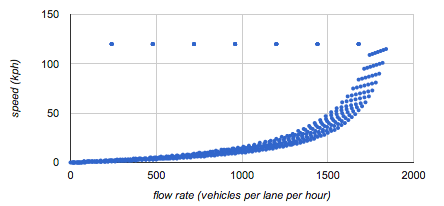

Yes, there is too much rambling for making a point, yes the tone of title is quite arrogant / link-baity.
But this terrible essay did prove the point: smoothing the wave is not going to make you go faster.