Valid points by those concerned with taking over the sidewalks.
I will also say, people riding electric scooters shouldn't be zooming along at 20mph (or pedal bikes) on sidewalks either, which are a true safety hazard.
And on the other side, much better for our environment, to have a lighter weight robot delivering a burrito than a 2,000lb vehicle, in terms of net energy consumption/expenditure.
Imagine how much better for the environment it'd be if your delivery was brought to you via a human-powered bicycle. Or as an in-between: e-bikes and e-mopeds.
Using 2,000lb vehicles for last-mile burrito delivery is a "we've tried nothing and we're all out of ideas" scenario. Delivery robots are an improvement because literally anything is.
Why are you assuming that a human would be more efficient and better for the environment than an electrically powered robot? It is very inefficient (approx 25%) to use food as an energy source, and humans are always burning energy. They can't turn off at night or when they are idle. I think it is very likely that the robot would be better for the environment than the person.
> Why are you assuming that a human would be more efficient and better for the environment than an electrically powered robot?
Because bicycles use 5x less energy per mile than electric scooters, which would be a reasonable analogue for slow electric delivery robots [0].
> It is very inefficient (approx 25%) to use food as an energy source,
By comparison, fossil fuel conversions are about 30-45%, depending on the energy source [1].
> and humans are always burning energy. They can't turn off at night or when they are idle. I think it is very likely that the robot would be better for the environment than the person.
That's a really, really weird baseline to use. Turning off a robot when not performing a task is standard procedure. Turning off a human when not performing a task is not standard procedure, and is frowned upon in polite society.
I live in a place with excellent bicycle infrastructure. All the delivery people ride electric bicycles. A robot would be that, minus the human. So probably better in terms of energy expenditure, cost, etc.
What does "good" for the environment even mean? I always assumed it means "good" for human purposes. But if we replace humans with robots, then the goodness of the environment seems somewhat moot.
Oceans filled with plastic would be "good" for something. Just probably not us. Maybe robots?
I think it's a symptom of our work culture and lifestyle. When people are spending anywhere between 1-2 hours a day in a car going to a job that sucks the life out of them, I'm not surprised they don't have the energy to get food for themselves.
Convenience services thrive in America because it's the only way the working class can claw back a teensy bit of time and energy. We could have had hybrid or even remote work, but that dream is dead. Traffic sucks, outside is loud and stinky, and you're in the office minimum 9 hours a day, 5 days a week. Minimum. I actually don't know anyone who works that little.
It’s a vicious cycle. I’m not a big delivery fan myself but you go into some small casual restaurants now and everyone else in there is a delivery driver.
Atlanta has been an early market for both scooters and various food delivery robots. Both have been a boon for the city.
We've had these delivery robots for about six months now, and they've grown to the point where I see hundreds of delivery robots on the sidewalks each week. Scores of them daily. They're flooding our city, making the long commutes people don't want to.
The reason this is great is that Atlanta's infrastructure is car-centric and spread too far apart to make walking or even biking make sense.
The biking infrastructure we have does no good when it rains and you're twenty minutes from your destination. That same infrastructure also doesn't serve our children or our elderly. Or help when you're sick or tired and need a pick me up.
It's easy to order for a group of people from one of these. To imagine the same group of four people hopping on bikes together to travel twenty minutes to food - that's never once happened in my life. Only certain types of people bike, and you'll invariably find yourself in groups with lots of non-cyclists.
I feel that cyclist culture is bright eyed and idealistic, but not practical. You need a city designed around it, and all the people need to grow up loving it. These delivery robots, Waymo, Lime bikes - they're much more sensible middle grounds for cities like ours. Where people can't bike, or simply don't want to.
Yeah, depending on the speed of these vehicles, it seems like bike lanes are the appropriate place for them. A smart city could even offer companies an opportunity to fund the buildout of additional bike lanes if there aren’t any existing in the neighborhood in question
The point of infrastructure is to have a common substrate where members of society can provide services to each other. Sure, in some sense there are subsidies but we have to account for the positive externalities. After all, a tennis court has very low utilization of space so that's a "subsidy for rich guys to talk about crypto". And golf courses likewise.
It's just not a meaningful way to think of infrastructure. The point of infrastructure is that it benefits society, and it will benefit some people more than others. Nice sidewalks benefit the rich people who live there more than they do the poor people who have to drive from the suburbs to work there.
And this business about "have to move out of the way" is really a bit much. If they're impeding the disabled then that's of some significance, and ensuring that those who need wheelchair access can still get places is worth it, but any able-bodied person can easily step aside.
I find the online reaction to so much of this stuff hard to fathom. Occasionally, I'll walk by a Lime / Bird scooter that's fallen over and I just pick it up and place it on the side. The net gain to society of having easy-to-access last-mile transportation is probably much greater than this happening occasionally. I really think these things are far overblown. But if you go online, you'd think that sidewalks are completely unwalkable. I principally walk and bike (now e-bike) places and this has never been a problem either in San Francisco or London - both cities where a large contingent has constantly insisted that it is.
I think you’re right that liability concerns are probably what motivated companies to design for sidewalks instead of roads. That being said, I think it’s very unlikely that a robot weighing 100 lbs and moving 15 mph is going to kill anyone. Could certainly cause some property damage or break a bone, but is that worse than blocking a disabled person on a sidewalk or pushing deliveries into full cars?
I think the problem is that if they're in the road their liability and required smarts go up a lot. Right now it sounds like they're at least partially relying on being the largest thing on the "road" and everyone else will naturally get out of their way.
A slow-ass cooler-sized wheely boy filling up the entire bike lane and stopping randomly, that'll be super safe for cyclists, yep. On the bright side maybe some of them will get knocked into traffic by people who don't bother looking for bicycles coming up behind them when they open their car door, never mind low-riding bots that are much harder to see.
Bikes and scooters aren’t legal on sidewalks in Chicago, and these little robots are just clogging up what little pedestrian space still exists. Totally apart from the questionable ethics of gratuitously using tech for tasks that could be a job for someone.
Wait, the first part I get: the robots are basically motor scooters, don't belong on sidewalks, sure. But the last bit, about "taking tasks that could be a job for someone" --- that's the lamplighter fallacy, isn't it?
As someone who has lived in chicago for 30 years I dont mind telling you that laws are not enforced here. Bikes and scooters not being legal on sidewalks has not stopped a single person from biking and scootering on the sidewalk
The economies of scale of a 2,000 lb (electric) vehicle are probably such that they use far less carbon than an individual delivery robot on a per-delivery basis
I live in a Chicago neighborhood where these are in use. They have very bright lights, actually blinding you as you approach one at night. They move much faster than is appropriate on a sidewalk. They position themselves in the middle of the sidewalk as opposed to the right hand side, impacting traffic in both directions. They round corners at intersections at below-eye-level, I’ve walked into more than one when they appeared in front of me at a corner. They park in the walkway while waiting for customers to retrieve their food. The hey are implemented in a way that demands everyone else gets out of their way. They have not attempted to integrate into the community, they have inserted themselves and we are to figure it out.
I am receptive to the argument that deliveries made in cars are wasteful. I ride a bike exclusively, I am not a fan of delivery drivers jumping out of double parked cars all over town, let alone the environmental impact. But much like rental e-scooters being abandoned on sidewalks, these claim to solve some problem by creating new problems and making the common environment worse principally to create profit for the owners.
And before anyone starts yapping bout NIMBYs: the sidewalk is in the front yard, stupid.
Edit: y’all, no bullshit I wrote this message and then left the house and ran into a Coco branded RC delivery bot at Grand and Ogden, stuck in the snow in the only walkable portion of the sidewalk, unable to get itself out and forcing me to walk around it in the snow. So there’s a little live reporting on the situation in the streets.
I had this exact same experience in ravenswood this weekend. I was walking to breakfast and one of these bots was blocking the entirety of the shoveled part of the sidewalk. I had to make may way into the snow to inch around the bot just so I could continue to use the sidewalk.
I had guessed it was stopped because it came to an unshoveled portion of the sidewalk. If it can't traverse that, it's not made for this city
I'm not fundamentally mad as these bots. But if they don't figure out how to make them work with other pedestrians, then I'm going to start cheering on any vandalism delivered upon them.
> I had guessed it was stopped because it came to an unshoveled portion of the sidewalk. If it can't traverse that, it's not made for this city
Have them partner with the city and collect evidence of unshoveled sidewalks. Automatically issue fines based off the collected video evidence.
This is one of those things where if these bots cannot traverse a section of sidewalk, many with mobility issues cannot either. And it's endemic to the city.
In my neighborhood there are $5m+ houses that literally never shovel their sidewalk the entire year, as well as a few businesses on "main drag" retail corridors. Fines for this have become exceptionally rare to non existent.
I agree they definitely create a ton of new problems that we will need to figure out, but I think I am simply much much more sympathetic to the fewer drivers argument to the point that I feel like it is still worth doing and figuring out how to fix the details.
Well, if there are fewer drivers then there is room for them on the road isn’t there?
Fewer drivers on the road because the pavements are becoming non-navigable because of robots nearly as wide as pavements does not sound like a benefit for anyone but drivers, and yet again demonstrates how messed up car culture is.
More to the point, I think these things can't really replace delivery drivers until they can get there as fast as delivery drivers, which one would hope they don't plan to do on the pavement. Though I can see them pushing to go faster :-/
>stuck in the snow in the only walkable portion of the sidewalk
"Normal" people can walk around at least. How about wheelchair-bound, blind, old/frail for whom walking up down iced/snowy sidewalk edge onto a pavement with moving cars may be an issue, etc. ?
> they have inserted themselves and we are to figure it out.
nitpicking a bit, but this reads as they are the robots doing the inserting instead of the companies creating/operating them and not giving a damn about this.
I've seen a few in Lakeview but my experience hasn't been entirely the same as yours. I haven't noticed blinding lights at night. They seem to move relatively slowly and cautiously.
I came upon one as I was jogging last night and was worried about getting around it. It, or someone driving it, seemed to notice me coming and it waited at a spot where it was easy to pass.
That said, these are a bad idea. Like another commenter mentioned, these are going to obstruct people with mobility issues or devices, or obstruct everyone when all but a narrow strip of sidewalk is snow and ice.
The escooters also are supposedly equipped with cameras and other deterants. Has anyone ever gotten in trouble for kicking them in to a bush when they are in the way?
A few years ago I was visiting a friend of mine in Ft. Lauderdale. We wanted some scooters to ride around on but there were none near him, so we drove and grabbed some off the sidewalk in downtown and threw them in the drunk and went back to his house. Heh they were beeping and vibrating like how you’d imagine some AGI would while being kidnapped. When we got them out at his house we scanned using the app and they unlocked no problem. (I think these were Lime scooters)
How far out are we from bi-pedal delivery robots? It wouldn't need to have AGI, just enough senses to keep from falling over, avoiding pedestrians and traversing minor obstacles. Or maybe a quadruped Boston Dyanmics robot?
The big appeal of humanoid robots to me is that they don't need to be automated; even if they were teleoperated there is a lot of new capability. Operators could rotate in and out more easily in shifts, they could operate where a human would be inappropriate (i.e. imagine a robot maid application where the robot could be activated 24/7, whereas something like a housecleaning service is only able to visit infrequently and during specific times. Or, with the delivery application the operator would be a lot safer than the robot navigating traffic and terrain.).
> So there’s a little live reporting on the situation in the streets.
> I offered no aid.
I just want to say I find this writing style refreshing as it’s a bit out of distribution for typical HN comments. Anyway, thanks for sharing your experience.
That video is hilarious, the “aftermath” is a funny video and that article, by the way. Thats it
so I’m having this discussion with parts of the country half a decade behind and this is the level of nuance as if it was half a decade ago? Is that what’s happening? Because thats even funnier
That’s… not many at all, really. You could do it in a year with ninety deliveries per day per location (well, 92).
Assuming a dozen robots per location, that's less than eight deliveries per day per robot (and even that might be beyond their upper bound, actually, given their speed and range).
But then they didn't do it all in one year. So… it doesn't feel like a stretch.
Given how many will be recurring customers with recurring journey routes, it feels barely enough to encounter all the possible unique problems.
This honestly would be solved quite quickly when the cost of vandalism starts eating into their margins. Once they piss enough people off it becomes self-correcting.
There's no scenario where these delivery bots survive US city sidewalks. They will be hijacked, destroyed/attacked, vandalized heavily. The police will not be able to do anything about it. The business model will not survive the US, unless the companies plan to deploy delivery tanks. It'll thrive in safer cities around the world though.
I'm not sure if you'd consider London to be a safe city but these things won't survive in London either.
People are already pissed off about delivery ebike riders, who disobey laws and ride dangerously. But there's very little you can do about humans. A helpless robot that is causing a hazard to pedestrians? A ULEZ-style strike force will be mobilized to drive them out.
And what about blind and partially sighted people? The place for wheeled vehicles in on roads. If you want to exist in pedestrian areas then make a robot that can walk.
But putting that aside, the biggest problems these things will have in the UK is a completely different conception of walkability even compared to, say, NYC.
People walk everywhere, pavements are cluttered and crowded, the vast majority of roads are not grid-structured almost anywhere in the UK, etc. So much so that when US firms do consider testing these things properly in the UK they will have to pick somewhere like Bath or Worthing or Hove: enough wealthy people to try it, and easy, grid-structured roads. Not many other good candidates.
The second problem they will face is the nature of protest. People won’t vandalise them. There will, however, be extensive civil mischief: people will box them in, mislead them, cover their sensors with googly eyes and woolly hats, put traffic cones on them, and generally make the whole scheme unworkable. And that is if councils don’t outright ban their operators.
Fundamentally I think they should just use the road and keep to the right (in the US), like other slow moving vehicles. They’d probably be fine in bike lanes where they exist.
Maybe they could enter the sidewalk for half a block at a curb cut like a cyclist would do to complete a delivery.
There's a very clear and obvious reason they are on the sidewalk. Bikes are not "probably fine" in bike lines themselves though. Bikes are mainly visible to drivers. These things are too small to be in the bike lanes let alone in an actual lane of the road. They'll just be a small speed bump to most cars.
I guess time will tell, but I think most cities in the U.S. have areas that are affluent / on the "right side of the tracks" where robots could traverse unmolested, and then other lawless no-go areas for robots.
Toronto outright banned a startup I was helping out with in 2021, they ended up packing up and moving it to Miami- Toronto has a rule that the city should not be made more inaccessible to folks with disabilities, and that a delivery robot could potentially cause an accessibility issue on the sidewalk for blind or wheelchair using folks. They didn't reach out to the startup, or tell them about the vote happening at council, they did invite the accessibility advocacy groups in. I agree the startup should have been banned (against my own interests) pending a review, however, I also believe a review of the technology and startup would have left very little room for concern. That said, I'm still skeptical robots on sidewalks are a great idea, ideally they can operate on the roadways.
This issue is going to become an issue with AVs too, if availability is the value prop and number of vehicles creates the availability and there are no humans to drive, I presume we end up with another situation where sidewalks across the world were littered with thousands of those lime/bird scooter things.
These robots would be a significant improvement over the current electric bike and scooter riders who not only drive recklessly on the roads but also take over the sidewalks. The situation has become lawless in the city, with many delivery drivers disregarding traffic rules entirely, they are a menace to pedestrians and vehicle drivers. I would like the city council to outlaw fast food delivery entirely, accept for the disabled. Young people need to get out more and should pick up their own falafel.
The thing with those guys, as you have rightly pointed out is for all their problems they do get out of the way and filter through traffic (dangerously as you point out)
A single startup with cooler sized robots tottering down the sidewalk is fine. When every single delivery company gets on board then we have a shit load of those things kicking around and in the way. I have the same issues in cities with those scooters that get left all over the place.
If you're referring to Toronto, I couldn't agree more. Couple times a week I find myself confronting an ebike deliverer on the sidewalk and kick him off.
They are frustrating to be sure, especially the moped versions, but are imo still far better to be around then drivers. I'd much rather the bike lanes to be together and throttled ebikes moved to the road, but it wouldn't make near as much a difference as getting people to not run reds or put down their phones.
In fairness cities are not legally required to sent notices so they won't. They do not really want you to know and fight against the changes. This was a failure of your business leaders. They needed to be more involved following city hall lobbying for their business. Losing a license to operate is a bigger deal then whatever priorities were focused on.
> They didn't reach out to the startup, or tell them about the vote happening at council
It's not the city's responsibility to do that. If your business depends on particular actions by a city's legislature, it's generally on you to be reading their agenda.
You only have to glance at the photos to see that the thing that has "taken over" is parked cars. The allocation of space is moving cars, parked cars, trees, poles, signs, lights, and then the sidewalk. It is not a fact of geology that the sidewalk is that narrow.
> “Chicago sidewalks are for people, not delivery robots.”
This seems to be a false dichotomy. Isn't it obvious that if there weren't robots, there would be people delivering your food instead? And as a biker, I actually find delivery drivers to be quite dangerous. They are constantly blocking the bike lane, forcing me to drive into traffic -- or they are riding their extremely heavy and fast bikes dangerously through the bike lane, which is particularly frustrating as the bike lane should be designed to keep me safe.
I don't know. I mean, there are definitely worse evils than delivery drivers in SF, but if you're going to argue that robots are objectively worse, I'm not so sure.
As a pedestrian I find cyclist are worse than cars for obstructing my path.
Riding on the footpath (illegal here) even with bike lane available right next to it, not respectig the traffic lights (mowing through pedestrians on crossings or blocking pedestrian crossings when stopped on red light), parking by blocking the footpath (must leave 1.5m of footpath unobstructed), riding the wrong way through traffic, flying down bike lanes (40kmh limit) and raging when anyone infringes their "rights" when they respect noone.
In my experience, I estimate that 20% of car drivers are a-holes, 50% or truck drivers and 80% of cyclists.
Your overall point is certainly valid, but there's no "dichotomy" there. I'd say "sidewalks are for people, not X" where X is pretty much anything that's not people (including scooters and bikes, even though there are people on them).
If those delivery drivers were parked on the sidewalk, it would be a different discussion. Or if the robots were in the bike lane, we'd be saying "bike lanes are for bikes, not robots".
My point is that you aren't simply pushing robots off the sidewalk and getting a better city. You have externalized the problem somewhere else. "Look, our streets are free of garbage", he says, dumping it all into the ocean...
It’s not clear to me there even is a “problem”. We did just fine before there were either robots or DoorDash drivers clogging up the road/sidewalk. (Admittedly DoorDash was very handy in 2020.) The problem is in allowing commercial interests to unilaterally clog public infrastructure.
But isn't this whole concept externalizing the commercial micro-transit problem onto pedestrian-only right of way? The sidewalk is the ocean in this metaphor.
Where the technology currently stands, people are far faster, more agile, and more compliant with the rules of sidewalk and street use than this category of robots is. They're currently objectively worse; a human being on two legs can make much better use of sidewalk real-estate than a robot (and that's before noting that most delivery couriers are in the street, using a bicycle, scooter, or car).
>if you're going to argue that robots are objectively worse, I'm not so sure.
Robots are becoming worse. I've been living in Mountain View for more than 2 decades, and Waymo cars have been around for years. They never been an issue until recently. I already wrote how several weeks ago our car was almost front-rammed by a Waymo, we had to swerve to avoid it. And recently i saw, and today was myself cut by a Waymo when i was driving in a left turn lane with the Waymo very aggressively crossing the solid white line to get in front of me. I can't remember actual humans cutting it that close, and it was the first time in many years i expressed my frustration by using horn while especially feeling how stupid that horn for AV. That my anecdotal experience much dovetails with some autonomous companies recently stating about increasing of the "assertiveness" of their AVs.
I mean i've been predicting that robots on the battlefield will soon push people out as people can't compete on speed, precision, etc. Yet, it seems that it may happen on public roads faster than on the battlefield. Don't get me wrong, i'm not objecting against such unavoidable robot future (it would be stupid and pointless to object to unavoidable), i just want parity, i.e. the law should allow me to outfit my car with similar (or may be for the old time sake of being a human - with better) sensor and mechanical capabilities and to allow me to for example cut the same way in front of humans and robots like those robots do.
>i just want parity, i.e. the law should allow me to outfit my car with similar (or may be for the old time sake of being a human - with better) sensor and mechanical capabilities and to allow me to for example cut the same way in front of humans and robots like those robots do.
Human drivers kill ~40,000 people a year in the USA. The last thing we need to do is enable humans to drive even more aggressively. Soon it wont make any sense to allow humans to drive at all, just like we currently don't allow them to drive while impaired.
Dragging out a number like that is entirely useless and makes me think you are being disingenuous.
Instead go find the accidents per 100,000 miles driven. Then make sure it takes into account that the robots only drive in fair whether places like California and Phoenix.
I think you might actually be correct in your argument but the evidence you have brought for it is poor.
If avoiding the collision with the robot increases the risk of colliding with a human the right thing to do is plow right into that robot.
Same as if an animal surprised you directly in front of your vehicle. If you swerve you are taking on risk that you don't need to.
“About half of all food deliveries globally are shorter than 2 and a half miles, which basically means that all of our cities are filled with burrito taxis”
There is a future where a city's burrito taxis are replaced with drones rolling on the sidewalk or flying to the rooftops. And, the large majority of the remaining city drivers are replaced by robotaxis with multi-sensor 360 tracking. Where there are nearly zero parked cars. So, the parking spaces have been replaced with bike lanes of bikers and scooters with every robotaxi on the street planning around their motion.
Far less fuel consumption. Far less street crowding. Far fewer accidents.
What do you think the noise is like in your future city? How many cameras and microphones are constantly streaming everything they see and hear into some corporation's private cloud? How many advertisements do we see on our pleasant bike ride? What's it like when a blizzard or flood drives the environment far outside of training norms? Have the debris-collecting drones already been deployed to clean up e-waste when the built-to-be-abandoned delivery drones lose battery or guidance, or is that a V2 thing? Are the police equipped to track down to track down the hacker that overrode my delivery drone?
We used to have books exploring scenarios like this. They were great books, a lot of time, but the most convincing ones didn't paint your future to be a very pretty, peaceful, or equitable one. You might want to read some, at least to understand why some people might be inclined to "hate this idea".
There are thousands of vehicles moving around your house and neighbourhood already. The vast majority of them are large enough to kill you, and emit fumes that poison you and the atmosphere.
Cities will have lots of drone deliveries in them in the future. And it'll be more safe and economical than the current situation.
Recently there's been a lot of anger in San Francisco about a Waymo (which have an excellent safety record with humans) killing an outdoor cat who that walked under the car and sat in front of a tire, when not long after someone was killed by a person backing into a crosswalk and it was a barely a blip on the radar.
The person who killed the bystander has social/legal/financial ramifications. Google had zero.
Anyone ever ask themselves why they have a knee-jerk impulse to support a billion dollar company's attempt at centralizing transportation?I'm sorry but safety and making your life easier isn't Silicon Valley's main concern.
Waymos need to be cheap and convenient to get business (they are a service), and they need to be safer to avoid litigation and social/political problems. Their business interests are aligned with both.
So why can't we prefer robot vehicles on the basis of safety and convenience?
If you want to make it about centralization, needing to pay big money for a personal vehicle (most of which through centralized dealers), register it with the state and an insurance company, requiring a government license, paying for insurance/registration in perpetuity, having to park it in special parking zones -- that's as centralized and locked down as it gets.
Waymo’s cars are, statistically, an order of magnitude safer than human-driven cars.
It sounds like your real MO is that you think SV tech doesn’t care about safety or its customers… which is fine, I guess, but it’s muddying the point you were trying to make as your comment kind of devolved into a strange rant.
For people outside the tech bubble, having strangers constantly market a product for a company they don't even work for as if it's their own spontaneous, original premise is "strange".
if an animal runs into the road and is hit by a vehicle, as long as the driver safely stops after, i don’t think the driver is generally charged after afaik
The comment is responding to a premise made regarding a person being hit by a car--which believe it or not--has legal ramifications. And we don't have to think about it regarding the pet, civil liability is still in play for them too.
These are a disability nightmare for folks in wheelchairs and scooters and even canes. They take up 75% of the sidewalk in normal sidewalk widths, let along narrower ones. In the snow, if sidewalks aren't shoveled well, this is even worse, as the traversable area is even narrower. Even being able-bodied it's more annoying than its worth to have to dodge these things.
These companies tried to start years ago in Berkeley but people wouldn't tolerate them and they always ended up flipped over in the road. Let it be known that I will not "dodge" something like this under any circumstances. Robots need to get out of the way and stay out of the way.
I’ve lived in coastal tech cities but I’ve never done DoorDash, or Uber eats, or anything by robots. Obviously I’m not the norm with these behaviors but I also don’t understand market demand when I see so many DoorDash vehicles at McDonalds, while the news also talks about how McDonald’s is suffering because they lost the poor income demographic.
I also work from home so going and getting my food, in person, is a welcome respite from my office. But who’s turning a $15 McDonald’s order into a $30 thing, regularly?
If it obstructs the sidewalk and isn't moving, you can almost certainly move it. You should act in good faith and try to do so in a non-damaging manner if you want to avoid vandalism charges.
If it's moving? You should just wait for it to go obstruct some other part of the sidewalk.
Just turn it upside down then. At best some “Good Samaritan” turns it right side up at some point but the food arrives late, cold, and spilled all over the inside of the robot.
Are actual delivery people that expensive or that much more expensive than robots? I assume they make minimum wage.
The availability, cost of acquisition, and engineering needed for support are much lower; the problem solving and communication are infinitely greater.
People were kicked off the roads when automobiles came into prominence and laws against jaywalking were lobbied for by corporations. It would be a shame for that to happen again with sidewalks.
1) "Take over" is slanted language. More accurately "Some residents complain about delivery robots on sidewalks"
2) Remote control delivery carts are much safer and less intrusive than double parked delivery cars (sometimes unlicensed, untagged, and uninsured) or even delivery bikes (riding 20+ mph in the bike line or against traffic on 100+ pound "bikes").
True, they are less intrusive than double-parked cars, and maybe vs some bikes, but that does not mean it is still not corporations trying to take private profit from using a public space.
The videos of those particular bots show them taking up a substantial portion of the width of a sidewalk (and definitely the full width in tight spots next to trees & fences) and moving and positioning themselves very clumsily and discourteously. They just sit in the middle occupying something like half the sidewalk width trying to decide what to do next, forcing people to walk to both sides in ~1/4 of the width. These things are not even close to ready for prime-time.
It is rude as a human to just stop in the middle of the sidewalk and unfold your map to figure out where you are going.
Programming in this kind of rudeness is just stupid, and will rightly generate backlash that will not be good for the companies. Of course safety is first, but it'd be more safe and courteous to have it hug one side of the walk. And if you cannot do that safely, not only are you not ready for prime-time, you aren't ready for public Alpha tests.
In another timeline, there are pneumatic tubes or underground trains routing to each building, negating the need for last mile delivery for most packages in dense urban areas. Adding these tunnels is probably too expensive now that the buildings are in place though.
In my hard sci-fi novel (beta readers wanted, see profile for contact), delivery bots play key roles in the plot. For local deliveries, a community of 1,000 people was constructed with no overhead cables, allowing food delivery by drop-drones.
Pipedream Labs is trying to implement a standard delivery tunnel + robotic delivery system, but yeah, I’m afraid they’re facing a serious uphill battle in terms of land use restrictions in the existing built environment
I feel like part of this is people not being comfortable with the idea that they don't have to be deferent to the robots (i.e. do what you want, it will avoid you). That's perfectly understandable (nobody wants to walk in front a moving industrial robots), but is something these companies will have to work on if they want people comfortable around their bots.
>Robertson shares Rodriguez’s concerns, pointing to incident reports of the robots pushing neighbors off the sidewalks onto busy streets, colliding with bicyclists and even deterring emergency vehicles.
Sounds like the robots don't do a good job at avoiding
The one I encountered a week ago, when I and another person got near it, it stopped moving. You have to go around them, and there's no way to get them out of the way if they're blocking something aside from leaving and hoping they start moving again.


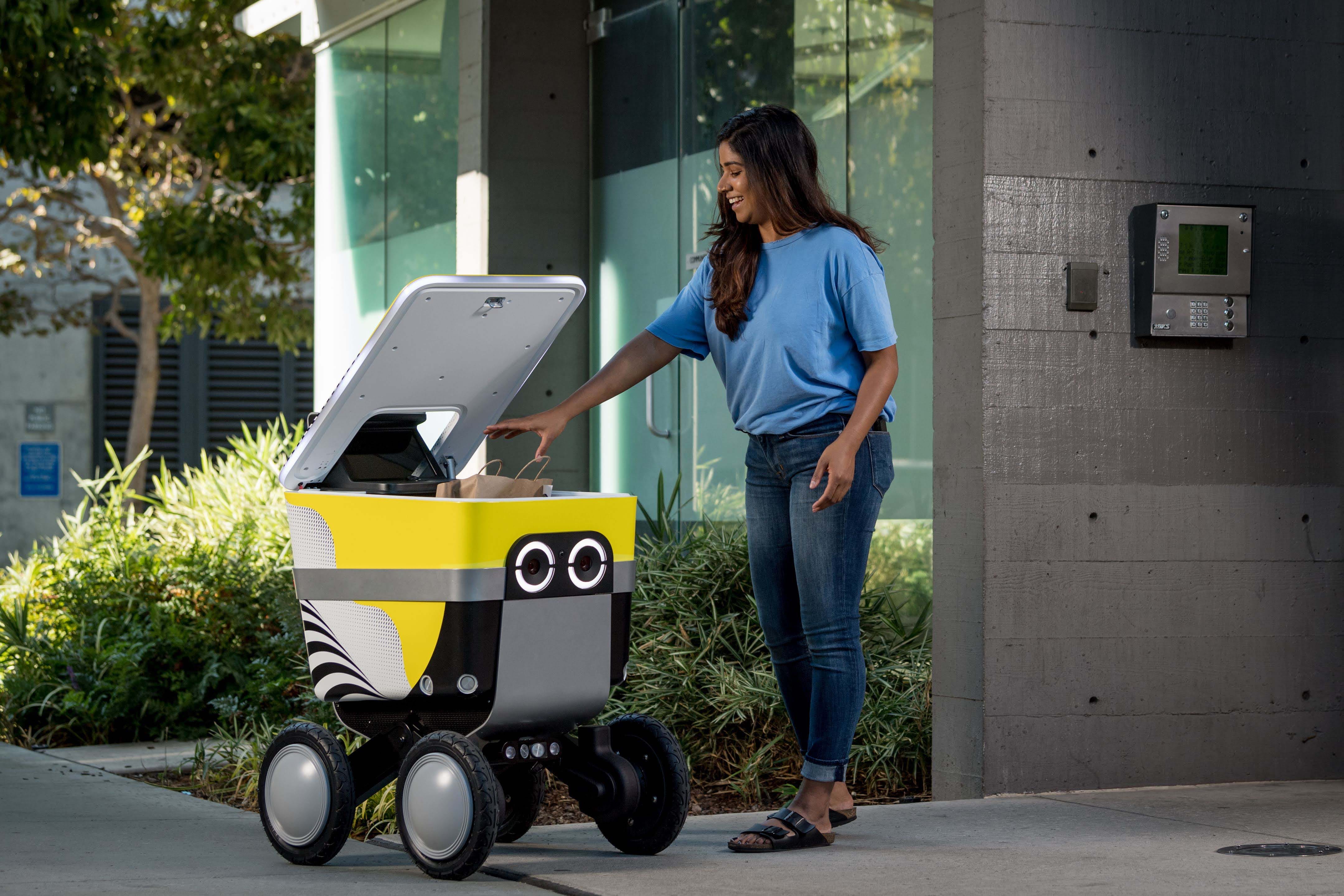
I will also say, people riding electric scooters shouldn't be zooming along at 20mph (or pedal bikes) on sidewalks either, which are a true safety hazard.
And on the other side, much better for our environment, to have a lighter weight robot delivering a burrito than a 2,000lb vehicle, in terms of net energy consumption/expenditure.