During China's ASAT test, almost all of the debris remained in the same LEO orbit. The amount of energy needed to climb over 1000km to reach MEO or over 35000km to reach GEO is significant, and even then, to reach a stable orbit after the climb is very unlikely. Kessler Syndrome is always a consideration, but with Starlink it's still minimal, especially since Starlink's elevation is only 340km, while China's ASAT test targeted a satellite at 900km.
Next gen starlink v2s are going to be 1000-2000km with starship. Low LEO v1s was more limitation of F9. Shooting high LEO ery expensive (PRC has HQ19s for 3000km), but realistically once US/PRC rolls out starship tier reusable payload vehicles at scale, we're goign to start seeing enough co-orbital asats being launched to guarantee kessler.
> On December 1, 2022, the FCC issued an approval for SpaceX[66] to launch the initial 7500 satellites for its second-generation (Gen2) constellation, in three low-Earth-orbit orbital shells, at 525, 530, and 535 km (326, 329 and 332 mile) altitude. Overall, SpaceX had requested approval for as many as 29,988 Gen2 satellites, with approximately 10,000 in the 525–535 km (326 to 332 mile) altitude shells, plus ~20,000 in 340–360 km (210 mile to 220 mile) shells and nearly 500 in 604–614 km (375 to 382 mile) shells.
Was not aware they scuttled 1,200km ka/ku band constellation and corrected in another reply. Either way, per your citation, the current plan still puts 10k+ objects in 400km+ orbits where debris hangs around for much longer. Primary point still stands - starlink isn't limited to sub 400km constellation and kessler syndrome risk for higher orbits is real (risk increase not linear). Especially, if starlink plan to go to 42k above currently planned 30k, most are going to be 400km+ since sub 400km orbits are taken. Unless UN/ITU increase slots, the amount of sub 400km slots are fixed, and expanding megaconstellations including future starlink expansion is going to be satuating orbits with multi year / multi decade decay.
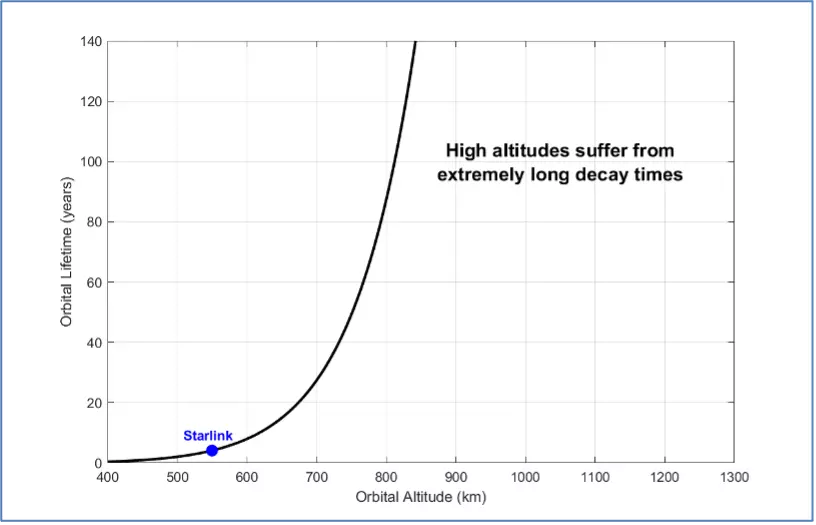
> SpaceX operates its satellites at an altitude below 600 km because of the reduced natural orbit decay time relative to those above 600 km. Starlink operates in \"self-cleaning\" orbits, meaning that non-maneuverable satellites and debris will lose altitude and deorbit due to atmospheric drag within 5 to 6 years, and often sooner, see Fig. 1. This greatly reduces the risk of persistent orbital debris, and vastly exceeds the FCC and international standard of 25 years (which we believe is outdated and should be reduced). Natural deorbit from altitudes higher than 600 km poses significantly higher orbital debris risk for many years at all lower orbital altitudes as the satellite or debris deorbits. Several other commercial satellite constellations are designed to operate above 1,000 km, where it requires hundreds of years for spacecraft to naturally deorbit if they fail prior to deorbit or are not deorbited by active debris removal, as in Fig. 1. SpaceX invested considerable effort and expense in developing satellites that would fly at these lower altitudes, including investment in sophisticated attitude and propulsion systems. SpaceX is hopeful active debris removal technology will be developed in the near term, but this technology does not currently exist.