The fact is that bitcoin's current primary use-case is long term store of value. To use bitcoin is to simply hold it for years, protecting yourself from the dilution of value that occurs in any other liquid asset in the world, of which fiat currencies are the worst.
Once you stop looking at the world through the fiat lens, things make far more sense. For example, house prices are currently the lowest they've been in 40 years, if you use gold as your unit of account.
speculation is the primary use case. Nobody is using their Bitcoin wallet like a regular bank, they're using it like an extremely volatile share portfolio hoping it keeps going up.
> You are using a bank speculating that it will not suffer a bail-in/bail-out/hyperinflation
You’re confusing speculation with taking a risk. If people are putting money in a bank with the expectation of profiting from its government guarantee, we’re in a credit crisis. The system is working as intended. Most of the time, the money in there is expected to stay still.
Most crypto buyers are buying with the expectation of appreciation.
Both are speculating. Both are taking on risk whether they understand it or not.
I would argue that the risk of bitcoin being a lower value in ten years is tiny, and also that chance of the dollar's value halving or worse over the same period, is almost certain.
I suspect my offer of several pounds of gold will likely need to exceed competing cash offers by a significant degree to be accepted by the seller of the house I’m trying to buy.
It's not any different than having your savings in a more reliable foreign currency: you can quickly exchange it to local currency without any such premium. The same for gold or Bitcoin. Any El Salvadorian saving up for a house would be wiser to save in gold or bitcoin, than local fiat.
The biggest problem with this statement is that you forget the rental income. In fact, I think the real "house price" should include the annual rent. This part represents your usage fee
Bitcoin is a bad store of value because there is no value.
If you look at Bitcoin as in game tokens, but one where tokens are given away to people who prove they have burned cash, you see it is a negative sum system.
Even Gold as store of value is questionable. It is a commodity. But we are entering naked empiror territory and I will avoid that hill.
Back to Bitcoin: it is basically a bet on mass adoption. If that mass adoption doesn't happen it is a ponzi. If it does the price should stabilize, even then not sure if it is a store of value.
I'd say bitcoin is a bet on progressive adoption of artificially but firmly limited resource as a store of value.
Which is actually happening for more than a decade now with larger and larger player buying some Bitcoin in every bear-bull cycle.
With amazing predictability that you can fit a curve to it for entirety of its existence. What's more, the more money was already funneled into it, the closer the price is to the curve.
You can plot it yourself. Find a dataset with Bitcoin prices going back more than a decade. Plot them on a plot with log y axis. Fit the logarithmic curve to that plot. Plot differences between the fitted curve and the price data. Observe how the envelope of the deviations shrinks in time but also the deviations oscillate periodically with the the frequency dictated by halvings.
If you are lazy you can just look at "rainbow chart" which captures the most basic observation about Bitcoin.
This works until it doesn't. If btc started at 0.01c and is now $100k (roughly) following the curve predicts it will be $100tn/coin or a market cap of $2 billion trillion.
You could say the same thing any time in the past an you'd be wrong every time.
That curve will predict such high price but in year 3400 (I'm guessing, I didn't check yet because I wasn't interested in time horizons that exceed my foreseeable future).
It's a logarithmic curve (albeit on logarithmic plot). For example the bull market in 4 years from the one that we are currently entering will result in just doubling Bitcoin price which is pathetic (even when compared to 5-7x of the current one, let alone past ones). In another 4 years the growth will be even less.
Besides, at some point the random noise in the price signal will mostly overwhelm the shape of the curve and bitcoin will just become like stock market, growing at the glacial pace of economy growth.
Bitcoin is ending, but not in a sense of becoming worthless but becoming another boring randomly walking asset at the price around less than $1mln per unit possibly for entirety of this century.
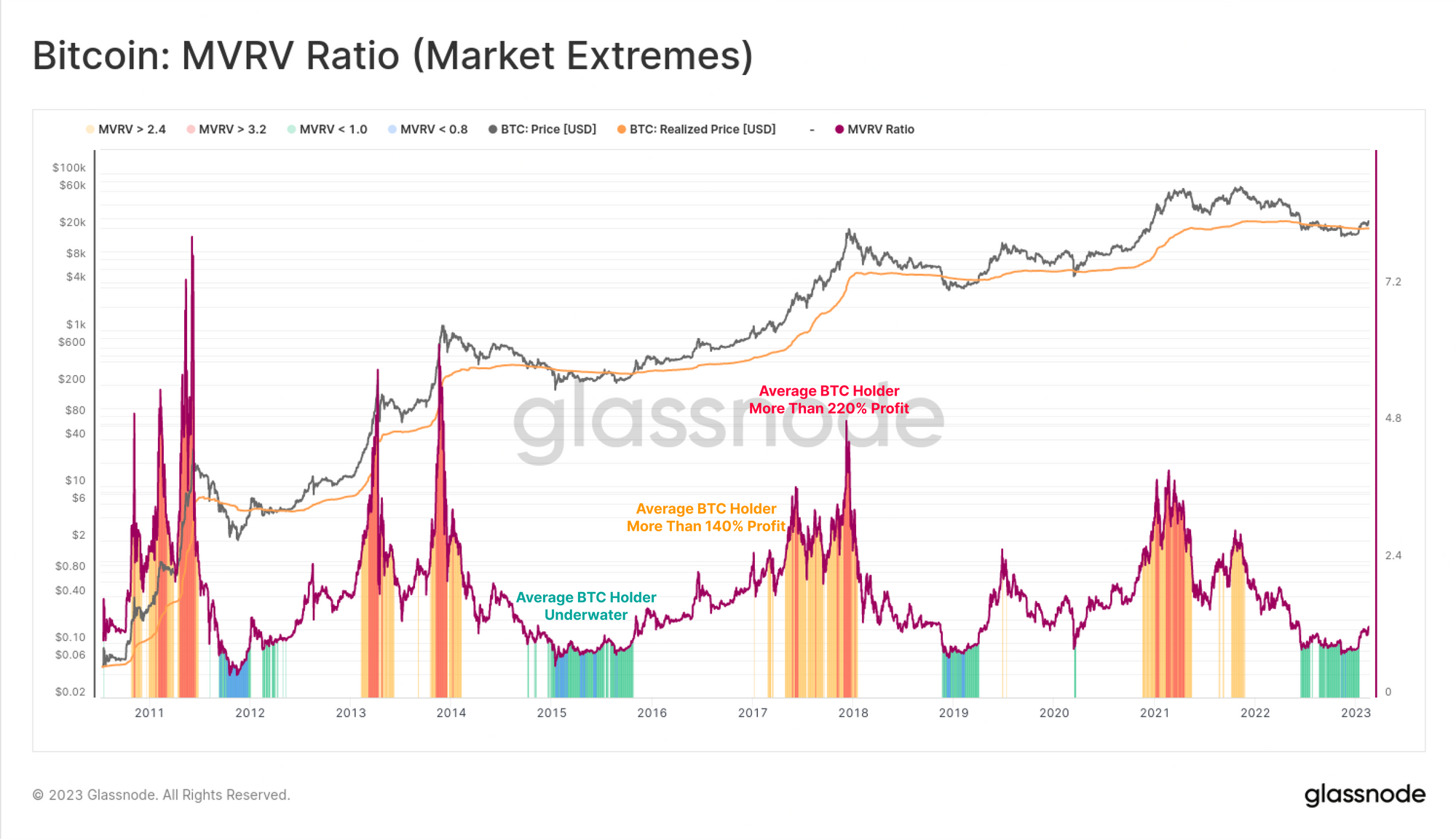
That general insight of the shape what Bitcoin is that can be inferred from long term prices is also confirmed by plotting MVRV:
I'd say mostly just the sheer amount of money that was already sunk into it. All those people have very little incentive to break the status quo. Bitcoin protocol successfully resisted changes that could potentially alter its shape.
> You could say the same thing any time in the past an you'd be wrong every time.
1. That is a weak argument. None of the prices so far would reault in this clear absurdity. Bitcoin cannot store more value than there is value. I am wrong if the population booms to the trillions, or the dollar crashes like Zimbabwe.
2. Past performance is not indicative of future results. For the past 40 years I have been alive. If you said anytime in the last 40 years I would die tomorrow, you'd be wrong every time. I will therefore live forever. Biology and statistics be damned.
> Bitcoin cannot store more value than there is value.
There no hard cap on entirety of future value that will exist at some point in time. And bitcoin growth is slowing down in a way. Same way since the day one. Hence simple fit to a single curve. I have no idea what fraction of value bitcoin will ultimately "store". You can look at gold amd take some guesses but there's no real reason for any of them to be right.
> Past performance is not indicative of future results.
Yes. And this is not an investment advice.
> [...] I would die tomorrow, you'd be wrong every time. I will therefore live forever.
Which is true to some approximation and good assumption to live by. Vast majority of people lives everyday with assumption they won't die tomorrow or anytime soon (for their definitions of soon). Then, if they were lucky they grow old and everybody seeing their decline adjusts their expectations. Where are the signs of decline of bitcoin? Is market cap shrinking? What about transaction volume?
> Biology and statistics be damned.
What statistics or rules of science understood at least as well as biology contradict the working assumption that bitcoin will keep for the foreseeable future its shape that it's been keeping since it popped up?
Ill ignore the stuff before the last question as it doesn't all seem in good faith. E.g. saying "it is an observation, not an argument" about a provocative statement containing the words "you'd be wrong". For other things you said it wont be interesting to dive into them on a HN thread. That is more about this medium than the points you made per se.
To answer the last question. First principles. Exponential growth tails off when resources limits are met.
At best Bitcoin takes over all currency usage and the value of it (at some point $ comparisons become useless as it has become more used than dollars) follows human progress i.e. the things we do to trade for bitcoin. There is no reason to believe that the growth rate of all human civ will be as high ad bitcoins break out from Satoshi. And if it is, it has nothing to do with Bitcoin and everything to do with AI. However the future is uncertain enough that we can't pretend this curve is a predictor.
Now my back foot is hurting so lets turn this around.
What are the underlying principles and systems that make your curve predictive?
I'm not sure why do you think any of what I wrote was provocative. Do you not agree that if you'd predict (or imply) immediate catastrophy for Bitcoin at any point in the past you'd be wrong every time you did that?
Isn't it just a factual observation of reality (even trivial one) that you also agree with? Or did you observe something different?
I just stated something. I did not propose argument for anything. I didn't even tell you that you are wrong, only that you'd be wrong if you said it at any moment in the past. I don't find it even mildly provocative. You might still be right right now. It's just very unlikely in my option.
> Exponential growth tails off when resources limits are met.
Do you believe that Bitcoin grows exponentially when I just told you it fits logarithmic curve not straight line on logarithmic plot?
Are you sure you are basing your reasoning on relevant first principles?
> What are the underlying principles and systems that make your curve predictive?
Statistics. Large number of uncoordinated trades so far and large number of capital exchanging hands in various ways, places and contexts makes it unwise to dismiss it as purely accidental and prone to flipping on its head any moment. Global "once in a century" pandemic didn't affect it. Neither associated disruption to global trade nor partial transition to remote work. No political changes. Nuclear power instigating war in Europe didn't affect it. Raise of AI didn't affect it. Evolution and degradation of global economy didn't affect it. Brexit. Trump's win. Trump's loss. Loss denial. And if we are looking at events "closer to home". Countless bankruptcies of crypto exchanges didn't affect the fit. Billion dollars scams in crypto coming out didn't affect it. Bans on mining in leading countries. Forking of BCH, BCC and Bitcoin gold. Invention of stable coins (also NFTs) is not visible on the fit. I'm sorry, but all that makes it super hard to believe that suddenly it's gonna deviate from the fit when it stayed pretty much on track while all other real world and crypto charts were going bonkers due to real world events and trends and whims of the markets.
Agree, although I would argue Bitcoin is likely to hold some amount of value in the long term because of historical importance, regardless of whether it ever ends up being widely adopted or useful.
Some other cryptocurrency could solve all the problems Bitcoin has and it will still be valuable because it was the first one.
I've been waiting for that since that one time it shot up to ~$30 and then crashed to ~$5, I thought it was the blow it needed to kill it... jokes on me I guess
So a dollar is a terrible long term unit of account. So if your salary, as your career progresses doesn't raise at least as much as price of gold (or grade A eggs or whatever) you are getting shafted by the economy.
I'm sure there are some other insights you can draw from simple observation of gold and housing prices.
Considering how Bitcoin's price has been manipulated in the past and how concentrated it is in the hands of a small cabal of whales and miners, this is total bullshit.
I pay people globally through HSBC all the time. Works instantly.
I never understand this argument anyway. If you can't send funds instantly that isn't because the currently itself can't be transferred instantly - it's because for whatever reason you don't have access to a provider that will provide that service. That's a separate problem and can be solved without having to build an entirely new currency / financial system.
The reason we have cash is (1) we used to not have widespread electronic instant settlement systems and (2) because you still generally need some type of physical fallback system because we energy sources and communications networks aren't always up.
Bitcoin is bad at 1 - 7 transactions per second (something something lightning network), and completely fails at (2) because it can't settle transactions without the internet, and electricity.
That may be what you think of as the core reason for cash to exist, but you shouldn't speak for others, who may see the privacy as a more relevant upside.