I could come up with a list of things that I don't like about Ron Paul personally, and a few things that worry me politically.
But none of that really matters.
He's the only candidate that I feel I could actually trust to stick by his campaign rhetoric, and the only one I would trust to actually defend the constitution.
Ironic, given that we have a constitutional scholar in the White House and a historian running for the GOP nomination.
Ron Paul is wrong on some things I care about, but so is Obama, and certainly so is Newt or Romney. I think I'll vote for the lesser of a dozen evils, and go with Paul.
I feel the same way. In fact, I'm sure most of Ron Paul's supports feel the same way. I find his foreign policy views deplorable and offensive.
You know what? I will still be voting for him.
I'm tired. I'm so tired of the lying. Gingrich, Romney, Obama, Bush, etc. will say anything to get elected. Once elected, they all behave the same way.
I'd rather have an honest man I disagree with in the White House, than a man who says one thing, but does another.
I think his foreign policy is one of his strongest policies for which he gets a lot of support. What's funny is that Bush got elected in 2000 for having almost exactly the same foreign policy that Ron Paul has now:
He's either lying now about the newsletters or he was lying then and in 1996 and profited from those lies.
I don't understand why people think he's an honest straight-shooter, any more than I understood that meme when it was applied to McCain. He's a politician playing a roll, that's all. He's not even a libertarian: he's perfectly fine with States grossly abridging freedom, just not the federal government. It's the same Southern conservatism that has been prominent since they lost the Civil War. Paul was smart enough to realize that you could sell this to a broader audience if you wrapped it in libertarianism is all.
You have to understand that he hasn't shifted his positions in 30 or so years, except on DADT and the death penalty. So to say he isn't a straight-shooter is absurd.
As for the newsletters, they dealt with economics primarily. Could he have done a better job of overseeing the newsletters? Sure. But they were released over the span of a decade or more and as a whole contained only a few articles with questionable content. I mean, is someone making noise about Gingrich's or Romney's questionable ethics and corruption? Is someone asking why Romney's people bought all the HDD's from Mass. state computers before leaving office? Is someone calling other GOP candidates racist for supporting racial profiling and the drug war? Of course not. But a 20-year old ghostwritten dead horse has been re-re-exhumed and is being paraded on every network "news" show. Am I the only one who sees something wrong with this picture?
> He's not even a libertarian: he's perfectly fine with States grossly abridging freedom, just not the federal government.
Exactly this. He's not a libertarian, he's a states rights guy because he wants the power to do things like ban abortion in Texas. I think he has a very regressive political philosophy, that would empower local governments to discriminate against minorities, women, the disenfranchised, etc. People talk about how he wants to legalize drugs, but he would be perfectly fine with state governments creating even more draconian drug laws.
>he's a states rights guy because he wants the power to do things like ban abortion in Texas.
No, he's a states rights guy because he's a states rights guy, and he holds to that position even when states pass laws he disagrees with.
Look, the two most decentralized first-world countries that I can think of are Canada and Switzerland. These are not draconian racist hellholes; they're considered some of the freest countries in the world.
This is a guy who thinks abortion is the most evil thing in the world and still opposes federal laws banning abortion because he thinks it's a state issue. I disagree with him about abortion, but the fact remains: he's not some scheming ne'er-do-well who wants to bring back Jim Crow laws, he's a consistent, ideological antifederalist who thinks decentralization is the way to go.
In the majority of recent, real-world instances, local laws have tended to be more liberal than federal laws. We've seen this with gay marriage, we've seen it with medical marijuana, and we've seen it with election reform (see also Calif. Prop. 14); we may very well soon see it with recreational marijuana.
In the majority of recent, real-world instances, local laws have tended to be more liberal than federal laws.
This is an excellent point. It's also far more expensive for lobbying groups to try to influence politicians state by state. Powerful Federal officials represent a one stop shop for buying influence, so decreasing Federal power will reduce corruption.
> Look, the two most decentralized first-world countries that I can think of are Canada and Switzerland. These are not draconian racist hellholes
But the South was. You're ignoring the evidence of history. Canada and Switzerland are simply much less diverse, and it's pretty naive to think that racists in Mississippi and Alabama, who never went away, wouldn't seize on the chance to reinstitute something resembling Jim Crow laws.
Edit: > No, he's a states rights guy because he's a states rights guy
The first rule of tautology club is the first rule of tautology club. He's a states rights guy because he's a Christian fundamentalist who wants the power to enforce his provincial values on others, and the federal government gets in the way of that.
>Canada and Switzerland are simply much less diverse
Switzerland has four official languages. It's also right next to Germany, which has a history of racism that would scare a Mississippian. Canada, too, has plenty of diversity; 16.2% of people belong to a visible minority:
>The first rule of tautology club is the first rule of tautology club.
It's not a tautology. I was saying that his anti-federalism is de novo, i.e., without ulterior motives, which has been supported by every single thing he has ever said.
>He's a states rights guy because he's a Christian fundamentalist who wants the power to enforce his provincial values on others, and the federal government gets in the way of that.
There is absolutely no evidence whatsoever to support this belief and I've provided substantial evidence against it in the above post.
The beginning of the "states right" movement in the 60s (1860s or 1960s, take your choice), was primarily motivated by race. Cletus was not an austrian economist.
I think the post you're replying to is going a little too far but there absolutely is a connection between states' rights and racial issues. That's why the stuff in the newsletter is resonating. Those who are in favor of states' rights on other issues (as I am to an extent) would be well-served to recognize this connection.
Any centrally controlled system will edge one way or another compared to decentralized units. If you take one example (a specific race issue) and generalize, then you'll conclude (as you seem to have done) that centralized control is superior.
The benefits of a large shift in power toward the states are too numerous to list, but to name a few:
- Look at the issues discussed in national political campaigns. They are unduly biased by the issues relevant to swing states, and candidate promises (and laws) end up exerting federal control over swing state issues simply to help candidates win Federal office.
- Voter empowerment. The washington establishment is so big and unwieldy that it takes lots of money to get one's voice heard. With increased power at the state and local level, individuals could more easily focus their activism efforts in ways that would create the biggest benefit.
- The biggest issue is experimentation. With 50 different "experiments" in democracy (state laws) there is hope of actually realizing that a law is bad. Our current system picks a single winning approach before any has been tried and then loyal partisans stick to it and ignore all evidence. How much better would it be to observe how 50 different entities solve similar problems. Like any optimization problem, this might at times be a less efficient approach, but it'd do far better at global optimization.
You're missing the point - I'm making a historical point.
I'm generally of the opinion that more states' rights is generally better as long as it doesn't create a game-theory zero-sum clusterfuck of misaligned incentives, like taxes for crossing state borders or something like that. Some things need a federal guarantee but many can/should be devolved to the states.
You are absolutely right. And that is what makes the constitution important, to be that "federal guarantee".
I'd like to comfort you that "taxes for crossing state borders" could never happen but I'm not sure I can justify that. I was hoping the Commerce Clause would say something there but I couldn't find anything. Maybe somebody else could find something on this bit of a hole in the libertarian philosophy?
     > it's pretty naive to think that racists in Mississippi
     > and Alabama, who never went away, wouldn't seize on the
     > chance to reinstitute something resembling Jim Crow laws.
He's the naive one? Frankly, what you're suggesting is absurd and borderline offensive. As if the enlightened North and federal legislation are all that prevents the re-institution of Jim Crow laws! Give me a break.
>The “good ole boy” network alive and well in Mississippi? Not hardly. Our new “network” consists of more black elected officials than any other state in the country – a number that grew from a mere 81 in 1970 to 897 in 2000.
Mississippi is as racist today as Russia is Communist. Give me a break.
Creating 99% black districts to consolidate the black vote into the smallest number of seats isn't really support for your position, even if the people doing it are pure post-racial political optimizers (they're not post-racial).
Also, I don't know how old you are, but you do realize that many southern people from 50 short years ago are still alive, right? You're positing that right after the civil rights act was passed, all those people firehosing black people and setting the dogs on them and stuff, they just changed their minds and did a 180? And raised their kids that way?
Every state gerrymanders. Mississippi is hardly alone on this.
>In the state of Ohio, a conversation between Republican officials was recorded that demonstrated that redistricting was being done to aid their political candidates. Furthermore, the discussions assessed race of voters as a factor in redistricting, because African-Americans had backed Democratic candidates. Republicans apparently removed approximately 13,000 African American voters from the district of Jim Raussen, a Republican candidate for the House of Representatives, in an attempt to tip the scales in what was once a competitive district for Democratic candidates.
The South was as racist as the North, at the time. Y'all just got better press about it.
Everyone knows about the sunset laws below the Mason-Dixon: hardly anyone knows that many small towns in Wisconsin had the same laws right up until 1970. The very worst - in my opinion - fights over desegregation happened in Yankee-land when schools started busing white kids to black schools and visa-versa.
Switzerland is really not a model when it comes to racism. Until very recently, its government was blatantly organized along ethnic lines, with clear glass ceilings for some groups. Public opinion is very conservative on this matter, and most laws are enacted in clearly racist terms.
> He's not a libertarian, he's a states rights guy because he wants the power to do things like ban abortion in Texas.
This is not inconsistent with libertarian thought. Protecting life from violence is a primary responsibility of government. If you believe that the fetus qualifies as a life at any point between conception and birth, you would be against abortion. Simple as that.
If you want to fault him for believing a fetus qualifies as a life, fine, but that belief in itself has nothing to do with politics.
You invite your friend to your home for a party. Your guest walked to your home. A blizzard starts outside. Your friend does something that pisses you off. You kick him out of your home, into the blizzard. He dies as a result.
Were you just asserting your property rights or did you commit murder?
When you tell your guest to leave, and they won't, or they don't have anyone to pick them up, and you wanted them gone, you would forcibly remove them from your home and place them outside.
You know that bacteria is "life", right? Does the government need to protect them? Obviously you intend "human life", but equally obviously that doesn't just mean living human cells (scratching -- killing skin cells -- isn't murder). The valuable thing worth protecting doesn't obviously begin at conception. On the contrary, it rather obviously doesn't.
> The valuable thing worth protecting doesn't obviously begin at conception.
Please let me know at which point it becomes obvious that it is a life worth protecting. It isn't so obvious to me. There is no physiological difference between a fetus that is in a mother's womb and an infant born a few minutes later.
It's easier to switch states than to switch countries. If you don't like the draconian laws in your state you can move to another one that shares your views.
Well yeah. Thats kind of my point. I was showing the silliness of the statement I was replying to, that somehow if I don't like the laws of my state, I can just up and move to one that does instead of having to try and affect legislative change.
If you don't agree with Ron Paul, it's because you've spent far less time studying the real implications and economic intricacies as he has. He's right on everything.
I agree with Ron Paul on economy more than any other candidate, but he's racist, anti-semite and a homophobe, or at least pretended to be one in order to get rich, which I find highly unlikely[1][2]. In my opinion, no matter how right on economy he is, we can't have someone like that as a president.
I don't believe that's true. But even if he were, the elegance of his philosophy is such that it renders him powerless to do anything about it.
He wants to take power away from the presidency and the rest of the federal government. He's not looking for power to oppress somebody he doesn't like (or favor the corporations he does like). He wants to make it so that it's impossible to curry favor or harm on groups according to a politician's whim.
Zavulon, why did you think he was rich? He's not. Why do you think he's pretending anything? He's not. Do you know the man, or are you just taking the easy path of buying into the hysteria?
He's flawed but you certainly didn't mention his actual flaws, which means you don't know him, you've simply read about him.
His worst crime is that he's homophobic on a personal level. But he's not one bit anti-gay on a philosophical level and he has gotten big endorsements from Andrew Sullivan and Dan Savage. So you've lost the anti-gay argument.
And ditto for the other accusations. Please don't just be a part of the echo chamber. If you do, you're being rather easily manipulated, sorry.
> I could come up with a list of things that I don't like about Ron Paul personally, and a few things that worry me politically.
That's completely OT and not really related to your post in particular but what's with the disclaimers lately? Are we becoming the sort of community where you need to preface every thought with a bow to group's believes? Are we so stuck in the "singaling game" [1] even here, on a niche website and clearly among people smart enough to get the gist of a comment?
Or is it just me? As in I'm just noticing those more often?
HN's voting "thingy" is obviously engaging a middle-ground positioning, especially when it comes to political views. Moreover I suspect that arguments are taken more serious when putting some "I try to be aware of my biases" upfront.
Especially among (more or less) non-political communities like this one an argument starting with a"I am an independent voter" premise is most likely going to get a better reception than a "I have been for years a dedicated follower of politician x". Not that I am a fan of this, quite the opposite - but there are other sites much more suitable for political "confrontations".
I'd hesitate to describe HN as non-political. The majority of HNer's are very pro-capitalist and pro-business from what I've observed, which makes sense given the community's focus on start-ups. The popular political sentiments that you'll find on Reddit are very different from those you'll find on HN.
You have to admit that most people immediately roll their eyes when they read another die-hard Ron Paul supporter. That disclaimer lets people know/believe that this isn't a fanatic speaking. While I agree with Robin Hanson that I wish we didn't need disclaimers, it truly is an effective way of signalling, and often essential in tone-less, emotionally-ambiguous internet discussions.
Disclaimer: Ron Paul supporter (hopefully not too fanatical)
Fallacies abound in politics. If anything, I think the majority of political discourse is based solely on fallacies. Such as "individual X is Y and is associated with group Z, hence all individuals associated with Z must be Y".
It's a game of influence, not rationality. If calling people names "wins" an argument with less effort and time than applying logically sound arguments, why bother with logical arguments?
The sad part is that Paul has been the only politician in a long time to resist the trend and talk about the issues in a serious and straightforward manner, only to be attacked and ridiculed.
He's saying he prefers an authentic candidate with principles over candidates whom pander to the media to get votes, even if his views differ in some areas.
If there isn't a single person in the western political discourse who proudly adheres to a given characterization, it's a strawman.
That's all. Meanwhile, on Ron Paul / race, that newsletter is a bit of a problem. Maybe you're too young to remember the conflation between states' rights and segregation.
I'm really interested to see what happens if he wins Iowa and comes in 2nd in New Hampshire. I do think it would be good for the Republican party.
Perhaps, but he did have a company that earned a lot of money from publishing newsletters containing racist and anti-gay passages under his name (e.g. The Ron Paul Survival Report):
> The newsletters, attributed to Paul, made statements such as "opinion polls consistently show only about 5% of blacks have sensible political opinions," "if you have ever been robbed by a black teen-aged male, you know how unbelievably fleet-footed they can be", and referring to Martin Luther King as a "pro-communist philanderer" and to Martin Luther King Day as "hate Whitey day."[72][73] An issue from 1992 refers to carjacking as the "hip-hop thing to do among the urban youth who play unsuspecting whites like pianos."[74] In an article title "The Pink House" the newsletter wrote that " "Homosexuals, not to speak of the rest of society, were far better off when social pressure forced them to hide their activities."[73]
Of course, he distances himself from these newsletters now. Would somebody who is truly not racist and not anti-gay have such words published in their name by accident?
I can't vote for anyone who, when reality conflicts with his mental model of the world, believes reality is wrong.
Paul's not just wrong; he works from false assumptions to come to consistently illogical conclusions. I don't care if my politicians disagree with me, but I certainly care that they live in a world of evidence-based decision making.
Can you please cite some of his false assumptions and the illogical conclusions. I believe his argument against SOPA and regulation/censorship of internet is quite sound. His arguments for a sound fiscal policy is based on evidence that governments (or individuals or corporations) spending beyond their means usually lead to their downfall. Results of Vietnam war, Iraq war provide alot evidence that much more diplomacy is needed before going to war, and once you go to war, fight it win it and get out, don't go into nation building.
Personally, I believe that Ron Paul will do what he says and that's a problem. I've read the articles, I've looked into things as much as I can and I very firmly disagree with him on his general monetary policies. The Federal Reserve being wound up and the USA returned to a Gold standard would not be A Good Thing for the USA or the world (me not being American); there's a reason why countries don't do that any more and it's not so politicians can lie, cheat and steal. We tried it his way before and it caused more problems than it solved.
Newt Gingritch, Mitt Romney, Rick Perry, Michelle Bachmann et al may well be unprincipled and deliberately lying about all sorts of things. But I don't think any are proposing anything quite as reckless as Ron Paul's economic policies. Frankly though, that this lot are the best the Republicans can produce is an abysmal failure.
OK, sorry, my wording was loose there; nonetheless, as he is looking for gold and silver to be admissable as payment, I think there's three possible scenarios.
One, the market ignores this and everyone continues paying in the dollars the president thinks are just another means of exchange. Sounds risky to me; it's pretty much a public statement that the gvernment won't at all seek to defend the value of the dollar so I'm not sure why anyone would want to accept such a risky asset.
Two, each merchant has to manage things in multiple currencies in parallel, along with the tax offices having to do the same and keep track of relative values and when the payment came in to establish the correct rates of tax. Won't happen.
Three, the market sees an unsupported national currency with little or no base backing and no national reserve bank backing it up. That's pretty much a guaranteed recipe for hyperinflation and flight to assets (remember, the historic result of not having the Federal Reserve was high inflation - it's been tried). It won't be orderly; the price of gold will rise fast due to demand against a basket of currencies, let alone against the dollar that'll be collapsing even faster. The banks aren't set up to handle physical deposits of gold, the merchants aren't set up to handle transactions in them so we'd end up with multiple, incompatible, payment systems based off private gold-measured currencies. Meanwhile industrial use of gold becomes prohibitively expensive putting brakes on the economy, while the fixed money supply inherent in a commodity-based currency puts us deliberately back into the situation that crashed the markets in 07-08 - no-one can get any credit to work with, so the economy ground to a halt. That was able to be mitigated by quantitative easing temporarily creating new money and injecting it into the economy, but under a commodity-backed economy that becomes impossible. Have a read of http://en.wikipedia.org/wiki/Gold_standard if you want; I'm not alone in holding these views.
There's a reason why the Federal Reserve was created in 1913 and why the US ended convertibility with gold in 1971. Ron Paul seems to appreciate the lessons of neither, and I don't wish to live through him reminding the world of them again. Which is why, reluctantly, I think even Michelle Bachman would be a better candidate than Ron Paul.
the historic result of not having the Federal Reserve was high inflation - it's been tried
Do you have the backwards?
The dollar has lost 95% of its value since the creation of the Federal Reserve.
Inflation with gold based currency is rare. The California Gold Rush is the big example of inflation with a gold currency.
a public statement that the gvernment won't at all
seek to defend the value of the dollar
The Federal Reserve and the government have already signaled through their actions that they want to devalue the dollar. Examples: Geithner asking China to revalue the yuan, quantitative easing, record deficit spending and so on.
If the dollar really is so wonderful, then it shouldn't be threatened by gold.
The dollar has lost 95% of its value since the creation of the Federal Reserve.
Inflation with gold based currency is rare. The California Gold Rush is the big example of inflation with a gold currency.
No, I don't.
Firstly, the periods when the US had no national reserve bank showed either severe inflation or a depression / panic cycle that only ended with a private reserve bank being set up as lender of last resort - hardly ideal. In both cases the lack of reserve banking made the financial system volatile and unstable.
Secondly, the Federal Reserve was created 99 years ago. A 95% drop in value (your numbers, I've no idea of their accuracy) is equivalent to inflation compounded for 99 years at just 3%. While I agree hyperinflation is bad, 3% is a long way from hyperinflation and a cursory examination of the Japanese economy in the 1990s shows why deflation is a bad thing. Some small inflation is good because it promotes market liquidity rather than hoarding and provides incentives to investment.
Thirdly, China are being asked to revalue the Yuan because its value is being artificially manipulated down to make both Chinese exports into world markets cheaper and foriegn imports more expensive, both to the benefit of China but the detriment of global free trade and free markets. It also has the side-effect of exacerbating China's balance of payments surplus and leading to it stockpiling both resources and currency (thus artificially boosting its international buying power), which is directly parallel to the mid-19th century 'silver grave' situation that led to the Opium Wars. Revaluing the Yuan is emphatically not an indication that the dollar is inherently weak, it's an indication that China is trying to use the openness of western markets and restriction of their own to its own advantage.
Fourthly, the California gold rush and resultant inflation is an example of what happens in a commodity-backed economy when that commodity suddenly becomes more abundant, a factor that is now out of state control unlike the Dollar money supply which is currently able to be tightly controlled. Commodity-backed currencies in the past have also caused severe deflation, and we're back in Japan in the 1990s. Now, the bulk of world gold mining assets are in Australia and China, and China is agressively buying up Australian mining assets - well, mining assets in general, particularly across Africa, using up its balance of payments surplus created by their artificial suppression of the value of the Yuan. A gold-backed US economy would have its money supply (and by extension both credit availability and rates of inflation / deflation) largely out of national control and primarily in the hands of China. I don't think this is a good idea.
All of which is why I think Ron Paul's understanding of economics is dangerously flawed and (reluctantly) I'd regard him as the least preferable Republican presidential nominee.
Rather than refuting all of the points above, I'd like to take the discussion in a different direction.
You are against allowing people to use gold as money. Is it because you are trying to save people from themselves? Perhaps it's because you are concerned about what it might do to the dollar. If that's your concern, is that not an admission that the dollar is fragile?
Is it wise to run the economy with the Federal Reserve as a single point of failure? We are suffering greatly from the failures of the Federal Reserve now. They will make mistakes in the future.
Edit because site will not let me comment on reply below:
The Federal Reserve failed us by stoking the housing boom with low interest rates. The subsequent bust has caused many people to suffer through lost jobs, lost homes and ruined credit ratings.
The Federal Reserve is a single point of failure because it controls the one currency that we are forced to use under the boot of the government. Because the dollar is used as the world's reserve currency, the Federal Reserve is in some sense a single point of failure for the entire world economy.
That's a straw man version of my argument. My concern is that the observed history shows that commodity-backed currencies lead to economic problems. I'm not in the least against people choosing to operate their personal economies around barter based on commodities, but the data is clear; it's not good for any of us to use commodities as the primary means of store and exchange of value. Just as the invention of the limited company allowed entrepreneurs to start companies that benefit us all at less risk to themselves, fiat currency's greater flexibility allows us to better control both the money supply and inflation to our collective benefit.
Besides, calling the Federal Reserve a single point of failure is at best over-dramatic. Should we also have a free market in governments? It's not really a single point of failure by any realistic definition though. The world economy is significantly interlinked and managed by the co-ordinated action of several central banks. The dollar's value is as much backed by its use as the primary international trading currency as anything, so short of Ron Paul's proposed disowning of the dollar its value is guaranteed by a large network of individual actors, all of whom have sufficient dollar holdings that they have no interest in seeing its value collapse; while it retains its status as the only payment means for the world's single largest economy, it's fine.
I'm curious what mistakes you think the Federal Reserve is making now that are causing you to suffer greatly. Inflation? Low, and (while it remains low and somewhat controlled) A Good Thing as I said before. General economic malaise? No, the FR's action on quantitative easing ensured any degree of market liquidity remained in a situation where it would otherwise have dried up almost entirely through fear of unknown and unknwable liabilities. Why would the ideal remedy to a crisis caused significantly by a loss of market liquidity be to move to a medium of exchange with little or no liquidity and what there was being outside of your control? It's madness.
What is great about Ron Paul's stance is that I am confident based on his continual display of principled politics that if elected he would stand by this. Who cares what the other candidates are tickling our ears with. Paul is the only one who I feel would actually stand up to the Movie Industry.
I don't know how credible this is but it leaves me doubtful.
Without checking out each quote, I believe the answer is that it's generally accurate, but you need to understand what these represent.
First, there's the normal crap about taking things out of context...
But more specifically, these are decidedly not things that Paul ever said or wrote. These are things that somebody else wrote in a newsletter that was using Paul's name. That doesn't mean that you should let Paul off the hook. It means that what you should be concerned about is not that he's a racist ass, but that he may have a lapses in judgment, as here where he allowed someone else to use his name without monitoring closely how they used it.
It's worth noting, though, that there are some very strong parallels here between Paul's misstep and President Obama. Consider Obama's association with the explicitly anti-American, anti-Semite minister Jeremiah Wright, and with the communist and terrorist Bill Ayers. Indeed, in my opinion, Obama comes out much dirtier in this comparison, because he refused to disavow those other people, and particularly Wright, who is acknowledged to have served (still?) as a mentor to Obama, shaping his thinking. In contrast, Paul condemns those statements, and there's no reason to believe that he ever took their writers' ideas as guidance.
Some of the quotes were not only written in a newsletter with Ron Paul's name on it, but were actually signed "Ron Paul," and written in the first person talking about why he voted a certain way. And he's refused to name these mysterious ghostwriters who wrote it.
And when these came up in the 1990s... he didn't claim they weren't him or even disavow them! He just said that they were taken out of context, not that he wasn't responsible for them.
I really don't give a huge crap about what it says about Ron Paul's deepest darkest prejudices--I'm a policy man, myself--but to simply try to shrug it off and say "I disavow these things" while also saying things like the Civil Rights Act should be repealed? Call me unsurprised if people are upset about it.
The Reverend Wright deal is a weak comparison. Something analogous would be if, in Dreams from My Father, Obama had said "I wish a Mao would rise in the United States to give the capitalist running dogs what they deserve." And given what he's given shit for... do you seriously not believe he'd get shit for that? It'd be an instant disqualification, even if the quote were taken out of context or even written by a ghostwriter.
The newsletter debacle is 'damning' simply because the US corporate media has decreed it so.
The newsletters are definitely offensive, and are reasonable cause for disliking Paul as a candidate and perhaps even a person, but as others have pointed out, they are relatively mild as far as political skeletons in the closet go. If the media favored him, they could be easily downplayed as have been countless much more serious missteps and outright crimes by mainstream candidates in the past.
I was personally very disappointed when I found out about the newsletters and disgusted by the idea that Paul would even associate with people who would think manipulating racial tensions for political expediency is morally acceptable. But let's put it in perspective--in the last decades the lies and criminality of the US political class have led to the wrongful deaths of millions, illegal torture, vast illegal wiretapping programs, vast financial fraud and unprecedented transfers of wealth to the very richest people in the world, stripping of civil liberties that have been fundamental since the Magna Carta... need I go on?
How much airtime do we see devoted to examining establishment political figures' complicity in these and laundry lists of other history-making type crimes? I'm sorry, but the idea that Ron Paul's lapse in oversight on some barely-circulated newsletters 15 years ago somehow ranks as 'damning' on the scale of political transgressions is, quite frankly, utter horseshit. This is just continuation of the usual program--distract from the real issues and manipulate public opinion through manufactured divisiveness and tabloid journalism.
You're inappropriately comparing the actions of candidates with people who have actual power. Neither George W. Bush nor John Yoo is running for office. Ron Paul is, and as a non-leadership representative, he's not in a position to affect policy in any significant way. He hasn't had the opportunity do things that Bush did. In order to assess him as a candidate, we have to understand how he acted given his opportunities.
Considering how small those opportunities were, a profitable newsletter publishing articles exhibiting this level of inaccuracy and racial animus is meaningful.
First of all, Ron Paul has significant power in congress. He is a member of two important committees and was instrumental, as a recent example, in strengthening the auditing standards for the Federal Reserve. He also has significant ideological influence on the Republican party, whether they like it or not. The rhetoric of the tea party movement was in many ways a direct attempt to co-opt Paul's support. He has used this power in near perfect accordance with his principles, stood against reckless war, attacks on civil liberties, favoritism for Wall St. and special interests, and economic plunder.
There have been plenty of opportunities for Paul to sell out, as there are for every successful politician, and he has rejected these opportunities at every turn. Contrast this with Obama's record: a supporter of the patriot act from the beginning, a friend of Wall Street, a believer in empire, in favor of suspension of habeas corpus for American citizens, in favor of the drug war, tolerant of illegal spying on citizens, tolerant of torture. Obama has broken promises and sold out the American people time and time again. It seems pretty clear who has the better batting average.
Paul is far from perfect, but the only alternative at this point is the status quo or worse for the next four years, and believing in that is a lot more insane and dangerous than any of Paul's most controversial beliefs. In fact, when you look pragmatically at the scope of what Paul would actually be capable of as president, you see that he could only really affect policy in the moderate and generally popular portions of his platform--ending permanent war, ending the drug war, vetoes on overspending. His more 'fringe' positions are well beyond the purview of the executive branch, and his principles explicitly preclude him from overstepping those bounds.
Ron Paul is to be commended for amending auditing standards for the Federal Reserve. However, he still hasn't had an important policy position as compared to his competitors for the presidency (excepting Bachmann). This is not a slight, but it should be acknowledged.
Now, I agree that he has had substantial power rhetorically. He has people who are passionate about what he says; his elucidations and opinions have influenced them, raised money, started conversations, and affected the political agenda. That is why it is disappointing that the very little power he has has been used inappropriately in certain instances. If he hired awful ghostwriters who spread stupidly racist material because he wasn't minding the store, then that is not a good sign that he has successfully managed the one area where he did have meaningful power.
Separately: I think you can critique Obama without mentioning things which seem to me untrue or at least misleading, which I think warrant correction:
- Obama has never (I believe) indicated that he's in favor of suspending habeas for U.S. citizens. There's misinformation around that NDAA does this; it does not. If you're thinking of something else, citation please.
- The U.S. torture debate has mostly revolved around waterboarding and unauthorized treatment of prisoners at Abu Ghraib, Bagram, etc. -- none of these are known to have happened under Obama. Some people believe that the Army Field Manual enables other forms of torture; Obama ordered a full review and asked for all torture to be taken out; if you think he missed things, that's a complex judgement call, not a simple issue.
- On several other fronts, like the drug war, Wall Street, etc., Obama has in fact applied the policies he stated--I'm not sure what makes you think he's broken promises or compromised his sincere beliefs in any of these areas. He's not a libertarian (except maybe in comparison to H. Clinton).
"Batting average" is a helpful term to use, but I think you're not using the right denominator: Paul hasn't been up the plate many times, whereas Obama, Gingrich, Romney, even Santorum have had a lot more opportunities to either accomplish something or screw up.
By the way, I'm not arguing generally that you should vote for Obama instead of Paul or whatever. But I am defending this newsletter "scandal" as a still relevant datapoint on Ron Paul. Not definitive, but relevant.
he's not in a position to affect policy in any significant way
I think you misunderstand the separation of powers in the US government. As a member of the House of Representatives, part of the Congress, it's been explicitly Paul's job to set policy.
As president, on the other hand, the job is to find ways to implement the policies that the Congress has defined.
We get all excited about Presidential election, but at least in theory, the Executive is less important than the other branches.
On the other hand, Congress has ceded so much power to the Executive branch (e.g., giving the EPA, IRS, FDA, etc., so much latitude in defining regulations) that power tilts significantly in that direction -- although not to that office itself, but to that branch.
And I suppose that it's natural to focus on the single individual figurehead, when the power of the Legislature, even if it really is more important as I claim, is more diffuse across all the members of that body.
> I think you misunderstand the separation of powers in the US government. As a member of the House of Representatives, part of the Congress, it's been explicitly Paul's job to set policy.
We're evaluating individuals here, not branches of government.
The House is probably the most most important single body in the government, and if we are unhappy with the laws, we should indeed generally hold that body as the first layer of accountability.
Ron Paul, on the other hand, is one of 435 members of the House. He does not chair a committee and has chaired one subcommittee for one year. He heads a congressional caucus--that's good--but it has ~12 members and virtually no record of legislation or other action. Separately he has gotten ~1 bill passed in his career and a very small number of notable amendments. He has not been a decisive vote on virtually any issue.
Many individuals have policy powers vastly exceeding this, including not only (obviously) the president, AG, Supreme Court, and perhaps 100+ Congressional leaders, but also (I would aver) the Cabinet, Federal Reserve Board, OLC, JCs, and dozens or hundreds of others.
I think it's very common for people to treat all members of Congress as if they're the same, but Ron Paul is not John Boehner or Nancy Pelosi.
Ron Pauls's power comes from his writings and speeches on various principles of governmental power and the economy. If he's been remiss on that exact front--hired famous cranks like Lew Rockwell to ghost for him and then failed to review his work--then he's mismanaged his power. I'm not saying that he's a criminal in the sense that, say, Warren Harding is a criminal, but it's absolutely relevant to his candidacy.
edit: Ron Paul does chair one subcommittee as of Jan 2011--misstated that.
Your linked article has some merit, it isn't something to dismiss out-of-hand. However, there's a significant flaw in it, where he discusses how Obama was excused but Paul isn't:
Obama did it with Jeremiah Wright, openly grappling with the past toxic association, owning it, explaining it. Paul has not had the wherewithal or presence of mind to do that. Indeed, he has not even named the association, the first step to disowning it.
But this is false, he did address it four years ago. I've linked and quoted that statement below. [1]
Also, Sullivan goes on to say "And unlike Obama with Wright, Paul got money from these newsletters."
You'll have to make your own value judgments here, but I think Obama comes out worse. It's true that Paul profited. However, it seems clear to me that Obama's relationship with the real perpetrator (Wright, in his case) was far closer than Paul's. Obama chose Wright to baptize his daughters, and used Wright's ideas for the title of his book The Audacity of Hope. This make me believe that Obama had a close, respectful relationship with Wright, and that some of Wrights ideas molded Obama's own. None of these things can be said of Ron Paul with respect to those newsletters.
"The quotations in The New Republic article are not mine and do
not represent what I believe or have ever believed. I have never
uttered such words and denounce such small-minded thoughts.
"In fact, I have always agreed with Martin Luther King, Jr. that
we should only be concerned with the content of a person's character,
not the color of their skin. As I stated on the floor of the U.S.
House on April 20, 1999: 'I rise in great respect for the courage and
high ideals of Rosa Parks who stood steadfastly for the rights of
individuals against unjust laws and oppressive governmental policies.'
"This story is old news and has been rehashed for over a decade.
It's once again being resurrected for obvious political reasons on the
day of the New Hampshire primary.
"When I was out of Congress and practicing medicine full-time, a
newsletter was published under my name that I did not edit. Several
writers contributed to the product. For over a decade, I have
publically taken moral responsibility for not paying closer attention
to what went out under my name."
An ABC News review of dozens of Rev. Wright's sermons, offered for sale by the church, found repeated denunciations of the U.S. based on what he described as his reading of the Gospels and the treatment of black Americans.
"The government gives them the drugs, builds bigger prisons, passes a three-strike law and then wants us to sing 'God Bless America.' No, no, no, God damn America, that's in the Bible for killing innocent people," he said in a 2003 sermon. "God damn America for treating our citizens as less than human. God damn America for as long as she acts like she is God and she is supreme."
Sounds like many of the biblical prophets to me. It's someone who took his cues from Jeremiah.
I never understood what was the big deal - it's just someone who takes seriously their religion. (And all of his accusations in that quote are factual. The crack epidemic was largely CIA-fueled as a way to funnel money to Central American rebels, and the rest is easy enough to verify.)
he had a 30 year career in politics, if he was really a racist, there'd be some video proof to support it of him actually saying this...or hell anything else to support that...but there isn't
the bottom line, is that if the worst thing that they'd been able to dig up about him, are some comments from ~20 years ago that weren't even written by him...then he is one of the cleanest politicians in generations.
While they are scrambling to pick something from 20 years ago that he didn't even write, there are many cases in which he actually came out against racism. It's amazing how that seems to not even matter, but a couple of sentences from a newsletter he didn't write 20 years ago, do.
The new ad from Revolution PAC is pretty powerful. James Williams, a black man, talks about his efforts to get medical attention for his pregnant white wife at a Texas hospital in the 1970s. The crescendo comes when a young doctor named Ron Paul broke through the indifference of the staff to give them the help they needed. Their baby would be stillborn. And Paul paid their medical expenses. Then Williams extols the virtues of Paul — his honesty and willingness to take on the establishment.
So as far as I am concerned, after viewing the physical evidence, I conclude Ron Paul made large sums of money from distributing and claiming at the time to write, hate speech, promoting misogyny, and promoting fringe conspiracy theories, in an effort to scare people into sending him money. Reminds me of how Glenn Beck operates.
Ron Paul's excuses today lead me to conclude he is either lying, or completely incompetent, and would not have the ability to lead a Cabinet effectively. In other words unfit to serve as Commander-in-Chief.
EDIT: I see the downvotes flying in. I provided evidence of the claim. Sorry to see his hero worship is so strong that people will ignore factual hard evidence. Kind of pathetic really. This reminds me of the circlejerks over at Reddit... thought the people over here were a few steps above that base level of ignorance.
let's say you build a user generated content startup. It's one of the projects you built, so after a few months you forget it and go work on another startup. Then while you were 100% focused on your new startup, one of the users posts up some rant on your old one that you barely check.
Should you be held responsible for something put up on a domain that's registered to your name? After all, you made a whole $2 off adsense clicks.
How much money do you think a local ~town/county level newsletter makes anyways? Millions?
Bottom line, is that one lapse of leadership/judgement/what have you is nothing compared to most people...and let's not forget that it was 20 years ago and he has been squeaky clean since then. Which isn't something you can say about any other politician....so either hold others to the same standard...or cut the guy some slack and focus on policy, especially considering the lack of "evidence" in this case.
Frankly, anyone who has paid attention to what Paul has actually said or done in the last 20 years knows this in no way represents his views. In fact, quite the opposite, Paul is by far the most open and tolerant in the GOP field. The fact that some people are willing to focus on these says more about them than about Paul.
The mainstream media works its magic by taking a mural 100 miles square and repeatedly hilighting the same 50 square inches. They do this in order to create the perception that fits their agenda, and ignoring the rest. It's an extremely effective technique. It's very easy to control what people think, not by lying to them, but controlling what they think about.
He's not racist, as long as people of all colors assimilate into his culture. I can see the confusion: people who aren't part of this culture see that as a set of racist, irrational beliefs that lead to stop-and-frisk harassment and profiling in airports, whereas Ron Paul obviously has a cultural fear of people different from himself and doesn't equate that with skin color except by correlation. He doesn't consider this "racism", and thus is offended by the implications.
We disagree on the terms and on whether or not it is a disqualifying feature for the highest office in the land, but we should at least be able to agree that the only evidence we have for what he believes have been the things he's done or said. That he began claiming he never did them when they became politically inconvenient doesn't mean he's changed his mind.
I wouldn't care what he said 20 years ago if he stood up and said, "yes, I said those things. Since then, however, I have spent more time with people from cultures I had previously been isolated from and feared, as many of us do when faced with the unfamiliar. I now appreciate that theses communities have come together in the face of adversity and are an assets to this nation." Instead he claimed that Not Me did it, and looks about as mature as that kid from Family Circus while doing so.
Uh-huh. I've paid attention to Paul just fine, and I can see he's not against Jews at all, unless we want to have a country - you know, like hundreds of other peoples.
Thanks, but I can do without his form of 'tolerance'. Anyone else in the GOP is preferable.
These are not credible at all. These are, when its all said and done, lies used to paint Ron Paul.
The very interesting thing is, why? What is the motivation of such people to bash Paul as a homophobe when there's decades of actions on his part that are anything but? What's the motivation of people to bash Paul as a racist, when he has freely associated with people of every color without any hatred his whole life? When in the 1970s he gave a poor family free medical care because he was a doctor and they couldn't pay? (and it didn't matter to him that they weren't white.)
I'll tell you the motivation. The people attacking paul now do not give a damn about the rights of gay people or about racism... after all, they themselves are racist, and they support a guy-- Obama-- who opposes gay marriage and gay rights and is widely known to be a homophobe, by his actions.
The motivation is that Ron Paul represents a credible threat to change the US federal government to one that protects rights of the people, limits itself from controlling the economy, and lets people be free to pursue their ambitions.
This is very threatening to people whose sole career has been peddling influence.
Most worrisome is that while these issues have come to light, in my /very/ limited experience, attempting to broach the issue with Paul supporters has been met with at best dismal and at worst outright irrational anger. In fact I've now been told a number of times that such quotations are falsified, that they've been planted by Paul's detractors. The implication seems to be they're suggesting this is the manifestation of some kind of conspiracy against him. I'm quite honestly baffled that supporters of a purist would allow exceptions... Alternatively, twice I've been told by Paul supporters that they are in fact are not supporters, but rather anarchists (this only comes up in the context of such content as the newsletter debacle).
Edit: I'm curious to know why anyone would downvote this? When presented with direct evidence, is it really logical to immediately push it away? Oh well...
To the commenter below, if you had read to the second paragraph of the article you would have found this:
'Paul’s Iowa chair, Drew Ivers, recently touted the endorsement of Rev. Phillip G. Kayser, a pastor at the Dominion Covenant Church in Nebraska who also draws members from Iowa, putting out a press release praising “the enlightening statements he makes on how Ron Paul’s approach to government is consistent with Christian beliefs.” But Kayser’s views on homosexuality go way beyond the bounds of typical anti-gay evangelical politics and into the violent fringe: he recently authored a paper arguing for criminalizing homosexuality and even advocated imposing the death penalty against offenders based on his reading of Biblical law.'
I didn't downvote (I don't have enough points yet), but I can already see some problems with that article. For one, it's based on newsletters published 20 years ago which he's repeatedly told the media that he did not authorize to use his name. The only other thing that's trying to stick to Ron Paul in this article is completely based on hearsay. So no, it's not direct evidence.
EDIT: I seriously hope you're not trying to tell me that Ron Paul is a terrible person because one of his supporters favors the death penalty.
He doesn't "favor the death penalty" he calls for the execution of people based on their sexual preference in accordance with Biblical law. This man's endorsement was touted by Paul's Iowa campaign. So yes, I find that offensive and reprehensible; Paul should immediately repudiate the endorsement.
EDIT: In re to nirvana's misreading of my comments below:
> To claim that Ron Paul endorses murdering homosexuals because some random religious guy who does, endorsed his campaign is a lie.
I never said any such thing. I said that Paul, i.e. the Paul campaign is seemingly directly linked to anti-gay sentiment as evidenced by the endorsement of Rev. Kayser they touted on their website. That's repugnant.
Also, I don't appreciate being called a liar: These aren't my opinions. They are confirmable facts. The campaign was endorsed by a person who wants to murder gays. This endorsement was featured on Paul's website. It's deplorable. I'm only sorry you don't feel the same way.
Ron Paul has some great ideas, he was against iraq war, iran invasion and more. But he hates gay rights and is very strong on Religion. He want laws against burning the flag, against abortion, and more.
He has extreme views, that you either hate or love.
This is false. He absolutely opposes anti-abortion (or pro- for that matter) legislation at the federal level.
He is personally opposed to abortion, and he'd like to see states forbid it. But since we're talking about him with respect to a national office, his views of what states should do shouldn't matter too much.
I think you'll find that in almost every way, he wants to get the federal government out of the way. From my perspective, that's a good thing.
CLARIFICATION for the reply. Paul's personal belief is in opposition to abortion. However, in contrast to other politicians, he doesn't believe that his personal beliefs should determine federal policy, and thus as President, his opposition to abortion would be irrelevant. That is, when wearing his president hat, he would advocate that the federal government stay out of the issue altogether. Only wearing his doctor hat does he oppose abortion.
Ron Paul wants to make it legal for states to ban abortions, because Ron Paul generally favors state powers and is against federal powers. It has nothing to do with his personal opinion on abortion.
He's made this clear several times, but most people don't seem to understand it.
Sigh, there is certainly a point being missed here. Should the federal government give states the right to ban Islam? If someone argued that it should... they'd rightly be acknowledged as anti-Islam, because freedom of religion is a human right, and rights aren't just rights for the federal government, but for all the state governments.
Rights are inviolable. If Ron Paul believes states should be able to violate certain rights, he is opposed to those rights. Which is fine: it's a perfectly coherent position that there is no right to privacy and self-determination. But call it what it is.
I would like to attempt a thought experiment and see if you could buy this scenario:
Imagine if Ron Paul becomes President (yeah, right, but hang with me) and he does give states the right to do all kinds of things within the constitution. (Side note: I think banning the practice of Islam is unconstitutional due to the first amendment)
So let's say that some Southern states ban abortion and ban gay marriage. That sucks but there is some elegance here that you didn't notice. California is not about to ban abortion or gay marriage, in fact now they have fully promoted gay marriage, and legalized marijuana. Colorado has done all that and decided to exempt themselves from all of the SOPA stuff as well (they aren't as under Hollywood's thumb as California is).
While it sucks for those gay couples in the south while they grow up, it should be obvious that they (and others that support these rights) will move to a new state. A state can't hold those couples in their state and refuse them to leave and states can't go to war with each other. So now you have two groups of people: those people in more "civilized" places like California and Colorado are happy and those people in the traditional south are happy too.
There is an elegance in letting complex, controversial issues be decided at lower levels and leave the top level government only worry about states violating a core set of rules. And you better believe that a constitutionalist like Ron Paul would enforce state adherence to the Bill of Rights. I would hope that at least that part would be indisputable.
I agree it can be messy. I agree that some people don't get what they want immediately (they might have to relocate). But at least they don't have to leave the country. At least they still eventually find like-minded people and influence their own local governments to get what they want.
Another point I want to make is that marriage is not a right explicitly guaranteed by the constitution and neither is having an abortion or smoking weed. And you'll only hear a libertarian note that the 9th amendment acknowledges rights outside of those explicitly guaranteed. So while you believe that these are rights (and I agree with you) not everyone does, and more importantly, not all of the Judicial branch does.
Should the federal government give states the right to ban Islam?
Actually... Paul's "We the People Act" seeks to expressly place state laws on religion, sexual orientation and abortion outside of any possible constitutional review (essentially it's a repeal of the Fourteenth Amendment, targeted at the issues that provoke the most frothing at the mouth from social conservatives). So if he gets his way, yes, a state could pass a law banning Islam and there'd be no recourse.
He also wants to make it legal for states to legalize marijuana, despite that fact that he (I assume) would personally oppose the use of marijuana.
His personal opinion on the particular issue isn't what's motivating him, it's his opinion that it should be up to the states to decide, not the federal government.
More specifically, Ron Paul doesn't believe that ANY abortion legislation should be passed at the federal level, whether or not it is for or against abortion, and believes that right should be held by the states.
Ron Paul wants to define life as "starting at conception", he wants to do this at the federal level, and he wants states to ban abortion (which they'd frankly have to do if life was defined as starting at conception).
this is incorrect, the bill you are referencing merely allowed states to ban abortion if they so desired and removed federal funding from abortions; this is very different than trying to force through a federal ban.
HR 2533: Sanctity of Life Act [1]
"Deems human life to exist from conception, without regard to race, sex, age, health, defect, or condition of dependency and requires that the term "person" include all such human life."
Thanks for the link. I hadn't seen the text of this before now.
It's interesting how interpretations are so easily drawn, because while you cite the "Deems human life" as synopsis, I draw "each state has authority to protect the lives of unborn children residing in the jurisdiction of that state" as justification that it simply allows states to have more sovereignty.
That said, I agree that the language, which I don't personally agree with (or have much opinion on) would likely tie the hands of states trying to enforce or enact pro-choice legislation.
He has a personal opinion, but this does not drive the policy he advocates. Likewise, he may not want people to drink alcohol on Sundays, but he would not outlaw such behavior.
megablast said he wants laws... against abortion and CWuestefeld pointed out that, although he doesn't like it, he doesn't support federal laws against it.
  And as President, Ron Paul will continue to fight for the same
  pro-life solutions he has upheld in Congress, including:

  Immediately saving lives by effectively repealing Roe v. Wade and
  preventing activist judges from interfering with state decisions
  on life by removing abortion from federal court jurisdiction through
  legislation modeled after his “We the People Act.”

  Defining life as beginning at conception by passing a “Sanctity of Life Act.”
It's very difficult to interpret that as anything but being anti-abortion at the federal level. Passing a law outright banning it is unnecessary if life is defined at the federal level as beginning at conception.
Passing a law outright banning it is unnecessary if life is defined at the federal level as beginning at conception.
This is false. Such an official definition would probably be only symbolic. The thing is, the federal government does not have any general police power.
Even if, by their definition, abortion were murder (and there's a lot more defining to be done before we could arrive at that conclusion), it really wouldn't matter. Consider that today, we would define all living people as "alive" (duh), the federal has no laws forbidding murder! Any murder charge is the result of state laws (other than in national parks and in DC, but those are a different argument).
The only way this could affect real life legalities is in the way it interacts with the 13th Amendment. But since that's got the goofy doctrine of incorporation, there would be no net change unless the Supreme Court were to recognize the right with respect to this new/clarified definition. And that just puts the ball right back into the SCOTUS court, which is where it sits today anyway.
(I upvoted you because I think it's worthy of discussion, but this is the way the answer is going to fall out in the end)
Mr. Speaker, we have some misfits who on occasion burn the flag. We all despise this behavior, but the offensive conduct of a few does not justify making an exception to the First amendment protections of political speech the majority finds offensive.
On what basis do you say he's against gay rights? He has the most progressive opinion on marriage of any candidate. Which is to say abolish marriage licenses entirely. It's only very recently (in the history of marriage) that marriage became an issue to the state anyway.
Excuse me, what? He supported both the Defense of Marriage Act as well co-sponsoring the Marriage Protection Act, "which would have barred federal judges from hearing cases pertaining to the constitutionality of the Defense of Marriage Act." That sentence alone is so offensive to my sensibilities as a citizen as to permanently disqualify him from my vote.
First off, Wikipedia is not a credible source. It is controlled by a group of editors who are leftists, and in many cases factual corrections are undone by them simply because they disagree with the editors politics.
Secondly that page agrees with me:
"Paul opposes all federal efforts to define marriage, whether defined as a union between one man and one woman, or defined as including anything else as well. He believes that recognizing or legislating marriages should be left to the states, and not subjected to "judicial activism".[197] For this reason, Paul voted against the Federal Marriage Amendment in 2004."
"He says that in a best case scenario, governments would enforce contracts and grant divorces but otherwise have no say in marriage.[201] Paul has also stated he doesn't want to interfere in the free association of two individuals in a social, sexual, and religious sense.[202][203] Additionally, when asked if he was supportive of gay marriage Paul responded "I am supportive of all voluntary associations and people can call it whatever they want."[202]"
Thus, Ron Paul, directly quoted, endorses gay marriage. Something you can't say for Barack Obama.
"Same-sex marriage
In a 2007 interview with John Stossel, Paul stated that he supported the right of gay couples to marry, so long as they didn't "impose" their relationship on anyone else, on the grounds of supporting voluntary associations."
I cut all the parts which contradict these because they are due to misinterpretations or assertions based on legislation that don't include any statements by Paul, or an explanation for why Paul might support some act. Paul has to pick and choose legislation carefully because most legislation contains both constitutional and unconstitutional provisions.
You can't cite him supporting some bad legislation unless you give the reasons he supported it, especially when it conflicts with direct statements. Well, you can, but that's just spin.
Now, I've spent time debating a wikipage, when you didn't provide even an argument for your position.
If you believe that marriages should be altogether abolished, but before they are abolished you refuse to support efforts to make the discriminatory status quo more equitable... then, yes, you're against gay rights.
I think you're missing Paul's philosophy on the matter. His perspective on Federal government is that it's outside their jurisdiction to dictate morality. The constitution already states that all people are made equal; more laws are not necessary to enforce the issue.
It's not marriages that he wants to abolish, but government-issued licences for it. The government should have no say whatsoever in defining what a marriage is; it's an inherently personal and religious matter (I use the term religion to refer to a person's understanding of reality).
Once you remove the government from the equation, any attempts to force others to believe what you do by law dissipates, and everyone gets to do whatever they want.
Marriage can be made equitable. It can be done either via abolishing marriage licensing altogether, or via making marriage licenses equitable.
Ron Paul believes it's better to keep marriage licensing discriminatory versus equalizing them.
If this were a world where government entitlements were available only to white people, and Ron Paul took the position "I'm opposed to doing anything to make government benefits race blind, so I'm going to work against people trying to make government entitlements race blind, because I believe all government entitlements are evil," that would be an effectively racist policy position, whatever his personal beliefs on race are.
And Ron Paul goes further: he has gone so far as to sponsor and vote for legislation that prevents the federal government from recognizing state-legislated marriage equality. So in this case, he thinks states rights go too far in allowing them to define marriage, so federal legislation is necessary.
And we're talking about a guy who not only is personally opposed to gay marriage. Do you really believe that plays no role whatsoever in his opposition to marriage equality?
Yes I believe that because as a libertarian he would oppose using state power to give one group an advantage over another.
A libertarian is happy to allow any two or more adults to marry should they wish to do so. A libertarian just asks that no one's marriage is recognized by the state because it's not a matter that the state should be involved in. Can you really say that after gay marriage is legal everywhere (which will never happen) that marriage is actually equal? What about polygamists? I'm perfectly happy to allow them to obtain licenses to get married but it seems easier to just say government has no proper role in what is a private affair. This seems to make your case even better because it just removes from politics what is not a political issue.
Marriage cannot be made equitable by the state so long as the definition of marriage differs from person to person.
Ron Paul believes that marriage licensing should simply not be. If there are no licenses, there is no discrimination. Problem solved.
It seems like you believe that everyone should know that gay marriage is ok, and that everyone should agree with your view on the matter, because it's clearly the right one.
There are people who will never agree with you, no matter the position. Your view on morality is your view, and that's all there is to it. It doesn't need justification, it simply is. Attempting to push this on other people by mandating in law is the worst form of bigotry.
That's what libertarianism is all about: freedom. Freedom for you, for me, for everyone, to do as they please, so long as it doesn't infringe on others rights. That's what Ron Paul is about: we all don't have to agree. We can believe opposite things, and still accept each other as we are.
Can you try to address my point instead of just repeating "freedom freedom freedom"?
I understand that Ron Paul believes that the ideal world is not to have government licensing of marriages at all. I get it, and might even agree with it. Okay?
What I've said is that Paul supports a discriminatory status quo over fixing the discriminatory status quo. This is true, and this makes him a supporter of homophobic discrimination, even if he has some theoretical plan that will never come to a vote that would be equitable. Remove your finger from the "auto downvote any critic of Paul" mode for a second and stop to understand this point: Ron Paul is supporting anti-gay discrimination.
Answer me this: suppose we lived in a world where black people were banned from going onto public roads. There were multiple votes to make it legal for black people to use public roads. Ron Paul voted against those attempts multiple times, saying "I'm not racist, but I believe that public roads shouldn't exist as they're an inappropriate use of public funds." So the status quo remains indefinitely, as there's no actual chance that public roads will be abolished altogether.
I argue that I get his position, but that it's still immoral to discriminate against black people, and so in the short term he should vote to make the situation equitable . And then you come along, and say, "your view on morality is your view, and that's all there is to it" and "attempting to push this on other people by mandating in law is the worst form of bigotry." That's narrow-minded and pigheaded, no?
Ron Paul's the bad guy here, even if he has some idealistic long-term view of the perfect solution that one of the victims of his votes might even agree with. You say "we can believe opposite things, and still accept each other as we are": well, you can get legally married, get benefits from my tax money, and get special rights from the government, while I can't. That's shitty, and Ron Paul prefers to posture for his ideology over actually considering the day-to-day suffering of regular people resulting from that shittiness.
The difference we have here is that I don't think it's anti-discrimination laws that change society. It's communication and confrontation of evil that changes society, and that happens over time.
Anti-discrimination laws didn't pop out of nowhere; the idea had been building over time, and when they hit the courts, new laws where made, instead of addressing the issues with the laws that were already made.
You argue that the status quo remains unless something is done - I agree, however that something is not law. There's a word for forcing morality on people: bigotry.
Allowing black people to use public roads is a matter of upholding existing law: All people are created equal. It took a lot of time, but eventually America began to understand the inconsistency of that law - A law that wasn't forced on people, but rather one that people chose to support when they supported the revolution. Change didn't happen by law. The change happened by people no longer standing for it.
The fact is, whether the group of people is gay, black, or whatever, there will always be a people group that is being discriminated against by someone. 20 years from now, we'll be coming up with more laws about group x, and pundits will say, "This is just like the gay rights wars of the early 21st century - we need more laws!", just as much as gay rights pundits are making comparisons to mid-20th century race relations, and demanding more laws to address an issue that people are already changing.
The point is this: laws don't change people. You can't enforce morality on people. Enforcement only creates bitterness and more problems. Change happens because of cultural influence, and that cultural influence is the input to the change function, not the output of f(law).
Your last point is that state-recognized marriages get tax benefits, but that's an issue with the tax code, not marriage. Attempting to fix the problem by defining/redefining marriage is like spraying air freshener without flushing the toilet. The problem is the tax code, not marriage. If you remove the concept of a marriage license, there are no tax benefits, for anyone, no matter their sexuality. The state simply has no jurisdiction over marriage. It's an inherently personal matter. Subsequently, Ron Paul's removal of the IRS also addresses the larger problem.
This is why I keep touting "freedom freedom freedom", because that's the core principle from which the solution is grown. Get the government out of the way, so that people, together, can work out problems. Enforcing morality by law encourages segregation. Staying out of it, thereby forcing people to deal with themselves and others without running to mommy government...that's the long term solution.
Freedom solves all problems. It's arguably the ether of human relationships.
I would note that you are on to something: Ron Paul is unlikely to ever "support efforts to make the discriminatory status quo more equitable" but his reasons are likely more constitutionally-based than personal. But, either way, that is not the same thing as "against gay rights". Refusing affirmative action is not the same as promoting the segregation.
But saying "states have the right to legally segregate!" is tantamount to promoting the segregation, even if he adds to that "states should have the right to segregate without federal intervention, even if I personally would oppose that segregation."
What irks me is that this is how a lot of people I've met approach presidential candidates.
They gloss over important things like how Ron Paul is planning to implement $1 trillion in budget cuts, a reduction in the cabinet, etc and go straight for his personal beliefs which he doesn't allow to dictate his political career. He even voted against the ban on gay marriages.
True enough. This is the pattern set by other candidates as long as I've been paying attention. It's why people don't get Paul, because he's not trying to push his views on other people by mandating them into law. As such, he's likely the only non-bigoted GOP candidate, because he's not out to force his opinions on others.
You can't really blame people - it's just such a foreign concept, so it takes time to really sink in.
Which ban? All I can find is his support of DOMA, and the Marriage Protection Act, which would have prevented Federal judges from ruling on the constitutionality of DOMA.
Further, he supports human rights in virtually every context, including marriage.
Paul wants the government out of the marriage business. Obama wants the government in the marriage business, AND he wants to keep gay marriage banned.
Thus if support of DOMA is your criteria, then Paul is a better choice than Obama.
Of course this has nothing to do with SOPA. It's just the leftist talking points for bashing Paul whenever his name comes up so we have to respond to these insinuations.
Yet he co-sponsored a bill that would make DOMA impossible to get rid of in any way. That doesn't count as much as voting for it?
Also: "If I were in Congress in 1996, I would have voted for the Defense of Marriage Act," So there's why he didn't vote for it or against it, or even abstain.
The censorship of Ron Paul really is pretty incredible. The Daily Show clip was already mentioned in this thread - here's another example I noticed the other day in the Chicago Tribune:
CNBC had an interview where they basically let him talk for almost half an hour. He was great for five minutes, okay through to ten, and then the wheels just came off. He couldn't answer obvious follow-up questions (some with obvious Ron Paul answers). He was bamboozled by questions on the gold standard from people who actually speak monetary policy. Toward the end he was hardly coherent.
I came away thinking his talking points are great but get him off those and there's very little there.
I suspect reporters who have seen the guy up close see this and don't bother with him. I think they're too invested in their self-image as news filters to provide deep, even-handed coverage and let their audience decide.
EDITED TO ADD:
As noted below, I can't find a link to the interview I had in mind. So I'll walk back what I've said here a step or two: That's my impression of how the guy seems after extended scrutiny. But I can't now point to a document that would support that impression as well as I'd like.
(Full disclosure, I was an activist for Paul during 2008)
I agree that Paul seems to have too narrow of a focus in his talk - he answers healthcare or fuel price questions half the time by saying these wouldn't happen with a gold standard / Fed, etc. I don't think he's thin in his views, but that (in typical libertarian fashion) he focuses just a bit too much on pure philosophy and not on pragmatism.
I agree with the previous commenters with his sincerity and trustworthiness. I think "The Incorruptible" can honestly be applied to his name. Whenever he gave a speech he just got up there and said what was on his mind - it's not all good policy, but he's serious and consistent.
The most likely result of a Paul presidency would probably be, not his legislative force, etc., but perhaps the waking up of America to what the establishment's power (and really the presidency itself) really is - fully controlled by interest groups.
I actually think that Obama is a genuine / smart guy, but he's too afraid (seemingly) to press his views. I think Paul would be fine pressing the views, but would probably be near censured by the true political ruling class.
A truly frightening situation would be in the near impossible case that Ron Paul does get elected president: that he ends up looking just as paralyzed and neutered as President Obama and we find out that it isn't a matter of conviction or fearlessness but that the collective power of interest groups and the media has just gotten too powerful.
...we find out that it isn't a matter of conviction or fearlessness but that the collective power of interest groups...
The collective power of interest groups is indeed the key.
The horror of slavery wasn't abolished by President Lincoln's stand on principle. It was an alignment of the industrial North's economic/geopolitical interests with the principled stand of abolitionists. Lincoln merely walked to the front of the parade and raised his baton. The Emancipation Proclamation was pragmatic, not principled.
Even Gandhi was doing this. He was able to align the interests of the average Indian villager with the principle of Indian independence, and get the population to understand it through clear material examples. (Cloth and salt.)
"The collective power of interest groups" is the reality, the landscape of politics. Those who fight battles and wage campaigns on this landscape had better be aware of its shape and implications. Wars are not won by those who "want it" bad enough. The energy of fervor needs to be directed in the most effective fashion.
Philosophy/Ideals without practice/pragmatism/policy indicate he's merely a populist.
When looking to who to vote for, identify where their money comes from. Then you can see how they might govern (e.g.: Obama got lots of money from the electorate-at-large, but a substantial amount from the financial sector - look where we are today).
Ideals sans Practice != Populist. There are plenty of populist revolutions and movements that have succeeded with the practice part - the French, Russian and most Communist roughly fit this mold initially - so "merely" is unfair to history.
The sad truth though is that nearly all of these fall back into hierarchies with a ruling class in control of the masses - which is probably some type of innate state of humanity of any size - unless social collaboration costs decrease significantly.
I came away thinking his talking points are great but get him off those and there's very little there.
That describes nearly every single politician. Bill Clinton comes to mind as an exception, and no doubt there are a few others, but not among the anointed GOP candidates.
This lack of depth and intellectual rigor does nothing to dissuade major news outlets from sticking a mic in front of nearly anyone or discussing them as serious contenders.
Reporters have decided that Paul is never going to get the nomination so they don't bother.
Anyway I'd love to see that Paul interview if anyone has a link. I'm curious about "bamboozled by questions on the gold standard" and "hardly coherent".
Can't find it. I can find a number of ten minute interviews with him -- this one has him discussing the Fed with an expert, and I don't think he showed well.
Ron Paul message resonates with people because he is talking about something none of the other candidates are talking about: returning freedoms and sanity to America. It would be hard to rollback all the damage done by the likes of Obama and his predecessors but I think it can be achieved gradually and with some culture changes in America. This is a great country and I hope to see its freedoms preserved and reinstated otherwise we will head down the road to god knows what and never come back. Freedom begets greatness and innovation.
The media needs to stop its blackout of Paul and the smear campaign and cover the issues he is highlighting which are of the utmost importance.
That's why we should flag political articles and leave them to other sites.
Except that at other sites, politics equals name callings and rhetoric. I understand that that is the primary reason you want politics to stay out of HN.
But if all scientists, techies and reasonable people stay out of politics and common people are distracted by media, how can we expect things to change? If readers of HN cannot discuss political beliefs in a rational manner, I wonder who can.
No wonder legislation like SOPA has reached to the doorsteps of congress in US.
I'm not. I'm saying signal to noise ratio of political discussions on political sites is so low that any rational discussion drowns out in the noise. Plus, most political sites have a clear and strong bias, such that opposing ideas are rarely discussed based on their merits.
Also, many techies who otherwise would not engage in political discussions (due to aforementioned reasons), can bounce off ideas here. I'm not claiming that HN becomes a political discussion forum, I'm saying downvoting legitimate political discussions for being political is taking it too far.
[Edit: missed a word and it bothered me enough to edit the post.]
The connection you aren't making is that politics leads to flame wars, on the internet. "Politics" regards deeply held beliefs people hold about how the world ought to be run. Also, the same discussions tend to be run over and over on ad infinitum. Hacker news doesn't need it. It does well by having a tight focus.
Your point is well taken. But tech discussions can also lead to flame wars and HN seems to handle those rather well. I for one am interested in what this community thinks about many subjects. Including politics.
The guideline I'm referring to here is not stupid.
The "don't comment about flagging" guideline is. It's meant to eliminate pointless arguments about what is or isn't germane to the site, much like how you're asked not to comment about being downvoted. But flags are invisible, and the number of people flagging is dwarfed by the number of people upvoting threads about Ron Paul's newsletters, so that the only way for it to leave the front page of the site (precipitously, if you didn't notice) is admin intervention.
Commenting on this post in the first place was stupid, since the story already got buried. I just felt bad for 'davidw, and I'm a nerd, so when someone says "I think HN is in fact a great place to talk about politics", it's hard for me to resist commenting that it's by charter not a place to talk about politics.
I'm answering in detail because you seem to follow my comments, and I don't want you to think I'm blowing you off. I'm not. I don't know you or have any problem with you personally.
"sanity" being "what you agree with" is generally a truism in any context.
HN is in a unique position to offer high quality discussion on topics that have become extremely important to hackers, much more important than some nostalgic ideas on what HN is 'supposed' to be. This is no time to stick our heads in the sand. We have a powerful platform and a powerful community here and it would be very foolish to waste them given the seriousness of what we face.
when I said sanity maybe I should have been more clear: political sanity against tyrannical crap like this: http://en.wikipedia.org/wiki/National_Defense_Authorization_... .. this bill silently passed without any substantial media coverage and grants the president unprecedented powers the kings of old would envy.. I know no politician or anyone for that matter is "perfect" (really no such thing exists) but I like a lot of what he is saying not everything. I would leave it at that to avoid any diatribe that may arise on HN over political discussions.
Maybe this should be a tech-only forum to avoid getting people charged up and polarized.
> Maybe this should be a tech-only forum to avoid getting people charged up and polarized.
Well, technically, it is supposed to be limited to tech, startups, and 'things hackers might find interesting'. Politics is generally considered off topic. SOPA is directly relevant to many of us, so it's gotten a pass, but this discussion doesn't seem to be much about SOPA, but about Ron Paul.
I don't understand why davidw has been downvoted. Ron Paul maybe a principled politician, but his views/past actions on the issues of racism, homosexuality and science and technology policy don't stand up to scrutiny. While some of his policies may be laudable, he also has plenty of stuff that can be categorized as insane.
I don't want to start a political flamewar on HN, so all I'm trying to say is that there are valid reasons to believe what davidw believes and he shouldn't at least be downvoted for it.
I didn't make any comments about Ron Paul; I just pointed out the use of "sane" to mean "things I agree with", which is indicative of a debate that's not headed anywhere good.
I don't understand how you can attribute "sane = I agree with" to that poster. What evidence do you have for that?
I think it would also be reasonable to attribute "insane = courting disaster by inviting unintended consequences".
I would posit that "insane" and "broken" are problematic in civil discourse, as these words tend to evoke strong emotions. However, if one ascribes to, "insane = courting disaster by inviting unintended consequences," and also to, "broken = fails to filter insanity," then SOPA/Protect-IP are clear indicators that something in the system is broken.
In a way, this is much worse than the "Indiana Pi Bill" since that bill wouldn't have had any impact on practitioners who understood math. On the other hand, SOPA/Protect-IP has a huge impact on practitioners of computation and programming on the Internet.
In Indiana they were lucky to have a mathematician in the legislature, and a legislature humble enough to listen to him. The US House of Representatives and the Senate apparently don't meet this standard.
It's a cheap rhetorical trick. "Sanity" is defined as what his favored candidate wants to do, no?
It depends. If Ron Paul were to reverse his views on positions where individual rights and freedom are the foundation, do you think the original poster would still support Ron Paul?
If your answer is no, then he's clearly not defining "Sanity = What favorite candidate wants."
If the answer is no, then the original poster is guilty of ineloquence and inadvisable word choice. By the same token your position is misattribution of the other poster's motivations.
My above phrase was not quite correct: it's not about the candidate, per se, it's about labeling as 'sane' those policies that he agrees with. Presumably, he could have a great time trading 'insane' and other verbiage with the people who view the lack of universal health care in the US as 'insane', as one example, and no one would be the better off for the whole exchange.
By the way, you, too, are insane for not agreeing 100% with me:-)
By the way, you, too, are insane for not agreeing 100% with me:-)
It would be seem we agree on many points, but you've thought a little more about the meaning and implications of (un)civil discourse. At first glance, maybe one would feel compelled to label insane proposals as such. But the lack of a clear arbiter of what is sane and not sane is a bit problematic.
Everyday life has always involved a bit of insanity and unreality, yet somehow we all muddle through.
But what if a person's value system defines certain ideas as wrong, and unsupported adherence to those ideas as insane? Is it wrong in a society that supposedly values free speech to express this belief?
> Is it wrong in a society that supposedly values free speech to express this belief?
Absolutely not! But there's a difference between expressing it here and on some other site. There are plenty of sites for political debate, from free-for-alls with all included, to various flavors ranging from neofascists to anarcho capitalists to communists and of course everything else in between.
I'm skeptical of many such sites producing anything other than volumes of vitriol, because many people do believe other people's positions to be 'insane', and if that's where you're starting from... it's difficult to find common ground.
My understanding is that Ron Paul's idea of freedom is to limit the role of the Federal Government by moving the legislative burden to each State. I can relate to the frustration that most Americans seem to have towards “Washington”, but would this really be in the best interest of the country?
It's 2011, not 1787. The US is a vastly different country than it was when the idea of States Rights was created. Would the level of innovation that you describe be possible in a country that does not have a strong central government? Could an individual State put someone on the moon? Would sectors of the economy that are closely associated with a specific area (Technology – CA etc) still be as prosperous without a central government? I am skeptical.
Abandoning the Federal Government because it is dysfunctional seems short sighted. Personally I do not see how the US can prosper in the modern world without a central government. We need more political compromise and a more consistent government agenda, not a shift towards one political agenda. Government should represent everyone, not just the 51% of constituents that elected them this term.
Also, suggesting that human rights should be legislated at a State level is absurd. It astounds me that a Libertarian such as Paul can so proudly proclaim that government intrusion is wrong, but then defer to the State on issues such as gay marriage and abortion. Legislating religious views at a State level is no different than doing it at the Federal level. Rob Paul style libertarianism only brings “freedom” for some.
I do not think people or Ron Paul are talking about dismantling the federal government just limiting its powers. As the old saying goes, "Power corrupts, absolute power corrupts absolutely". It is extremely dangerous to give power over to a few in central government and not distribute the power evenly to all of its participants as history has shown us. I fear governments that want more power in the name of providing for my welfare and giving me security. I will do most of that on my own no thank you.
Innovation coming from a strong central government? What happened to the Soviet Union's innovation? They had a strong central government and collapsed... almost zero innovation came from them. What about China? Largely a beneficiary of treaties like NAFTA and GATT which gives them a great opportunity to ship in products made with substandard wages or as some would argue, slave labor wages. They also appear to be manipulating their currency and have a copy-and-paste business model. I see little innovation here as well.
I do agree that states and the fed can collaborate on issues of national interest that apply to all parties but I am totally against shredding the constitution or increasing the size of the fed because we are not in 1787. This country got to where it got because of freedom and allowing the people, like hackers, to tinker, fail, experiment, succeed, and do whatever they wanted as long as they did not infringe on the rights of others. SOPA and the NDAA are acts of central government that are appalling. Centralize government did not get us here, free people did.
Sorry, I should have been more specific. I did not mean to imply that Ron Paul or the average Libertarian intends to completely dismantle the Federal Government. However, it does seem that for many important issues, they wish to defer to the State level.
By “strong central government” I did not mean an economy centrally managed to the point at which Washington would be dictating how many widgets are made in a given month. I meant to imply a government that acts in the best interest of the population. Is it unreasonable to have minimum national standards for education, welfare, safety, and pollution? Every successful OECD country has these because they are necessary to prosper in the complex modern world. Would the US be more successful if we had policies such as centralized healthcare? Insurance is a HUGE burden on business in the US (not to mention on the individual – my wife was seriously ill earlier this year, even with insurance the total out of pocket cost will be ~$30,000. I can assure you that this burden is NOT helping my own attempts to start a business).
The freedom for people to tinker, fail, experiment and hopefully succeed comes from living in a society that educates, has some form of a social safety net, and provides reasonable economic legislation – i.e. the stable conditions necessary for capitalism to flourish. It is disingenuous to ignore the role that government has played in the success of the US and every other successful country.
No one is down playing the role government has played in helping liberty flourish and prosper in certain conditions we just do not want it to be to become to big and threathening to freedom.
It's not surprising that Ron Paul would be against SOPA.
That said, libertarians like Paul would have been against funding the projects that led to the Internet, and are today against funding similar government projects that might lead to future innovations.
In many cases, innovations are bootstrapped by government funding or research, and then handed off to an appropriate role by the free market. Libertarians are usually against regulating the private market once the handoff has occurred (for good in many cases, and definitely in this case), but they are usually against the initial government bootstrapping.
It's easy to imagine attacking the initial ARPA work on privacy, anti-military, or anti-elitism grounds, and I could easily imagine it losing its funding today, decried as a boondoggle that was useless for regular Americans, who of course would never have access to a computer, with taxpayers footing the bill.
It's often assumed that without the ARPA the internet never would have existed. ARPA, however, is just one of many "internets" that sprung up over the years. There was also FIDOnet, Prodigy, BIX, Compuserve, MCInet, etc. Everyone with more than one computer thought to hook them together. Heck, even some friends of mine invented their own internet back in the 70's.
If it wasn't ARPA, it would have been something else.
The examples you listed arrived after ARPA. CompuServe, which arrived pretty early in the greater scheme, was founded in 1969 as a time sharing computer service. It wasn't until quite a bit later that it became a packet-switched computer network, likely in response to the success of ARPAnet's implementation.
In contrast, the plans for ARPAnet were finished in 1968, and the system was operational in 1969. The concept was pretty pie in the sky at the time, and it's likely that the success of ARPA led to commercial implementations of packet-switched networks.
Additionally, the early private networks did not have the character of the "public Internet" which is a crucial component of the Internet we know and love today. Indeed, the reason we care about SOPA is that the public Internet, and not a patchwork of private internets, won the day.
You really believe connecting two computers would not happen without government "bootstrapping"? I hope this is not a serious position.
I personally enjoy your simplistic vision of how an economy works. It's as simple as having the government water little seeds of innovation, and to simply hand it off to the "free market" to flourish and capitalize.
You see, entrepreneurs operate in a market, in which they compete to create value. A monopoly on violence is not an entrepreneurial entity.
See my other response on this thread. My comment here was based entirely on what actually happened, not some theoretical view of how economies work in the abstract.
> My comment here was based entirely on what actually happened
I'm not disagreeing with your historical account, just what you derived from it.
You're essentially arguing networks would never exist unless the U.S government made it happen -- and that's why government must act as an "entrepreneur". I hear you, I'm saying this is naive and without evidence, and most likely exists to support your opinions of central planning. It's been tried, I recommend you investigate the history behind that (hint: it doesn't end well).
Your argument here takes my claim that there are cases where government infrastructure bootstrapping (interstate highways, Internet) is useful and concludes that I would be in favor of a command-and-control economy.
This is a classic reductio ad absurdum fallacy, and only works if your concept of how the economy works is very ideological.
You're confusing principle with ideology. We're discussing central planning verses distributed planning. I'm for a distributed economy that resembles a p2p network. I support p2p networks because it's robust and lacks a single point of failure -- and it's difficult to corrupt. You're saying, p2p networks will never work, because it's too ideological. Ok, cool story bro. But why is a centralized protocol better? That's what I want to know. There is no "hybrid" protocol, if a protocol is contingent on a centralized aspect, then it's a centralized protocol. Just because you have no principle doesn't make your ideology "moderate".
the real world is more complicated than you think it is. it's not a binary choice between p2p networks and command and control economies.
bring your analogy back to the real world. the fact that government funds research does not preclude additional research. maybe the internet would have been invented without government funding, maybe not; i don't know, and neither do you.
the point is that it's good to fund research because it can progress research. your analogy makes no sense, because "p2p" and "centralized protocol" are not mutually exclusive. in the current world, the government funds research, but (in general), it doesn't prevent anyone from funding research, so if you want to fund your own research, you can.
there's no hybrid protocol, but the real world is a hybrid system. some research is privately funded, some is publicly funded. i think its good that way
You know, I've just about had enough of libertarians and conservatives claiming such moral superiority of their economic world view that they perceive any disagreement with it as obviously wrong.
I was replying to a parent comment that claimed that ARPA wasn't particularly important in the greater scheme of things ("If it wasn't ARPA, it would have been something else"). I replied by pointing out that even when ARPA did exist, it took quite some time before the free market started churning out Internet alternatives (none of which really survived, by the way), so perhaps the initial bootstrapping was useful. I also pointed out the the ARPA internet defined the character of the "public internet", which most people here think is vastly superior to the walled garden alternatives that the free market cooked up years later.
I didn't go into a long treatise on economics because that wasn't the point I was responding to. Just because I don't take every tangentially related opportunity to evangelize my personal thinking on economics does not mean that I'm ignorant about economics.
I've said this before to people who take a moralistic tone on economics: if you are a true believer of purely free market economics thinking, please take the time to read extensively from respected economists who disagree with your world view. There are plenty of Nobel Prize winning economists who disagree with your position, so it shouldn't be hard.
I, personally, have a somewhat nuanced (read: "not unprincipled") view largely because I have read extensively from people with radically different positions on economics. It really helps.
I demand half your salary. My economic theory permits me to take this from you. Don't worry, it's supported by academia and Paul Krugman, therefore you love it. Following your logic, this represents virtue.
Yes, there's a wide array of economic theories. It's the equivalent of religion. Everyone has their own belief. Libertarians believe people shouldn't impose their beliefs on others. Why are you against choice? Shouldn't I get to choose how I invest my earnings? Do your theories trump my liberty?
However if a project was useful for military it would have gotten the funding from military budget. I don't think Ron Paul wants to dismantle the military.
I think Ron Paul would consider ARPA to be military pork, and he is in favor of a drastically smaller military, so things like ARPA would likely end up on the cutting room floor as "pet projects" etc.
The actual article is titled "Presidential Candidate Ron Paul Slams SOPA", which I think is a better title, especially for us non-US residents.
As while I'm hugely interested in the whole SOPA story, being from the UK, I had no idea who Ron Paul was, let alone that he was a presidential candidate.
Now that I know who he is, his stance against SOPA is much more interesting. Just a thought.
The first time I heard of Ron Paul was when he was basically the only one who stood up for Wikileaks in Congress and defended them when everyone else was calling them traitors and terrorists. I really liked that and I've been following him since:
I get not knowing who Ron Paul is, being from the UK, but at the same time I would expect you would at least know his name, being from the Internet. He's not exactly a low-profile figure in these tubes of ours.
As a British person I don't know much about American politics but I often see this Ron Paul guy turn up in discussions about politics in general.
He seems to a hero to many people including those who aren't the stereotypical republican voters. I have to admit I don't quite understand his appeal, his position seems to always just be to oppose any new legislation on government involvement in anything. His position always seems to basically boil down. "let the free market decide" or "let the individual states decide"
At least he appears consistent in what he says and I'm not necessarily saying he is even wrong about anything in particular. But let's say he was elected president , I can't see him actually doing anything (some might argue this is what the president should be).
Let's say there was a national disaster of some kind, what would he do? Just say "we the federal government would help but we would just mess it up , let the free market create a solution"?
If he became president, you'd likely see him close down many government functions and make strong pushes towards states rights and small federal government.
He is a hero to many because he holds stances that are antiwar and, generally, pro-individual liberty.
I must say that I would be scared of a Paul presidency but I also love the way he's shaken up the republican party.
Let's put it this way. Without his supporters, the Republican party can't win the general election. So either the Republican party accepts them if they want to ever beat the Democrat party again, or they reject them, and they might end up forming a strong 3rd party later on, and help change the laws so they are more fair towards 3rd parties.
He says things that politicians don't typically say. The average American politician chants "create jobs" when he orders breakfast.
Paul says things that sound insightful and refreshing on the surface, when heard in terms of a soundbite. Most of his fans don't dig much deeper.
He would be a horrific president, but he's having a positive impact. By speaking his mind and talking about things that don't make it out of the PR machine of the mainstream political parties, he's giving air to important issues.
I agree with most of what you say, but I think your idea of the word 'horrific' is something like running out of milk halfway through filling your bowl of Cheerios.
The media collaborating with the military-industrial-complex to drum up a war on phony pretenses that resulted in the slaughter of more than 100,000 Iraqis is horrific.
Strip searching citizens before they can get from point A to point B is horrific.
The media (both Team Left and Team Right) blatantly conspiring the blackout of a popular politician is horrific.
93 out of 100 senators rubber stamping the indefinite detention and torture of American citizens and declaring the Internet a battlefield is horrific.
A president that would do anything in his power to prevent these things from happening would be Heroic, not Horrific.
A president that would do anything in his power to prevent these things from happening would be Heroic, not Horrific.
If we've reached a time for heroes to be politicians and politicians to be heroes, then we're living in interesting times indeed.
What it means, is that the US and possibly the world economic/geopolitical body as a whole is in a systemic crisis. Heroes can either change the course of the world, or they can be a temporary stopgap. Worse, they can be a throwback to old patterns of thought that no longer work.
I agree with everything other than your first sentence 100%.
A Ron Paul Presidency probably wouldn't be a member of the war-of-the-month club that we've been members of since 2001. But I think he would rapidly discover the limits of Presidential power. A Paul presidency in the current environment would almost certainly lead to economic ruin as markets panic and that military-industrial complex (which employs millions of people) gets turned down. IMO, a Ron Paul administration would be like a second Andrew Johnson administration.
When 93% of Senators (the house of Congress that is supposed to squash bad ideas) are willing to attack fundamental principles of American government, a new president isn't going to have the influence to "save" us.
What Paul CAN do is inspire people. We need people in congress, state houses and county governments who can represent the people, and not just the various special interests that pull the strings.
I believe Ron Pauls support comes as a backlash against politicians who have been trained to give certain responses, like for instance Sarah Palin when she was running for Vice President and had absolutely no knowledge of national politics. People don't necessarily agree with every one of Ron Pauls ideals, but at least you believe he has spent a lifetime nurturing those political ideals for himself, rather then having someone coach him.
He says "no" a lot because the federal gov't has become way too bloated. There already is a free market solution to your scenario - it's called "insurance".
Except insurance against "acts of God" is extremely hard (and expensive) to get. The free market has spoken: when emergency strikes, f*ck the poor people.
I'm not sure about how much more expensive it is, but if I lived in a hurricane-prone area I would probably investigate it and consider it a cost of living there. Otherwise, if I can just get bailed out by the federal gov't when disaster strikes, those who choose to live in the safer areas of the country are essentially subsidizing the risks I assume by living there. Think of it as a negative externality (stretching my ECON101 limits a little here perhaps? :).
I think the conclusion I'd rather draw is "the free market doesn't owe you anything."
One of the Representatives of the State of Louisiana at the time of Katrina lived in an area that was not directly hit by the hurricane.
She had insurance that covered, flood, wind, and rain damage. The insurance company did not pay her a dime, even after she, and the rest of LA sued them.
There is no free market when insurance companies can buy judges to get their way out of doing what they were paid to do.
Insurance companies don't buy judges. This is really just nonsense.
The thing is, judges work for the government, this means, no matter how illegal a law is, they will always take the government side of it.
For example, the constitution doesn't give the government the power to regulate insurance at the federal level, but judges will rule based on the assumption it does because they are government employees and wouldn't be able to keep their jobs otherwise.
> but if I lived in a hurricane-prone area I would probably investigate it and consider it a cost of living there [..] those who choose to live in the safer areas of the country are essentially subsidizing the risks I assume by living there
The problem with this logic is that there are extremely few (if any) locations in the United States that aren't affected by severe natural events (blizzards, heat waves, wildfires, tornadoes, hurricanes, droughts, flooding, earthquakes, etc). I live in one of the more moderate locations in the USA (western MA) and in the past 11 months we've had an earthquake, tornado, hurricane, an ice storm that left much of the region without power for about a week,and 80 inches of snow in February alone.
We all subsidize each other - maybe you had more moderate weather this year while we got whacked, but the situation could reverse itself next year.
The free market doesn't owe you anything indeed, but society, which the government represents, is a very different thing.
Sorry, I'm European and hardcore US "free-marketism" is so incredibly alien from here... I mean, the free market wouldn't ever give me 24 days of paid vacation every year, so why should I want more of it?
"I should force people, at the threat of violence, to give me 24 days of paid vacation."
That's pretty much what you are saying. I agree with you: the free market doesn't provide everything but that is what charity is for. Government is not charity. What kind of charity is it when they will send you to jail or bankrupt you for not tithing on time or enough?
Most Europeans also find the fringe libertarian argument that government collecting and distributing rent is morally wrong because of the use of "coercion" a little odd. There's no more or less coercion when the government (or private individuals) enforce particular rules essential to the function of the market system US property-rights libertarians hold so sacrosanct: namely property and contract enforcement. Both have a high degree of social acceptance generally ensuring people will comply, but both are ultimately preserved by implied violence, be that legislative or physical. So when it comes down to it, all property rights libertarians tacitly acknowledge the use of implied violence to collect rent is acceptable and sometimes necessary. If any corporation has a right to force me to pay to live on land they acquired through some historical sleight of business, and then dispose of the collected rent how they see fit, why exactly is it morally objectionable for the government to do the same thing?
It's a more constructive debate when you start analysing on utilitarian terms whether there's any practical benefit to having 24 hour weeks, whether the market tends to underprovide them and whether regulation is the optimal solution.
The problems with charity as a model for providing what is provided currently by the government is that it is basically dictated by being able to make a plea to people with enough spare money to donate.
So if a billionaire for example has a relative who suffers from a rare type of cancer for example they will be likely to donate a disproportionately massive amount of money to research and care for that particular type of cancer, or perhaps they find one particular endangered species particularly cute and will donate the money to the preservation of that particular species. They might also be opposed to environmentalists or hate gay people so will donate no money at all to environmental causes or treatment of aids victims.
If their income is 1000x that of the average person they basically get 1000x the say in what is important (actually perhaps more since their cost of living will likely be lower as a % of income).
This money might be used far more efficiently when some kind of justification is required in terms of providing the widest amount of help throughout society or the world as a whole.
In addition allot of the "free market" type people that I know are quite opposed to the idea of charity anyway, although I think this may be somewhat different in the US.
If people in a society want to pay for poor people's problems, they can just do that. On the other hand, if people don't want to pay for that, then of course they would never vote for a law to make them do that.
To take an extreme example. Let's say that as a society we decide that young children living homeless on the street is a bad thing and that some provision should be provided for this. However let's say you have a handful of people who are the owners of the owners & directors of huge monopoly companies, their personal income put together might be comparable to the rest of the population (basically the 1%/99% thing).
Now if these guys decide that they don't really care about homeless children because they all follow a religion which tells them that children are evil. Now the people who want to do something about the homeless children problem have a much more restricted amount of money with which to do that.
What this really implies is that if you have more money available to donate then you have a better understanding of what is important in society.
So yes, if the government comes in and forces the rich guys to hand over some of their money to solve the problem they are going to be pissed but if not then countless more people would be at least equally pissed that nothing can be done about a massive problem facing society.
The problems with charity as a model for providing what is provided currently by the government is that it is basically dictated by being able to make a plea to people with enough spare money to donate.
But the government just gets money from the people. Also, they get mandates from the people. So getting the government to tax you to pay for someone else's problem is exactly the same as paying for the problem yourself. Except now you've got a bunch of politicians involved. I don't see how that's supposed to make things better.
If people in a society want to pay for poor people's problems, they can just do that. On the other hand, if people don't want to pay for that, then of course they would never vote for a law to make them do that. I can't think of a case where people would rather be taxed by the government instead of giving money to charities.
Political scientist here. The United States has tried relying on charities in the past. Here's (partially) why it didn't work out: people are selective to the charities they donate to and charities are often selective to the people they choose to help (some charities target war veterans, some children, some minorities, some certain neighborhoods). This leave a large, noticeable gap of many people left ignored. It's not a matter of whether people wanting to be taxed or wanting to give to charities; of course no one wants to be taxed. The government took the responsibility from the church and various charities because they weren't providing enough help across the board to citizens in need. I'm not saying don't donate to charity or volunteer, you should, but I am arguing that government, albeit in need of improvements, is one of the best mechanisms for helping the needy.
> If people in a society want to pay for poor people's problems, they can just do that. On the other hand, if people don't want to pay for that, then of course they would never vote for a law to make them do that.
In most countries people do not vote for individual laws. Instead we trust the politicians to write laws we like. This means the government being a single huge entity can have a more holistic plan where less obvious groups get left out in the cold.
I for one have no idea what groups really need help in our society and do not want to spend time to figure it out so am very happy that I have a government doing that job for me. Sure they do it quite poorly but I am positive I would do a worse job.
There is no threat of violence, workers' rights are a civil matter, penalties are financial.
So yeah, society should force wealthy people, at the threat of financial ruin, to give their workers a decent lifestyle, to compensate for the unfair advantage they enjoyed (in terms of education and family networks as well as purely financial) and to basically let them call the shots on everything else.
Obviously, as a social-democratic position, this moves from an implicit critical view of original capitalism, i.e. rich people exploiting the poor for financial gain, as observed through post-XVII-century history (more so in Europe than in the US, I guess, which might explain why it's not as widely accepted a concept over there). Times when Charity was widely praised and practice, but clearly was never enough.
Obviously, if all economic disparity was eliminated overnight, things would be different. I look forward to the 1% renouncing their fortunes in order to establish a free-market utopia where such laws wouldn't be necessary.
> There is no threat of violence, workers' rights are a civil matter, penalties are financial.
And if you don't pay the financial penalties? You go to jail... Ultimately, the government derives all its power from having a monopoly on the legitimate use of violence.
Actually, it slipped my first reading of this and probably yours too. The wording is so 'big government' that we don't even see it: If you don't pay the financial penalties your assets are seized and you go bankrupt.
Seizure of assets is violence. You can be sure I would not like my assets to be seized because I have to follow some dumb, overreaching law. But I don't have the guns.
Holiday entitlements, probably not. However, in each country where there are things like corporations, directors can go to jail for stuff like nonpayment.
What right do people have - even poor people - to demand that everyone else in society pay for damage to their homes? At least with insurance, the amount paid in is related to the probability * amount paid out. But if something is covered by the government, I'd pay a fixed amount in my taxes regardless of the risks I personally would be taking. So in that case, what would my incentive be to minimize risk? Anything bad that happens will be taken care of by other people.
If you are valuable enough your employer probably doesn't want you to take any vacation. Your only real bargaining chit is being able to get a job elsewhere which means that if your skills are specialised enough and your employer is the only game in town where you would be that valuable then you actually have little to no bargaining power.
Also when you have a large number of staff who all doing essentially the same job they will usually get roughly the same vacation time or that would be regarded as unfair.
Just because somebody works as say a programmer but doesn't happen to be numero uno rockstar-ninja coder doesn't mean they don't deserve some time off every year.
If that sort of insurance is hard to get in a given area, or prohibitively expensive for say, Kansans to get tornado insurance, then that is an issue that the Kansas state government should take up with the insurance company.
The point isn't that people who are poor get fucked, but that the federal government shouldn't be the ones bailing them out, especially because under Paul's regime, the federal government would be much much smaller, and wouldn't be able to afford to.
Instead of paying federal taxes to the federal government, for which states could then petition to get some of it back, states would levy the taxes they saw necessary to operate and maintain their own infrastructure without help from the federal government.
This means that moneys spent on infrastructure would be spent more efficiently, as the overhead on managing the money would be significantly lessened.
Right, perhaps the federal gov't is too bloated (I wouldn't really know , I'm british).
My question more would be does he have a fundamentally different view on what the federal government is for?
In which case I would expect him to say "we will do less of all of this stuff, but I think instead we should do more of this".
Seems to me he's suggesting that the federal government do essentially nothing, except perhaps maintain enough of a military to defend the USA if directly attacked.
In a way, yes. The role of the US Federal government described in the constitution was to make sure agreements were upheld between the states, and deal with international issues outside of the states concern. The rest is up to the people to decide for themselves, whether by individual liberty or local government bodies.
Specifically, that the people support the government, not the other way around. Ron Paul's favorite president, Grover Cleveland, says it well:
"I can find no warrant for such an appropriation in the Constitution (federal aid for a natural disaster), and I do not believe that the power and duty of the general government ought to be extended to the relief of individual suffering which is in no manner properly related to the public service or benefit. A prevalent tendency to disregard the limited mission of this power and duty should, I think, be steadfastly resisted, to the end that the lesson should be constantly enforced that, though the people support the government, the government should not support the people. The friendliness and charity of our countrymen can always be relied upon to relieve their fellow-citizens in misfortune. This has been repeatedly and quite lately demonstrated. Federal aid in such cases encourages the expectation of paternal care on the part of the government and weakens the sturdiness of our national character, while it prevents the indulgence among our people of that kindly sentiment and conduct which strengthens the bonds of a common brotherhood."
Seems to me he's suggesting that the federal government do essentially nothing, except perhaps maintain enough of a military
As I read his position, his philosophy is that of a pretty strict Constitutionalist. That is, the federal powers are limited to what's listed explicitly in the Constitution. Most of those powers can be found enumerated in Article I Section 8 [1]
- - - - Quote
The Congress shall have power To lay and collect Taxes, Duties, Imposts and Excises, to pay the Debts and provide for the common defence[note 1] and general Welfare of the United States; but all Duties, Imposts and Excises shall be uniform throughout the United States;
To borrow Money on the credit of the United States;
To regulate Commerce with foreign Nations, and among the several States, and with the Indian Tribes;
To establish a uniform Rule of Naturalization, and uniform Laws on the subject of Bankruptcies throughout the United States;
To coin Money, regulate the Value thereof, and of foreign Coin, and fix the Standard of Weights and Measures;
To provide for the Punishment of counterfeiting the Securities and current coin of the United States;
To establish Post Offices and post Roads;
To promote the Progress of Science and useful Arts, by securing for limited Times to Authors and Inventors the exclusive Right to their respective Writings and Discoveries;
To constitute Tribunals inferior to the supreme Court;
To define and punish Piracies and Felonies committed on the high Seas, and Offenses against the Law of Nations;
To declare War, grant Letters of Marque and Reprisal, and make Rules concerning Captures on Land and Water;
To raise and support Armies, but no Appropriation of Money to that Use shall be for a longer Term than two Years;
To provide and maintain a Navy;
To make Rules for the Government and Regulation of the land and naval Forces;
To provide for calling forth the Militia to execute the Laws of the Union, suppress Insurrections and repel Invasions;
To provide for organizing, arming, and disciplining, the Militia, and for governing such Part of them as may be employed in the Service of the United States, reserving to the States respectively, the Appointment of the Officers, and the Authority of training the Militia according to the discipline prescribed by Congress;
To exercise exclusive Legislation in all Cases whatsoever, over such District (not exceeding ten Miles square) as may, by Cession of particular States, and the Acceptance of Congress, become the Seat of the Government of the United States, and to exercise like Authority over all Places purchased by the Consent of the Legislature of the State in which the Same shall be, for the Erection of Forts, Magazines, Arsenals, dock-Yards, and other needful Buildings;—And
To make all Laws which shall be necessary and proper for carrying into Execution the foregoing Powers, and all other Powers vested by this Constitution in the Government of the United States, or in any Department or Officer thereof.
Interesting. So essentially he is talking of not so much reducing the federal government but basically dismantling it in it's current form and reforming it into something that is basically responsible for the military (although interestingly that list provides no provisions for an airforce presumably because planes hadn't been invented when it was written, so I guess it would have to be ammended) and currency control.
Interestingly also it does provide for copyright control which could be viewed as being consistent with SOPA?
I wonder if his supporters realise what a fundamental restructure this would be and whether such a change would even be practical.
Has he outlines a plan for doing this? I assume he couldn't just turn up on day 1 and basically tell all federal employees to go home.
I can't imagine that you'd really need more than a few thousand federal employees (not counting military) to provide these services.
> Has he outlines a plan for doing this? I assume he couldn't just turn up on day 1 and basically tell all federal employees to go home.
You might be interested in reading Paul's proposed budget for his potential term in office. He realizes that instantly switching to a constitutional federal government would be terrible, so he takes a more gradual approach.
Um, anyone who wants something insured? Life insurance, homeowners insurance, automobile insurance, agricultural insurance, etc. I think most policies refer to things like hurricanes as "acts of God".
Actually, I usually hear him promote local (and often church-based) fundraisers and volunteer efforts to assist in these situations. Admittedly, that may not be enough for a Katrina-size disaster -- that might genuinely warrant federal intervention via the Reserves/Nat'l Guard.
It's interesting to think about consistency as something that is necessarily valued. I think the naive rationale goes something like this, "Well a politician should be consistent because they must represent the will of the constituency which elected them, thereby enfranchising those people and validating the institution of democracy." However, that said, consistency can be a burden. Imagine this applied to the startup world. I shudder to think of a founder who is unwavering in their convictions about their business model, i.e. wholly uncompromising. Today things like lean are popular methods that advocate quick iteration as your data changes, nearly the opposite of holding one and only one consistent position. But being dynamic and changing your product as new data are available is arguably a key strategy to avoiding waste and more importantly, producing something people actually want. I suppose then you could argue it really isn't the same as someone like Paul who is advocating for constitutional consistency. But on the other hand the constitution was written over three hundred years ago, although I think it's paramount to protect the rights as allotted in the Bill of Rights I don't necessarily think that the constitution insomuch as it exists as a legally-binding document, needs to be adhered to without the consideration that iteration may need to be made on the intent of the original authors with respect to the ever-changing world. That is to say that the document was written with a certain intent, so long as we respect that essence we should be able to work within that as a framework that isn't wholly limiting to the literal wording; in fact the constitution has already been amended, if that's what it takes to convince purists then maybe that's what should happen. Ron Paul is saying, quite literally, that he wants to limit the govt to do nothing but what is legally provisioned in the constitution, i.e. most federal programs should be stopped as they are "illegal".
he wants to limit the govt to do nothing but what is legally provisioned in the constitution
That's essentially correct, but a bit of an oversimplification. A more accurate representation would be "he wants to limit the federal govt to do nothing but what is legally provisioned in the constitution". There are a number of things that he'd like to see the government do, but at a state or local level.
For example, he's strongly opposed to abortion, but he's also opposed to any federal legislation addressing the issue one way or the other (note that there's no federal law against murder, for example; this is dealt with by the states).
So your concerns about the agility of the organization are better handled through Paul's approach. The way the system works today, politicians make a choice, and then stick to it no matter the evidence (see the War on Drugs, NCLB, etc.). No matter what happens, they can't back down on their position because it weakens them politically. Given Paul's approach, the states can serve as mini laboratories, each trying out different approaches to solve problems, with the rest of the country able to watch what happens, and then pick the best results from the other states.
I'm very concerned with your statement:
the constitution was written over three hundred years ago, although I think it's paramount to protect the rights as allotted in the Bill of Rights I don't necessarily think that the constitution insomuch as it exists as a legally-binding document, needs to be adhered to without the consideration that iteration may need to be made on the intent of the original authors with respect to the ever-changing world.
The problem with this is in the interpretation of the "intent of the original authors". This is essentially what's happening today, and it means that whoever is in power gets to do whatever the hell they want, as long as they can come up with some plausible rationalization. When the document can be plastic in this way, it serves as only a very weak protection against runaway government.
A few points to mention.. there is most definitely a federal law against murder: US Code Title 18 Section 1111.
I'm also concerned with your statements regarding abortion et al. These are serious issues that significantly impact people's lives. We shouldn't have a "playground" or a labyrinth of "mini laboratories" for such issues. What's to stop a state, say Alabama for hypothetical purposes, from testing out slavery again? It's economically beneficial, isn't it?
Also this statement seems contradictory: "with the rest of the country able to watch what happens, and then pick the best results from the other states." Who picks the best results? Certainly not the federal government under a Paul administration. Many supporters counter by stating that people can just move to another state... but unfortunately for the poor moving is almost impossible.
You say that we then pick the best result from the states, but that seems contradictory to Ron Paul's message.
Finally, the Constitution was written by rich white individuals who were basically looking after their own well-being (I may be overcritical, but you can decide whether I am or not by reanalyzing it). This requires critical analysis and a historical background: but how many clauses benefit the rich? how many the poor? how many benefit slave owners? The constitution is a relatively vague document, and although I agree that some branches are overextending their powers (i.e. executive) I don't think a strict adherence to the literal wording of the document will be any beneficial to solving the broad problems that exist today.
Sorry if my wording seems harsh, I don't mean for it to be. I had to hastily write this in a couple minutes before I head out the door.
I'm on my tablet right now so it's a little difficult to type lengthy responses, but hopefully these are sufficient.
First, it specifies a death penalty for Murder 1st Degree -- but we all know that there are plenty of states (most?) in which you cannot be killed for this. So there's a contradiction.
Actually, it isn't a contradiction. The wording for part B (which you are referring to) states "Within the special maritime and territorial jurisdiction of the United States." If you are confused as to what that means you can refer to 18 USC 7 which lays out a specific definition.
18 USC 1092 is only applicable to Chapter 50a, not 18 USC 1111. However, 18 USC 1111 is applicable to states (but not part B). There are several complex nuances to this. I won't claim to know all of them, but 18 USC 454 adds better clarification than I could explain.
Ummm... maybe the 13th Amendment? Honestly, I think you're being intentionally obtuse here.
Yes, I was exaggerating. Sorry if that wasn't clear. Replace slavery with abortion, child labor, or anything... the point is still the same.
The people of each state, or their duly appointed representatives, of course.
######################
We can keep discussing this as this is the single most important argument overclouding this entire conversation.
######################
To start the discussion, do you believe that the collective taxes of one state should go to benefit another?
It looks like you're so afraid that a small portion are going to be disadvantaged that you're insisting on a one-size-fits-all solution. But experience shows that such solutions are almost always worse in the end (e.g., NCLB), and by their very nature they hurt a much broader scope of people -- better to make your experimental mistakes at a small scope. Especially since experience also shows that legislative mistakes (again, like NCLB, but there are countless other examples) are almost never rolled back, because of political gamesmanship.
First off, it's not as small of a portion as you may think. NCLB is a good example of a federal program gone awry, but fortunately this administration is putting into place several policies to fix the fundamental issues of why NCLB didn't succeed. There is no reason why federal legislation can not give leniency to the states. If you are interested in learning about these policies let me know and I can generate a few sources for you to check out.
In what way is insisting on using Article V (the amendment process) in order to patch bugs inferior to ad hoc power grabs?
I understand your argument and why you feel that Article V is a good process, but it isn't. I'll give you reasons why but first I'd like to read your response to the question posed a couple sections above.
Your explanation appears correct, but I'd want to understand the larger framework around the whole thing. Because, taking a step back and looking at the big picture, it is certainly true that the federal government does not have general police power. See, e.g.,
- - - - Begin Quote [1]
In United States constitutional law, police power is the capacity of the states to regulate behavior and enforce order within their territory ... Under the 10th Amendment to the United States Constitution, the powers prohibited from or not delegated to the Federal Government are reserved to the states respectively, or to the people. ...
Because the Congress has limited powers granted in the Constitution, the Federal government does not have a general police power, as the states do. The exceptions are laws regarding Federal property and the military; the Federal government was also granted broad police powers by the Interstate Commerce Act of 1887.
- - - - End Quote
To start the discussion, do you believe that the collective taxes of one state should go to benefit another?
There are two ways that I can answer, depending on exactly what you mean.
If you're talking about the application of federal revenues, then I think it's OK for a given state's residents to pay more in taxes to the federal government then they get back in terms of services, etc. For example, we do like to have interstate highways spanning across those large, sparsely-populated states. This clearly demands a model for spending that doesn't necessary allocate spending in lockstep with revenues. Similarly, the federal need to secure borders demands that more federal money be spent in border states.
However, I fear you might instead mean that, in a more decentralized system, state revenues could be redirected to other states. For example, in the absence of significant federal aid for education, it's likely that not all states would be able to subsidize public education in the same way. I would not support any forced redistribution of taxes from one state to another for such purposes. Not only do I believe that it's morally wrong, but I think it also ruins the potential for those mini laboratories. For example, the Massachusetts attempts at healthcare reform were crappy examples for the federal government to follow because their success (inasmuch as they were successful, which they were not, but the politicians like to pretend that they were) depended significantly on the use of greater federal Medicaid funding, and thus the rest of the country has been underwriting Massachusetts plan.
There is no reason why federal legislation can not give leniency to the states.
It's certainly true that our legislators could patch NCLB to fix its most glaring failures. However, they almost certainly will not address the flawed premise on which the whole thing is founded. They virtually never say "we were wrong, let's undo this", they'll keep patching and duct-taping more to the side of it to shore it up. And this interferes with finding an approach that really is better.
fortunately this administration is putting into place several policies to fix the fundamental issues of why NCLB didn't succeed.
If you're referring to what I think you are (Obama granting waivers to states based on his own criteria) [2], what Obama is doing is almost certainly illegal. The Congress, and only the Congress, has the power to set the laws. In some cases the President may have some discretion, like he could instruct DOJ to stop prosecuting people for marijuana violations. But there's no question that the President does not have the authority to simply discard terms of the laws as Congress passed them, and insert his own.
I'll note that this is becoming habitual with him. He's been doing it for some time already with waivers for ObamaCare, and there's further talk of IRS rules re-writing part of the ObamaCare rules governing federally-created exchanges.
EDIT: and this is precisely the kind of usurpation of power that your "living document" philosophy permits, and I believe is necessary to stop. The government is leviathan. It grows and grows. You may think that an instance of such growth is good or advantageous, but that's fleeting, because a little ways down the road your opponent will have a chance at the reins, and morph those powers into something that will damage you.
there is most definitely a federal law against murder: US Code Title 18 Section 1111
Any lawyers here to clarify? I looked this up [1], and find a couple of interesting things. First, it specifies a death penalty for Murder 1st Degree -- but we all know that there are plenty of states (most?) in which you cannot be killed for this. So there's a contradiction. Also, see [2]
Nothing in this chapter shall be construed as precluding the application of State or local laws to the conduct proscribed by this chapter, nor shall anything in this chapter be construed as creating any substantive or procedural right enforceable by law by any party in any proceeding.
So my best guess is that this stuff is applicable to DC, national parks, etc., but not to the states.
What's to stop a state, say Alabama for hypothetical purposes, from testing out slavery again?
Ummm... maybe the 13th Amendment? Honestly, I think you're being intentionally obtuse here.
Who picks the best results? Certainly not the federal government under a Paul administration.
The people of each state, or their duly appointed representatives, of course.
Many supporters counter by stating that people can just move to another state... but unfortunately for the poor moving is almost impossible.
This creates a competitive situation between states. In the end, the most prosperous states will be those that can find the best equilibrium between positive and negative rights for the residents. Crank up the taxes too high, and you'll get mass exodus as with California today. But with them too low relative to expenses, the states can't provide necessary services (or wind up in significant debt, as we see with PIIGS in the EU; this suggests that balanced-budget rules are necessary for the states, which is a problem we'd need to overcome).
It looks like you're so afraid that a small portion are going to be disadvantaged that you're insisting on a one-size-fits-all solution. But experience shows that such solutions are almost always worse in the end (e.g., NCLB), and by their very nature they hurt a much broader scope of people -- better to make your experimental mistakes at a small scope. Especially since experience also shows that legislative mistakes (again, like NCLB, but there are countless other examples) are almost never rolled back, because of political gamesmanship.
I don't think a strict adherence to the literal wording of the document will be any beneficial to solving the broad problems that exist today.
In what way is insisting on using Article V (the amendment process) in order to patch bugs inferior to ad hoc power grabs? When the changes are ad hoc, we get phenomena like GWB's power grabs around USA PATRIOT and other issues. In some cases these were decried by the other side, but a few years later, when power swung the other way, those that claimed to oppose the overreaches did nothing to right the problems, and indeed, have enjoyed exercising and even expanding those newly-minted powers themselves.
So it looks to me like the ad hoc route has tremendous dangers. The only disadvantage I can see to the use of Article V is that it requires enough political support that those advocating the changes, although they don't admit it, don't believe they can get it (or so it seems to me).
If people want to increase the scope of federal power to grant it a role in education or any other myriad of issues, then there is a clear process - pass a constitutional amendment granting it that power. For example, alcohol prohibition required an amendment yet somehow the war on drugs did not.
After Katrina he made remarks[1], and here I'm paraphrasing, that amounted to saying that neighboring states shouldn't have to pay for the misfortune of other states, i.e. through FEMA.
If it's not out for the job then why is he applying for it?
Perhaps he is essentially a "protest vote" but there appears to be at least some chance that he could actually get elected?
He is not out to be president of the USA, he is out to do what he believes is right, and to do that he has to be POTUS. If that is his standpoint, then he is not ironic.
You can still have a bloated federal government administration with autonomous states, so I do not think he will be put out of work. Just look at the EU.
I'm not a lawyer, but IIRC that act merely made it legal for states to prohibit abortion if they so desired. I'm pro-choice, but think that abortion, much like murder should be decided at the state level.
This morning I woke up with an idea to find out what the different presidential hopefuls have said about SOPA. Sadly, this one was the only one I could find...the only one I thought I could guess his stance on.
Current conventional wisdom is that after Iowa, Paul will leave the "top tier" of the Republican race. He has always been ignored by traditional media and this is the highest hes ever risen, so there is a possibility he may find the staying power.
To get to the meat of your question: why Paul now. Paul has always been a solid choice for people dissatisfied with the traditional Republican party. Many of his libertarian views speak to often ignored American ideals, and he is willing to tell it how he sees it, not the political-speak whitewash heard from everyone else. His supporters even include voters who don't normally support the GOP (hes the Republican with the most significant youth following and I've met many people who would vote Democrat-or-Ron-Paul). Hes showing strong now because the electorate has started to feel (like Paul supporters do) that the rest of the GOP field right now is in pretty bad shape.
There has been a sense of inevitability to Romney picking up the nomination, hes been near the top of all the polls since he entered the race, but it seems voters don't want to be stuck with him. They've been scrambling around and sending a long line of candidates to the front of the polls, and inevitably once they get the spotlight they make an ass of themselves. Then the voters send someone else to the top of the polls. Right now is Paul's turn there (at least in Iowa). It remains to be seen if he can stay there and defeat Romney, or if once voters get to know him better his numbers will start falling.
edit: Or is Iowa special? It is to Iowans, and any pundits who want to act like Iowa will be a bellweather of the country. Really, they just go first. The next races will be in different states, and after more time, and more news cycles so Iowa is not necessarily indicative of anything but the current opinions in Iowa.
Winning Iowa, or at least winning expectations, correlates with additional fundraising and additional support leading into the following states: NH, SC, FL, NV. A winner is able to build up momentum into those states and have the chance to continue a successful campaign (Obama for America 2006-2008). And to be honest, Iowa and New Hampshire both are special. I've been to both states countless times and the people are fervent in understanding today's issues and the candidates' stances on those issues, more so than any other state in the country. But you are partially correct with your final assessment, winning Iowa does not guarantee a successful campaign run.
To simplify things, Iowa is basically the first state to start voting for candidates. Four years ago Mr. Paul was generally getting like 5% nationally and with a concentrated effort on Iowa ended up with 10% of the vote. This year he's getting like 10-12% nationally and 20+% in Iowa. Paul actually leading several polls in Iowa is something that was not even fathomable four years ago.
A vote for Paul can be taken to mean many different thing; I wish that - regardless of what one thinks about his electability or desirability as president - such votes would be interpreted as a measure of support for basic civil liberties that no other candidates (including Obama) seem to care about. But that's probably hoping for too much!
It has a pretty good track record of picking the eventual Democratic nominee, but Iowa is not special for the Republican party. It has a poor record of voting for the eventual Republican party nominee in races where there is not an incumbent - 2/5 races since 1972. In fact, it has a better track record of picking the GOP outlier.
When people are asked which republican candidate they'd vote for, most of them say "none of the above". Of the people that have decided on someone, Ron Paul seems to get the majority.
I have to say it's jarring to hear Ron Paul referring to "6000 years of human history" as though that is the totality of human history. While I still support him fully because everything he has to say wrt government and foreign policy is sound and principled, it's really difficult for me to reconcile this one thing.
http://www.youtube.com/watch?v=6JyvkjSKMLw - In this video he claims he does not "accept the theory of evolution as a theory". While he doesn't come straight out and use the tired "just a theory" attack, it sure sounds like it.
http://www.youtube.com/watch?v=2eiR_U8vhIo - A reading from his book expounds on his answer to that question. He seems to think the question of evolution is "silly" and irrelevant to his campaign. He also attacks public schools and evolution with rather weak and banal rhetoric.
Ron Paul lacks the perspective to be commander-in-chief of this country.
No one person has perfect knowledge as to man's emergence on this earth. Yet almost everyone has a strong religious, scientific, or emotional opinion he or she considers gospel. The creationists frown on the evolutionists, and the evolutionists dismiss the creationists as kooky and unscientific. Lost in this struggle are those who look objectively at the scientific evidence for evolution without feeling any need to reject the notion of an all-powerful, all-knowing Creator. My personal view is that recognizing the validity of the evolutionary process does not support atheism nor should it diminish one's view about God and the universe.
This is a debate about science and religion...and should not involve politicians at all.
For Paul to claim that someone could hold a "scientific opinion as gospel" shows that he has either forgotten his scientific education that he no doubt received during his Ph.D. candidacy, or that his meaning was lost in his sweeping rhetoric. In this age of climate change, resource depletion and environmental degradation the most powerful country in the world needs a Commander-in-Chief that demonstrates the ability to understand and interpret scientific advances. Paul has not shown this ability.
He's an MD not a PhD, as for showing ability to take science into account, I'd say that the politicization of science has been extremely detrimental to the publics trust in it. I've done a lot of research into the philosophy and history of science, and basing policy on "cutting edge" research seems to be wrought with disaster. In general scientists and engineers are extremely optimistic in the systems we can design, control, and understand. In government, we need a conservative approach that waits for science to be firmly established before acting, though a case be made against it, and in general it's better to directly convince the public to do something than use the threat of violence. Of course counter examples do exist (leaded gasoline and CFCs).
Good on Ron Paul! I've expressed this sentiment on here before, but it still bothers me that so much of what I read in opposition to SOPA is linked to actual piracy. Sure, I think that DRM is ridiculous and counter-productive, but piracy only serves to legitimize the claims of SOPA supporters, and undermine the claims of it's opponents that it would do no good. Please, if you oppose SOPA, stop using rhetoric from sites that appear to condone piracy.
It should have been more convincing for me if he instead made this statement before the goDaddy boycott, and net giants public opposition against SOPA, not a few days before the election circus.
Politics is still politics, and this kind of rhetorical display and timing have long been around for centuries as politicians' device that pander to the media to get the favor from the people. I do not question his principles and previous acts, it's the timing that's fishy.
How was that a great writeup when it discounts him in the first paragraph, using adjectives like wacky, radical, no-hoper and quirky? I was expecting it to be an objective look at Ron Paul's policies by Economist.
That IS a great summary of Ron Paul, so the Economist is being reasonably objective - as they usually are. Only the libertarian fringe and people who don't know much about anything support Ron Paul.
Thanks for posting. A question about this statement from the article:
>> But [Ron Paul] coming this far tells you something about the mood of Republican voters.
Don't you think it's a bit limiting to single out republican voters? I am fairly convinced that there are a significant amount of voters on all sides that support Ron Paul. I have also come to believe that specifically many republicans are against him, largely due to the anti-Ron Paul right-wing media influence. Thoughts?
There is a huge amount of ignorance about what Ron Paul really stands for - when he becomes a serious candidate (not very likely) and is given the scrutiny and attention that other candidates are given, then he will implode like Perry and Herman before him.
The thing I like most about Ron Paul is that he's unelectable as a national candidate, he knows it, yet has fun on Reddit and the national stage every four years.
The thing I like the least about Ron Paul is that some of his ideas are easily comprehended and adopted by people who I would otherwise consider intelligent and educated. It breaks my heart that for all intents and purposes, they are insane.
It's not pandering; it's consistent with the philosophy he's been touting for the last billionty years. Every time he gets up to speak, he talks about freedom of the individual, and having the federal government get out of the way. It's almost comical how people continually want to know his positions, when he doesn't have positions, but rather a unifying philosophy that positions grow out of.
That's the unique thing about Ron Paul, he's not your standard politician, which is why he confuses the media so much.


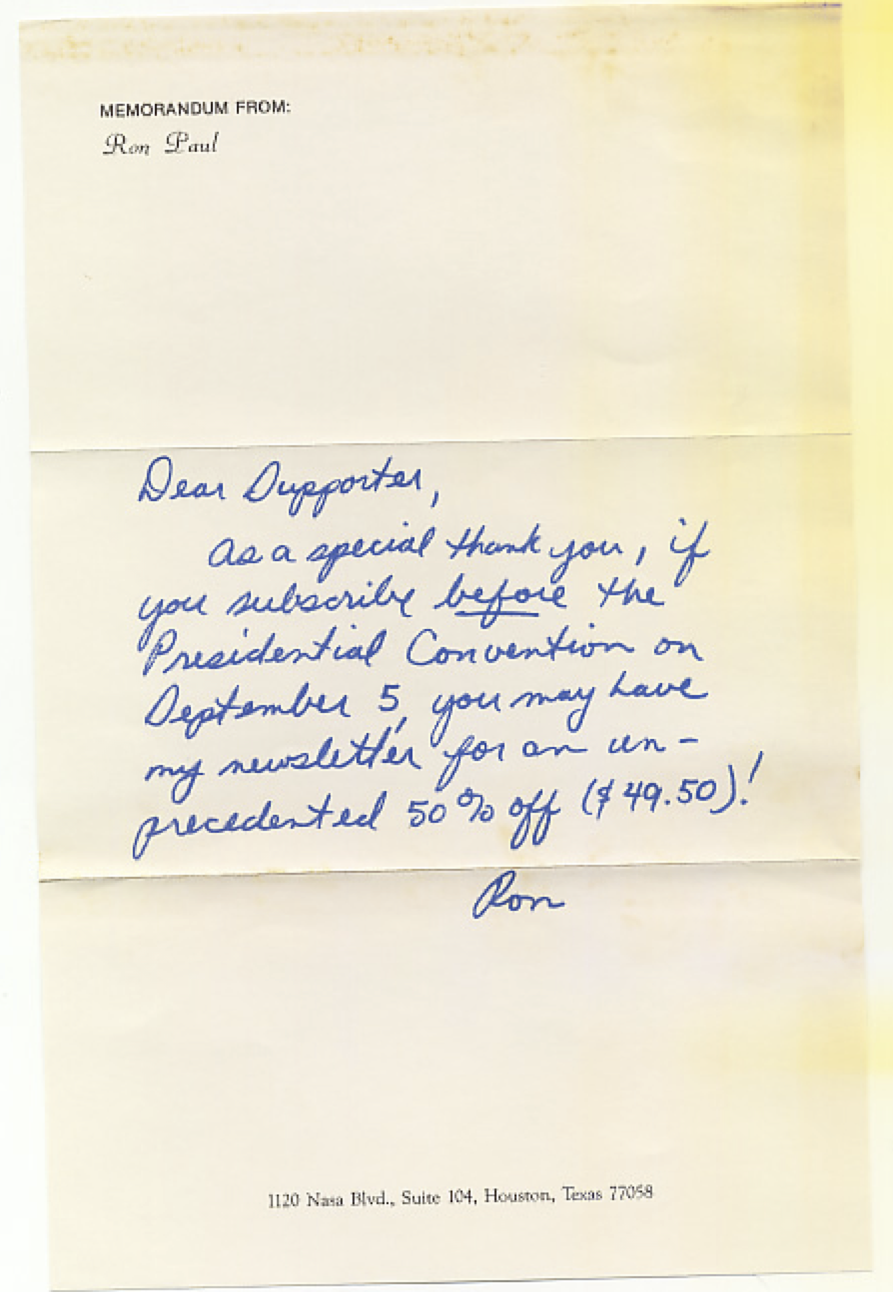
But none of that really matters.
He's the only candidate that I feel I could actually trust to stick by his campaign rhetoric, and the only one I would trust to actually defend the constitution.
Ironic, given that we have a constitutional scholar in the White House and a historian running for the GOP nomination.
Ron Paul is wrong on some things I care about, but so is Obama, and certainly so is Newt or Romney. I think I'll vote for the lesser of a dozen evils, and go with Paul.