Great idea. What's worked for me is simply taking a 20"x20"x1" filter and sliding it into the back cover of a standard $25 Lasko box fan. Cheap, easy option for air filtration in the home.
Yes! This is the basis for the Corsi-Rosenthal Box [1]. Five 20"x20"x1" filters and a box fan, with duct tape to seal the edges. Not the prettiest, but it's effective.
> An updated design, also known as a Comparetto Cube, [1] uses four filters and a cardboard base that can sit directly on the floor.
I never understood the purpose of the bottom filter in the Corsi-Rosenthal Box, so it felt like a waste of a filter, but I'm a big fan of the Comparetto Cube (no put intended). And 4 packs of filters are readily available -- 20x20x2 is suggested for the Comparetto Cube.
[edit] Also, thank you. I couldn't recall the Corsi-Rosenthal name/link, but thought of the wiki immediately.
> I never understood the purpose of the bottom filter in the Corsi-Rosenthal Box
It's for when the box fan is not sitting on the floor - either raised up on feet (which many have), sitting in a window, or hung somewhere. That said, you're right - 4 packs are easier to come by and probably work nearly as well in the real world.
I have been focused on HVAC / air purification recently.
Its amazing to me that these designs are less than two years old when the tech has been available for decades.
One of the biggest problems with the C-R and comparetto is that they are large and hideous to look at.
I have been working on a design that makes the C-R or comparetto or a smaller version than the 20" something that can be attractive enough to hang in the corner of a room as both an air purifier and room lighting.
It’s true. I don’t think popular, consumer grade luggage for the middle class had wheels until the 1970s. And if you watch for these kind of details in popular culture, I don’t think you even see wheeled baggage in the movies until the early 1980s. I couldn’t tell you the reason, but I think this was one of those status, income and class things: "I can afford to have someone carry my bags around."
It's easy to add "legs" to the C-R device - a few dollars at most in wood dowels and no tools, for example. Maximizing filter area is really important because flow vs static pressure for a fan like this is usually logarithmic...and static pressure rapidly rises as the filters get used (their efficiency goes up, but flow drops.) That's one reason you see a lot of squirrel fans used in air filtration units; they can generate much more static pressure.
In theory, if you mounted it fan-down and placed some towel or blankets underneath, you could also dampen a fair amount of the noise coming from the fan.
It's probably more effective and cheaper to get thicker filters. A 20x20x5 filter has five times the filter surface area of a 20x20x1 filter, but costs $36 - about 2-3x as much as a 20x20x1. Two 20x20x5 filters would provide twice the filter surface area.
But...these solutions were all intended mostly for emergency situations where purpose-built air filtration units were in really constrained supply. Folks should really just buy a regular air filtration unit that uses much less electricity and is quieter, especially if it auto-adjusts speed depending upon need.
> Folks should really just buy a regular air filtration unit that uses much less electricity and is quieter
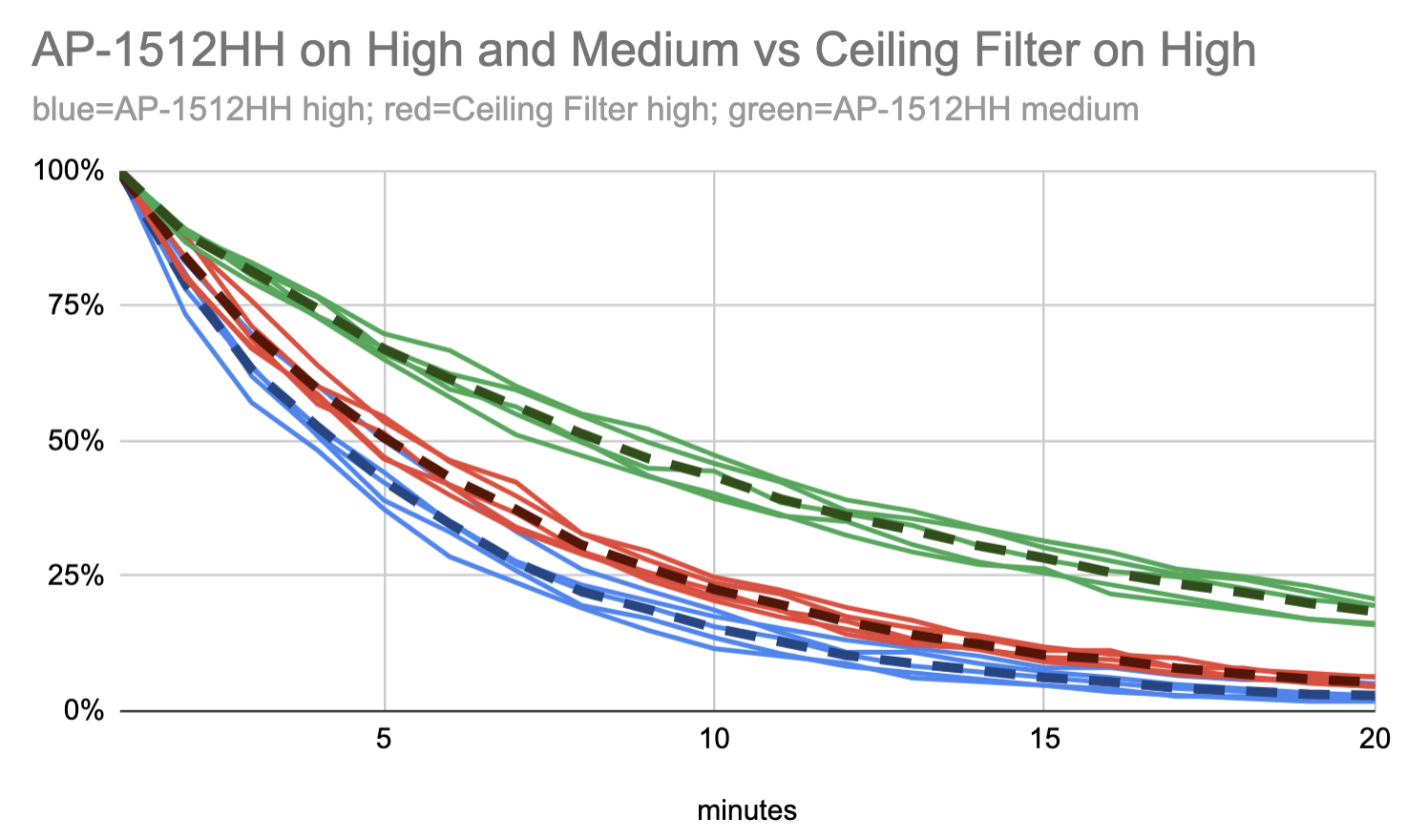
This post is about how one of these made with a ceiling fan can be much quieter than a regular air filtration unit: "Testing my prototype, it has a CADR of ~180 CFM and is only 33dB. By contrast, the Wirecutter's top-recommended air purifier has a CADR of 233 CFM at 54 dB or 110 CFM at 36 dB. With some tweaks it should be able to match the commercial purifier's performance, without being louder."
> especially if it auto-adjusts speed depending upon need
I see how that works for wildfire smoke, but how would it work for covid?
virus in the air is dependent on effective filtration, rather than bulky particulate matter by volume.. the virus is highly contagious (few particles matter a lot)
That's not the same concept: that requires tools and woodworking skill. A CR filter cube requires only a box fan, duct tape, filters, and the box the filters came in.
It filters much more air with a single box fan. Box fans are optimized for flow, not pressure, and reducing resistance with four or five parallel filters means the fan can move much more air through its filters.
Vornado used to sell an air filter that took two 10x20” house filters. Before I discovered that model I was trying to build my own using computer case fans (my intent was to hide the loud box under furniture).
Home Depot used to carry those in the 1500 classification which was great, but those are getting harder to come by too, and even the regional chain that had them doesn’t as much anymore and I have to use the 1200 or once in a while the super basic ones. Or buy them from Amazon and fuck Amazon.
Air filters became a rent seeking gambit before the term rent seeking was even invented. We should just be able to use furnace filters. And speaking of furnace filters, if you have central air, do yourself a favor and change the filter religiously. Also helps slow down accumulation of dust in your ductwork, which makes it hard to ever get the house clean, though you can hire someone to come out and vacuum them out. They have something like a softer version of a chimney sweep’s brush with a longer handle. Last place we had them do that on like day 2 to avoid any problems from the previous owners.
The EPA disagrees with you regarding duct cleaning. It makes sense since anything that is sitting in your duct can’t be removed by the airflow your hvac generates. If it could be then it wouldn’t be in there in the first place.
I'm looking for data on the power usage and motor temperature difference from a 20" Hurricane in normal operation, with a 20" merv 14 on the back, a C-R and a Comparetto.
He has an addendum at the bottom where they tested the fans and saw no problems with a single filter. I... don't understand how they come to those conclusions based on the charts in the paper. All of the fans were >10ºC hotter and one model went up by 20. 15C is a lot for cheap, planned obsolescence consumer electronics.
They might be cheap, but I have never seen a box fan fail, and I have a few in service for many years.
Consider that they are designed for cooling in a window application, which means they must be able to survive operation 35C in direct sunlight. As an air filter, mine operates at 22C in shade. That easily makes up for the temperature differential due to load conditions.
Reminds me of this video that came from University of Michigan during one of California's fire season when many fires were ablaze and air quality was terrible:
I did this for a cheap dust filter when demoing a ~7 cu ft concrete shower pan in my house. Pretty incredible how much material it pulled out of the air; I ended up running through 3-4 filters total throughout the whole process.
This is very similar to what hobbyist mushroom growers use in our setups to inoculate substrate in a 'sterile' environment. Other methods include using sterile, hot oven air, buying very expensive equipment, and making a still air box at home with a plastic tote box. Good times.
I think a lot of those options are born out of creativity. Inoculation typically happens from jar to jar or from a jar to a block of substrate for instance. A Bunsen burner would probably work well for many applications in mycology. I only ever used one in cell bio, and only a mini Bunsen in my mushroom hobby.
Is that enough for allergens, smoke, and pet dander? I don't care about virus filtration (which is not going to happen anyway, if it's something I'm making out of cardboard and duct-tape)
You would be hard pressed to find much difference between one of the diy jobs and a hospital grade system (although you might need to add a UV light) assuming you use the same filters. The reason is, it's not about having some perfect seal with dirty air going in one side and sterile air coming out the other. It's about recirculating the same air over and over through the filter catching a little bit more particulate matter each time.
You're not getting a "guaranteed certified safe" environment with cardboard and duct tape, but there is no reason why you shouldn't be able to get a significant risk reduction.
You're trying to reduce the viral load in the air, not build a BSL4 lab.
I use a furnace filter (3M brand 2200 (merv 13) or even 2800 (merv 14)), and I tape smaller merv 13 filters on the outbound vents in the bedrooms. Those latter ones clearly need changing every couple of months as they become quite dark. So clearly the furnace filter is not sufficient, at least in my case.
I've had surprisingly good luck in my area finding brand-new furnace filters at Goodwill for quite cheap. HEPA, too. If you're making your own setup the size doesn't matter as much so that can be a good way to go.
Very cool, if I was going to build something like this de novo I would start with a squirrel cage fan. When you oversize them and run them at low RPM they can produce a startling amount of airflow with virtually no sound at all. You could also bump it up to a MERV 16 with enough intake filter area.
I too am a fan of the squirrel cage fan, and have collected a lot over the years. One excellent location to source them for 'reuse' are photocopiers. Old analog copiers can have as many as 4 fans while newer digital ones seem to have 2-3 depending on size/capacity. Mostly DC too, but I have also come across some big A/C fans.
They almost always are designed for higher voltages (i.e. 20+VDC) so when combined with a common 12VDC power source it's already been stepped down.
(source: used to work for a photocopier company, and when people bought newer units, we would pickup the old units and usually junk them.)
Old furnaces nearly always have big-ish squirrel cage blowers in them, and many are replaced before the fan motors fail for various reasons. In my area they are a reasonably frequent sight by the side of the road on bulk garbage day. If you get there before the scrap metal guys do, you could easily nab a blower.
They're typically 120V single-speed devices, although some newer ones may have variable-speed fans. Not 100% sure how most of them vary the speed; my bet is that they just have some capacitors switched inline with the fan motor to add reactance to the circuit and slow it down. (That would probably be how I would slow down a single-speed one to make it quieter, at any rate.)
There are a lot of projects online that you can find, showing how to build fairly big workshop air cleaners with a furnace blower and some cheap plywood/MDF/whatever. Basically you just build a 5-sided box around the blower with a hole for the outgoing air, and then mount a furnace filter on the open face of the box.
There doesn't seem to be good control tests to say what difference the filters really make - seems one was added in in the comments, but it's missing important details (is the control with everything off? What happens if the fan is running on medium or high, etc.?
And, of course, it's not really practical in that most people really don't want to be sticking stuff on their ceiling, but it could be an interesting experiment with more details provided.
I was thinking the same thing. He has graphs for how quickly the pm2.5 levels reduce compared with a commercial machine, but not compared with running the fan alone, without filters.
I believe that it is quite possible the majority of the air is not going through the filters. It seems that much of the air might spill out down the insides of the filters, rather than being forced through. In that case, the graph could be equally explained by the fan causing outside air to be sucked in.
I wonder if there is going to be an issue with the structural integrity of the filters, since they are designed to rest on an object rather than hang? Wouldn't think it would be a big issue, but possibly? If you were wanting to do this long term, feels like a series of light wood frames to support would not be too expensive/difficult to construct or possibly 3d print, and have advantage of reduced adhesive smell.
Most filters (especially the 1" and thicker ones) are surprisingly sturdy across most dimensions except for torsion.
Thinking about 3D printing, you could probably print a nice corner bit, that would hold the corner of 3 filters together and square to each other. That would make the whole assembly easier to put together and seal up with tape.
As long as the filters are adequately supported at the edges it shouldn't be a problem. I know because my house has two 12x24 HVAC filters which are only supported at the edges and are almost certainly subject to much higher rates of airflow.
I think people are missing the point. YES this is bad engineering for a finished product:
- The fan is not designed for high static pressure. It won't do well pulling air through filters.
- It's ugly. It will get uglier as filters get dirty.
- It's expensive to replace filters.
- Etc.
But it's not a finished, industrial project. It's a prototype. Those sorts of issues are universal for prototypes. They're easy to address:
- Switch to a rotor design with higher static pressure
- Provide prefilters. Ideally, there's a nice cover, followed by a washable pre-filter, followed by a carbon filter, followed by the fancy high-filtration filter.
With an appropriate frame, it could be beautiful -- nicer than a normal fan. The filters could actually reduce noise. The frame could guide air (much as in a Vornado), increasing airflow.
Good job OP. It's a clever idea and a good design. It's a proof-of-concept implementation, but that's the point of a proof-of-concept.
(Unless you like the DIY aesthetic, which some do)
One way to reduce static pressure is to increase the number of filters. I saw one design last year, during the fires, that was a cube. Lasco fan on one side, and five filters tied into a box shape.
A couple problems. One, space - this thing was bigger than a dorm fridge. Two, availability - no way you were finding five filters during a wildfire. Three, etiquette - if you found five filters that meant two other people weren’t getting any at all. Four, diminishing returns. Two filters reduce the pressure by half. Another only reduces it by a third, and so on.
> Two, availability - no way you were finding five filters during a wildfire. Three, etiquette - if you found five filters that meant two other people weren’t getting any at all.
Filters last a long time unopened: buy them in advance and store them until you need them, rotating stock.
Sure, but that’s hard to do when reading a tutorial that was posted after the sky turned orange.
Edit: To your point though, help out the distribution networks by buying yourself an extra filter or two now, and put it on the shopping list every time you use one.
> To your point though, help out the distribution networks by buying yourself an extra filter or two now, and put it on the shopping list every time you use one
Yes! Socially we need to make a distinction between buying extras of things after an emergency has started (harmful) and doing it in advance (helpful)
If we're looking for a finished product, we're leaving a tool on the shelf -- filters aren't the only option. Pipe the air through a duct flooded with deadly UV-C and sterilize the air instead of just filtering it.
If you have a whole-home furnace you can often make it run the fan even if cool/heat is off - and install a high power filter and change it regularly and it’ll filter the air reasonably well.
The ecobee has a “minimum fan time per hour” setting - it can also help to balance the air temperature.
My dad worked in AC his whole life. Do not put a constrictive filter on your ac. He even recommends the cheap ugly ones as they are the least restrictive. The AC is not meant to filter air. The only reason it has filters is to keep large particles out of the evaporator coils.
When I upgraded my HVAC system, the installer recommended an AprilAire filter box, I uses a 4" high pleated filter, each MERV-13 filter has around 16 pleats, so if you unfolded it, it'd be around 10 feet long.
Comes with full warranty from the manufacturer, so I don't think it's going to shorten the lifetype of the system.
I wouldn't put a regular flat MERV-13 in an existing HVAC system, but the pleated ones have so much more surface area that they seem safer.
It "may" reduce efficiency, but as long as you don't restrict airflow too much, it seems unlikely to damage anything. It's not like restricted airflow puts stress on the AC blower. In fact, less airflow creates more of a vacuum and causes the fan to draw less energy.
The one thing it can do is cause your equipment to run longer (because of the lower efficiency) thus wearing things out quicker. But, most HVAC systems are not nearly as "fine tuned" to the size of your house as many might think. Most traditional HVAC systems basically have 2-3 speed settings for the fan depending on home size. There is a lot of play between those rough settings where a bit more filtration is not going to put it out of recommended ranges.
I have a very high Merv rating filter on mine plus a charcoal filter, but I change it out every 3 months or so.
Compared to the standard, cheap, barely there filters, the run time and energy usage difference is not enough to notice.
You don't want to restict the total amount of flow, but with more media area you can have a tighter filter media with the same (or even better!) total flow.
A thicker filter and/or one with more pleats can filter better and be less restrictive at the same time.
I've had HVAC techs tell me not to use those thick filters unless your system is designed for it. They make the fan work harder to pull less air. This reduces how much air it can move.
A good system like an AprilAire [1] will have a 4" thick filter vs the standard 1" thick filters. This allows much more filter area than a standard filter allowing proper airflow even with a finer more restrictive filter medium.
You can't just swap filters, the 4" thick one usually go in right before HVAC air handler intake rather than at returns. I have had an AprilAire installed for over 10 years in my HVAC when it was replaced last time, recommended by HVAC installer, its has worked very well and I do have my blower fan cycle constantly regardless of need for heat/cool to turn over and filter air.
You can have them do a test and adjust the system depending on the filter that's installed to make sure it's moving enough air (though that is mainly important when heating to prevent the heating element from overheating).
It is also important in the cooling cycle for two reasons.
1. If there is not enough air moving over the air-conditioner coils there is the possibility that they will ice over. This has a cascading effect where there is less transfer through the coils and more ice builds up until the whole thing is a block of ice. This most often happens though when people buy condensers that are too big for their system (the thinking being the bigger the better the more cooling, but it is a balance within some tolerance) but can also be done on the other side by reducing airflow too much.
2. Less airflow can also mean too much condensation in the air which can end up sitting in the ductwork and causing it to rust out. This happened to my parents when they installed extra filters in their HVAC system. I guess this is similar cause as #1, just different potential effects.
I have been told a different take. The amount of airflow over the coils is important as the compressor system also expects a certain thermal exchange (think air conditioning) and thus a certain pressure on the return.
Less air over the coils can inhibit the cooling properties, this was conveyed to me as high "head" compression pressure that can lead to premature compressor failure in the outdoor AC part, the expensive part. This is more important as the higher the SEER level, generally newer the system, the more sensitive they are to this issue. HVAC tech sold me with high head pressure expect failure of compressor in a few years.
Also you are running as efficient since the AC has to work longer burning electricity.
I've always heard this, but I don't know that that's true. The thing that dies first on an HVAC system isn't the motor, it lasts a long damn time, it's the capacitor, or contactor or some other fault not really related to the motor work load.
Plus, your "motor" isn't an engine, it's not variable speed, it only has one "hardness" that it works at. It might push less air with the thicker filter, but it's not going to ramp up and consume more wattage or anything like that.
It's usually a misunderstanding of how furnaces "work" - the blower motor does its thing and doesn't really "spin up or spin down" depending on the load - it just moves more or less air.
The problem is (especially with older furnaces; modern ones have safety features to prevent this) that if you have too much back-pressure you don't get enough airflow over the heat exchanger (or air conditioner coils) and it can crack - allowing dangerous exhaust gasses into the airflow (or freezing the coils for the AC which isn't as bad).
Once the heat exchanger is gone the furnace is basically trash and has to be replaced (you can replace the heat exchanger but it's rarely worth it).
> The problem is (especially with older furnaces; modern ones have safety features to prevent this) that if you have too much back-pressure
An everyday way in which people induce this scenario is by shutting the heating vents in particular rooms because they get too hot. Even on the newer furnaces, this results in the automatic controls shutting off the burner when the pressure and temperature gets too high, and then the fan starts pushing around cold air.
A secondary negative effect of this is that it pressurizes the ducts causes them to leak more, resulting in reduced efficiency, and also quicker failure.
A well designed system which has been configured to deliver the correct amount of heat to each room doesn't experience the same issues. Unfortunately, most older homes and even newer production built homes have poorly designed HVAC systems.
Heat pumps don't experience as many of these issues because they just don't get air as hot, and instead rely on higher throughput of lower temperature air to heat spaces, but that makes them far more reliant on good duct system design.
>Plus, your "motor" isn't an engine, it's not variable speed, it only has one "hardness" that it works at.
This is incorrect - electric motors draw more current when under load. I would suggest researching this or playing with some toy electric motors run from a battery through a current meter.
> This is incorrect - electric motors draw more current when under load.
Which is a true statement but incomplete and therefore misleading. A fan motor is under the highest load when it is doing the most work. That is, moving the MOST air. If you restrict airflow (e.g. with a dirty filter), the motor is under less load and draws LESS current. A lot of people get this wrong because it's counter-intuitive on the surface of it.
You can test this very easily with a box fan and a kill-a-watt. Turn the fan on High in the center of the room and read the power. Now move it against the wall. You will hear the fan get louder because it is spinning faster, because it's doing LESS work. The meter will also show less power being drawn.
It is true that a dirty filter restricts airflow through the whole HVAC system. This extends the system's "on" cycle, which reduces the whole system's efficiency. But the popular claim that a dirty filter will burn out the motor is bunk.
I have a degree in electrical engineering, thank you for telling me to do my research, I spent four years doing that.
Sure, some motors have characteristics that can be tweaked to run at different work loads either with PWM, or allowing them to pull more amps to drive higher loads. Hell, you can even overvolt them and make them actually work harder.
That's not how HVACs work though. Have you ever opened one up and did a repair? The circuitry is dead simple, there's no current limiting setup or PWM to control how much the motor is pulling or spinning, there's no CFM measuring device to give the motor more volts or a higher amp limit.
The motor is simply pushing air. Air isn't something like a solid load where a motor might lift something or move a lever or gear, it's fluid. The motor is going to run at max and be done.
Ya, and restricting airflow reduces load. It may not be intuitive, but you can plug a vacuum cleaner into a meter and put your hand over the tube to restrict airflow. The load on the fan will go down because less air means less friction. In other words, it's easier to run a fan inside a vacuum. The louder sound you get when you put your hand over a vacuum cleaner tube is the motor speeding up because it has less load.
Maybe our disconnect is that we're talking about two different things, one being the rated design point of the blower system, which is presumably constant (though newer systems seem to be more sophisticated), and the other being the exact load and power consumption that depends on backpressure. A higher backpressure will certainly increase the motor power consumption on a classic induction motor - if not by 100% then by some non-zero amount.
Anyway at the end of the day I agree with the original characterization of wear and tear - motor and blower will probably outlast most other components. In the case of the one I mentioned this seemed to be true. You just may end up paying a little more for the electricity to run it.
> I have a degree in electrical engineering, thank you for telling me to do my research, I spent four years doing that.
Apologies for the tone!
> Have you ever opened one up and did a repair?
Well funny you should ask, but yes! Two times. One time, a power relay on the control module shorted and blew a hole in the circuit board. Had to replace the control module there. Another time, the start capacitor needed to be replaced on the giant 2KW squirrel cage motor. I removed the blower, disassembled it, lubricated moving parts, and of course tested it out on a stand. That much blowing power is quite impressive when right next to your face.
That's true, but it's not so simple anymore. Furnace blowers are all electrically commutated brushless DC motors now, and will ramp to keep a constant torque.
It’s a trade off though, because good filters will keep dust out of the HVAC systems innards, which according to the techs I’ve talked to makes a difference in longevity.
Matthias Wandel's secondary YouTube channel has a lot of recent videos about retail air purifiers compared to homemade ones using box fans. I'm not up to snuff on the science of it all, but he does a lot of cool comparisons on the effectiveness of each. Worth a look if you're interested in this sort of thing.
I like his channel. He is one of the few people you will see out there with almost an entire shop full of very useful, but completely diy woodworking tools.
I like your concept, can imagine it to look quite aesthetic.
Consider you need to create a fair pressure gradient between the two sides of the filter and it needs to be higher the more the filter clogs up. AFAIK radial fans are more efficient for that purpose. Downside is the noise.
If you are running the ceiling fan anyway just for the turbulence it creates on a hot day, it's probably fine even if just a small percentage of the airflow is pulled through the filters, your data certainly looks promising.
That’s why those filters are full of zigzags. The CFM/m² is very small, and so it can capture small particles instead of them zipping through. Also takes longer for them to clog up. Way longer than the oil change place wants you to think. The test of a dirty filter is that it looks dark when backlit, not when it is covered with surface lint. When they show your your filter, take it out of their hands.
That's kind of brilliant, tbh. The biggest downside that I can think of is that they tend to be electrically noisy and fairly space constrained. It'd have to be really small, but probably possible.
Kind of ugly looking... And that paint is probably coming off when the tape comes down
I had a new furnace/AC installed last year with a 4" filter. $50 CAD for a carbon filter and leaving just the fan on made a vast reduction in smoke smell during a wildfire or two from BC.
"people often select purifiers based on their maximum flow"
I don't know if that's really true. Looking at the top 20 or so Air Purifiers on Amazon, almost none of them mention the CADR or flow in the title, and very few of the reviews mention it. Most talk about sound, "HEPA", "ozone-free" etc.
My guess would be that people care much more about physical appearance than maximum flow. I would personally not tape an octagon of dirty air filters to my ceiling because that would be look ridiculous and probably not filter as well as my beautiful, silent $200 Winix box.
Neat idea however air filter changes would be extremely expensive as its about 5x the air filters of a conventional purifier - which already seem to cost around 50-100 dollars to replace.
The filters are MERV-14, not HEPA, so they're much cheaper ("materials for one fan are nine MERV-14 filters for $110"). See https://www.jefftk.com/p/merv-filters-for-covid for why MERV-14.
If you push air down, it's going to displace the air below it off to the sides, so I don't think it'll make a big difference.
My main concern would be that the filters limit flow, and thus it might be more likely to pull air up, causing a tight vertical loop (air goes down, turns outwards, and then back up while still inside the filter ring).
I don't really have a solid mental model of how air flow works, though. Some experimenting with the shape (and some colored smoke, perhaps) could be interesting. What if the filters tilted inwards to be slightly narrower than the fan's reach? Or if they were shorter than the ceiling-to-fan distance and just inside? Or does it help to put them further out? (Seems unlikely, but would be a good thing to test.)
A good reminder to change it at least. If this were a purchasable product, I envision making the filters replaceable and the frame compatible with some standard furnace filter size, so that you can just run to the store and grab new filters when you can visually see the filter needing replacement.
Contrast this with the furnace filter, which needs some other mechanism (often, a schedule) to determine when to change the filter since it's not readily visible on a daily basis.
I read on the internet, that HEPA filters actually just filter better when they start getting clogged. But clogging increases air resistance, so you need higher power level in the fan to get the same throughput. So the economics calculation is, the cost of new filters vs. the cost of electricity of running the fan and eventually the cost of a new fan. And the comfort factor is more noise when the fan is running at higher power level.
So running the filters a long time before replacing, might be the cost-saving option.
Nice work! I built a "Corsi cube" using 4x 20" filters and a 20" box fan. Some simple extrusions for the filter corners would be a win (and probably a good basis for a DIY kit).
Since the Corsi cube can be hung from the ceiling (it looks weird being a cube hanging up there) but it is ungainly. This is a much more elegant solution.
Is nobody going to mention what a pain in the ass it would be to change all those filters regularly? I love in a somewhat dry and dusty area and need to change my filters (near the ground) every two to three months. I'd hate to have to climb up a ladder to change eight to nine filters that often.
Unless your ceiling is very high you probably wouldn't need a ladder to change the filters on a productized version of this. Reach up, twist something to unlock, old filter slides out, slide in new filter, twist to lock. Repeat for each filter going around. Ten minutes every six months?
Not to forget, you'll have a looming black octagon after 6 weeks or so already depending on your environment. At least a reminder, that the filters are doing something useful.
Great idea! I thinking about make something similar (with one very big prop) for computer cooling system, and also it could be beneficial to make computer case with purifier filter, why not.
I mean if it works, but it's also the ugliest thing I've seen. It's up there with those plastic covers for furniture. A standalone air purifier in the corner would be less noticeable and ikea even makes a table with a hidden one: https://www.ikea.com/us/en/p/starkvind-table-with-air-purifi...
Aesthetics matter. Now if you could somehow make the blades the filters, that would be badass.
Aesthetics only matter for the extremely insecure.
I for one would happily proclaim “my shitty looking box fan contraption that costs $100 outperforms your $700 dyson by a decent margin”
Why lick the boots of brand centric corporations. Maybe you’re one of those “lifestyle brand” people… I think that’s code for no originality or personality.
A box fan with a filter looks infinitely better than filters taped to the ceiling... I have a dyson air purifier because the sound profile is different and doesn't keep me up while I sleep. In the room with my 3d printer I have the jankiest air purifier I could find.
If you're ok with this contraption taped to your ceiling, while having guests over, more power to you. This of course would be totally fine if you lived in a state dealing with wild fire smoke I will say.
I agree - I love the enthusiasm for IAQ, the data is fantastic - but find a conventional white good stand alone room air purifier “RAP” and it will be as effective, better designed, and likely in the same cost range once changeouts are considered.
Founder is very supportive, good product, easy to build
The sensor will display PM2.5, CO2, Temperature and Humidity on the display and can optionally send the data to any server for data logging (e.g. the AirGradient platform or any other cloud backend).
Parts:
Wemos D1 Mini USD 2.24
Wemos OLED display USD 2.47
Plantower PMS5003 PM Sensor USD 13.89
Senseair S8 CO2 Sensor USD 28.00
SHT30 or SHT31 Temperature and Humidity Sensor Module USD 2.55
We run one of these (https://www.adafruit.com/product/4632) off of an Arduino Uno with a small LCD hat (w/ micro SD for logging as well). I think that's the same sensor as in the outdoor units that Purple Air sells. ~$150 for the whole setup, but could definitely run that off a smaller / cheaper board, display only. Going strong for 2+ years at this point.
That looks extremely cheap and ugly, I would be embarrassed to have company over. I'll stick to my True HEPA Coways, which you can get for roughly the same price as this DIY contraption.
High ceilings will help. Next step would be to add paint the joints and latticework (or run some colorful tape), and maybe add some LEDs.
Black light tape along the latticework, black light at the top of the room. Other lighting is all dim lighting in the lower half (warm lamps).
I dunno. It'll be hard to make this not look weird unless you do something crazy, like a drop ceiling so the fan and filters are inset. If the aesthetics are important, I'd put it on the home office (out of view from Zoom) rather than the living room.
I going for aesthetics I might just put them in the ceiling and have what appears to be low profile vents that one might not even notice. That would keep most of the noise in the ceiling. One could build an enclosure that the HEPA filter unit sits in and routes the intake/output to different ceiling vents.
With a little extra effort the filter could be swapped out by removing/lowering the vent intake.
My intuition says most airflow comes from the center(and drops linearly towards the tip of the blade and picks up at the blade)
i.e. there's no need to build a filter the size of the fan; you can cover "most" of the airflow by using something similar but extends 50-60% of blade length(pure guess) and the whole arrangement can be above the rotating plane (so easier build?)
I love the enthusiasm and DIY ingenuity here. That said, the post is tagged with COVID-19. The COVID virus particles are .1 to .5 microns in size, and these MERV-14 filters, while certainly better than nothing, are not going to capture a significant amount of these virus particles. A better approach is to not filter the particles, but actually rip them apart at a molecular level. This has the added benefit of destroying all sorts of other contaminents that even high grade HEPA filters will miss, such as mold mycotoxins. A system like the Molekule is a good example of this approach.
1) MERV14 will capture 75%-84% of particles in the 0.3-1μ range.
2) A filter which captures 70% of particles with an air flow of 100cfm will capture the same amount of virus as a filter which captures 100% of particles with an air flow of 70cfm. Both will clean the room just as fast. For air filters, lower filtration + higher airflow is usually a better design option. Going from 70% to 95% to 99.9% means you'll have a more expensive, power-hungry, and more noisy product over one which just has a little bit more air velocity [1].
3) The rating is for 0.3μ since that's the hardest size to capture. A filter will actually capture more particles below 0.3μ.
4) COVID19 virus particles are around 0.1-0.2μ, but that's beside the point. They're travelling on water molecules. Those are much bigger.
5) Even if there were a virus particle somehow floating around, a viral load of one virus is very unlikely to get you sick.
From an engineering standpoint, something around MERV14 is almost certainly the sweet spot for a COVID19 room air filter.
[1] High-filtrations makes sense in places like vacuums, face masks, and other places where the goal is to have clean air coming out. Vacuums shouldn't blow up dust. That's a different engineering design goal than a room air filter. If you'd like to see the impact of loading on a fan, put your hand behind one, and hear how much noise goes up. MERV14 has a much lower load than HEPA.
2) It will not clean the room just as fast, it will take longer to clean the room.
4) COVID-19 particles do travel on water molecules, but they are also airborne. The CDC has admitted this and there is a growing body of research proving this to be true as well.
You're making statements with no backing, logic, or argument behind them.
2) The percent of material removed by a filter per unit time is the product of (1) filter efficiency with (2) what percentage of a room's air passes per unit time.
4) "Airborne" is generally via microscopic droplets. The CDC's guidance changed from large droplet transmission (which is relatively short-distance and short-time) to airborne. This doesn't mean individual viruses are floating around without any H20.
5) No one credible believes 1 virus particle is likely to infect you, except by very bad luck. Most citations give claims in the 100-1000 particle range. Low initial infectious dose also /appears/ to correspond to less aggressive infections. This has not been rigorously proven (and it's hard to do), but has a strong theoretical basis:
- One virus particle is unlikely to make it past the mucous layer, unless you're super-unlucky.
- If it does, your innate immune system can usually handle minor infections before they escalate.
- If it can't, your adaptive immune system has more time to respond. You're looking at a few days before it kicks in. With a lower initial infectious dose, you'll still have that much less virus when it kicks in.
If you'd like to contradict any of this, please provide citations. I'll read them. I'm glad to be proven wrong. Perhaps I'll learn something.
> > A filter which captures 70% of particles with an air flow of 100cfm will capture the same amount of virus as a filter which captures 100% of particles with an air flow of 70cfm. Both will clean the room just as fast.
> It will not clean the room just as fast, it will take longer to clean the room.
Here are two different models:
A. Air moves sequentially. First you filter all of the air once, then you filter all of it another time etc. In this model, a filter with 100% efficacy will get everything in a single pass, and the CFM determines how long that pass takes, while a filter with lower efficacy will never get it all, but will get pretty close after a few passes. In this model you want high filtration.
B. Air moves randomly. At each minute, the purifier selects air from the room at random, filters it, and spits it back out. In this model, a filter with 100% efficacy at 70 CFM is exactly equivalent to a filter with 70% efficacy at 100 CFM, and you will often want to trade off efficacy for flow.
I think real rooms are generally much closer to (B) than (A), though of course somewhere in the middle?
Brownian motion affects how small particles move around at small scales [0]. This is why HEPA filters can be effective even against smaller particles (which bounce around and get caught).
Specifically about the Molekule - their claims seemed to be empirically false and the device performed worse than a standard HEPA filter (and they were resistant to allowing independent tests at all).
When the tests came out awful their responses were mostly bullshit. [1]
Is this legit? Their website feels kinda sketchy to me, with the huge and somewhat tacky CG pictures, sweeping claims, apparent SEM photography that just looks too good to be true (could there really be zero residue? and the background never change, presumably over time span of at least minutes!) This really reminds me of vaporware like WaterSeer, or one of the recent "turn kitchen garbage into dry dust" appliances that I've seen ads for
In the summer of 2019, we purchased a Molekule Air (the flagship model) and tested it. We bought an Air Mini that fall and tested it in February 2020. At the time we tested the Molekule Air, the company claimed that its “scientifically-proven nanotechnology outperforms HEPA filters in every category of pollutant.”
Our tests proved otherwise. And by mid-2020, that language had been withdrawn, after many of the company’s claims were ruled against in a case before the National Advertising Division and upheld in a later appeal before the National Advertising Review Board. The Molekule Air turned in the worst performance on particulates of any purifier, of any size, of any price, that we have tested in the eight years that we have been producing this guide. The Air Mini outperformed it, but that’s not saying much: It still produced the second-worst performance we’ve ever seen.
Guide author Tim Heffernan asked Molekule CEO Dilip Goswami why the language was removed. He answered, “The point about ‘in all categories’ is that we see a device that outperforms across all of the categories. Right? So we’re not trying to say that individually, on any particular metric, we would be number one. Right? What we’re saying is, when you look across all the categories, we outperform HEPA. Right? And that’s what we’re attempting to convey with that. And so—it’s fair to say that we needed to re-examine some of the language to make sure that it’s saying what we’re intending to say.”
And, I will say that they have numerous tests by independent labs. They did do some testing with their own lab and with a lab affiliated with them, but this is far from all the testing they have done. So to say that all their tests were tainted or affiliated with them is simply not true. See: https://molekule.com/papers