The etymology of the word has nothing to do with race.[1] There are many uses in the English language where colors are used as descriptors in ways that have nothing to do with race.
Do you think we should ban the terms blackout, blackbody radiation, black holes, black ice, black ops, and black markets? Not everything is about race.
> The symbolism of white as positive and black as negative is pervasive in our culture. Watts-Jones has highlighted many terms with negative meanings that reference blackness. In the English language, she wrote in 2004, color is “related to extortion (blackmail), disrepute (black mark), rejection (blackball), banishment (blacklist), impurity (‘not the driven snow’) and illicitness (black market).”
The point isn't to proof that these words are bad, the point is that people have already called for banning these words. 5-10 years ago you would have had similarly "bad" sources for banning blacklist et al., and yet here we are.
> In Old English, the adjective could mean “very evil or wicked; iniquitous; foul, hateful,” according to the dictionary. The earliest Oxford citation is from a scientific and theological treatise written by a Benedictine cleric in the late 10th century.
Not only that, but those colors have similar associations all over the world, for example in India and Japan. It has to do with nighttime/darkness having foreboding/negative implications.
> Berne notes that the ideas of light=goodness and dark=badness existed in ancient cultures (including Egyptian and Greek), and can be found in Asia and around the globe.
> Joseph Campbell, writing in the journal Daedalus in 1959, says it was the Persian philosopher Zoroaster (circa 600 BC) who put the seal on the concept of darkness being evil.
Yes, black vs white is a very old concept. Why do you think europeans started referring to people from africa as black and themselves as white, when they are really more like pink and brown?
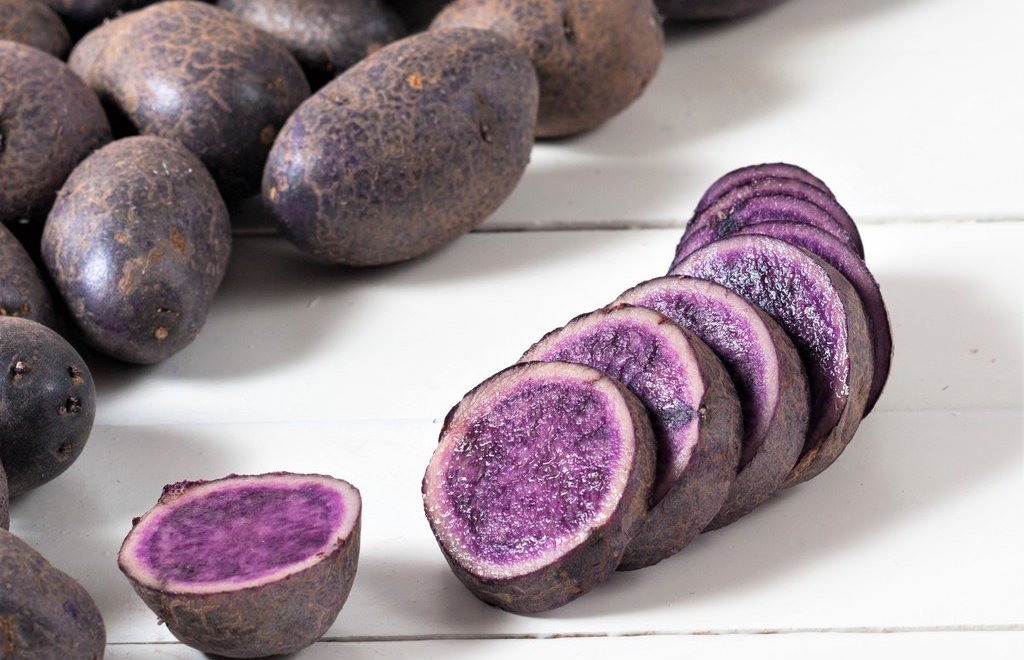
Ever notice that purple foods tend to be called either red or blue (or sometimes black if they're dark purple)? Like red cabbage, red onions, red grapes, blue potatoes[1]. Or for that matter how white grapes are green and black walnuts are brown? How black eyes are usually purple?
English just seems to have a strong preference towards approximating everything with the most basic colors.
Europeans also called native Americans red and Asians yellow, and it probably wasn't because they associated those colors with evil.
All people are shades of brown. White people can be pinkish, but are usually light brown or reddish light brown. When you look at this white man's [2] skin color next to the light brown wood he's working with, he's clearly a darker brown than the wood. But I imagine Europeans didn't want to label races as light brown, medium brown and dark brown.
This is interesting. I plugged them into Google ngram viewer. Whitelist was almost unused until 2000. Blacklist came into use right after the Reconstruction era (may or may not mean anything), but it has two peaks in use: WWI and WWII. I was expecting McCarthyism, but it wasn't as popular as during major wars.
Blacklists's first known usage in English comes from England in the 1600's, specifically referring to a list of people who were involved in the execution of Charles I. Its origin literally has nothing to do with race.
I personally like using “blocklist” instead of “blacklist” but that paper is pretty terrible. It seems more like an opinion piece with a bunch of references to give it authority.
Here’s a critical piece of the “evidence” presented:
“In this context, it is worth examining the origins of the term “blacklist” from the Douglas Harper Etymology Dictionary, which states that its origin and history is:
n.
also black-list, black list, “list of persons who have incurred suspicion,” 1610s, from black (adj.), here indicative of disgrace, censure, punishment (attested from 1590s, in black book) + list (n.). Specifically of employers’ list of workers considered troublesome (usually for union activity) is from 1888. As a verb, from 1718. Related: Blacklisted; blacklisting. [32]
It is notable that the first recorded use of the term occurs at the time of mass enslavement and forced deportation of Africans to work in European-held colonies in the Americas.”
Seriously? We clearly need to rethink the whole academic publishing process.
Excuse me but "person" contains "son" in it which is indicative of gendered childhood, and heteronormative reproduction.
This is highly problematic for children and adults who identify as children who may be struggling with their gender identity; as well as those who chose to reproduce through non-sexual or non-heterosexual mechanisms.
Please refer to them as per-offspring potato heads instead.