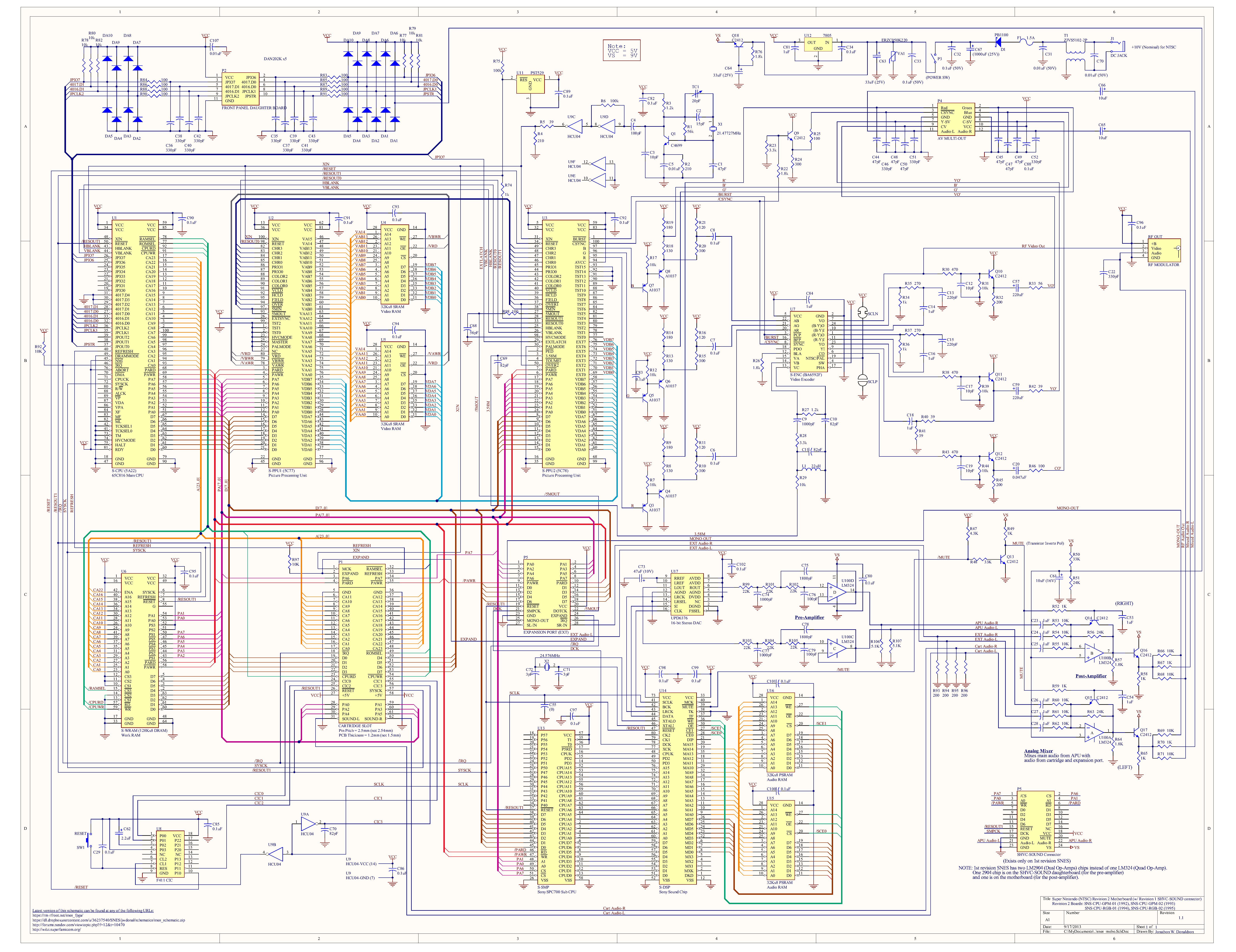
The Famicom and SFC were both the most powerful consoles on the market in most regards when they came out, too. I'd say that rather than the N64 being an exception, this strategy only really solidified after the back-to-back quasi-failures of the N64 and the GC.
Hm, but couldn't you say the hardware in the SNES fits the description above; the 65816 was essentially last-generation 8-bit hardware with some modifications for 16-bit/24-bit addr support. They went this direction while most everyone else was going 68000. Remember this is the era of the Amiga and the X68000 and many arcade games were going 68000 based.
They then bolted that to some pretty good video hardware but again it wasn't the kind of bitmap addressable blitter supported hardware that was out there on more advanced systems. It was still sprite/tile based stuff, with specific hardware support for common character-movement/scrolling/sprite/tile management, basically a more advanced version of what early 80s gaming systems had done.
The SNES was built to be a dedicated 2D gaming powerhouse, and in 1990 nothing came close to it. Yes, it was basically a more advanced version of what early 80s gaming systems had done - but it was the most advanced version of what they'd done. Its direct competition was the PC Engine and the Mega Drive, and it smoked both of them.
Comparing it to arcade machines and computers isn't really fair - totally different price points and market segments. But outside of high-end workstations nothing could spit out the kind of visuals the SNES was in 1990. The Amiga 500 was, what, like $500 in 1990? At least double the price? And that could display a mere 32 9-bit colours on-screen, two background layers, no alpha, no scaling or rotation. PCs were starting to come with VGA cards standard, but you'd need to spend at least 10x as much on one to get a CPU that could do much with it. And that's not even getting into the sound hardware!
The 65816 was an unorthodox choice to be sure, but you're doing it a bit of a disservice: it's still a fully 16-bit CPU internally, and even at ~1/2 the MHz the performance delta between it and the 68k is generally overstated (because the 68k is such a cycle hog), especially for the kind of calculations 2D games tend to do.
Anyway - weaker CPU + powerful video hardware (that gets outmodded by home computers within the next two-three years) has been, with few exceptions, the model for high-end game consoles since, well, at least the SNES. It's true of the PS4/XB1, it was true of the Xbox 360 (and the PS3, sort of, the whole Cell thing is complicated), it was true of the GC...CPU is rarely the bottleneck for games, so as a rule console designers don't get too spendy there. Exceptions might be the N64 and the Xbox, although even they had CPUs that could best be described as mid-range for their release dates.
The SNES took a several years old, cheap CPU used in early PCs, and added some good 2d graphics capabilities. I wouldn't call it a powerhouse, but it was powerful for specific use cases/types of games.
Comparing to PCE and MD is interesting, the differences in capability seem roughly in line with the different release dates. Being first to market doesn't work in the industry and many consoles were skipped by most consumers. These days MS and Sony are synchronized in terms of release dates, and Nintendo does it's own thing, releasing whenever they feel like it.
GC is kind of interesting, it's kind of halfway between the high performance target of N64 and the philosophy of older hardware + something unique.
Never thought of the 65816 as a supercharged 8-bit CPU but looking at it, that's really not far from the mark.
> bitmap addressable blitter supported hardware that was out there on more advanced systems.
In 1991 when the SNES hit the states you had the Genesis, which was also sprite based, and I think the TurboGrafx-16, which was also sprite based. All of your arcade games of the time had those insane CPS-2 like sprite engine. Maybe CDI was out by then, but I don't think that thing had any graphic acceleration.
I've done plenty of 816 programming and it is basically just a 6502 with a couple 16 bit registers and ALU (accessible only by switching register modes, quite awkward) and a 24-bit address bus bolted on with a page register. Program counter, etc. wraps at 64 boundary, stack can only exist in the bottom 64k, etc. It's really a supercharged 8 bit CPU, yes. They probably made the right choice with it, though, it makes some sense for a game CPU because interrupt responsiveness and cycle efficiency is primary there, and the 6502 series is king for that.