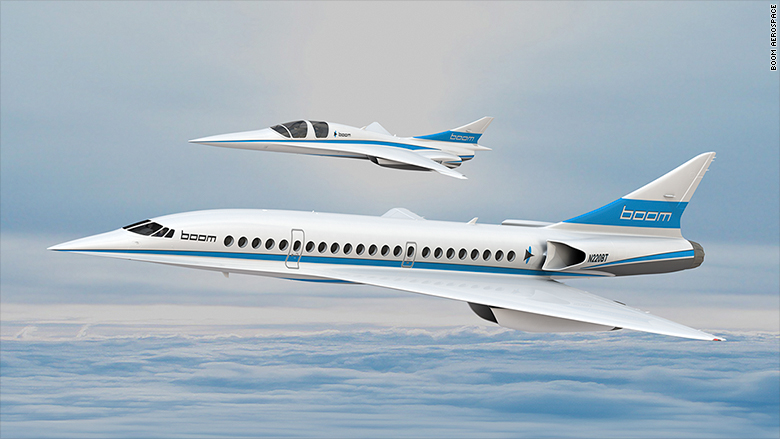
That pilot interface looks really nice. Not used to seeing a single seat like that for commercial planes. Although I'm guessing the real one will be scaled up.
If I recall correctly the Concorde used about 2 tonnes of fuel rolling on the ground alone.. I wonder how this new aircraft fares for fuel consumption?
I believe the Concorde is a marvel. You could travel faster than the rotation of the earth in it! However I don’t think we need more environmentally unsustainable travel.
Looking at the Concorde's fuel usage taxing is only part of the picture. All turbine engines are very inefficient at low power outputs due to the need to use energy to create sufficient compression for them to function. On top of this the Olympus engines generated a lot of thrust at idle, so much so that only two were used for taxing and it was still apparently tricky to control.
While cruising at supersonic speeds the engines were actually the most efficient machines of their time achieving 43% thermal efficiency [0]. Despite being very efficient they still had high fuel consumption rates as the total amount of energy required to sustain those speeds is a lot higher than subsonic.
Modern jet are in the 50%s thermally efficient [1] but despite airframe improvements there has been no way to improve fundamental aerodynamics so that supersonic energy costs aren't high.
The Concorde did use reheat to take off and break the supersonic barrier which is very fuel inefficient.
Using a modern airframes and engines that also don't need reheat will reduce fuel consumption but not to a level anywhere similar to a modern jetliner.
That's why you have tugs to move jets around - back in ww2 the Me226 was towed up to its start point on the runway by a Kitenkrad (and in some cases horses) to save fuel and engine life.
I think the industry was thinking of having electric tugs or motors built into the plane to move passenger jets around on the ground to save the fuel used getting from the stand to the start of the runway.
You narrowly missed the opportunity to write "Kittenkrad", which sounds like the cutest form of transport yet conceived. Or, of course, "Kettenkrad", the german half-tracked motorcycle/tractor hybrid from WW2.
I'm a bit suspicious of the qualification 'thermal' in 'thermal efficiency' which sounds like it's hiding something. From the wiki article on thermal efficiency https://en.wikipedia.org/wiki/Thermal_efficiency, and I'm no wiser for reading it:
"For a heat engine, thermal efficiency is the fraction of the energy added by heat (primary energy) that is converted to net work output (secondary energy)."
Does thermal efficiency = actual efficiency in the case of jet engines? I find that difficult to believe.
A heat engine is a device that converts heat into kinetic energy. The amount of heat that is converted into movement as a proportion of the total heat is the thermal efficiency. With a jet engine it's the amount of energy in the burnt fuel that's converted to both rotation in the shaft and the speed of the expanding burnt gasses exiting the back.
Propulsive efficiency is how good the engine is a converting this energy into thrust. The Concorde's engines were a type where all the propulsion was from the fast gasses exiting at the back, i.e. a turbojet. Efficiency is less than 100% as energy is taken from the gasses to power the engine and not all the gasses exiting the rear usefully push the aircraft forwards.
I don't have the exact number for the Concorde to hand but looking at [1] from my previous post, we can see it was typically around 60% in 1970, but these numbers are likely for (low bypass) turbo fans. These work in a slightly different way where they have more energy in the rotation of the shaft and less in the gasses going out the back. The energy in the shaft drives the big fan at the front which pushes a large volume of air more slowly out of the back. This is to address the problem of the gasses which exit the back but don't usefully push the aircraft forward.
To get the total efficiency of the jet you have to multiply the thermal efficiency by the propulsive efficiency.
> To get the total efficiency of the jet you have to divide the thermal efficiency by the propulsive efficiency.
Also need to consider combustion efficiency (i.e., the percentage of fuel turned into heat as an input to the heat engine), though for gas turbines this is typically ~99.9%.
Yes thermal efficiency is a common rating for engines that work by burning fuel to make heat then turn that into useful power. You take the theoretical energy in a litre of fuel and work out how much of that the engine can convert into useful work.
The reason for that is that the concorde used afterburners (basically, pump fuel into the high speed exhaust for extra thrust) which are incredibly inefficient. Great for a fighter jet where you need a sudden burst of extreme thrust, but not something you want a long-haul airliner to use.
Boom uses turbofan engines to reach supersonic speeds which are much, much more efficient. In fact, many airliners could theoretically go past mach 1. The reason they don't is that the airframe itself doesn't have the correct shape to deal with transonic and supersonic speeds.
I'd expect fuel consumption to be higher than a typical passenger jet but nowhere near concorde levels. Fuel consumption would also depend on the climb profiles of the plane, ideal cruise altitudes, etc. Since the more time you spend in subsonic flight and at lower altitudes the more fuel you burn (more friction and the aerodynamics and engines will be optimized for supersonic flight).
> The reason for that is that the concorde used afterburners (basically, pump fuel into the high speed exhaust for extra thrust) which are incredibly inefficient.
Concorde didn't use afterburners "at speed". The afterburners were used for takeoff, and to go through the mach wall.
Concorde burned insane amounts of fuel on the ground because turbojets are very inefficient at low-speed. Not unlike the SR-71's really (though the SR-71 also had such extreme high-speed bypass it was basically using ramjets at speed).
I never said anything about concorde using afterburners "at speed"/in cruise flight. But the mere use of afterburners in the early stages accounted for an extraordinary amount of fuel consumption.
Yes but that's a separate concern. The engines were not efficient at slow speed / ground levels even ignoring the "leaks until it gets hot enough to seal the pipes" issue, the blackbird was designed to hit peak efficiency above Mach 3 (generally speaking all jets are designed to hit peak efficiency at their cruising speed, and the blackbird was designed for a cruising altitude of mach 3.2).
That's only because they decided to not use tanks inside the wings. The wings themselves contained the fuel. You can certainly build a non leaking SR-71 if a higher weight is acceptable.
> That's only because they decided to not use tanks inside the wings.
It's not only that. It's because they didn't have alloys which would handle the thermal constraints without significant expansion, so they had to design for that expansion. And in the same way rail tracks handle expansion by leaving gaps, that's what they did.
Furthermore, due to limited room and systems able to handle the temperature gradients, the fuel acted not just as fuel but also coolant, heat sink and even hydraulic fluid for some propulsion components (e.g. the afterburner nozzles and inlet guide vanes used JP7 as hydraulic fluid).
While fuel cost is minor part of total flight cost (most is staff + depreciation), I wonder how much will be saved by a good satellite network. Being able to work on a plane at some point starts to pay itself off.
Concorde itself could have been much more efficient, there were plans for a "Concorde B" with high-bypass engines that would have carried a larger payload with additional range at higher efficiency.
The Mk622 engine was still a turbojet, albeit improved. Primarily its gains came from a more efficient compressor, providing more oxygen to the combustion chamber.
Warning: That page contains a background animation that cannot be disabled, even when disabling page styles. I had to open it in W3M, which I'm glad I did as it was very informative.
> The reason for that is that the concorde used afterburners (basically, pump fuel into the high speed exhaust for extra thrust) which are incredibly inefficient.
To put things in perspective, Concorde was using two Olympus engines designed originally in the 50s.
It was already a marvel that they can run for such a range at Mach 2.0 when designed 70 years ago.
A lot of things improved since. Most fighter jets can supercruise at supersonic speed without afterburners nowadays.
> You could travel faster than the rotation of the earth in it!
You can do that in a conventional jet at latitudes far from the equator. You can walk faster than the earth rotates if you're very close to a pole (very very close).
It's hard to say how efficient this plane will be before it's built (or more details made public) but from what I've read sofar the big version, 'Boom Overture', is meant to use turbofan engines. That alone should provide significant fuel savings over the Concorde, which used turbojet engines with afterburners on takeoff.
Even so, supersonic flight is less efficient than getting there a bit slower. Unfortunately, air resistance is nonlinear like that.
Seems to me that everything is nonlinear in the domain of aircraft, particularly when concerned with "efficiency". There is an equation [1] which makes it clear that the power required to maintain flight is a function of air density, drag coefficient, lift coefficient, wing area, and -- velocity cubed. All things being equal (which they never are), double the speed and you need 8 times the power. So in the most simplistic analysis (which is wrong, but instructive), consider that energy is a function of both power and time applied; if you double the speed to fly from say London to NY, would you cut the time to fly to less than 1/8th what it would otherwise be?
To be clear, that's wrong, because of other factors; when you go faster in a given airplane, you can be more efficient at higher altitudes - mindful that wing size is dictated more by landing speeds than just how fast you want to go - if anything, you want smaller wings for weight, cost, and other considerations, but landing speed gets in the way.
So, if you took the time to solve that equation for an airplane at, say, 30k feet, and for say 50k feet altitude, would you still get efficiencies over say, one of the modern , slower jumbo jets?
> Seems to me that everything is nonlinear in the domain of aircraft, particularly when concerned with "efficiency".
The same physics applies to fast trains and other modes of transit. Fast electric trains have the advantage of not having to lug their fuel along with them at speed.
> consider that energy is a function of both power and time applied; if you double the speed to fly from say London to NY, would you cut the time to fly to less than 1/8th what it would otherwise be?
I think I understand what you’re trying to say, but note that by definition going twice as fast will get you there in half the time. Work and Energy are in alignment here because of the various efficiency losses you’re talking about.
The Concorde did have some reprieve in that it flew 20k feet higher than the usual cruising altitude.
Ultimately high speed transport is not about conservation of energy. It’s about conservation of human time. Weighing that against the environment and other factors are important but few people weigh their total use of energy in a given day.
So I think that’s not really true. Even existing battery chemistry could do 1000km per stop (although it still needs certification for aircraft) and at comparable speed as HSR. That’s much longer than the California HSR project that was canceled, plus you just need a recharge (or swap) to continue on your way. With further efficiency improvements and battery chemistries in development right now like Li-S, we could potentially do 4000km flights (enough to reach Hawaii... and anywhere else using multiple hops, as Boom is planning). And shorter flights at higher than HSR speeds.
HSR has its own unsolved problems. Like not being able to work over deep ocean... and insane infrastructure costs.
“if you double the speed to fly from say London to NY, would you cut the time to fly to less than 1/8th what it would otherwise be?”
It’s bad, but not that bad. If you double the speed, you need 8 times the power, but only half as long for a given distance, so energy use is ‘only’ 4 times what you had.
(Of course, were talking about a very rough approximation that likely is so inexact that 8 might even be a better estimate)
Recent discussion of Concorde-2 discusses the fuel improvements which would have come with adding spools and turbofan to the motor, and wing changes, and larger fueltanks.
Concorde didn't get to move beyond its first model. This boom jet is leveraging decades and decades of post-concorde engineering.
High-speed rail isn't high speed enough. Even with way faster than current tech and NO stops you'd still be looking at taking 12+ hours for what a plane can do in 5.
That's ignoring the trillions it would cost. The US does not have the population density to make HSR viable.
You say like it is a bad thing but I'll take 12 hours in a nice stable train over 7 hours spent in going in and out of airports and sitting on economy airliner seats.
I would actually pay a premium. This actually is reality today. Acela on the Northeast corridor is more expensive than comparable air fares and it's not even that good.
Maybe you would. We know from other countries that in general 5 hours is about the max time people will spend on a train before they choose to fly instead.
Because of air resistance planes are more fuel efficient as well for those longer trips (don't forget about energy lost to brakes when the train needs to stop)
I'd like to see it thoroughly planned out, and a real cost estimate. Most of the trip is plainsland...simple. Getting through the Rockies, way more complicated. I've tried to read on the subject but estimates are an order of magnitude off between projects.
All that said, of course, figuring out how to lower costs safely would be a great thing.
The Rockies are the big obstacle of course, but the stretch east of the Mississippi is also problematic... hard to go around all the towns, and you've also got to cross the Appalachians and/or Alleghenies.
> High speed rail is well $100m/mile, just for the track.
That's frankly an insane figure, and depends vastly on what you're building and where. For something that's largely running through rural landscape, you really should expect no more than half that for the total construction cost. Maybe US construction is that expensive, but… wow.
If we're talking east-west in the US, there are two major mountain ranges, many smaller ones, vast deserts, let alone getting contiguous land in the East.
That seems too high.
I'd rather say in the order of c.$100bn.
In France the average cost is €15m/km, and that's for extremely high standards / constraints (350km/h or 220mph nominal speed, incl. barriers & bridges for wildlife)
12 hours is a lot, but for shorter distances most people would prefer a good train to a plane. Living in Europe, I will take 4-5 hour train ride compared to a 1h flight, most of my friends as well.
Many people will also prefer 5-8 hour 100mph train ride to 1h plane ride due to comfort, price and carbon footprint.
Well... price-wise, in lots of Europe, taking a plane is cheaper..
What really made the difference for me is that the 4-5 hour train ride is done after 4 to 5 hours. My 1 hour flight starts 3 to 3.5h before the flight to get to the airport and through security and at the destination, after de-boarding, I'll spend another hour for security and to get from the airport to my actual destination.
Plane only seems cheaper in many cases. Shuttle to and from the airport can be as expensive or even more expensive than that flight. Frequent delays / cancelled flights, check in misery, security theater and so on. If possible and available I'm more than happy to take the Thalys, ICE or TGV.
You can still work two consecutive days taking the sleeper train. Leave central London at 6.30 p.m. or later, have something to eat/drink, hop on the sleeper and get off at the other end in the centre of the city, bright and early.
Traditionally there has been a large jolt at Crewe where carriages and/or the locomotive gets changed on the train. This will wake you up. But if you are properly tired from working hard then sleep is no problem.
They changed the trains recently. They were with stupidly small 'bedrooms' with absolutely nowhere to put your stuff. Plus sharing a 'bedroom' with a random stranger in the other bunk is slightly weird when they snore and take up all of the available space.
The end carriage used to be a gambling den with an all-night bar. It wasn't supposed to be a gambling den but the large round table and movable chairs made it perfect for betting on card games. The crowd was a regular one for this, working on oil rigs in the North Sea. I liked this illicit activity not that I was involved.
I also did the plane option a few times, but this was not optimal if you were trying to get work done.
Rather than just take the tube across town to Euston for the sleeper train there would be a fraught journey out to the airport - Heathrow. So you would have to do this during working hours hoping not to get caught up in rush hour. At the other end you would need to get a taxi from the airport plus you would need to book a hotel room. There would be no working maximum hours at both destinations, any money saved by the plane would be wasted on taxi and hotel bills and it would also be a mad rush rather than sensibly paced. The 'bump in the night' at Crewe and the guy in the lower bunk snoring was a small price to pay.
Most plane flights are for leisure rather than business. What makes sense for work doesn't make sense for leisure, the cheap flight wins every time when it is you that is paying for it.
> Most people are not flying LA to NYC so that is a minority use case anyways.
This is true, but it is however one of the busiest aviation routes in the US. Certainly you can almost certainly go after some of the busiest routes (New York/Chicago, LA/SF), but where you go after that is less clear.
> The US does not have the population density to make HSR viable.
The Democrats, after they take the Senate and Presidency, should launch a $1-$1.5 trillion regional HSR development project, partnering with Japan.
Here are the regional routes, generally speaking, that make tremendous sense and should be built this decade:
Oklahoma City, Dallas Ft Worth, San Antonio, Austin, Houston
San Diego, Los Angeles, Phoenix, Las Vegas, Bay Area, Sacramento
Milwaukee, Chicago, St Louis, Indianapolis, Detroit, Cleveland, Louisville, Cincinnati, Columbus, Pittsburgh, Philadelphia, Washington DC, Baltimore, New York City, Boston
Arguments can be made for linking up New Orleans initially; then later using that to link into Florida and Atlanta. Later on you'd link Atlanta to Nashville, and then Nashville to Louisville, completing the Texas to NYC connection. You'd later take Dallas or San Antonio out to El Paso, and then to Tucson & Phoenix, and then to Los Angeles, completing Texas to California. You could also debate Atlanta to Charlotte to Richmond to DC, completing Texas to DC & NYC by another path and creating an easy link from NYC to Miami. No idea what to do about Portland, Seattle, Denver and a few others.
If you build the three major regional HSR sections, you get a de facto national trivially with just a few more connections.
Ideally we would work with Canada and they'd simultaneously fund HSR using the same tech from Japan for max compatibility, and we'd link across the border to Toronto (and they'd link Toronto, Ottawa, Montreal, Quebec City.
This can be done. All it requires is the Democrats to have the gumption to steamroll the zoning / regulatory / environmental bullshit out of the way using executive orders and being abusive with federal power as necessary to the loads of idiots that will inevitably try to get in the way. Knock them down, push them out of the way, build the fucking rail. We might get one good shot at doing it before we drown in debt and it's too late (ie we might as well drop another trillion dollars plus in debt into the never-to-be-repaid ocean).
That sounds like a massive waste of money to me. Those first 2 regions are full of cities with massive sprawl and little public transit meaning you will almost certainly want a car at the end of your trip and at that point, just drive, they are all like a 3-5 hour drive anyways which isn't bad (interstate traffic isn't bad outside of cities).
The older east coast cities make some sense at least since they tend to have some trains and density due to historical past but they mostly already have rail lines you can take (albeit not high speed).
Nobody is willing to pay for trains that take 3-4 as long and are 3-4 more expensive. Maybe you are one of those very, very few people who would do that, but for the most part humans are willing to have 2h of less comfort to get somewhere.
Also, as European who has traveled a lot in train, they are not always so super comfortable over night.
Also, lets be honest, 90% of the discomfort of plane, has to do with boarding, and not plane rides themselves. Those things can be expressed relativity easily.
Building incredible expensive high speed trains across a territory as large as the USA is insane in scope and expense, and minimal in benefit. Specially with electronic planes, cars and autonomy happening.
There is also the reality that there are already huge amounts of airport infrastructure that could be activated with electric planes.
Building a high speed train network is a 30 year project, that in 30 years would be mostly pointless and unused.
Electric aircraft like the Eviation Alice could do similar speeds and 1000km miles between stops. Comparable to HSR (early routes in CA were about 500km).
Tried to read their FAQ but it is sort of handwavy. Do you have any links on the research behind this tech? I understand it uses CO2 from the atmosphere and solar + wind to build hydrocarbons? But what are the technical details there? How is this being done and why wasn't this done sooner?
I think the real problem is that the Concorde wasn't fast enough to justify the cost.
Whether you can fly JFK-CDG in 8 hours or 4 hours, when you factor in how irritating airports are, parking, security line ups, waiting for baggage, etc, it still takes all day to make the trip.
Might as well save several thousand dollars and take a longer flight. I believe they would have to cut the flight time down to about an hour to justify Concorde pricing.
The main reason the airlines managed to run Concorde at a profit is because they bought the planes for quite cheap. At one point the British government even sold two planes to British airways for £1 each. [0]
The airlines might have profited, but the R&D and manufacturing programs were a more or less write offs.
It also ran on only two routes for most of that time, with all others shut down because airlines lost money operating Concorde on them even without having to pay off the capital costs.
The Concorde was also blocked from flying a lot of profitable routes because of sonic boom concerns, some justified, others less so. In particular, you can't legally fly over any part of the US at Mach 1 or faster unless you're military.
The problem is that there's no realistic way to fly across the US, supersonically, without massively impacting a substantial fraction of the electorate (who will enthusiastically vote for anyone who will stop the noise).
You can read about the supersonic experiments over Oaklahoma City in the 1960's to learn about the effects of sonic booms, and why people don't like them.
For reference, the Space Shuttle generated annoying sonic booms over west Los Angeles when landing at Edwards Airforce Base. The approach path to Edwards is more than 30 miles from west LA. So, for any supersonic airway, you'd need to set aside a roughly 60-70 mile wide swath of land. That's a lot of people voting to shut down your SST operation (or suing you).
Sure, but I don't see a startup called Boom changing the political landscape around sonic boom concerns, particularly not in an era where there's also a lot of environmental lobbying.
if they revive the noise implications they might well manage to change it. IMO those restrictions are also because it wasn't an American jet so it kept the competition out.
Agreed on both points, but they're fighting against the physics of sonic booms, not just Concorde's noisy turbojet [a solved problem] so I wouldn't bank on it, and lobbying against Boeing as well as an environmental lobby that's far more influential now than in the seventies.
Several European states without commercial airframers introduced supersonic overflight bans too and the Anti Concorde Project started in the UK so I don't think the argument it was all protectionism stands up anyway.
I think this issue was range. Many of the over ocean routes it simply couldn't fly. One of the reason BOOM believes in themselves is that they open up many more routes.
Boom's planned range of 4,500 nm is actually only a marginal improvement on Concorde's 3,900. Their site advertises routes like "LA-Sydney", but at ~6,500 nm this won't work without a refueling stop.
if it weren't for the concorde, airbus wouldn't really exist and be able to compete with boeing. so while your point isn't untrue, it's also fair to say that it ended up paying huge dividends and was worth it.
On top of that, none of the things mentioned were big problems during the 80s when the concord was in its peak. Security just started ramping up after the wave of 1970s hijackings that necessitated security at airports
It crashed because of a fault on another airplane, a 5 Kg titanium strip from a DC10 entered the wing at very high speed. Not a lot of aircraft of the day would have survived such an impact.
These are true but with Air France what made it profitable were all the special and charter flights...
And realistically it also failed because while flying west makes sense as you could land "before" you took off, going east didn't work like that. Sure you're losing less time either way compared to a regular flight but flying east, you might as well take a slow flight to get some shuteye.
1. Communication was not as instantaneous as today and more things required face to face meetings.
2. You could basically walk onto an air plane with minimal security interference.
My dad said he flew the Concorde several times from Europe to NYC for business in the late 70s and early 80's and he said it was worth it in that context.
I should ask him how comfortable it was next time I see him. I've been inside of a Concorde that was turned into a museum piece and it is a pretty cramped airframe. I dunno how modern 2020 people would feel about the compactness.
The Concorde interior was pretty similar to the first class seating of the era (maybe a bit tighter), i.e. more like today's conventional domestic business/first than Polaris lie-flat seats (much less the mini-cabins airlines like Emirates have available).
> Whether you can fly JFK-CDG in 8 hours or 4 hours, when you factor in how irritating airports are, parking, security line ups, waiting for baggage, etc, it still takes all day to make the trip.
Security lines weren't a thing until 2001. The Concorde operated from 1976 to 2003. The retirement was due to low passenger count due to a crash in 2000 and 9/11 in 2001.
I remember going through security for domestic U.S. flights in the 1990s. They had magnetometers and I think they had some kind of baggage x-ray machine. It was faster because they didn't check IDs, and I don't think they were that careful about having people go through the metal detector one at a time with a security agent actively watching them pass through.
im guessing if you really need, and can afford, supersonic travel then either it'll be like flying business/first or you'll have top tier ff status with the airline, and queues etc are much less of, or even a non issue.
Exactly this. Supersonic flight is likely to be more expensive than subsonic flight, and will likely mostly be used by people that fly regularly. Even moderately frequent travellers don't find airports that much of an issue because a) their status allows them to skip most of the horrible parts, and b) they have learned how to travel efficiently.
Flying with first class tickets will get you into an expedited security line in most airports as well as other perks like lounge access. If you're paying Concorde prices I'd expect that to also come with the same perks as a first class ticket on a slower plane. That means less waiting than the rest of us and the wait you do have is more comfortable.
Well for all but the last two years of the Corcorde's existence there was no TSA or security lines. Also I know at JFK at least the Concorde had it's own private departure lounge called the The Concorde Room(it's actually still there) and it also had its' own private jetway as well. So it was definitely a premium experience all the way around.
that's true of LHR as well, there is a Concorde Room just after the priority security scan lane, and first class or top tier BA pax get invited. the place is insane in terms of 'premium-ness' with the experience being s whole level above the usual BA first class lounges - you'll find the full details on the ba.com site. sadly i only managed to use it once or twice, when my boss guested me in ;(
Propeller planes used about half as much fuel per mile as early jets. Jets have caught up, but it took half a century to get back to earlier levels of fuel efficiency.
Slowing down in general is an easy way to bring down energy usage, but it's often a hard sell.
basically true, but speed isn't the only reason why jets have dominated; being able to fly above the weather, noise, and (perceived) safety are factors too.
I wonder what the fuel usage of a spacex starship doing a sub-orbital flight from say NY to Tokyo would compare with a 787 or a concorde doing the same journey.
> I don’t think we need more environmentally unsustainable travel.
Why do you think Boom is environmentally unsustainable? Boom is working with fellow YCombinator startup Prometheus to use synthetically produced fuels that are net zero emissions.
Real question: have we solved the radiation problem yet? The concord's solution was to sample exposure with a cockpit Geiger counter and descend to 40kft if things got too hot.
I expect with radiation it's really just the pilots having to deal with it day in and day out that are over their exposure limits right? If so, maybe automating it so the only people on the plane are the passengers would be a good move.
This is an issue of altitude, not speed. If the Concorde’s solution was to fly at a lower altitude, I know of no reason that wouldn’t be possible for other supersonic craft.
These guys followed the "Design Wins" pattern from Crossing the Chasm where the gtm is a series of technical evaluation meant to land one or two large customers. Same thing happens in Silicon startups.
Can anyone here comment on the kinds of things you can and can't learn accurately from a scaled prototype? I'd guess that for something that flies, changing the surface area/volume ratio makes a big difference.
In aerodynamics we have several "similarity" quantities such as the Reynolds Number which is a dimensionless coefficient that characterizes (in a nutshell) the ratio of inertial to viscous forces in a flow.
Much research has gone into the applicability of scale models to real world conditions and the validity of a model is contingent on maintaining similarity coefficients. So for example you want your model to be flying at the same Reynolds Number as your full size aircraft will. If you can achieve those conditions then you can expect good predictive results from your model.
In general you can learn a great deal about your aircraft from a model including handling and stability characteristics but you're limited by the tunnel and the test apparatus. Post stall behavior comes to mind as something I would imagine to be very difficult to investigate with a scale model in a tunnel.
Their half-size model would need to be flying twice as fast for the Reynolds number to remain constant with varying length or diameter.
This changes the Mach number.
So no, in general, you can’t build and test a smaller model and transfer the results to a larger model using similarity, because your similarity model is incomplete.
You can either have similarity for the Reynolds number or the Mach number, but not both.
This is a tech demonstrator and not quite a "scaled prototype." Two occupants vs ~40 makes it pretty much a completely different aircraft. What it's probably demonstrating is some key design aspects like inlet/engine interactions, sonic boom mitigation, thermal resistance on various points, and overall validating simulation data. It won't show anything about extrinsic performance like range or takeoff distance of the final passenger jet, at least not directly.
Well you can use the same materials and manufacturing process that you intend to use for the full scale model, and know that your carbon composite body holds up as good as the simulations.
The unknown unknowns. There is always something you forgot to account for. So you do many different models and then a few full sized prototypes to give you the best chance of finding everything.
I study aerodynamics, and haven't heard of problems from scaling down the models.
The main problem with supersonic wind tunnels is ensuring there's no interference from shock waves bouncing off the sides of the tunnel, which is why the X-plane program used actual airplanes. So wind tunnels are rated to a certain Mach, and above that, like for hypersonic, actual airplanes are still used.
FYI: I believe the DC-3 was the first passenger airplane designed with a wind tunnel, and as a result was efficient enough to be the first twin-engine commercial passenger airplane to fly over the Rockies with a safety margin to fly single-engine, and adequate to be the first proposed Shuttle wing design.
Their engines are a version of the General Electric J85 that dates from the 1950s. It's been very widely used in both military and commercial aircraft. One version was used in the Dassault DA-20 executive aircraft used at the start of FedEx after FedEx cargo door, etc. modifications.
> Boom’s first major airline partner in the development of the
> first privately built supersonic airliner and the second ever
> after Concorde, retired in 2003, is Japan Airlines with an
> option for 20 aircraft.
How could any reporter, especially one writing for a publication called "airlineratings", not research the topic at hand? It is widely known in the aviation community that the Soviet union flew the supersonic TU-144 even before the Concorde flew.
"During the show, there was a "fierce competition between the Anglo-French Concorde and the Russian Tu-144".[6] The Soviet pilot, Mikhail Kozlov, had bragged that he would outperform the Concorde.[6] "Just wait until you see us fly," he was quoted as saying. "Then you'll see something."[12] On the final day of the show, the Concorde, which was not yet in production, performed its demonstration flight first.[6] Its performance was later described as being unexciting, and it has been theorized that Kozlov was determined to show how much better his aircraft was.[12]
Once in flight, the aircraft made what appeared to be a landing approach, with the landing gear out and the "moustache" canards extended, but then with all four engines full power, climbed rapidly. Possibly stalling below 2,000 ft (610 m), the aircraft pitched over and went into a steep dive.[6] Trying to pull out of the subsequent dive with the engines again at full power, the Tu-144 broke up in mid-air, possibly due to overstressing the airframe. The left wing came away first, and then the aircraft disintegrated and crashed,[6][8][10] destroying 15 houses,[13] and killing all six people on board the Tu-144 and eight more on the ground.[8] Three children were among those killed, and 60 people received severe injuries.[14]"
i mean bragging about how good it was and then crashing is a trademark of the USSR.
Is there an intuitive everyday explanation as to why the sound barrier is so hard to break?
I know that the forces in an airframe change a lot as you go faster, and that the controls invert for some reason, but I’ve never really had a good feel as to why.
Hm, imagine your ship made really big waves when swimming. Below the speed of waves you don’t really need to worry about them because you don’t really experience them - they just run ahead of you.
If your speed is close to the speed of waves, the waves that you produce get stuck on top of one another, so you have this huge wave ahead of you.
If you want to break through that barrier, you need a really strong ship to plow through that huge wave, but once you’re through it, it gets smoother - you don’t encounter your own waves any more.
But now the problem is: the moment you slow down, or make a turn, all the waves you produced will hit you from the back.
We don’t get that with water due to various reasons, but we get that with air and sound.
In simplistic terms, at supersonic speeds the air particles do not have sufficient time to "get out of the way" of the body moving in the air. This causes the air particles to be compressed into a dense "shock wave", which can cause separation of the air flow from the surface of the airfoil, leading to a stall. The properties of a wing that handles supersonic airflow well are often at odds with a subsonic wing.
The speed of sound is vaguely the speed at which air can get out of the way. If you try travelling faster than that the air bunches up into a shockwave, which causes all kinds of problems and is generally different to travelling through air slowly.
I am amazed at the, apparently almost exclusive, use of formed composites for the entire skin of the aircraft. This was an aircraft skin design no no for a long time because of the susceptibility of graphite filled epoxy composites to failure under shock and/or point loading even though the specific strength/rigidity was better than any metal. I wonder what the composition of the composites used now are comprised of. Anyone know?
Concorde was incredibly loud taking off, long before it went supersonic.
I lived about five miles from London Heathrow, and you had to pause your conversation for a minute when Concorde took off.
> I've always wondered why they can't fly at normal airline speeds until over a rural area or an ocean before accelerating to sound barrier speeds.
Because geometry and engines which are efficient at very high speed are extremely inefficient at low speeds, so you want to avoid subsonic flight as much as possible.
Variable geometry (mostly variable-sweep wings) bridge that issue, but they're weak points, and significantly increase the weight and complexity of the machine, to the extent that Boeing's competitor SST (the 2707) abandoned variable-geometry mid-project as way too heavy and still not efficient enough, reverting to a more classic fixed delta.
To put that in perspective: the hourly fuel consumption of Concorde at Mach 2 or at Mach 0.9 are pretty similar... So you want to fly supersonic if you want to go far...
fuel burn is unacceptably high at subsonic speeds, decreasing the range from about 4500 miles to 2000 miles or less.
good supersonic performance and high subsonic efficiency are essentially opposing goals - a big wing that generates lots of lift is more efficient at slower speeds, but obviously becomes problematic at supersonic speeds. Also, drag is highest near the transsonic regime, and fuel burn is nonlinear, it's partially a function of time, so "getting there faster" can actually burn less fuel than having to run the engines for longer.
The footprint of the sonic boom is sizeable so there aren't many rural-enough areas on direct routes between candidate cities (slaloming along quiet corridors would cancel the speed advantage). So supersonic was largely restricted to trans-oceanic, which coupled with the range limitations mostly meant trans-Atlantic: New York to Paris or London.
It never really flew supersonic over land. Sure some people would get to hear the sonic boom based on weather or poor planning but all the routes were designed so she'd go supersonic over water.
There were few countries were you could go supersonic over land: Russia and Saudi Arabia comes to mind.
And when BA last flew one of its Concorde from NYC to Seattle, it flew supersonic over Canada.
The final flight of a Concorde in the US occurred on 5 November 2003 when G-BOAG flew from New York's JFK Airport to Seattle's Boeing Field to join the Museum of Flight's permanent collection. The plane was piloted by Mike Bannister and Les Broadie, who claimed a flight time of three hours, 55 minutes and 12 seconds, a record between the two cities.
a sonic boom is a phenomenon that occurs continuously when traveling over mach 1.0 so supersonic flight is usually limited to over water routes and forbidden over or near urban areas.
Many people think the sonic boom happens when one breaks the sound barrier. It happens continuously once past the speed of sound. Back to the OP's question, once could simply only fly transonic over oceans
It's still a supersonic jet, just not the one you want. What is essentially a privately-built supersonic fighter jet is still impressive, but how much more investment will they need for the full size passenger version?
I trust Boom has smart people working on these things, but... model aviation doesn't scale up[1].
It's interesting they're going with a scaled-down model instead of a full-scale testbed. The article seems to incidate they're wanting to go from the scaled-down model as a PoC, then onto an actual airline that JAL want's to fly. I'd think they'd need a full-sized PoC first...
> “They want to enjoy a first-mover advantage in supersonic and have invested 10 million dollars.”
That's chump change for an airline. Doesn't really signal strong support or anything - more of a curiosity I think. A Boeing 737-800 costs around $100 million, for comparison.
Ballistic flights make no sense at all. Consider how finicky rocket launches are about weather. So you need to go to the spaceport for your launch, hope that you don't get scrubbed by the weather and save a few hours? Hard to see how that makes any sort of business sense.
Some of the wind sensitivity comes from the hulls being long and narrow. SpaceX's Starship design will be much wider and thus more robust compared to their Falcon 9 rocket.
From their website: Overture flights will focus on 500+ primarily transoceanic routes that benefit from supersonic speeds—such as New York to London or San Francisco to Tokyo. Overture won't generate a sonic boom over land cruising at subsonic speeds. Its passengers won't even notice breaking through the "sound barrier," which will be inaudible and uneventful.
There is a common misconception that the boom happens once while accelerating through the speed of sound. In fact it happens continuously while traveling supersonic. The Concord mostly (only?) flew transatlantic mostly for that reason. The US military hasn’t always been shy about continental supersonic flight. I grew up near Beale AFB where the SR71 was stationed and hearing a sonic boom was not an uncommon occourance in the 80s.
Huh. As soon as I read what you wrote, I thought, "that actually makes sense", but then I wondered how it worked. Happily, Wikipedia's entry on Sonic Boom is detailed, with animations and specifics - including altitude and temperature, which affect if the boom is heard or not at ground level. Very interesting.
It's interesting... you'd think the military would have gone down this path already, and perhaps came up short?
The ability to fly supersonic NOE (Nap-of-the-Earth) into enemy territory without leaving a trail of very loud sonic booms seems like it would be something of interest. B1-B Lancer's exist to do exactly this, but are quite noisy.
Which either means I'm wrong and the military doesn't care about being quiet, or Boom will eventually reach the same conclusion... or Boom has something truly revolutionary that nobody else has achieved.
> The ability to fly supersonic NOE (Nap-of-the-Earth) into enemy territory without leaving a trail of very loud sonic booms seems like it would be something of interest. B1-B Lancer's exist to do exactly this, but are quite noisy.
Wikipedia claims B-1B max speed at low altitude is Mach 0.96. High speed flight at low altitude consumes fuel like crazy due to the high density atmosphere.
likely the same answer as to why the SR-71 is discontinued - advances in satellite reconnaissance and UAV technology made it irrelevant.
What advantage exactly does a B-1B have over a cruise missile? What advantage does it have over some UAVs sent on an autonomous mission? Bearing in mind that you can easily fire off a couple dozen cruise missiles just for the airframe cost of a B-1 let alone the training, etc.
A manned pilot is some better in some respects, but is it enough better to justify the additional cost, training, and the downsides that come along with a manned mission (political risk, etc)?
For certain missions, the B-2 and the B-52 etc have their merits, and close-air-support with a UAV in non-permissive airspace seems like a bad idea. But by and large the trend has been and continues to be using unmanned and expendable platforms to replace a lot of roles. The B-1 doesn't do anything that a cruise missile really cannot replace.
I'm not so sure. Airplanes are hard to keep secret when they're flying around, and existing planes have their capabilities pretty well figured out by now. It's not every day a new airframe is built.
I'd expect the $100MM USD F-35 to have all the latest tech, being the newest fighter available.
the military doesn't need to. they can boom as needed. most training is subsonic and during combat they aren't going to care if someone complains about the boom.
(Big fat disclaimer: I don’t understand anything I’m about to say)
Wouldn’t the windows be broken _behind_ the plane? In my mental model, you’re flying below radar so anyone on the ground will know you’re there anyway. If you’re sub-sonic people hear/see the plane and you hope they don’t have time to do anything before you strike. If you’re supersonic they hear/see the plane, their windows break, and you hope they don’t have time to do anything before you strike.
You would leave a long trail of broken windows and reports from the moment you went supersonic in their territory, charting your trajectory. Threat detection is a network, not a single point.
However, if you're moving fast enough and the target is close enough, your premise is valid. They would not have time to react. Cruise missiles tend to be used for those mission profiles.
if the enemy knows you’re there but doesn’t know exactly where then it’s a huge benefit to get in and out as quickly as possible. it’s also a huge advantage if the enemy is moving fast and you know where he is, but you don’t want them to know that you’re coming at them.
If you are below the radar you are still visible and detectable. If they have any reason to suspect you are coming they can send people outside to look, you are low enough to be easy to see. Give that person training with a gun and you can be shot down. (speed makes it harder, but it also means the pilot does in the crash before having time to realize anything is wrong)
Flight testing of a one third scale prototype will likely begin next year. Given they haven't even started manufacturing the full scale prototype it seems unlikely that they can get into service in 7 years. To give a recent example the A400M took 7 years from the start of the prototype build in 2007 to entering service in 2014.
And besides, we're talking about a supersonic aircraft with no prior platform to build this out of. Given the safety profile that will need to be proven, the schedule can't be taken seriously. It's harder than making a rocket.
"Privately built", so it's technically accurate, even if there's still an elephant in the room. Similar to that amusing SpaceX marketing speak with the Falcon Heavy being "the most powerful orbital rocket since Saturn V", which was also technically true because both Energia flights were payload-assisted. (they changed that line since then)
Which is what I meant - it was designed and built by the state, not a private company, so the careful wording is probably correct.
Although come to think of it, Sud Aviation/Aerospatiale was also a state-owned company, and the BAC wasn't private either, so the nitpicking can go on forever.
I'm sorry to be so nit-picky but it always pains me to see a long exchange each side doesn't understand the other. Here's a minor reading comprehension issue where I think you and the GP are failing to communicate:
> first privately built supersonic airliner and the second ever after Concorde
In this sentence, do you think "second ever" refers to "second ever privately built supersonic airliner"? Or "second ever supersonic airliner"?
If the Concorde was the first privately built supersonic airliner, what airplane is "first" intended to refer to in Boom's marketing?
I think anybody would be hard-pressed to argue that the Tu-144 saw meaningful commercial passenger service. Neither has Boom yet, to be fair, but it at least isn’t provably a failure at this point.
True, but it was a supersonic airliner, 16 pieces were built and it did have 55 passenger-carrying flights (according to Wikipedia), so if you make a list without further qualifiers as in the article ("second ever"), it's a bit strange to gloss over it completely...
> From my childhood I was under the impression that it was a rip-off copy like the Buran.
That's never been proven-proven, but there still are lots of suspicions: it looked strangely like earlier concorde design, at least one person (Sergei Pavlov) was caught smuggling concorde design documents, and there are many declassified reports (e.g. from the CIA) of a large industrial espionage ring targeting Concorde in both France and the UK.
Also regardless of the previous, the TU-144 had flagrantly been rushed to arrive before Concorde, the inside design was complete garbage, it needed braking parachutes to stop, and it was very unstable at low-speed. This necessitated serious improvements and refinements which led to its first passenger flight taking place almost 2 years after Concorde's (November 1977 versus January 1976).
The sadness comes from that it's quite misleading. Saturn-V couldn't bring to orbit the satellite of some 100 tons - the mass of Space Shuttle orbiter, which Space Shuttlle launch system obviously could. Saturn-V could either send to LEO the Skylab - less than 80 tons - or bring to orbit an Apollo stack, from which a lot of mass was the 3rd stage of Saturn-V with carefully unspent fuel, intended to provide translunar injection; that stack, yes, was way more than 120 tons. So is Saturn-V less powerful to LEO than Space Shuttle? We usually don't do this hairsplitting and leave the crown with the Mighty Saturn. Here we can also see a technically accurate reading, but the problem remains - the author omits an important member of supersonic commercial flights fame - the one with some 55 passenger flights, which is more even than half of Falcon-9 flights and e.g. way more that Spruce Goose flights.
I do think that HN readers generally know - and ought to know - better.
I'd imagine that had more to do with the tone of the comment. Would be more helpful to readers if it said "actually, the first supersonic aircraft for commercial use was the tu144 made by tupolev from the Soviet union"
The new 787 has made her lag a lot better with better air quality, timed, dimming cabin lights and a few other comfort trucks, it definitely takes the edge off.
Airliner cabins are usually pressurised to 6-8,000 ft (1,800-2,400 m) elevation while the aircraft flies much higher. Concorde’s pressurisation was set to an altitude at the lower end of this range, 6000 feet.
Jet lag, for me, is more about circadian rhythm disruption than air quality. That’s where sleeping on a longer flight is much more preferable to taking a shorter, faster flight and then suffering until one can get into a blacked out hotel room. But in either case the downtime would be similar, I think.
As a (pre-Covid) extreme frequent flyer, supersonic and other rapid point to point initiatives are thoroughly unenticing.
Part of the reason I loved long flights was the ability to put away the laptop and zone out to a book or movie with some wine before landing, dealing with immigration, hotels, Ubers, and days of frenetic, high stress meetings afterward.
The prospect of trying to optimize how fast we can jump from one business trip to another is uninspiring.
You're not doing Sydney->Los Angeles, Santiago->Tokyo type long-haul, are you. When you're continent jumping (excluding Eastern US to Europe) 7hrs at supersonic is long enough to get a movie and relax a bit. When you're getting 16 hour flights on a regular basis, you get used to it, but when you've seen all the movies, you realize how much time you've wasted on a plane.
The trouble is, supersonic flight is optimised for flights which take 7hrs in regular aircraft, not longer flights Boom isn't claiming it might have the range for in one hop.
Even where fuel stops somewhere like Hawaii are practical, the disadvantage of the supersonic flight is that its still long enough for you to notice they're a lot less comfortable than the first class seat you could have slept and got a morning's worth of work done in...
I’ve done US to Sydney twice, I just drank the free booze then popped a sleeping pill and woke up just in time for breakfast before landing. Not ideal at all but not terrible either.
I don’t especially get the supersonic flight love especially from people who will never pay the $10k or whatever to take a transatlantic supersonic flight. I don’t love long economy flights. But honestly there’s not a lot wrong with modern lie flat business. A few hours of my time is not that big a deal.
You sound like someone who doesn't live that far away from your destination. I live in Australia. Bring the boom boom flights! If I can get to London or New York in less than 20 hours, I will be very happy.
But parent didn't say they wanted that without any refueling. A London - Sydney or London - Melbourne flight would have several eligible refueling locations in Asia and Middle East. Australia - West Coast of the US would be more challenging I guess, but probably not impossible, perhaps some of the diversion airports in the Pacific would be able to support refueling operations https://en.wikipedia.org/wiki/Diversion_airport
Once you start having refueling stops, you're losing a lot of the benefits to supersonic flight. Many of the inefficiencies are in the subsonic range and now you're going to be in queues for takeoff.
The airports where one might refuel don't necessarily have to be big congested megahubs. Boom's a small plane, I wonder what the runway requirements are?
The Boom plans to land at 185 knots/213MPH, comparable to a 737-800. They probably need a fraction of the distance to stop though, since the plane has about 1/3 of the seating capacity.
Wouldn't be so sure. Stopping depends mainly on how good the thrust reversers are. Wheel brakes will only take you so far (and being lighter doesn't meaningfully help you.. lighter weight means less traction.
Airliners are required to be able to land with reverse-thrust inoperative: reversers are useful for shorter taxi times and reducing brake wear but they aren't essential.
Yes I see what you mean. I would be curious to see some estimates though(I'm not competent enough to try that) - how much time, if any, would you save, compared to an average flight, even taking the necessary refueling stops?
Same here, I'd rather upgrade to a comfy class for 12 hours than spend multiples of the cost to shave off a few. If it's flying on a schedule the only real point is less seat time (okay, also whee fast airplane), much of the time slow airplanes will have left and landed before the fast airplane's next scheduled departure and landing. These will make for one hell of a business owned or leased aircraft, although that doesn't change my preference. If there's one nice thing about air time on a business trip, it's the chance of taking a break from coworkers, like them or not.
To address the "empty Concorde" problem, Boom is explicitly targeting a 50-seat business class layout with similar seat cost per mile. Filling 50 comfortable seats is an order of magnitude easier than filling 100 uncomfortable ones.
Building certain premium flights around it, not necessarily; Singapore Airlines operates a 67-seat business class on a plane from Newark to Singapore that only has business and premium economy. BA operates a 32-seat business-only flight from London City to New York via Shannon. And these are just the subsonic flights.
JAL is one of the bigger investors in this project, so it's not as if there's no interest at all.
Even so, the main point of my comment was that the maximum capacity of a Boom supersonic plane is a lot smaller than that of the Concorde (and presumably a more comfortable layout rather than the Concorde's narrow cabin.) So at least the battle it's fighting is a lot less severe.
Theoretically speaking, if the seat cost per mile is as low as advertised some airline might want to take some business class seats out and put some premium economy in. What a plane does with seating layouts is its own concern.
You don't need 'certain' premium flights to make an airframe programme commercially viable though, you need 100+ which airlines are sufficiently confident of to make downpayments on aircraft, and it's not like such routes haven't been unsuccessfully experimented with before.
I honestly don't get that. One can enjoy one's career and still enjoy spending time watching movies and reading books. I don't love flying even upgraded economy but I'm perfectly fine flying up front in normal times. Yes, trans-pacific is a bit of a drag but even that isn't a huge deal a few times a year.
But what if you just enjoy flying? I still get a thrill out of it even in cattle class. (Getting up at 3am to make the 5am flights they put us on is a whole different matter, though...)
Edit: These are 1.5-2hr intrastate flights, though. If I were going nonstop to London every week I would be all there for the supersonic. Actually who am I kidding, I wanna fly supersonic just for its own sake.
I can do that when I'm home. But at home I can also stand up, go for a walk, or go to the restroom without having to wait in line, or go to sleep, etc. In a long flight I can do none of these. I can instead suffer from dry air, I have a hard time sleeping in something that is a bad approximation of a bed, etc, etc. Oh, and don't ask me if my kids enjoy 10-hour flights (of which they have experienced a few, unfortunately). Sometimes it's so stressful for them that their immune system is ravaged, so we spend time with doctors instead of enjoying vacation.
The shorter the flight, the better for me. If I can afford it. But before it's cheap it first has to exist.
I get that some people don't travel well although I'd probably argue that a faster plane doesn't eliminate jet lag, dealing with airports, etc. And comfort, being able to walk around, etc. is mostly just a function of the market for air tickets at particular price points. After all, the upper deck on a 747 used to be a first class lounge. But it got turned into conventional seating on AFAIK all commercial flights.
The range perhaps doesn't allow this now, but if we could make the really, really long flights much shorter it might be nice. Being confined in a tin can gets old for me after hour 12.
The one in the picture is a reduced scale prototype. Then they hope to build a full scale plane. And then roll that out five years from now.
Given how many years we've been hearing about this, I wouldn't hold my breath. I personally give it less than a 50/50 shot at even getting the prototype into the air.
This is cool, but despite what the company implies, it's never going to be anything but a toy for rich people. In no conceivable scenario are flights on this jet ever going to sell for less than $10k per seat.
That might make Boom a viable business, but most of us will never get a ride on one.
Please don't let COVID-19 kill this thing. They're going to need a lot of money to build the full-size plane and it's going to be hard to get it if airlines are cancelling orders and not placing any new ones for planes: https://dsm.forecastinternational.com/wordpress/2020/05/19/a...
OTOH if flying becomes more rare, then the only demand left will be from people with deep pockets. Maybe the only way there is a market for supersonic jets is if all the other long haul routes go bankrupt.
I know you're half-joking but it is still often missed in these discussions that private flight (whether owning a jet or something like NetJets) is an existing competitor. And I assume that many wealthier people would rather fly private (for a variety of reasons) than commercial, even if the commercial jet is faster and/or has longer range.


https://boomsupersonic.com/xb-1/build