The ecological history of the earth shows there have been dramatic changes in climate before. It is speculated/strongly believed that some of these changes had a strong contribution from organic life eg plants and trees affecting weathering rates and therefore atmospheric composition. These climate changes were usually associated with the annihilation of most (sometimes all) complex life, certainly anything you would ever call an animal.
I just make this point to say that climate change can definitely wipe us out, just as it has other large animals before.
One issue that isn't discussed much - an ageing population. Obviously this is a generalisation, but the more elderly are disincentivized to do anything about climate change. They also lack the resources to really change behaviour, and are resistant to the kind of sweeping economic and societal changes being proposed. At the same time, they have a lot of influence on political decision making or are the decision makers themselves. I don't see a solution to this problem, aside from waiting until the influence of that generation dies off (about another 10 years).
Generalizing the problem - if a group of people (X) is disincentivized to tackle a problem which terribly affects another, possibly bigger, group of people (Y), and if X also wields a lot of power to prevent any meaningful solutions to the said problem, then History shows us that it is only a matter of time before Y will acquire enough power to overthrow X. See - French revolution, Russian revolution.
But I also disagree with your take that "elderly are disincentivized to do anything about climate change". I believe that the elderly in the fire prone areas of California or hurricane prone areas of Florida would be very much interested in tackling the climate change. A big problem is the lack of meaningful solutions. Once you have seen enough in the world, you can see through the gimmicks like banning gas pipelines to all the new houses (Mountain View) or flight shaming or moralizing against meat by all the vegans.
> I don't see a solution to this problem, aside from waiting until the influence of that generation dies off (about another 10 years).
Another solution is active resistance. Either we solve it via a civilized conflict now, or we all get brutal conflicts around the globe later (in 10 years?)
I am personally more of an optimist, but I originally saw this post on r/collapse and then on r/bestof and now its made it to my FB feed via this Medium post. I care more about people understanding what a dire situation we are in so that we can take action ASAP. there are also a number of good links in here, whether or not you agree that we are locked into this future. It will definitely take a concerted effort from society to make sure the future is not grim.
Nothing happens because politicians needs to sell dreams in order to get elected. The public doesn't want the truth, that's the problem.
There's people out there in very poor shape, smoking cigarettes, drinking alcohol and eating junk every day and it would take a massive health problem to get them to change their habits, even tho they feel like crap all the time.
This is essentially the same thing with our society. What needs to be done is drastic, yet how do you convince people that this is desirable? You can't. Most people need suffering in order to change.
I'm calling for a different group of people to sit and think. People with a bit of abstract math, systemic and various fields (food, geology, ecology, logistics) to assemble, and reflect on how to migrate people lifestyle gradually.
Spreading small degrowth groups around, creating nature cattering associations, educators to turn people from consumers to actors of their neighborhoods with pleasure and care.
I'm highly convinced it doesn't require much to tip off a whole population in our case. Because the system is already sick to me. People just need a smooth path out and the benefits are not far (better diet, more physical exercises, less loneliness, less stress, less toxic competition, more control over their life).
It's partly relevant still because all tech is sold as a 'tool to aid humans'. Otherwise I agree. And the original question still remains. Anybody who solves the intermediate organization problem (doesn't matter how) will wins a special spot in human history (what remains of it)
- nation wide (or larger) is not happening (there are big efforts but there are also contradicting accounts of actual progress and even opposing forces like countries investing in coal even more)
the usual levers (parties) are not effective, how to combine individual efforts into groups (the middle layer) so that people can 1) have access to useful information 2) find solutions to problems (buying local food, consuming less, producing some stuff locally if it makes sense).
I have this view where small groups spread in enough numbers would divert all the yet passive people into followers so that quickly economics will be redirected into a sustainable low pollution model.
Run for local government, enact low carbon policies (electric buses, prohibition of new natural gas service and petrol fueling stations, establish municipal electric service that buys 100% renewables in bulk for citizens, etc). If you need funding, go to the muni bond market and skip the federal gov green bank if they can’t get their act together.
The thing that makes me most optimistic is the IPCC is highly confident that if we switch from fossil fuels, within 10-20 years the man made part of global warming will end.
In just 20 years my state has moved from 70% coal - 30% natgas power to 25% coal, 50% natgas, 25% wind. In maybe a decade the only CO2 my state will be producing of any significance will be from automobiles, which look to be on the verge of being replaced by electric in at most 2 decades. Granted my state in the US has likely moved the fastest on this.
It is hard to believe that given just our current level of progress, that the world won't have drastically cut CO2 by 2050.
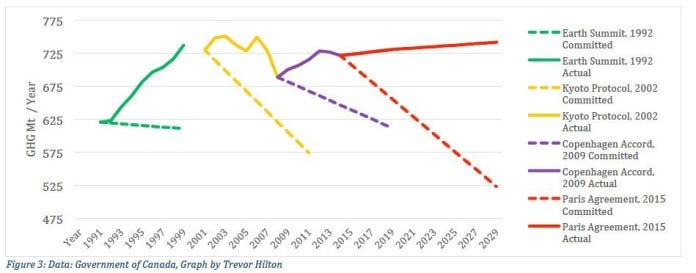
There are some local success stories here and there for sure. But global co2 emissions are still rising. Not declining, not even flattening, rising! According to the latest UN emissions gap report we need to reduce global emissions by 7.6% every year starting now to meet Paris agreement. Last year global emissions increased, again. Reduction trend is nowhere in sight yet. I have no idea where hope and optimism come from.
If. COP25, the 25th year, was a farce of self-interest from fossil producers. Australia found a way to fiddle their historic figures to claim they need take no action! No one's listening to the IPCC, except those not running countries (except maybe some of the smaller, poorer ones).
If you would like to read some actual peer reviewed science, you can view the IPCC 2018 special report which covers the possible outcomes of a near zero CO2 production scenario.
If you're going to dispute the qualifications of the IPCC, it would help to show something peer reviewed by people in the field.
The IPCC recommendations are fine -- where do I dispute them? I don't. Did the double negative throw you? I point out no government is taking notice of them. Can you name one government that is responding to the IPCC recommendations appropriately? As seen at the UN COP25 climate summit in December, substantive action appears no closer than decades ago. If they were taking note of IPCC reports, we might have had a far more inspiring result.
The EU are nearest to meeting IPCC recommendations, and have taken some worthwhile steps forward, but so far not nearly enough, though they committed to net zero by 2050 shortly after the failed COP25. Most of the rest of the world is doing nothing, or worse. Don't forget emissions are still rising, coal and gas plants still being built, and new oil fields explored.
Taking bets on the most likely path to worldwide civilization collapse, sans adequate action.
My bet is mass migration north in response to loss of tropical and subtropical agricultural production drives isolationism, putting fascists in power, who initiate wars leading to (limited?) use of nuclear weapons. Resulting chaos disrupts farming, food transport, trade, industrial supply, and climate disruption response, resulting in more chaos, more fascism, more war, and on down. Timeline 2030 unless CO2 is actually declining by then.
> Of all the birds left in the world, 70% are poultry chickens and other farmed birds
While the overall thesis of this article may be correct, the writer undermines themself with the inclusion of misleading statistics like this one. It makes it sound as if we have killed all the wild birds or shunted them into the food industrial complex when really these things are fairly independent of one another. We're simply growing more chickens than ever because people like to eat meat.
I don’t doubt the bird population has declined. But the stat cited above doesn’t convey any information about the decline.
If you have 30 wild birds in your property and you setup a barn with 70 industrial meat birds inside, you did not necessarily obliterate the wild population.
Fair enough, for sure, but the statistic doesn’t really get at that point directly. It’d be better to say “50% fewer non-agricultural birds were alive in 2019 than in 2018” (or whatever the stat is) if that’s the point they wish to make.
> the writer undermines themself with the inclusion of misleading statistics like this one
This author does this a lot. I just couldn't keep up with all the inaccuracies and mischaracterizations, so I stopped reading near the bottom. This article is an example of modern top-notch fear mongering.
As much as I loved The Newsroom, that Toby clip is one example of a failure in their writing. Where 1 death by climate change somehow translates into everyone on earth dying. Spoiler: Everyone does at some point. SMH
I'm not sure he completely undermines himself. Yes, we are definitely growing more birds for food and he could have made that relationship more clear, but at the same time, there is simultaneously a bird "extinction" event going on that also results in an increase in the percentage of birds that are for poultry use.
I'm not sure if you've seen this, but based on an extensive report examining 140 million records of birds, the Oct 2019 paper in Science, "Decline of the North American Avifauna"[0] determined that there are now 3 billion fewer birds in the US since the 1970s:
>"Using multiple and independent monitoring networks, we report population losses across much of the North American avifauna over 48 years, including once-common species and from most biomes. Integration of range-wide population trajectories and size estimates indicates a net loss approaching 3 billion birds, or 29% of 1970 abundance. A continent-wide weather radar network also reveals a similarly steep decline in biomass passage of migrating birds over a recent 10-year period. This loss of bird abundance signals an urgent need to address threats to avert future avifaunal collapse and associated loss of ecosystem integrity, function, and services.
This paper also spurred some articles that discuss the issue such as "Birds are Vanishing From North America" in the NYT [1] and "The Quiet Disappearance of Birds in North America [2]
Then a week after that paper came out, the Audubon Society released a report "Survival by Degrees" [3][4][5] saying 2/3rd of birds are at risk of extinction from climate change alone if global warming hits 5.4 deg F by 2100.
So while the author could have been more clear, the fact is, the evidence is clear that bird populations are rapidly declining due to climate change and the latest reports warn that we must take steps to "avert future avifaunal collapse."
When I see articles with so many various facts assembled together, I have to remind myself that the author cannot possibly be an expert in all of them, and so the story is just that - a story.
Which doesn't change the fact that something needs to be done, or that many of the predictions will come to pass, just, the full story is never going to work out quite how anyone expects. And that's enough to have some hope.
Looking at the chart of the climate summit targets, we don't really seem to have a history of doing the right thing. I would love to share your optimism of "some hope" but to me it seems that as a species we're simply incapable.
We're currently at +90 million people per year. The UN predicts that to drop by around 1 million people per year [1], which would mean the total population is still increasing for another 90 years.
Humans have an incredible history of adaptation and survival, and I do agree climate change is a big problem. The metrics are all going the wrong way, but I see the fallout (famine, disease, death, etc) as a natural corrective mechanism. Earth has a long history of hot and cold periods, the only difference being this time it's largely caused by humans.
We survived the plague, world wars, and much more, so I think we (as a species) will still be around on this rock for a long time to come.
Of course humans will survive, but what about our civilization? That seems less likely.
I also fear the "natural correction" will be violent, painful, and potentially apocalyptic in scale. Watching everything we built crumble, watching our children suffer, etc, would be horrific. We have to do something.
Humans, outside cities, were not then dependent on long-distance food transport.
Furthermore, the Roman Empire was not destroyed. It declined over centuries. Catastrophic collapse is an entirely different phenomenon.
It matters which humans. If you mean that after six billion starve, the remnants will have access to substantial remaining infrastructure, OK. Probably the wars won't destroy most of it.
The retraction of the western part of the empire, and move of the capital to Constantinople, was conflated as a collapse via the anti-oriental bias of Gibbons, which has colored subsequent perceptions. The Empire carried on as a major power for centuries after.
> I see the fallout (famine, disease, death, etc) as a natural corrective mechanism
Correct me if I'm wrong but I guess that most people who say these sorts of things don't believe that this natural corrective mechanism will affect them personally.
We (as a species) did survive world wars indeed, but I wouldn't envy anyone who had to live through it.
We are also pretty fragile and adapt (evolutionary) really slowly. Whenever there's some local major disaster (fires, earthquakes, tsunami, volcanic eruptions, mud slides, floods, hurricanes) we don't really do so well locally so I'm not sure we'll do that much better under some global major changes.
The worst case scenarios here look pretty bad and our lack of ability to respond so far seems to indicate we just won't be able to respond.
Humanity is taking a big gamble here. Win, and we maybe have slightly higher standard of living (whatever that really means), lose and we can't live on this planet any more. That's a pretty dumb gamble to be taking as a whole, it's just some people think they'll end up ahead of the others.
Assuming there are plants/animals left that are edible and usable topsoil returns. Else we'll have to wait for single cells to evolve into beef in order to thrive.
We are a lot of people, tied to hard built cities, and depend on a lot of things running smoothly (food, comunications, world peace, and more). Disrupt that (and the way the climate is changing will disrupt everything) and you won't be able to sustain a civilization like ours.
And as AIDS, it won't kill you, but it may put you in a position where otherwise minor problems may become lethal (wars, plagues, self-destructive social trends, etc)
I can only read so much far-left death cult nonsense before rolling my eyes and closing the tab. How many cherry picked stats can you fit in one article? Look at the number of people removed from extreme poverty. Look at the price cliff solar and electric vehicles are falling off. Every "problem" is a hypothetical projection that I have no doubt will be addressed once they turn into economic problems. I'm not losing sleep about fresh water when I'm paying a fraction of a cent for a gallon. If I could talk to a person from the future 1000 years from now, my first question isn't "how many degrees did the Earth warm from climate change" it's "how many star systems have humans colonized."
I expect climate change will look more like Y2K than the black plague. If anything the increase in precipitation, higher temperatures, longer growing season and CO2 concentration will help humanity more than it hurts with mass afforrestation and better crop yields.
Don't make assumptions. I have both an electric car and a 7kw solar system on my home. Not because I'm saving the world or smelling my own farts, but because it makes economic sense. That is the reason, the only reason, climate change will be solved.
Lots of things make economic sense. That does not make them possible, let alone probable. What makes you so confident in our ability to find solutions that you predict we will look back on global warming as similar to Y2K?
"where there's a will, there's a way." Like I said, these problems are hypothetical and immaterial. If people were struggling to drink clean water or get food, they'll prioritize it with their time and money to solve it. We're dealing with massive time scales to solve these problems. The media makes money off the hyperbolic, pseudoscientific fanfiction they churn out and politicians are elected by fear. "97% of scientists believe in climate change" doesn't mean "97% of scientists believe we've caused the Apocalypse and it's over for humanity in the next decade." It simply means "97% of scientists think the world is warming and is caused in part by human activity."
If you found a person 1000 years in the future from now, before you could ask them anything, you may need to teach them how to understand the concepts you're describing.
> Reid Hoffman, the co-founder of LinkedIn and a prominent investor, recalls telling a friend that he was thinking of visiting New Zealand. “Oh, are you going to get apocalypse insurance?” the friend asked. “I’m, like, Huh?” Hoffman told me. New Zealand, he discovered, is a favored refuge in the event of a cataclysm. Hoffman said, “Saying you’re ‘buying a house in New Zealand’ is kind of a wink, wink, say no more. Once you’ve done the Masonic handshake, they’ll be, like, ‘Oh, you know, I have a broker who sells old ICBM silos, and they’re nuclear-hardened, and they kind of look like they would be interesting to live in.’ ”
Yeah doesn't seem like a well conceived plan if there really is a consensus amongst the super rich to isolate themselves all together on one relatively small island. First of all globally there are a hell of a lot of super rich people. Secondly I'm not sure you'd want your neighbors to all be other aggresssively well resourced people in a world of survivorship. Third, if the masses blamed the super rich for the catastrophes of the world we'd know where to find them.
The masses never blame the super-rich. Instead, they hate their immediate bosses (who hate theirs). Politically, we mostly resent the party of the middle managers.
We are a "managed population", following Edward Bernays's program from one century ago.
Billionaires don't cause the climate change. If you kill all the billionaires, there will be zero difference. If you kill all non-billionaires, you have an immediate solution to all the problems in the article.
It is an inconvenient destination for mass migration and military invasion, not downwind of likely thermonuclear war targets, is large enough to support amenities, and is at sufficiently high latitude.
Latitude. Tropics become uninhabitable (anyway, unfarmable) by humans fairly early on. When the super-rich do finally decamp to New Zealand, CO2 output will probably be declining precipitously. A resulting new ice age would make refuge at high latitude ironic.
2. Peter Thiel bought there and sold NZ to all of his rich friends which started a snowball effect
3. “New Zealand is an enemy of no one,” Lynch said in an interview from his office in Murchison, Texas, southeast of Dallas. “It’s not a nuclear target. It’s not a target for war. It’s a place where people seek refuge.”
To add to the many good comments, it's also very low population density -- at 18 people per km^2. Being well down in the southern hemisphere, it's well out of the way when the fighting and desperate mass migration kicks off. It's probably no coincidence it was one of the last land areas to gain humans.
Serious questions. What is wrong with a hypothetical scenario that our children will have to move to Antarctica and northern Russia to grow corn and grapes? I mean after all, people moved all the time. Civilizations collapsed in the past from lack of water where it used to be plentiful, and other natural disasters wiped out entire civilizations. And we are still here, living well, eating organic food, drinking clean water and watching Netflix. And we are living longer and better, and in the West we have more forests than a century ago. How do we even know that these naysayers are correct while those that blamed witches and proclaimed impending apocalypses were wrong?
Drinking clean water, watching Netflix and utilising over 50% of the earth's entire landmass. The best, most fertile, most productive half.
What are we planning on doing, digging up a trillion tonnes of the formerly fertile soil from previous areas and transporting it? I very much doubt that Antarctica and northern Russia have soils that are as amenable to agriculture after a few millennia frozen solid. Even if the area were enough, which it isn't, yields would likely plummet.
Civilisations collapsed in the distant past, migrated and fell, yet there was a glut of available land everywhere. So hardly surprising here we still are -- we were nowhere near limit. Somewhere else fertile and usable could be found. Borders weren't controlled.
To give a rough example, the UK currently has a population around 68,000,000. The black death in the 1350s led to the population falling from around 3m to 1-1.5m. London's population fell 60% from 120,000. I don't know the population during the Roman civilisation period, but well under a million. 200k perhaps? That's a hell of a lot more area per person, and a huge amount of scope to relocate come catastrophe.
p.s. The West has more forest than a century ago because most of Europe's forest was clear cut centuries ago. What's been planted particularly in the 19th and first half of the 20th century is monoculture forestry, completely unrelated to the former temperate rain forests and other mature native forests that once thrived, long ago. It's certainly nothing to crow about.
The problem is that we cannot comprehend how fast things can shift. I just came across this video in another thread that I think illustrates the problem very well: https://youtu.be/kZA9Hnp3aV4
Basically, we can’t see something growing exponentially for the disaster they it will unleash until the last minute (literally)
For instance, if something doubles every hour, we don’t realize there is any problem until the very last moment: one hour before, half the resources were free, and the hour before, 3/4. But two hours later, it’s 0% and we never saw it coming.
The point is well illustrated in the talk, I highly recommend it.
The late Albert Bartlett, who debunks infinite growth so easily. If you haven't seen it I agree it's highly recommended. It should be compulsory viewing for all politicians.
Because the Earth is a sphere there's a lot less land between 70 and 80 degrees latitude than between 0 and 10. Quite apart from the difficulty in moving people.
If the whole world used Japanese farming techniques, we could easily cut land use in half. It's quite possible to use far less land, it's just not a priority to most people to pay more for food.
"Climate change over the next 20 years could result in a global catastrophe costing millions of lives in wars and natural disasters..
A secret report, suppressed by US defence chiefs and obtained by The Observer, warns that major European cities will be sunk beneath rising seas as Britain is plunged into a 'Siberian' climate by 2020. Nuclear conflict, mega-droughts, famine and widespread rioting will erupt across the world."
It's 2020, and the climate of Britain is not "Siberian" by any stretch of the imagination.
Reading these lines makes my blood boil:
"Disruption and conflict will be endemic features of life,' concludes the Pentagon analysis. 'Once again, warfare would define human life.'"
This is a report by a military complex that has waged endless wars in the last 20 years. And they're steadily working towards a new major war right now. We don't talk about that on HN, but please spare me their reports about how climate change will cause as many deaths as their willfully engineered on false pretexts wars.
> A study by the Pentagon confirms [there will wars caused by migrants]
The reading of newspapers confirms that the Pentagon is causing wars today.
Some of the climate change scare is a huge distraction from much more important and actual issues, on which we have much more agency and yet we've decided to ignore.
Just to give an example, we seem to be extremely worried about populations living on a bare subsitence level- that is, without secure food sources, decent housing or sanitation- being threatened by climate change. And somehow we've decided that we need to invest trillions not to take them out of poverty, but to keep them in the same poverty but with a better climate. Priorities.


I just make this point to say that climate change can definitely wipe us out, just as it has other large animals before.
One issue that isn't discussed much - an ageing population. Obviously this is a generalisation, but the more elderly are disincentivized to do anything about climate change. They also lack the resources to really change behaviour, and are resistant to the kind of sweeping economic and societal changes being proposed. At the same time, they have a lot of influence on political decision making or are the decision makers themselves. I don't see a solution to this problem, aside from waiting until the influence of that generation dies off (about another 10 years).