Consumer GPS devices have a speed and altitude limit [1], which I initially thought should preclude using it in a fighter jet, but I was wrong (only something extreme like an SR-71 would hit this limit):
> ...a limit placed on GPS tracking devices that disables tracking when the device calculates that it is moving faster than 1,000 knots (1,900 km/h; 1,200 mph) at an altitude higher than 18,000 m (59,000 ft).[3] This was intended to prevent the use of GPS in intercontinental ballistic missile-like applications.
>> > ...a limit placed on GPS tracking devices that disables tracking when the device calculates that it is moving faster than 1,000 knots (1,900 km/h; 1,200 mph) at an altitude higher than 18,000 m (59,000 ft).[3] This was intended to prevent the use of GPS in intercontinental ballistic missile-like applications.
> That makes sense - the limits are designed to stop you guiding a missile with one, not guiding a jet plane.
Only some kinds of missiles, though. It seems like those limits would be quite acceptable for cruise missile guidance, and I'd think GPS would be more useful there than in an ICBM.
Probably because the threat surface of a cruise missile is similar to a low-flying manned aircraft. There's lots of civilian use cases for GPS under those same conditions, where there's relatively fewer uses for speeds and altitudes in excess of the COCOM limits.
I take it it’s much easier to get rid of cruise missile than ICBM?
I just had a very dark thought suppose a nefarious entity got hold of starship, added a multi ton nuclear payload and sent it towards some city center.
The basic idea of missile defense is to intercept the incoming missile with another missile. What really matters is detection with enough time to react and fire those intercepting missiles. There are both cruise and ballistic missiles that can travel at hypersonic speeds which drastically reduce the viable interception window. Cruise missiles are actually scarier to modern militaries, in part because they are harder to detect separately from other aircraft.
>enough time to react and fire
You mention the intercept window, but it's more complex than interceptable / not interceptable, and time is not the only factor at play.
It's much easier to intercept the missile earlier rather than later, even if the window allows for a later intercept.
It's easiest during ascent phase, because: 1) the rocket is still accelerating (slower target), 2) the rocket is still burning (bright target) 3) before the payload(s) has separated from the booster (big target) 4) before warheads and decoys deploy (single target)
There are some other aspects to consider as well, like a trajectory-changing near-miss during early ascent will have a much greater impact than the same in late ascent, (depending a lot on the target type).
Which is why US missile defense began as an entirely ship based program, to be deployed where ascent interception would be possible.
Although this has changed a great deal since then; technical abilities and limits revealed through testing, as well as political/ budget constraints have shifted the tactical role of the system more state-side, not without controversy.
There are no hypersonic cruise missiles. There are cruise missiles that are supersonic for at least part of their trajectory, though that is often achieved by using a final ballistic trajectory.
And no, cruise missiles are not scarier than ballistic missiles. There is no difficulty detecting them or distinguishing them from other aircraft. Ballistic missiles are far harder to deal with because the time to intercept is tiny and they have gravity on their side.
Probably wouldn't even need a nuclear payload for that. If it was a sufficient size starship impacting at light speed I assume the impact would be tremendous.
If you have the capability to acquire/build a ballistic missile of that class, you most likely can (will) build your own GPS/GNSS receiver. Hell you can take a software defined radio and make your own software-based GPS receiver that does NOT disable itself at those described thresholds (some folks have done this for extremely high-altitude balloon experiments).
People under-estimate how difficult geography/ geodesy/ navigation used to be, pre-NAVSTAR GPS. This difficulty was "built-in" to the military defensive posture/strategy/tactics of many countries, to the extent that simple possession of a GPS receiver was/is a crime. And not a misdemeanor, but a treason level offense.
Keep in mind, the programs that evolved into NAVSTAR started in the 50s\60s and the tech specs were pretty much set by 1980, along with the legal framework and military policy regarding it's operation.
Ironically, it was some of the systematic weaknesses if the original design that led to it being so much more useful (and accurate) than it was ever intended to be.
But it is still a military program, with military style regulations, so it shouldn't be too surprised that some of the 1960's era rules haven't evolved too much.
It's more surprising to me that so many of the restrictions have been relaxed. (Even if it's policy playing catch-up practice.)
Or even reverse engineer the firmware to remove the restriction. I'm also guessing that there are plenty of Chinese made gps devices that don't have that limitation. Simply because, why bother. Assuming you can find one accurate enough on AliExpress, I'd say there is a good chance it has no special restrictions.
But any number of non State actors would. The IRA or ISIS or Hezzbollah for example. They probably don't have the tech capabilities to RE their own GPS firmware, but non-orbiting rocket science isn't that hard. Iron Dome does okay against simple rockets, but a big guided rocket (V2 size) would be a different problem entirely.
Obviously drone attacks make use of GPS, and it's a worry to many -- for example, there is frequently GPS jamming when Putin is visiting somewhere.
Realistically, this is the kind of restriction that's in place to impede the high-frequency & low-capability regime in the space of non-nation-state (or, historically e.g. the 70s, non-peer nation) threats.
I think, post HK protests, it's going to be harder to order precursor parts from China. All sorts of jamming and drone tech is being used there by both sides. Hopefully we see restraint and mutual de-escalation and we don't see any use of energetics.
For everyone else that notices that COCOM limits require both speed and altitude, the problem is that some manufacturers have implemented these safeguards with an OR rather than an AND. So it’s possible to get tripped up by either limit in practice (unless you know for sure your specific device implements this as an and).
The GPS has to shut off when going faster than a certain speed or higher than a certain altitude. IIRC the GPS maker can decided which they want to follow, and most chose to stop working at high altitude. It’s possible but more difficult to find a GPS that will work with high altitude balloons.
I am no fighter pilot, but I (used to) fly airplanes, floatplanes and helicopters. A watch with a 12 day battery life makes little sense to me as I find it too easy to forget to charge it. Even if you put it on a checklist, it may be too late to charge it when you are about to go.
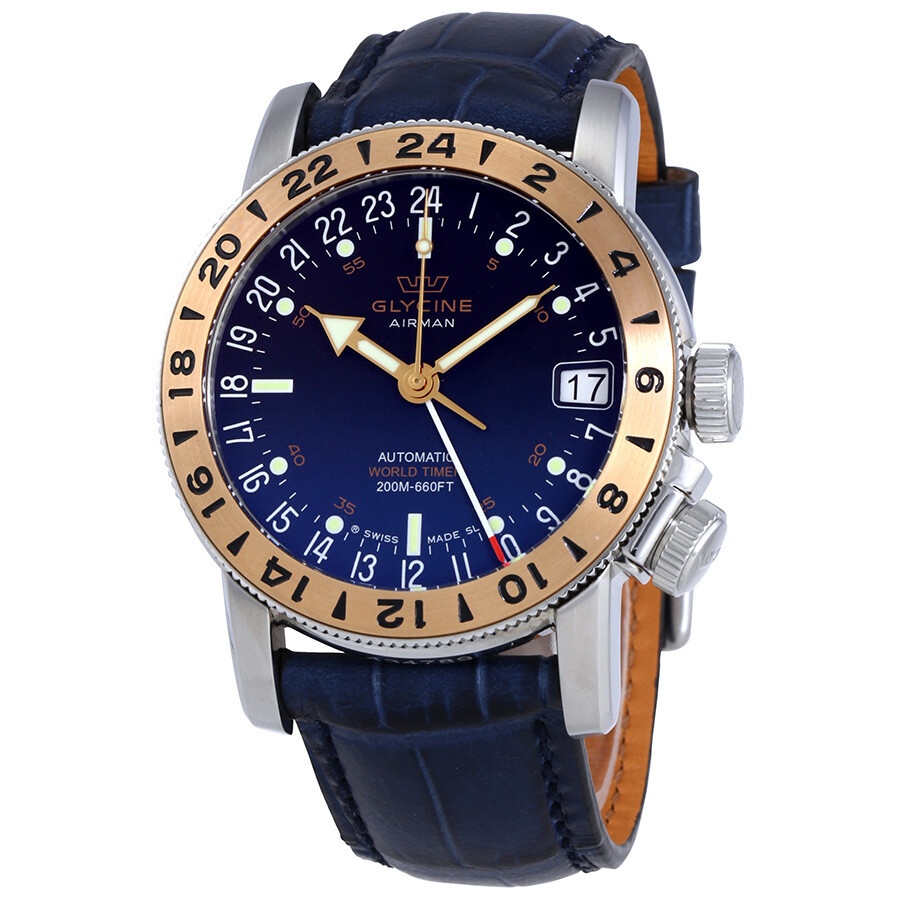
For my flights I mostly use an automatic Glycine 24hr watch with a second dial set on UTC for "Zulu" time. If the watch is running at the beginning of the flight (confirmed with a checklist) it will continue running during the flight.
I have to admit that this Garmin MARQ looks lovely though :)
Almost any GNSS receiver is by design power hungry. Modern mostly SDR constructions have faster time to (reasonable) fix, but still it involves large amounts of essentially opportunistic computantion to acquire and track the CDMA downlinks. This is one of the arguments why Spy-Fi style inconspicuous and globally accurate and useful trackers are nonsense. The whole process of associating with 2G GSM network and sending one MO-SM message is incredibly energy expensive, but getting reasonable GNSS fix is in completely different barpark.
Possibly more feasible if you periodically capture and store a few ms raw IQ, then transfer a quick burst when the handler comes near, to do the nav solution offline.
I fly sport planes and the battery in the iPad I use to augment the cockpit has a 5 hour life. I definitely have the "charged iPad" on the checklist, I don't make assumptions and I make sure to charge it before flight. I use it for GPS altitude only as I have 2 baro altimeters and an old Garmin GPS, but the iPad's GPS is usually more precise to indicate current height above ground.
A 12 day battery life for a smartwatch I would only wear when flying is more than enough. I would not wear the smart watch on the ground, my regular watch is running without any maintenance for 21 years (Citizen EcoDrive).
I think this likely has to do more with individual habits rather than anything else. But I find that watches that I do not use all the time are more likely not to be ready to be used when I need them.
For example, I have an old Suunto Ambit watch that I used for outdoor activities and/or exercise. I found that because I was not wearing it all the time, it was not charged most of the time that I needed it.
The point was to compare battery life and care for equipment. I cannot mod the plane to add a 12V socket, but I can use an external battery pack. Still, 5 hours vs several days comparison still makes the smart watch good enough.
The issue is certified aircraft. I think the 'certified' USB charger was around $300 for the part when we installed one - in addition to the certified mechanics time. The experimental side is cheap.
The Tecnam P2008 has a 12v socket and it's a rare luxury in an otherwise awful plane. Most single engine piston aircraft don't have charging ports or 12v sockets.
I had one in my '67 182 and two in each of the 58P and then A36 that replaced it. I seem to recall them being present even in the Piper rental airplanes as well.
I would expect them because I would have expected that back in the '50s and '60s people would have started using their plane's cigarette lighter socket for powering things, just like they did with cars, and so people got used to having power available and thus manufacturers would keep including it even when cigarette lighters were no longer standard equipment.
And yes, small planes used to have cigarette lighters.
There's an airworthiness directive from 1979 that required owners of a bunch of Cessna models to either disable the cigarette lighter or add a circuit protection device. There's a copy of that AD here [1]. It includes a big list of Cessna models and serial number ranges, which can give a good idea of how common cigarette lighters were.
My light plane has six 2.1A USB ports for charging use plus several others dedicated to avionics updates that can also charge. In addition I have three 24V cigarette lighter "outlets" which have two dual port USB adapters. So... Plenty of on board charging foe the six seats. Not hard to retrofit. I only wish I had more!
It's trivial to have such things for your plane (talking about small planes with propellers etc used for hobby flying, commercial aviation of course would have specific requirements) -- it's getting them to pass the relevant regulations that's the deal. Eg.
I know very little about planes and think of them as being very like cars, and a 12v socket is a cheap and useful feature in practically every car since the 1950s (more recently USB has replaced them) so I assumed planes might have the same thing.
My C182 had a 24v cigarette lighter plug that was there when the plane came to me and I think was from the factory. Took a while to find a 24V USB charging dongle, but when I did it powered my iPad just fine.
See FAR 1.1. It's (correctly) judged to be a minor alteration in the eyes of most A&Ps and can therefore be signed off by just an A&P with just a logbook entry.
They are functional, durable, and extremely common in my office of Learjet and King Air pilots. I agree with you on the battery life. Personally I'd rather have some world-timer, but I'm an asshole.
If you're wearing the watch on a daily basis then the battery gauge on the face makes it obvious when you need to recharge. You can fully charge the battery in the time it takes to shower and dress in the morning. And if you're only wearing it for flights then just leave it connected to the charger at other times.
>I am no fighter pilot, but I (used to) fly airplanes, floatplanes and helicopters. A watch with a 12 day battery life makes little sense to me as I find it too easy to forget to charge it. Even if you put it on a checklist, it may be too late to charge it when you are about to go.
Whereas a watch with a 24hr battery makes more sense?
I'd say, if you're to forget it, you are to forget it, whether it holds a 24h or 12 days...
And if you're doing an emergency landing and/or you're stranded somewhere, you'll want to have that 12 day watch with you, not the 24h one...
I have a Garmin Fenix watch and the long battery life is why I chose it - it's much better than most smart watches. I charge it every week and have over 50% battery life by the next week.
That does look like a 21st century fliegeruhr. Looks nice. One wouldn’t think a ‘watch’ would still prove useful for flight, but obviously the durability and modern features make this watch indispensable in flight emergencies.
There is a solar version of the Fenix 6 (the slightly less ridiculously priced sportswatch brother of the MARQ series), and according to most reviews, it barely makes a dent on battery life. I wouldn't hold my breath for self-sufficiency.
Hello could you please explain what's the added value of the 24h face? I looked at some pics and feels too crumped; however I understand that it's preferred among pilots.
Zulu time where I mostly fly is 8 hours off local time. If the watch is a regular 12 hour watch you have to do a mental calculation for time and as a pilot you learn that the less mental calculations the better, when a lot of things are happening in the cockpit.
It is true that the 24 hour display is cramped. But I got used to it after 15 years with this watch.
I cannot find the exact version that I have online, but this one is the closest:
I think the watch you linked is the Glycine Airman GMT. I believe the standard hour hand actually has a 12-hour sweep (yes, even though the labels are both 24-hour) and only the GMT hand (pointing to the 10) has a 24-hour sweep.
From what you've described, you probably have the Glycine Airman Purist [1]. There is no GMT hand but the regular hour hand has a 24-hour sweep (and you can set the second hour dial).
Glad they are using stock watches. Usually when something goes through the usual procurement channels you will get a watch that took ten years to develop and costs 100k each.
Still, the most badass Garmin ad is the photo of GPSMAP mounted in the cockpit of the Russian SU-24, while it flies close to the NATO's airspace without transponder switched on.
Wow! This reminds me a lot of that old "Americans spent millions of dollars developing a pen that could write in space, and the Russians used a pencil" story.
There is link in the Reddit discussion [1], unfortunately the original Estonian article is not available - it's probably about the Baltic Air Policing. Also Google search returns some results.
When the Strava heatmap issue came to light i recall seeing many tracks on military runways and wondered, "who's out there doing laps on the tarmac? So this makes sense now.
Apparently a lot of people in the military upload their runs to strava. If there are a bunch of people uploading the same route, it will show up on the strava heatmap. This has previously caused secret locations to be revealed[1], but they are probably being more careful about this now.
In general, you can bring a watch but not a phone in some areas. An aviation friendly watch does a nice job of being visible (bonus visible in the dark) as a watch. Bonus as a timer. Extra bonus if it can give you zulu time with current time, as that is asked frequently.
If it's going into a secure facility it doesn't matter if it's a phone, an iwatch or a garmin, if it has a radio and/or nonvolatile memory, it's not going in.
With the loss of visibility, descent to an altitude below the freezing-level may not have been possible.
The crew returned to NAS Whidbey, which meant that they had to overfly Washington's Cascade Mountains. The freezing level that day was 7,000 feet or less [1], and some of the mountains are taller than that (many near 7k, a big one reaches 10.5k, and Rainier is 14.4k). It also appears to have been cloudy over the mountains from about noon onward.
There is a pretty good chance that they were blind until they were sure they were back in the Puget Sound region. I'll bet they descended as soon as they could.
The canopy was thickly coated with ice. When you're blind you can't VFR. They couldn't use ice-obstructed instruments either, so a rapid descent would have endangered their plane and other aircraft. They did the right thing, suffering frostbite and cooperating with ground control to preserve life and property.
I wasn't questioning whether they did the right thing. I wanted to understand why the obvious solution of descending (which is what commercial airliners have done successfully on numerous occasions when losing cabin pressurization) didn't work in this case.
Given Washington's geography, the freezing level on the west side of the mountains would have been far higher than on the east side. They might not have been able to descend below freezing until they crossed over the mountains.
Yes that's why I said "a rapid descent would have endangered their plane and other aircraft." I seriously doubt that any commercial airliner, with orders of magnitude more volume than this plane and insulation as well, has ever suffered an internal ice-over like the one described here.
I am not a pilot nor do I have any familiarity with the workings of aircraft (so please take this as pure speculation until a pilot can come in), but I believe the ventilation comes through high-temperature bleed air. The bleed air is dehumidified, cooled through a heat exchanger, then fed into the cockpit. If the ECS went haywire, one failure mode be to not dehumidify the air, and also to run the heat exchanger at full blast (i.e., the "thermostat" basically broke).
EDIT: according to https://www.navy.mil/local/pes/Comprehensive%20Review%20PE.p... , ventilation is provided by mixing high temperature bleed air with cooled, dehumidified bleed air in whatever proportion is needed to keep the cockpit at the correct temperature. So assuming the cooled air is reaches -30C or so, an ECS failure that stopped mixing in any hot air would cause the event described.
If they could confirm that they were not over a populated area, would ejection be a possibility? The article calls out "both pilot and EWO suffered serious injuries due to frostbite". Did they suffer serious injury to avoid ejecting and in order to save the aircraft, or was ejection not an option?
Ejection risks much more serious injuries. One source [0] gives 92% survival rate and a one-in-three chance of a fractured spine. The survival rate is probably higher in this scenario as the plane isn't actively on fire or too low for a parachute, but if it was me I'd sooner lose a finger or two to frostbite.
If the situation is bad enough to risk ejecting I don't think the Navy will ever expect you to preserve the plane.
I would presume they did, but that it takes ice a lot longer to melt than to form on an aircraft, especially when considering how cold it can be even at breathable altitudes.
Absolutely, but as a frequent visitor on this site, this is my first time becoming aware of Garmin's being used this way. I think it's broadly relevant even if it is PR.
Way back in the day, I was curious if my TomTom (like generation 1 or 2) would work on a normal flight. Then one day when travel from Durban To Johannesburg (South Africa) I took it out of my bag and switched it on and was amazed to see we were travelling over 700km/h
It is, if the Garmins are connected to public Garmin profiles or to third-party apps like Strava.
Otherwise, they function as GPS-signal receivers and only record data to the watch. (If connected to a phone or computer via the Garmin app/program, then Garmin watches will sync the watch data to the phone/computer.)
Ok, says they have Bluetooth and WiFi. I'm not sure I would trust the firmware not to be vulnerable to 0-day data exfiltration once the device is back in base.
Yup! If I’m going to do a 15 mile run on Saturday or something crazy I will top it off before, but’s it’s pretty good at battery life. Too reason I don’t have an Apple Watch.
Not only the transflective LCDs are still LCDs, but the transflective LCDs tend to have most pronounced effects of extreme temperature. On the other hand such effects mostly means that the display looks ugly and updates really slow, but is still somewhat readable.
As a diver, I really like the idea of the Garmin Descent being able to do surface GPS for tracking entry and exit points. I hope more dive watch manufacturers (Suunto is a big name) will add such functionality in the future.
I got a Coros Pace new for $200 and it seems to do as much as the higher end Garmin watches for a few hundred less. You definitely pay a premium for the name.
$2k backup instrumentation sounds inexpensive when weighed against the potential loss of personnel, logistics, flight-training hours, airframe, and mission-effectiveness.
Every instrument on the cockpit of the small sport plane I am flying costs about $2k, some go to double or triple that, a single headset (Bose A20) is $1k, so that 4K smartwatch in a plane worth tens of millions seems like a good investment.
Not to mention the lifetime cost of training a crew of two up to U.S. Navy standards. Lose one E/A-18G, you lose two very expensive and hard-to-replace people along with it.
I was trying to figure out how much they were, and found the BLS inflation calculator I've used for years seems to be broken, as it has for several days:
It looks like the Fenix 3 or maybe a Fenix 5, range there is $400-$800 or so. Unclear whether they're issuing the MARQ watches. The Fenix series does everything the MARQ does but for 1/4 the price. The most expensive flight oriented watch they sell (outside the MARQ, which offers no additional features) is something like $1200-$1300.
> The fog inside the aircraft iced over the instrument panel, forcing the pilot and electronic warfare officer to use a Garmin watch to keep track of their heading and altitude […]
The obvious question is: Why does the instrument panel have this failure mode, and is issuing Garmin watches really the best fix?


> ...a limit placed on GPS tracking devices that disables tracking when the device calculates that it is moving faster than 1,000 knots (1,900 km/h; 1,200 mph) at an altitude higher than 18,000 m (59,000 ft).[3] This was intended to prevent the use of GPS in intercontinental ballistic missile-like applications.
[1] https://en.wikipedia.org/wiki/Coordinating_Committee_for_Mul...