"Unlike some other "driverless" truck companies, Starsky isn't building a completely autonomous solution. Instead, it uses teleoperation to remotely drive the truck between freight depots and the freeway where a highway-only automated driving system takes over."
Starsky is doing really impressive work, but the trucks aren't designed to be 100% autonomous 100% of the time. I think this is a great solution to the last-mile problem for freight logistics, however.
I was wondering when teleoperation was going to be taken seriously to plug the gaps in full autonomy.
If Starsky is successful, I suspect this will be used a lot of places. For instance:
Image vision detects a police officer. Maybe a police officer doing hand signals. Immediately switches to teleop (with last several seconds replayed) if in a safe situation to do so. Corner case: solved.
Pretty much all of the self-driving car companies use remote assistance to help out with difficult cases and have been for years. The other companies just realize it's another tool in the arsenal with its own limitations, whereas Starsky seems to push hard on it being the magic sauce.
The problem with remote assistance is it's only useful for static scenarios, like getting a vehicle unstuck. It can't help you make a left turn due to lag (cellular networks are not reliable for real-time safety critical systems), but it can tell you whether or not you can proceed after stopping for a paper bag in the middle of the road.
At least the truckers have an easier time being with their families if they don't have to drive all over the country all the time and can instead do their job from an office. It's also easier to switch drivers so that they don't have to drive when they're tired.
How much of a hazard have semi truck operations been to pedestrians and cyclists? They can only use large arterial roads.
I'd wager that a primary motivator for self-driving+teleoperation is increasing the amount of time that trucks can be hauling, not necessarily making them safer than existing trucks.
Starsky engineer here. We spent a few days getting all of our emergency procedures in place and testing all fail-safe aspects of our system on the road in preparation of the run. We've done unmanned runs before (also in Florida), but at much lower speed and with a vastly less sophisticated emergency system.
Got to this question late. We had this happen [1] during our first unmanned run completely unintentionally. We were testing our 1st gen emergency and diagnostics systems, and the truck ground to a halt a few minutes into the test. Our teleoperation center lost complete power (freak outage, no weather or anything) so the teleop station disconnected, even though our UPS was still working along. We've made a few changes to support this case a bit more, but the broad strokes worked in that case. Long story short, the truck will stop itself. There are many different ways we try to do that more safely depending on road conditions, and those are outlined in the VSSA linked elsewhere.
Link below is a dramatized account of the events, couldn't find anything less editorialized, sorry!
Thanks for the link. This basically says in that scenario (which I did not see specifically mentioned in my admittedly cursory glance) is to just hit the brakes...and then since there's nobody in the truck and there's no wireless signal it's just stuck there until someone goes there in person or the cell signal comes back up.
What if signal is lost while the truck is performing an unprotected left turn, in front of oncoming traffic with right of way? Braking in that situation will not be safe.
The pdf is pretty helpful! Outside of total system failure, it will try to find a shoulder, and if it can't do that it will gradually come to a stop inside its lane.
In such an instance, “controlled stop” means that the system has the capability to control both steering and braking, so that the system can continue to ensure it is not leaving the lane as it brakesand is not hitting objects in the lane ahead. “Immediate stop” is the final fallback mechanism for the extremely improbable occurrence that everything in the system is failing.
That was the paragraph I found interesting. It seems to me in the worst case scenario from what I can tell it just slams the brakes and hopes for the best. It would be interesting to hear a response of what the truck would do in a jamming situation. I assume since it would not lose it cameras and other sensors it would slow down and pull over.
I'd trust a stupid autonomous system to be safer than a driver who loses consciousness during one of those situations. You just need to make sure that the system doesn't break down completely more often than human drivers have a heart attack at the wheel.
- they could use vehicle-mounted transceivers with much better antennas
- they could use redundant transceivers on different networks
- they could map out routes with best signal. Remember this is last mile only, so it's not a huge area. Instead of going the shortest way a la Waze, optimize the route for best signal.
First off, congrats! I think self driving trucks have a lot of promise and would really change the American economy.
I'm curious as to the ways that the self driving problems in trucks might be different to the problems of self driving cars. For example, with heavy trucks, your braking distance must be a lot larger than a normal car. So things like following distance must be different. Also having to worry about skidding and the direction the trailer might move.
Also, I imagine that you have to be pretty careful about cars cutting you off. It seems to happen all the time on the road, and is more dangerous than people give it credit for.
> I'm curious as to the ways that the self driving problems in trucks might be different to the problems of self driving cars. For example, with heavy trucks, your braking distance must be a lot larger than a normal car. So things like following distance must be different. Also having to worry about skidding and the direction the trailer might move.
Right on the money. If you slam on the brakes on a truck, you and your trailer can jack-knife, sending the trailer the wrong direction. It's a more complicated controls problem than in a car as well!
> Also, I imagine that you have to be pretty careful about cars cutting you off. It seems to happen all the time on the road, and is more dangerous than people give it credit for.
I've spent hundreds of hours in our truck over the last 3 years and my god drivers are absolutely terrible around trucks. You have an incredible view of the road from up on high in a semi, and the spatial awareness compared to a sedan is way better, so the crazy maneuvers happening around us seem a lot crazier. In California trucks can only go 55 mph, so we get a lot of folks (even in normal driving) trying to speed around us during merges on/off highways.
Do you see the move towards autonomous driving being regulated to the point where they are required to adhere to posted limits.
Are you free to talk about liability concerns? Is there a consensus on how unmanned vehicle will affect the outcome of a suit arising from any accident. I assume these trucks have more than every angle covered to protect against false claims
> Do you see the move towards autonomous driving being regulated to the point where they are required to adhere to posted limits.
Yes. Starsky early on made a choice that we will operate in an explicitly legal manner, and avoid the grey areas of self-driving. That means a person behind the wheel on public roads in California, but we're all-clear in places like Florida to remove the person behind the vehicle.
> Are you free to talk about liability concerns? Is there a consensus on how unmanned vehicle will affect the outcome of a suit arising from any accident. I assume these trucks have more than every angle covered to protect against false claims
It's still an open question about how best to insure autonomous trucks. Getting a truck on the road, legally able to drive is surprisingly difficult. Watching Starsky struggle from the inside to get our first truck on the road hauling freight at the beginning was sort of a confidence builder in how the DoT and the regulatory organizations work. We are legally insured, both our normal trucks and autonomous trucks. And of course, we've got a ton of cameras in case of an accident.
Understood :) I had this idea myself but had no real way of pulling it off. I have believed for a long time that the real wins in autonomous vehicles would come from long haul trucking, but the last mile problem would really seal the deal. I'm excited to see you guys succeed :)
I'd recommend being careful about making flippant remarks on public forums lest some future litigious asshole try to make hay out of it.
But on point: on I-5, for one example, I've encountered semis doing 80+ MPH in loose groups and not at all unsafely.
It wouldn't take many semis doing only 55 to make life miserable for many of your colleagues and competitors, especially if they face driving-hour limits and logging constraints that you don't. Has that issue been hashed out internally?
In case anyone isn't reading the article, these aren't "autonomous self-driving" trucks. They're remotely controlled trucks. Though I think Starsky has some longer-term goals of making some highway portions autonomous.
We think of it like a spectrum running from hands-on-the-wheel, manual actuation of the brake/throttle/etc. to full autonomy. The middle parts are "supervision" where the human isn't manually pushing the pedals, but might, for instance, tell the truck to take an exit, or slow down, and the truck can do all the acceleration/braking, lane changes, etc on its own.
This pattern of "supervised autonomy", where you automate the low-level (and safety critical) parts, but leave the higher-level decision-making up to humans, has surprisingly broad applicability. That's part of why I'm excited to work here.
Are there any worries around drivers being more careless with driving since their own live is not in danger like it would be while actually in the truck?
Are you worried about (cargo-)theft? The way I imagine it:
- (assumption) it takes less criminal energy to steal something when no human observer is around
- lonely road in the middle of nowhere
- well known driving behaviour means it is easy to stop (overtake, then slow down to a halt?)
- enable mobile phone jammer (optional)
- take cargo
Not sure how we're thinking about this now internally. If there was such a technologically adept actor targeting us I'd be more worried personally about safety than the cargo itself.
Wouldn't that work pretty well with a human driver? I don't think most truck drivers are going to risk their life for their cargo. If you block a truck in with a couple cars and block them from calling 911, they'll just try to protect themselves and maybe try to film you if they're brave.
Some things might be easier for the thief, but others I imagine harder.
Multiple on-board backup locations of numerous video sensors means unless the entire vehicle is torched (and even then), some evidence of the people who carried out the theft will probably survive.
When talking about autonomous platforms, a jammer might no longer be sufficient. If communication is lost, how hard is it to launch a drone (or multiple) whose job it is to keep visual contact with the vehicle while increasing distance, and relay the feed up when communication is re-established (how large an area does a jammer affect?).
There are ways to mitigate these defenses/logging (reduce all unique visuals, stop vehicle in tunnel), but also ways to minimize those mitigations.
I'm not sure it's any easier than when a human is present to defend the goods.
I feel like the risk of this is lower than that of rail car theft (find a place where the train slows down, hop on it, steal stuff, leave before it gets to a depot. Or alternatively disconnect the last car and take everything).
Starsky CEO here: Currently, cargo theft is less of an issue than F&F would have you believe, and unfortunately seems more driver related than land piracy.
It certainly is something that I think of, but safety engineering requires simpler processes (because simpler means less things need to go right, which is good when things are breaking). I'd rather pay more for cargo insurance than have more complicated logic that causes more accidents with people.
Easy answer- self destructing cargo. Epoxy Glue tubes which can be exploded on capture inside the container. Goods become unusable, robbery unsubstainable.
How are you guys planning to handle the paperwork, inspection, and liability hand-off tasks typically done by truck drivers today? People at the depots on either side, virtual sign-offs/inspections, or what?
Great question. We're now public[1] with the news that we're operating a trucking company, and by headcount a significant amount of starsky employees are truck drivers. Part of how we're approaching the trucking business is to automate as much of it as possible, including all this invoicing, bill of lading movement, automatic payments, doc signing, unloading/loading, and dispatch.
It's pretty easy for a carrier like ourselves to decide how to manage this business process, so we have carte blanche to work with our shipping partners on novel solutions. They're also interested in transparency and speed of transaction, and especially interested in being able to work with a truck that is easily traceable. There are modern shipping depots that have robotic unloading, but also a significant portion of freight is unloaded by the people manning the shipping/receiving offices of our freights' end destination.
This is exciting technology! My father in-law is a trucker, although nearly retired. He's fascinated by the developments made by you guys.
I'm not entirely familiar with the industry and day-to-day of a trucker, but I'd imagine you'd need some "on the ground" personnel, at least initially, to perform tasks such as fueling on long hauls.
Aside from this, it'd be interesting to see how quickly you can go coast-to-coast without a human needing a break/sleep.
With regards to fueling, there are a good amount of fuel stops around the country that will do "concierge" services for fueling up the truck, giving it a wash, etc. There's some infrastructure in place for when we need to get there.
Interesting stuff. I'll certainly tell him about this. He's been talking about retirement for some time (early-to-mid 60's) but he's a workaholic like my own father. He's always had a challenging time finding trucking jobs that are local in the Vermont area, but should an opportunity arise where he can drive anywhere closer to home, I think his ears will perk up.
IANAL, however, a lot of road activity is regulated state-to-state in the US. It turns out to be a really fascinating regulatory problem.
To get a flavor of what we're dealing with, we've had some concerns from law enforcement officials that our tele-op drivers need to be sober, and that officers need some mechanism for administering a field sobriety test to someone who may not even be in the jurisdiction.
IMHO, there needs to be a federal solution to some of this. If it becomes common that vehicles and equipment are operated across state lines, it will become increasingly difficult to comply with every state's rules. That said, unlike some other companies, we are very committed to honoring both the letter and spirit of the law. Our view is that this is an important moment for US civic engagement where industry, labor, insurance, vehicle manufacturers, and the public need to come together and work it out. We explicitly are not taking a "move fast and break things" attitude toward legal compliance.
>I wouldn't be surprised if you eventually have to end up getting police to stay on site with the drivers for this scenario.
that's ridiculous given that similarly important situations happen all over the tech sector, and there are no such police escorts.
I understand the issue, but there aren't any police to tackle rogue actors all over the place. At some point we rely on trusting a professional to be a professional, with retroactive punishment being the ultimate deterrent.
Unless Starsky is hiring people anonymously without payroll or background checks, the identity of the person who flees will be known -- at which case the criminal justice system kicks in and attempts to apprehend and prosecute.
Put another way : Do you often get police escorts on your drive to the grocery store?
My first hacky technical solution? Put a breathalyzer on the teleoperation terminal. A high count calls up some supervisors and disallows the use of the terminal. No cops needed.
Is this practical? Is it responsible? No, probably not -- but it's nowhere near as impractical or irresponsible as wasting hours of on-site police during all hours of operation.
There’s likely issues with a hacky solution being brought up in court where an officer wasn’t there to administer it when the accident happened.
One officer on site also doing physical security and consulting elsewhere is definitely not impractical.
I’m sure drone pilots in the military aren’t sitting by themselves. Rarely are any tech people under DOT or highway patrol scrutiny because they don’t put lives at risk by operating heavy machinery while drunk/high
Do you have any thoughts about the "sudden hand-off" problem, i.e. when the "autopilot disconnects" and the human has to suddenly take over and make a decision in the next fraction of a second? This is difficult enough even with the driver in the vehicle, and remote control can only add latency.
Why would this ever happen? The failsafe will probably be "hazard lights go on, truck immediately brakes and pulls over", not "goes into super manual mode over slow link".
This is assuming it knows how to pull over while it simultaneously doesn't know how to drive on its own. The assumption "it always knows how to pull over" is similar to "it always knows how to drive forward." They're not the same, but you need validation for either.
At least European driving regulations are made in a way that allows you to stop right in the middle of the road in case of danger, except for highways of course - where the problem is significantly easier.
That's the goal. The problem is it literally has to be 100% perfect for this to work, which is an insanely difficult barrier which has never really been done before in robotics. To call it ambitious would be the most generous way to describe it.
Remote truck driving sounds like a scary job, driving a heavy vehicle capable of causing major fatal accidents, via tech that could lag or drop out at any time, with none of the tactile feedback that you normally get from a vehicle?
What does the interface look like? 2D screens (no depth perception), or something more VR-like with stereoscopic vision and head tracking?
Starsky engineer here. We are actively hiring developers to work on this system (we call it "tele-operation" internally).
I'm currently (this afternoon) working on driving the latency of the communication in this system down even further by stripping it down to bare socket programming. We'd love to meet anyone who's done RTS games, first-person shooters, or anything else that involves keeping moderate amounts of state synchronized over medium-latency networks. :)
I've done a small amount, but mostly as hobbyist stuff.
If you haven't looked at it already, Glen Fiedler has a great series on game networking on his Gaffer on Games blogs that covers a lot of those topics in ways that were really helpful for my implementations. https://gafferongames.com/tags/networking/
It looks like his site is down, but it's also available on the internet archive: https://web.archive.org/web/20190405204744/https://gafferong.... It's all fairly high-level stuff, and I'm sure it mostly just retreads ground that you're familiar with, but I thought the explanations were all super-clear and helped crystallize a lot of thoughts that I already had but hadn't focused that well.
RTS games are potentially one of the simplest cases for online multiplayer - a deterministic lockstep approach is possible, and you don’t send state over the network, just actions (e.g. ‘move group 1 to x,y’). And as unit control is indirect, an RTS can tolerate a few tenths of a second of latency much better that many game genres
The mood lighting is not the main problem, cutting back and forth between two completely different viewpoints (feet- and eye-level) is. Especially in a 360 video where you are trying to transport the feeling that the driver is basically sitting it truck, this seems very counter-productive to your point.
Theoretically, yes. But I'd be concerned about fatigue and stress of having a current-gen headset on people all day long. Seems like 3D screens might be a better solution until headsets get lighter / more comfortable.
Truly incredible project that I would never wanted to work on because when it suceed, all drivers can go look for another job.
The video is nice to see a professional driver even in his orange vest driving truck ten thausand miles away. And once he is done he shuts down his laptop and walks to the room next door, where his wife cooks dinner to play with their kid. Right?
If reality of automatization learnt us anything so far, is that all these people will be fired almost overnight, and the huge hangar of $2/hour Phillipino “drivers” will be hired to most drive most likely multiple trucks at once, because why the hell not to divide screen in four.
The only good thing is that we are some 10-15 years away from full implementation, but if I were you I would not look for long and prosperous career as a truck driver.
> The only good thing is that we are some 10-15 years away from full implementation, but if I were you I would not look for long and prosperous career as a truck driver.
(I work at Starsky)
That's one way to say it. Another is that the industry is suffering from a major lack of qualified drivers. Earlier this week, we announced our operation of a commercial trucking company in addition to our autonomous R&D group. We're getting better-than-average employee retention by offering employee-drivers a career path out of long-haul driving if they want it. Even so, we've heard tons of stories from our drivers about poor working conditions at other companies, and people quitting after only 3-4 months.
For whatever reason, trucking skews older. Younger people just don't want to do it. Which is fine, except that groceries, diapers, and everything you order from Amazon won't get delivered by itself.
[...] Another is that the industry is suffering from a major lack of qualified drivers [...] we've heard tons of stories from our drivers about poor working conditions at other companies, and people quitting after only 3-4 months. [...]
Which one is it - shortage of drivers, or poor treatment of drivers? You can't have both, look at the software engineers for an example of actual shortage.
Starsky CEO here: surprisingly it's both. Truck drivers have limited productivity (freight rates set by the market, cant drive more than one truck at a time), but it's also a large fragmented industry where many players have a zero-sum mindset.
Shippers often take too long to load your truck, which costs you scarce driving time. Your carrier might stiff you on you last weeks pay, because driving is too hectic and they're too far away for you to chase them in small claims court.
There arent enough drivers, but the industry also has many bad actors who are mean to the drivers that there are.
Don't get me wrong - you guys accomplished incredible stuff so I am far from dissing you.
But to think you finally open your offer to Wallmart and all other big stuff-movers and not to see them drooling at the fact that they can cut their workforce 15% and just hire turk-style operators at $2/hour is just naive.
While your technology is amazing, the assumption that you will have same trucker seating at the wheel now siting at the joystick comfy at home at the same rate is wrong IMHO.
Starsky CEO here. Not an unrealistic thought at all.
My childish/idealistic personal thesis is that if you think 10-20% more, you can make "doing the right thing" into "doing the long-term profitable thing." Most business leaders are just too lazy / short-sighted to put in the extra effort.
Part of why we're being the operator is to make sure the teleop drivers can be paid well. Now, we might have competitors in time who mess that up, but if regulators which I think can be prevented by regulators and other stakeholders
I think the <insert minority/foreign country here> will steal our jobs narrative doesn't really work here.
This will cut jobs, yes, but as a latency/redundancy sensitive application jobs servicing this will be geolocked to 'hubs' of some form. Like air traffic control, but for trucks.
One thing I like about their business model is that it isn't just the autonomous/teleoperation tech, but also that they're a full-service trucking company. That kind of integration should hopefully allow them to provide the same service as a normal trucking company but with much lower cost.
Even if the company just serves long-haul routes from depots in less congested areas very close to freeway on-ramps, that's still a huge market, and the labor cost savings would likely be huge if humans are just driving from the depot to the freeway.
Related, I was thinking about the idea of teleoperation for drone deliveries recently as well. The same kind of "last mile" problem exists for landing cargo from a drone. Have the drone fly from the warehouse to the customer location, and then pass it over to someone sitting in their house with a joystick to control landing and delivery of the cargo. Once the delivery is complete and the drone is airborne again, have it fly autonomously back to the depot. Pay people $1/landing or something like that.
The last mile is going to be the hardest part of any of these autonomous businesses. The hybrid teleoperation model where the computer handles the relatively easy (but mundane) parts makes total sense.
Personally, I'm most worried that this will reduce the attention or personal responsibility that a driver would normally have --- if you're actually in the vehicle, anything that goes wrong has a very real chance of injuring you, possibly fatally; whereas if you're safely sitting far away, then you may feel like nothing can happen to you even if your vehicle gets into a horrible crash (you may get arrested, but there's no immediate risk of death from doing anything wrong.) That lack of subconscious fear for your own life is IMHO not at all a good thing, because I think it's really that --- and not the law --- that keeps most drivers on the road from being dangerous and compels them to attention.
I personally don't like crashing my RC car or quadcopters, either- it isn't something I like to do. I'm also a new driver, and I've had several near misses. One of the possibilities with tele-op is that someone entirely different can take over if someone else falls asleep, messes up, or does something belligerent. Technology is a double-edged sword.
That doesn't solve the "hand-over" problem --- which I already mentioned in another comment here --- if you were suddenly given control of a moving car headed in a dangerous direction, how long would it take to assess the situation enough to make a decision on what to do? You have to be already paying attention to react in reasonable amount of time.
Of course there is the "workaround" of having multiple (alert) drivers per vehicle, but that seems more trouble than it's worth just to avoid putting a single driver in a vehicle. (In addition, as all the stories about self-driving-car accidents have shown, even when people are in the vehicle itself, they don't tend to pay as much attention if they already have the "someone/thing else is driving" notion anyway.)
Maneuvering a truck in an urban area looks really hard for a by-stander. The proposition here is to do it with remote control, that sounds even harder. On second thought, it might be an easily solvable problem with the proper sensors and UI.
I've seen a video of experimental tech where a military humvee had a 360 array of cameras, whose feeds were collaged into a live 3rd person perspective feed. I think the humvee also had all its windows boarded up. The idea was for the crew not to use in-vehicle perspectives at all. I could see that working when you have to do tricky slow speed maneuvering. A top down view, where you could also see projections of how the truck would shift given different steering angles.
> 360 array of cameras, whose feeds were collaged into a live 3rd person perspective feed
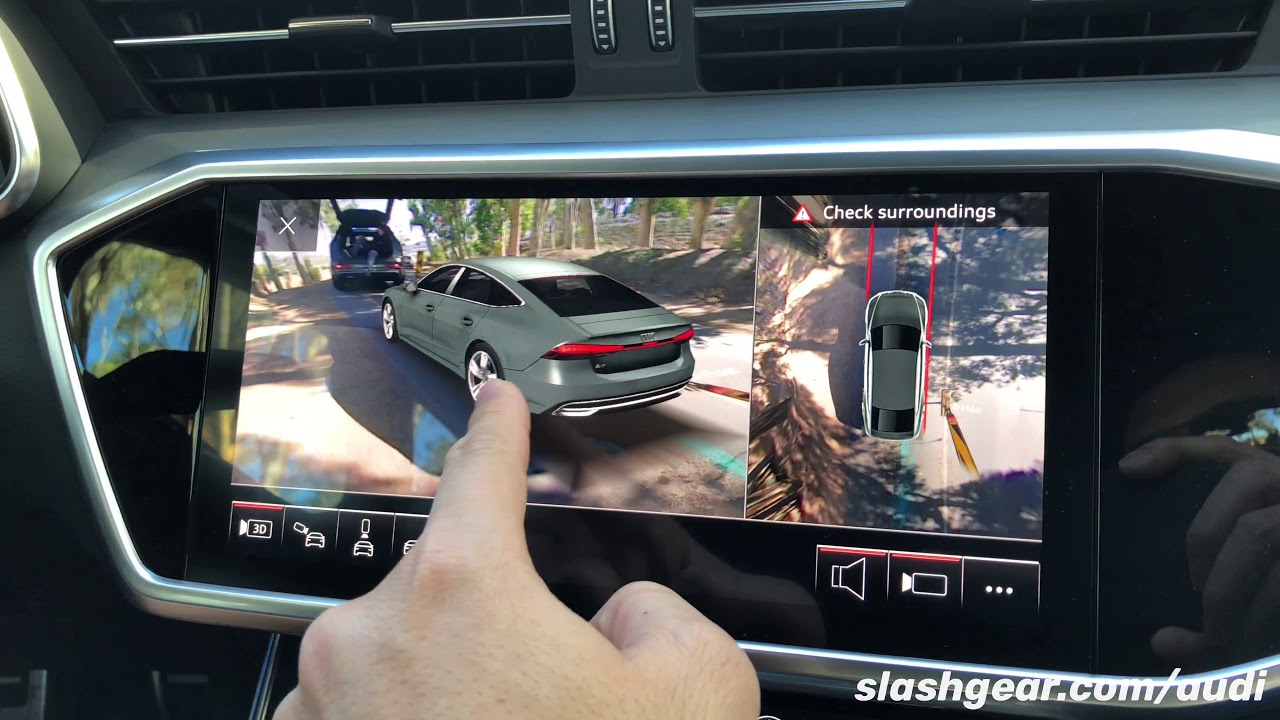
The parking cameras on high-end cars have already evolved from a simple top-down view (which is now an option even on entry-level cars) to a 3rd person perspective 3D view, complete with a little 3D model of the car https://i.ytimg.com/vi/FyjVphbHAL0/maxresdefault.jpg
You don't really need to board up the windows for the cameras to be a big help. At least in the up armored humvees (the ones with bolted on armor), the side windows were very small, to the point that you had to have a passenger look out their side window to tell you if there was any oncoming traffic, or if it was safe to change lanes.
This is REALLY hard stuff, but fascinating from a UI/Human-machine interaction perspective. Shameless plug - we're actively hiring for software engineers and product management around the Teleoperation system. We need more people fully focusing on making this better and working with our drivers on feedback, features, and other enablers for the remote-control experience.
The other day I saw a truck carrying a blade of a wind turbine. It was gigantic, looked around half the length of a city block. Driving with one of those must be nearly impossible, I can't imagine how you would make a turn
Would be interesting to have a head-mounted display a la VR headsets and model a truck with the virtual windscreens being the camera outputs on the truck. Would be interesting to see.
I'm guessing this is being driven on a closed off express lane, but the fact that the video image shows signs facing the "wrong way" makes it look like the truck is going the wrong way on the highway.
> Unlike some other "driverless" truck companies, Starsky isn't building a completely autonomous solution. Instead, it uses teleoperation to remotely drive the truck between freight depots and the freeway where a highway-only automated driving system takes over. ...
The video hints at "lane keeping." How much automation is involved?
However much it is, it's not hard to imagine a smooth transition between remote operation and autonomous driving over time. Each iteration would eliminate one more thing the driver needs to be concerned with until nothing is left.
What I don't understand about this solution is that if you have full automation on the highways then what you need isn't really remote control for the rest, all you need is to get regulation change so that drivers aren't considered to be driving during autonomous periods. In most of Europe this would mean you could have a driver in the vehicle but they could use the long periods of automated highway driving as their rest time meaning they can travel almost non-stop, as opposed to how they operate at the moment where they are forced to pull over for several hours a day.
>Because of that focus we've been able to develop a highly reliable SAE Level 2 system and a highly reliable teleoperation and supervision system, and it turns out that's all you need.
It seems to me there are two smart ways to go about this. One is Startsky's path of starting their own company. The other is a company like Tesla teaming up with one or more existing big trucking companies, which would be motivated to do that to lower costs and overcome their huge problems hiring drivers.
The cybersecurity implications here are chilling, it’s only a matter of time before a hacker takes over a truck and drives it into a crowd from a remote location. Where there is a shell, there is a way.


"Unlike some other "driverless" truck companies, Starsky isn't building a completely autonomous solution. Instead, it uses teleoperation to remotely drive the truck between freight depots and the freeway where a highway-only automated driving system takes over."
Starsky is doing really impressive work, but the trucks aren't designed to be 100% autonomous 100% of the time. I think this is a great solution to the last-mile problem for freight logistics, however.