To see how Google feels about ad blockers, all you need to do is look at Chrome on Android & the fact that it does not allow extensions at all. I have personally used Firefox on Android for years because of this.
I predict Firefox will see a large uptake in market share if ad and content blockers become ineffective on desktop Chrome. I've finally switched to Firefox on the desktop now that U2F support is here, and it looks like it was just in time.
Add Apple and their walled garden to that list. When Intel first attempted to introduce "Trusted Computing" in the early 2000s, there was a huge outcry. Few years later Apple comes along with something that is much more restrictive, and now people are happy to accept that you can only do with your device whatever the manufacturer allows you to do.
Successful technologies become a success due to early adopters, power users, developers that target those technologies. Lose the sex appeal, make the techies angry and the monopoly starts to wither away.
How many people here have installed Chrome on the computers of their friends and family? Is there anybody here that never did that?
I remember recommending Chrome, even though I was a Firefox user, because Firefox on Windows tended to get infested with crappy toolbars and other extensions. Well not anymore.
And that whole recommendation process can always happen for another browser.
All it takes is for the developers to come back to Firefox. And I've seen a noticeable shift happening among my peers ever since Quantum.
> The one thing that I've come to realize is that we're losing. The web is now closed. Owned by Facebook and Twitter for the most part.
Nah.. They're both losing users.
The problem with "modern" internet is, that there's more and more people using it, and that makes the numbers 'weird'. The number of IRC users is probably higher than it was in the late 1990s/early 2000s. But back then only geeks used internet, and only they were on irc.. and now.. a lot of them are still there, just that now there is a bunch of of other people on facebook.
As we've seen with myspace, digg, etc., and as we're seeing with tumblr and also facebook now, younger, more tech-savy users have no issues with changing platforms.. from facebook to tumblr to snapchat to instagram to SomethingNew(TM).
One "bad" turn of events, one company that doesn't want to sell to facebook, and the "owned by" sentance will be completely different in a couple of years.
As one of those younger users, I still have an account on all of those and still use many. Instagram is from Facebook, Tumblr is from Yahoo which is owned by Verizon. A lot of funny content is taken from TikTok, Tumblr, Instagram, Reddit, Twitter, Facebook and more and reposted over and over through those platforms.
This is directly in response to "As we've seen with myspace, digg, etc., and as we're seeing with tumblr and also facebook now, younger, more tech-savy users have no issues with changing platforms.. from facebook to tumblr to snapchat to instagram to SomethingNew(TM)."
>The number of IRC users is probably higher than it was in the late 1990s/early 2000s. But back then only geeks used internet, and only they were on irc..
Rumors of IRC's death have been disproven fairly frequently, but at least when I was active on IRC everyone I've talked to had the impression that IRC as a whole was losing users throughout the early 00s.
I suspect services such as slack and discord killed off a lot of IRC users as of late as well.
Wouldn't mind being disproven, but at least personally IRC has fallen out of favor except for very specific use cases (like Linux distro support) rather than just chat in general.
> A big reason why "we're losing" is that kind of defeatist attitude.
A big reason why losses can be so bad is that approach of refusing to accept reality. It robs you of time & resources that would be better spent on a solution for what happens after.
There's a big difference between surrender and "accepting reality" when formulating tactics and strategy.
>>> ...[it's] not enough ... to make a difference....we're losing. The web is now closed...
...is more surrender than anything.
Many, many important social changes in the past century happened because some group of people refused to "accept reality" and surrender to the status quo, and instead embarked on a seemly quixotic effort against all odds to change it. They don't all succeed, but many do. Don't smother that success in the crib.
Yep, it just takes a "NewHotApp(TM)" for the kids to migrate to there, forget about their facebook accounts, and their parents will follow in a couple of years.
Considering most younger people don't actively use facebook anymore, their (facebooks) only chance is to buy the NewHowApp company every couple of years (khm.. instagram.. khm,... whatsapp..)
An overwhelming majority of respondents (96 percent) feel that online privacy is crucial. And their actions speak for themselves: 97 percent say they take steps to protect their online data, whether they are on a computer or mobile device.
There is a near equal percentage of people who trust (39 percent) and distrust (34 percent) search engines across all generations.
Across the board, there is a universal distrust of social media (95 percent). We can then safely assume that respondents are more likely to trust search engines to protect their data than social media.
When asked to agree or disagree with the statement, “I feel confident about sharing my personal data online,” 87 percent of respondents disagree or strongly disagree.
> I am in the vast majority (97%) according to this survey:
It's easy to dig up a survey someone did that supports the conclusions you wish were true. It's much harder to find the actual state of reality.
If you click through to their report, you'll realize that there's not much information about their sample, other than this:
From January 14 to February 15, 2019, Malwarebytes Labs conducted a survey on nearly 4,000 participants to measure respondents’ confidence in their own privacy and security practices, as well as their confidence in privacy being maintained by businesses.
There's absolutely no information about the demographic breakdown of the participants and no way to access the dataset itself. In other words, we have no way of establishing that this survey is worth anything more than a blog post on a site that tries to promote its software.
I loathe advertising as a business model and block it everywhere I can. But I understand that content isn't free, so when I am given a reasonable option to pay for content, I do. YouTube gives you the option to pay $10/month to remove ads from YouTube, so I do that. I understand if others don't think $10/mo is worth it, but I think it is a fair ask.
What bothers me is that usually when sites offer a paid ad-free option, their prices are very much not what I would consider reasonable. "Reasonable" would be the amount necessary to offset the revenue lost from a lack of ad views, plus a little extra.
$10 per month is nearly the cost of a Netflix subscription. There is no way Youtube generates anywhere close to that much in ad revenue per user per month.
This is hardly my area of expertise, but my understanding was that banner ads generate less than a penny per view. I'm sure video ads are worth much more, but I'm finding it quite hard to believe that could add up to $10 per month for even a heavy single user.
I watch about 2-3 hours of YouTube creator content a day... far more than Netflix. Can't say for what my actual offset is, but the $10 is worth it to me.
I see this as a factor of quality over quantity. Stranger Things is worth a lot more to me than a how-to video or product review, and rightly so, given the budgets involved in making each.
I want to note, though, that this also goes for much more than Youtube. I read a lot of Vox Media websites, and I'd gladly pay for an ad-free subscription—but not for more than $10 per year (and less if it was just the individual sites, rather than a package). Unless I'm quite mistaken, that should more than make up for their lost ad revenue.
I don't want to be stingy, but I also read a wide variety of different sources, and all these subscription costs ad up. I also just don't think freedom from ads should cost so much more than the ads are apparently worth.
> Unless I'm quite mistaken, that should more than make up for their lost ad revenue.
It's not just the ad revenue itself that has to be replaced.
In addition to that, you have substantial costs baked into supporting a subscriber program. Customer service costs, payment processing fees, development effort to manage your subscriber system itself, incremental development and creative costs to ensure your wireframes and functionality account for the ad-free and ad-filled versions (which may include multiple form factors and platforms for content delivery), marketing related costs (be it marketing labor, development labor, conversion rate optimization labor, etc) for user acquisition and retention work, and additional complexity in ensuring harmony between what you promise in your subscriber contract and what promises you're making in your advertising/data brokerage contracts.
In addition to all that overhead, the people that pay for subscriptions are those with disposable income to pay for subscriptions. Which substantially overlaps with who advertisers want to reach. So the more valuable part of your audience pool is self-selecting out of your advertising pool, which exposes you to substantial risk of devaluing your advertising pool and the CPMs you can command overall far in excess of the value of any single individuals ad- and data- related revenue (which only gets worse as your paid subscriber base gets larger and more noticeably absent from your advertising pool).
So you take on risk at the beginning in the form of overhead, and as your subscriber base scales the overhead becomes less of an issue as it's amortized across a larger base. But your risk itself still exists, it just shifts over to the advertising side of the house where your addressable audience is becoming less and less valuable (or maybe even just less in volume, if not in value).
And after all that, if they just broke even it wouldn't be worth the risk. So in addition to just paying for your equivalent value to an advertiser that month, you're paying for that + a portion of the overhead and incremental costs it takes to support the ad-free version + a portion of the long term devaluation of the advertising pool that results from having an ad-free version + a bit of profit to ensure it was all worth the hassle to begin with.
I'm not just watching product reviews, etc... however, there's also a matter of scale. Even if it cost 1:10000th the funds per episode of a YouTube channel vs Stranger Things, they also make 1:10000th the money from it, give or take. Just like programmer books cost more than novels because they don't have as many buyers.
I agree that they all add up, and I've dropped a few this past year. I'm just pointing out that I find more value in the YouTube content I do watch than I do from other sources in terms of the time I spend watching.
I wish Google did this for regular ads. I doubt they'd stop tracking you (videos while paying for YT premium still contributes to your ad profile for when you cancel it later) but even $25/month for no ads across all of the internet (while signed in) would be amazing.
Maybe there would be two tiers; $20 a month for just "Google" ads, and $40+ a month for all ads to be removed (Via AdChoices).
There was an effort https://en.m.wikipedia.org/wiki/Google_Contributor which worked very well: you set a monthly budget just like advertisers, and you participate in the bidding of ads on the website you are visiting. If you win the bidding, the ad will be replaced by a static image.
Sadly this was turned down and the new version of Google Contributor only works on some websites.
Strongly agreed! There are some weird outcomes regarding privacy and NoScript interactions with the "all ads" proposal. I'd be happy to just pay to remove ads from Google properties (Gmail, Maps, etc). But yes, anything where I can exchange money in return for no ads is something I'm happy to support.
> Currently, new revenue from YouTube Premium membership fees is distributed to video creators based on how much members watch your content. As with our advertising business, the majority of the revenue will go to creators.
I don't know, and most of the articles that turn up on a quick search are from the very launch of YouTube Red, so their speculation may not have held up in practice. My understanding is, creators get more revenue from Red viewers than from ad-backed viewers. However, I also support many of the creators directly on Patreon, and YouTube itself provides value to me which I don't mind paying for (high quality and actively developed app; decent discoverability features; bandwidth ain't free).
I pay for YouTube music, which also removes ads anywhere you are using YouTube with your logged in account. I was testing YT Music as a replacement for Spotify (since push notifications are broken and they apparently have no intention to fix). The YouTube experience of paid vs. non-paid is night and day, I highly recommend it.
you know that content (specially well made content on youtube) is not free right? content creators spend money to create stuff for you to see.
so now, they need to recoup the money, or even better, earn a living through content they create. that's done either by ads, youtube premium or stuff like patreon.
would prefer that your favorite content creators stopped doing stuff you like because they can't earn a single cent on stuff they do?
I discovered newpipe during the Amazon / Google spat when YT was disabled on my Amazon tablet. I've decided to just stick with it, since it blocks all ads, and has (IMHO) a nicer playback UI.
Take a look at the Kiwi Broswer [1] it's a fork of Chrome for android, lets you add extensions and has a built in dark mode and ad blocker. I love Firefox for my desktop but found it extremely slow on android so Ive been using this for about a month and have been really happy.
Can you tell us which browser apart from mobile firefox allows extensions? Safari no, Edge no. I use firefox mobile for extensions, but browser vendors might want to make different tradeoffs since mobile has different requirements, and it is used by far too many people for far too much personal tasks and allowing access to browser data may not be as desirable as on Desktop. 99% of mobile users don't have the technical skills required to understand what data extensions will have access to.
Off course, Apple doesn't even allow other browsers on iOS, so firefox iOS can't support extensions even if it wanted to. If you look at a single policy and decide that you know all you need to know, then maybe you should first ask for apple to change.
You can develop extensions for the browser on iOS — they just have to use JavaScript inside the page or the share sheet to work. An example of an iOS browser with such extension support would be iCab, though natively in Safari the share sheet is supported too. I commonly load translation apps that way, and once upon a time it was the only way to load LastPass/1Password, etc. And Safari supports content blocker apps natively as well. Not that I don’t support greater choice of defaults and fewer “Reader” apps on iOS, but the situation isn’t actually that dire if you look into it a bit.
Brave browser allows you to default disable JavaScript which for 90% of sites means to block adverts (and 10% of sites will break the site)
Firefox Focus will at least destroy everything the moment you leave a site
Firefox allows ad-blockers
These are what I use for all sites that aren't owned by Google... Google sites I open in Chrome, but only Google sites do I open in Chrome
I have no default browser on my Android, I pick a browser when I click a link, with Brave being my default in most cases, Firefox Focus for "must have JavaScript but please scorch the Earth afterwards" and Firefox for somewhere inbetween
Brave makes different trade offs. I use brave with javascript disabled, and find a lot of sites not working. Specifically, any links I open from email mostly don't work due to JS. If you don't know why your fav site isn't working due to JS, brave might not be your cup of tea. And that is 99% of mobile users.
On my Nexus I've made Firefox Focus my default browser.
Not that I use it the most — I have standard Firefox for hitting my everyday fave sites — but when I follow a link from another app (email, etc.) I know I'll get a fast experience w/o cookie persistence and the other upsides of a stealth browser.
It's been a long time since I used it, but Dolphin Browser used to support them. Chromium or webkit based, to the extent that early versions also had "Jetpack" available to distribute a newer build of the browser engine than was natively available.
Edit: still has an ad blocker add-on based on the Adblock Plus rules, and the browser has been updated within the past month. I believe it was the first tabbed browser on Android, and supports some useful features like definable gestures.
On OSX, there are Safari App Extensions. They’re not as user customizable as extensions on Chrome but they do exist. In fact I recently release my own Safari Ad-tracking blocker on the Mac App Store.
Came here to mention this, so thanks for bringing it up.
Safari has definitely come a long way, and the app extensions tend to get underrated.
Are they 100% up to par with Chrome's? Probably not, but when shopping around for reasonable competitors, you need to account for the trajectory, rather than just the current state.
But all of them are Chromium based, so are either going to be crippled by the Google proposal in the article, or they're going to diverge more significantly.
But if they added extensions (which mobile Chromium doesn't support at all), they're not shy about divergence.
Not meant as a comment on the proposal or FF vs Chromium.
This (v3) proposal, and the slick rewrite of Mozilla's stuff probably means I will be off of Chromium for mobile and desktop some time in the hazy future.
Ad blocking, not any way to run "browser extensions". The parent is saying "all you need to do is look at Chrome on Android & the fact that it does not allow extensions at all." iOS doesn't allow any browser vendor to let run extensions too, let alone run them in Safari.
Safari's content blockers are third-party extensions. It's not Turing-complete code execution yes, but it's still a meaningful kind of extension compared to Chrome's complete lack of them.
also, this is a really interesting project; would you mind allowing me to interview you over IM at some point? I'm trying to improve my breadth of knowledge by doing deep dives into unfamiliar areas.
> The deprecation of the blocking ability of the webRequest API is to gain back this control, and to further now instrument and report how web pages are filtered since now the exact filters which are applied to web page is information which will be collectable by Google Chrome.
Which means in the medium run they are looking to deal with ad-blockers altogether because if you can instrument what rules are applies to pages by the most popular blockers you know exactly how to get around those rules. Basically this is a way to dump all that data into Google's pockets so it can slowly but surely get around all of that.
This is simply untrue. There are a myriad of adblockers available for iOS (crystal, Wipr, Adblock, Adguard, Purify, 1Blocker X, etc), as well as VPN applications which provide content blocking.
Curious about this. Are you expecting something different than going to the safari settings and enabling a third party content blocker? What are you looking for that isn’t offered by that feature?
In January, Google announced that Chrome was going to be blocking all ads on domains that had too many ads ( https://blog.chromium.org/2019/01/building-better-world-wide... ) ; website owners were told to use the new "Ad Experience Report" in Webmaster Tools/Search Console to find out if they passed our not. Months later, my sites never were reviewed. Everyone I asked also did not have their sites reviewed.
Now Google has updated the Search Console and this "Ad Experience Report" is no where to be seen.
Maybe whoever came up with this idea and announced it never had the authorization to do so. After all, Google's Adsense was happily encouraging web site owners to add ad placements to their websites that were blatant violations of these new rules, including the most egregious, full page interstitials. The UI of Adsense would easily convince a more novice operator to just turn on "auto ads" and have Google blanket their website with ads automatically. Certainly this couldn't have been the plan, follow Google's advice so that your site could never earn advertising revenue from Chrome users again?
I suspect Google does have a plan to deal with ad blocking. They might have a few plans. Right now, it resembles someone bashing their own head against a wall. These changes to Chrome precipitate the end of Chrome having a dominate desktop market-share. If it really happens. But no matter what happens, Google is once again a little less trustworthy after.
Chrome security lead Justin Schuh says he is responsible:
"The sole motivation here is correcting major privacy and security deficiencies in the current system. I know, because I set that focus, and the team reports up through me."
Ugh. Reading this guy's account is just making me depressed. There is not a single convincing or meaningful response to gorhill's excellent and concise twitter thread:
All I see is handwavy posturing and tweets like this: "I should know better than to check Twitter after a painfully long day, but I am not dumb enough to actually reply to any of this crap."
This is the person who (by his own claim) is making the call on something that will fundamentally change the entire Internet?
Total nonsense. In the manifest document it claims that the change is for performance reasons, not privacy/security. Is it for performance, or privacy/security as he says? If it's the latter, then why aren't they deprecating the observational parts of the webRequest API?
I used a friend's phone to look at some website and was horrified that the website had added ads everywhere since the last time I visited! Then I noticed he was using Chrome, which doesn't have adblock, and apparently the web is just terrible.
Most people don't realise this, but on Android, setting private-dns [0] or using local VPN apps like blockada / dns66 or intra+nextdns [1] / intra+adguard-dns [2] would block ads even within apps, provided they aren't doing their own name resolution [3]. It allows one to use Chrome for websites that don't work well or at all with Firefox+plugins; in addition to helping bypass censorship.
In my experience they slow down browsing quite significantly, almost down to 2G speeds (may be a quirk of the Oxygen OS?) Thankfully Firefox Mobile with uBlock works fine.
iOS / Safari / Content Blockers are not as full-featured as Android / Mobile Firefox / uBlock Origin, but I'm quite content with https://1blocker.com/ , it provides several lists (with a less stringent limit than the crippled webRequest API discussed here) of rules to pick from, and the possibility to create your own rules through a Safari extension.
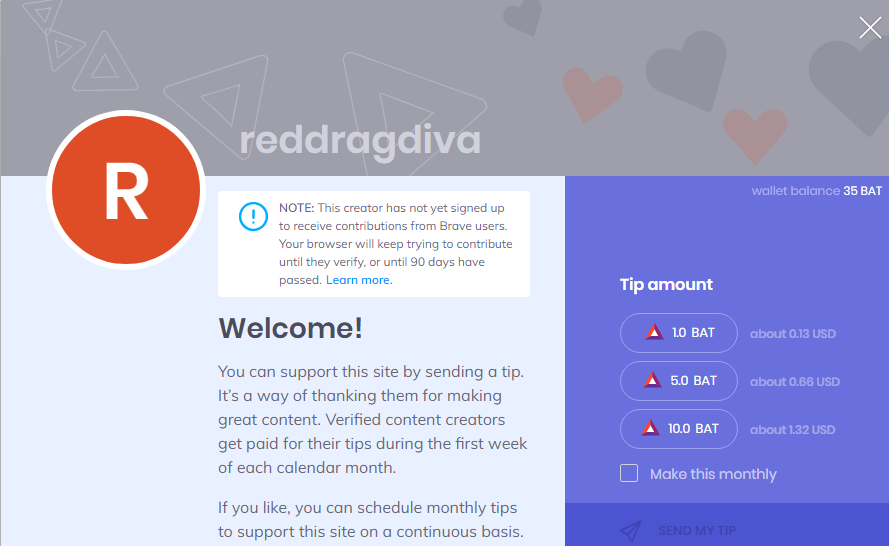
That's not even close to a facebook shadow profile. It was a way to donate to a public creator page. It didn't track anything.
They have also fixed the issues. The page makes it clear when someone has not opted in, and in that case it won't use profile images or names and the tip won't go through.
Too bad they're trying to monetize it. The new Basic Attention Token icon in the URL bar takes up so much real estate that it's almost pointless to have a URL bar in the first place.
"New and existing technologies could affect our ability to customize ads and/or could block ads online, which would harm our business.
Technologies have been developed to make customizable ads more difficult or to block the display of ads altogether and some providers of online services have integrated technologies that could potentially impair the core functionality of third-party digital advertising. Most of our Google revenues are derived from fees paid to us in connection with the display of ads online. As a result, such technologies and tools could adversely affect our operating results."
I personally use NetGuard which is free and open source. It works by setting up a vpn locally combined with a hosts file to send ad requests to a blackhole. This works on the Web and in apps. Follow this guide here: https://github.com/M66B/NetGuard/blob/master/ADBLOCKING.md
actually the Adguard for Mac can work the same as Adguard on Android... so even when Google removes adblockers you can still block on network level (though not as good of course).
If this becomes a reality, we as a tech community must do our part. We must personally leave chrome, ask all our friends and family to stop using chrome and switch to Firefox or Brave. Really show Google what we as a community can do.
Agreed, except Brave is a closed source wrapper for Chromium and you can't be sure if it's really as safe and private as they say. Also, it's married to a cryptocurrency scheme and that alone is reason to stay away.
Thanks, I wasn't aware they had finally produced source code with an open source license for the wrapper code. Still, I don't see anything on their Github about the servers that run the backend of their ad-serving and cryptomining services. Until I see otherwise I'll assume that is closed and proprietary and that all browsing activity is monitored, logged, and monetized per their advertising model.
I think the mindset that crypto = stay away when looking at Brave is silly. The idea is novel, they have a working product, and IMO they really aren't "locked in" to crypto. I imagine they could pretty easily transition the ad payouts, tipping, and auto-contribution features from BAT to traditional currency. Building the platform around BAT to start just allowed them to cash in on an ICO at the peak of the craze.
If they aren't opted in to the program then you're not giving them anything. As far as I know Brave is still accepting tips on behalf of people even if they're not opted in. Also, these tips are in an altcoin that Brave created and not the currency of the content creators.
Everyone I tip to is verified. And the BAT sits in an address until that creator does verify. And yeah of course the tips are in BAT, the whole point is to increase the value of the network. Also, people are donating BAT that they've gotten from ads. No one is tipping people with BAT that they've bought with their own money as far as I'm aware.
>And the BAT sits in an address until that creator does verify.
To my point - you're not tipping the content creator at all until they claim (edit: although as you say, tipping to verified does tip them). Also, these tips that are done with BAT that came with the promotion of Brave is sent back to Brave if they remained unclaimed for a set amount of time. Seeing as Brave has complete control of the tips they can change the rules and take the BAT back at any time.
>the whole point is to increase the value of the network.
This is kind of a pain point, isn't it? Many content creators have established ways to donate (Patreon, Twitch built in methods, Paypal, etc). Why should they opt-in to an altcoin created by Brave? There's no incentive for content creators to "increase the value of the network."
>Also, these tips that are done with BAT that came with the promotion of Brave is sent back to Brave if they remained unclaimed for a set amount of time. Seeing as Brave has complete control of the tips they can change the rules and take the BAT back at any time.
That's true for unclaimed tips. I don't believe they have any control if someone is verified, but I could be wrong.
>This is kind of a pain point, isn't it? Many content creators have established ways to donate (Patreon, Twitch built in methods, Paypal, etc). Why should they opt-in to an altcoin created by Brave? There's no incentive for content creators to "increase the value of the network."
I'd imagine the incentive to grow the network would be more tips through Brave. I don't donate through patreon or paypal since I find that to be a personal pain point. But I will be using Brave. I'd imagine there are others like me.
The same friends and family that we convinced a couple of years ago that they should stop using that shitty Firefox and switch to Chrome, which is so much more performant and don't worry about Google?
Firefox was in a pretty bad spot when I switched about 10 years ago. I would not have recommended to anyone who didn't have an excessive amount of RAM.
I only switched from firefox to chrome, many years ago, for two reasons:
1. Better dev tools
2. Better WebGL performance
But today, Firefox has upped their game on both, and really, I don't play much with WebGL anymore so it doesn't matter that much to me.
I am kinda sick of this whole back-and-forth thing, though. I'm also getting tired of seeing the way the web is going; monetized and walled off. More and more, I'm starting to look into and toward distributed solutions.
Give me back the internet I remember from the early 90s. If I can't have that, then I might just return to BBS-ing over ssh...
The “back and forth thing” is the market force keeping the browsers from stagnating. Even though it’s a hassle, you really don’t want the world where it doesn’t happen.
Actually, the internet has become too commercialized. But the problem is the top 1% driving all the revenue. And they are using this revenue to shape the web which is profitable to them.
People don't really have an alternative to Facebook currently. Even if I leave Facebook, I still am tied to their ecosystem - Instagram, Whatsapp. And let's be honest, everyone is there. If you want to be in touch with someone you need to be on Facebook's platform. But Google is much easier to leave. Make Firefox your default browser and make DDG your default search engine.
Instead of complaining I'm going to make a suggestion.
What if we had a middle ground where we build a browser to fight ads by putting forth responsible ads with responsible tracking and used the revenue to fight for a responsible web.
I don't know if this is what you're getting at (probably not), but I've often thought a lot of the "ills" we see with the current web ecosystem (particularly so-called "fake news", disinformation campaigns, propaganda, etc - the whole stinkin' mess) could be solved if it were required that everyone identifies themselves - almost like a driver's license to use the web.
Make people truly responsible for their words and actions online, and maybe politeness and civility might return. Let anonymous actors still communicate, but they would be known as such, and the browser or whatnot could identify that and mark them as such, so that others can know whether or not to put their trust in them.
But then - that also goes against my real belief that the internet should be free and anonymous; it also goes against reality, as we've seen real-life examples of people who are toxic, divisive, insincere, hateful, etc - being perfectly forthright with their identity online and people flocking toward them by the thousands. Conversely, there are also plenty of completely anonymous personas and characters out there that people also believe and hold their words to be true; in some cases more true than objective reality.
I don't know what the real solution to all of this is, at least in the short term. In the long term, better education for everyone would be the ideal solution, but with that also being vilified and worked against by individuals and groups who have an agenda to prevent such betterment, pushing that solution and having it work long term is increasingly becoming seemingly non-viable. Even in a perfect world, though, where such a thing weren't being molested, it might still take a generation or two before any results were potentially seen.
I think long before this is solved, the solution may present itself in the utmost form: A worldwide civil war, that'll make both WW1 and 2 look like skirmishes.
Yes, but chromium isn't removing the feature completely- since it's still allowed to be used in enterprise versions the code is all still there. Brave has already committed to making sure it continues to work.
The Brave Ads are opt-in, disabled by default. The idea is that they will incentivize users to enabled the proprietary ad notifications by paying those users (minuscule amounts to be fair) every time they view the ad.
Or Safari, which, for my family that uses iPhones, is completely sufficient for their needs - and has good privacy settings (AND sane default privacy settings.)
People warned for years here that exactly this was going to happen. But the HN tech community was "no, no, you are just a hater, Google IS GOOD, it's a company run by engineers, not by suits, they will NEVER betray us, this is totally different than the IE situation"
Title should say "uBlock Origin". I think a new name would really help the tool, even just officially changing to "uBO". Every single thread about it has several people confused over the name.
Where was this antitrust enforcement you mentioned when Google bought DoubleClick and YouTube, and Fb bought WhatsApp? Antitrust regulations aren't working at all, to the point other markets/nations might have to take steps to brace from the monopoly the US is breeding.
I switched to Firefox when Quantom came out and never looked back.
On Android I use Opera, which has a built-in adblocker. I would love to use Firefox as well, but on Android it just seems very sluggish. Especially the scrolling is kind of cruel.
I keep seeing people complain about scrolling on Firefox on Android, I've been using it for several years on Nexus 5X, I just don't see what people are talking about. Whatever you're experiencing, is it really bad enough to justify using a proprietary browser? Do you have any clue what the browser or that built-in ad blocker are really doing? Where do they get their block list? Does it block trackers? Do they collect data about you directly? I don't have time to dig into it now, but I remember hearing some kind of story about them acting as a proxy to accomplish the ad blocking, if true, that's a horrible trade-off.
Sorry, I wasn't trying to be condescending. I just get fired up when I see someone taking steps to keep control of their machine but then falling into traps intentionally set by companies like Opera.
I try again from time to time - just did, it definitely got a little better with the scrolling, but it seems like Opera is still ahead quite a bit. That's for some very specific acitivies like quickly scrolling through a twitter feed with the profile pics and embedded images loading just a bit slower on FF, which is annoying. Maybe not the typical experience on average web sites. I found however that while scrolling on news sites that are js-heavy it also jumps and stops quite a bit (I guess when new assets are loaded and it live-updates during the scrolling). Just something I never have on Opera, which is butter-smooth.
Yeah, Twitter is buggy on Firefox mobile. It's the only site I've noticed that on, so I assume it's Twitter's fault, not Firefox. Just another way for them to force you into their app.
Well it's only buggy on Firefox, so not sure it is their fault. Probably it's just where you can see the inferior asset loading strategy show up more, but I've seen similar issues with other asset/scroll-heavy sites as well (like news sites).
I use adblocking tools on most sites most of the time, mainly as a security measure and for some privacy. I would be okay if there was a button to allow self-served ads to be displayed, and would be especially fond of something that allowed me to limit certain types of ads, and to only share certain bits of info to the ad-determining-system.
So long as ads are served by third party servers I can not stand the lack of security and privacy.
If example.com serves ads from it's own server and there is malware in them, then example.com has issues. Currently places like yahoo have served malware and simply blame the third party and portray themselves as duped victims that have no liability.
If this thing happens with chrome - and someone is using an adblocker that has been crippled, if then a malvertisement is served, wouldn't google become liable for blocking the security plugin from working properly and therefor causing the infection?
I followed the link logged in to Google, in a private window and through a VPN in another browser. The results were the same and in the same order in each case: Firefox addon, uBlock.org, Gorhill's Github, Wikipedia, MS store, Reddit, Twitter and the Opera addon. The Chrome addon doesn't show up until the top of the 3rd results page.
The suggested searches were for adding every major browser apart from Chrome to the search.
If you add Chrome to the query then uBlock for Chrome appears as the top result.
Seems kind of a strange failing that Google search needs such a specific query to get a result for a chrome addon that their own store page claims has over 10 million installs.
Every time I tried, I got the Chrome Web Store, uBlock.org, gorhill/uBlock, the Firefox addon, Wikipedia, How-To Geek, and the Microsoft Store. Somewhat interesting, I think…
I had recommended uBlock Origin to a of couple of non techy people, both of them ended up installing the regular uBlock instead, now I don't even bother.
Microsoft could auto-install a Microsoft branded chromium with native uBlock integration in the next windows update. That would be entertaining to watch.
On a related note, if OSes were shipping uBlock powered browsers by default, removing ad blockers would be considered a security risk and a no-go. Hopefully we'll be there one day.
switched to firefox back when the news about chrome potentially blocking ad-blockers broke.
At first i was worried my workflow would be disrupted, but literally nothing has changed. I was able to find all my chrome extensions in firefox's marketplace
Google as an Ad company has interests diametrically opposite to people who want to browse without annoyance. Having a monopoly browser with an ad company should surely be deemed anti competitive. Google should be allowed to keep only one - Ads or Chrome.
I'm struggling a bit to understand the outrage directed specifically at Google over this.
When Apple made a nearly identical change in Safari, some people even praised it for protecting user privacy by preventing malicious ad blockers from intercepting every URL you visited. Most people didn't seem to care, and those who did generally seemed happy about it. But when Google does it, people assume the worst intentions.
) There’s no stunningly obvious conflict of interest leading to the conclusion that Apple is undermining ad blockers in order to protect their ad sales business.
2) Safari’s API is less restrictive than Chrome’s proposal. Rules can be updated dynamically instead of requiring resubmitting the extension for approval, for instance.
3) Market share is materially relevant to level of concern. What the mouse does is less concerning than what the 800 lb Gorilla does.
It sounds like there is some performance-based argument getting shouted over here - something to do with blocking I/O (not blocking ads) - what exactly is google proposing?
Using the internet without uBlock is a one big dumpster fire. I would drop chrome in a heartbeat and switch to firefox full time If I can't use uBlock.
It won't be forced to take a similar approach. Google is leaving the code in the codebase for enterprise users, so presumably it will just be a toggle / straightforward for them to keep it functional. Microsoft also has the manpower to basically do whatever they want.
I am trying to switch to Firefox right now. The main challenge for me is I am used to Chrome filling in all of my passwords so there are some that I have forgotten.
You can import those into firefox by going to options -> privacy and security -> saved logins and click on import. I just did it yesterday and it worked well.
I switched back to Firefox just over a year ago. I just go to passwords.google.com when I come across a site I haven't visited since my Chrome days. Admittedly it's a minor inconvenience but it's only once per site.
DNS based adblocking is a last resort because it's so much worse than extension based adblockers, even worse than the manifest v3 that's being proposed. They can't block first party ads, so Google would be fine if you switched to it.
I believe DNS based adblocking performs poorly with respect to blocking YouTube ads. I ran into this issue when I setup a pihole on my vps and noticed the ads seemed to be served from the same domain as the video. Digging into it, others had the same issue and the solution seemed to be extension based adblocking.
What about Pi-hole as a service? Surely someone could set up Pi-hole or similar as a service. $5 a month or something similar. You could point your home network and mobile device to the service.
Thanks for the option. I know some VPNs do this, but what about having something like Pi-hole as a paid service. Being that hosting and bandwidth for said hosting is dirt cheap, how difficult and/or legal would it be to set up a service for this? Some web hosting companies tout "unlimited" bandwidth. Would this fall afoul of their notions.
A friend tried this with a DO Droplet, but the Google Pixel does not allow changing of the DNS servers.
Thoughts?
*
Editing to say I found this. Some nice gentleman is allowing this for anyone who would like to use it. I cannot vouch for the safety of said link, but here it is:
Check the comments on that public pi-hole link; the guy gives a few "tips" (in the form of a paste of shell commands and apache config changes - so you'll have to understand all of that) on how to begin to set up your own "public pi-hole" if you don't trust his.
The greatest issue seems to be whether your hosting service will allow you set a server up (droplet or raspi host) to be a DNS server; his changes in the paste seem to be to mitigate the issues that could come from allowing it. While I've done my fair share of apache config editing and other sysadmin tasks (for my own hobbyist purposes mainly), I'd still do a ton of research on the changes listed to figure out whether they will do what they're supposed to, and whether there are any other things to apply as well.
Lastly - I wonder if you could set this up (on a raspi of course) and let it be public facing on your home network? That is - would say comcast or cox allow it (technically, they don't allow any servers, but I've heard that at least cox tends to "look the other way" for low-bandwidth home-based stuff; I would think a home-based DNS pi-hole server that only you and maybe trusted family/friends use would fall in that category - ymmv)?
Thanks for the info. My ISP tends to be fairly benign with stuff like this, and as little bandwidth as DNS lookups use, I doubt it would feature in unless they are blocking DNS, but I guess I could also set up a VPN as well.
It is a good idea anyway but, chrome can probably figure out a way to resolve dns over http anyway. It will be sold as decreasing the risk o dns poisoning.
From a strategy perspective now is a great time for all ad blockers to simply abandon Google... causing a massive outflow of users to Firefox and other browsers. There is not reason to keep making this sort of software for Chrome.
Should be interesting to watch how this shift will change the web development community who, for awhile, could safely focus on targeting Chromium for the most part.
Rates of ad blocking in the UK remain relatively low compared with other Western countries tracked by eMarketer. We estimate that 12.2 million people in the UK will use an ad blocker at least monthly in 2018, representing 22.0% of internet users, compared with 28.7% in France, 32.0% in Germany and 25.2% in the US. ... We expect 43.0% of UK internet users ages 18 to 24 will use an ad blocker this year."
https://www.emarketer.com/content/ad-blocking-in-the-uk-2018
A lot of people don't know or barely know the difference between browsers, but that doesn't mean they don't care about ads. If you don't install a chrome ad blocker, you should.
If you spend a bit more time reading about the issue, the way Google is changing the API in Chrome will make the very methods uBO is using obsolete. They are crippling ad blockers at the browser level and no amount of forking will change that.
Edit: There seem to be few good alternatives at this point, now that almost every browser developer is using Chromium. Waterfox, Icecat and Iceweasel all have different things I like about them, but no one has 'the full package' any more. Google made sure of that.
I did read. Google will not completely block ad-blockers in a single step, they will do it gradually. Which is why parent suggested complete ad-blocker embargo on Chrome, to force the issue. But Google is too smart to fall into that trap, and even then, GPL saves the day.
I personally switched from Chrome to Firefox, but I think we need more well running browsers, not less. Even most well-meaning organizations get many have strange ideas and can use "my way or the highway" liberally when competition does not produce other palatable options. Thus while I did switch I hope Google steps back from this heavy handed approach (and more valid options get developed by other groups and companies). My 2c.
We do need more well-running browsers, which means browsers with roughly equal market share. I'm not comfortable with an 80/20 situation, but even then I'd prefer Firefox to be the 80 instead of Chrome.
I would also prefer an 80/20 split to be in the Firefox favor.
However, I do not see that "many well-running" means "roughly equal market share". Browsers are software and thus easy to replicate. And due to the huge market (> 1B users), even 1% market penetration is meaningful -- that is provides enough users to stay alive and develop.
Linux, text editors, many email clients, etc. were originally hackers toys, not grandma's tools and as such had a small (but vocal and dedicated) user base that cared about functionality and not market penetration. But once certain functionality threshold has been reached a lot of people were willing to wrap the core in a grandma-style interface. It could work for new browsers, too -- the main threat is not low user base, but being eaten by a large corp once it is capable enough to be a potential threat. My 2c.
I'm on OSX. My primary browser is Safari, but I typically had Chrome running, too.
Something pushed me over the edge last year, and I switched to Firefox for exactly this reason. There was a time when FF was lagging badly, but that all seems to be over now.
Firefox is great, and since the Quantum release is getting better on each release.
My 2 reasons to keep coming back to Chrome for Mac are the battery life and DevTools.
Firefox is very power hungry in macOS, there are a few bugs reported about that (see [1] and related tickets).
The best in terms of energy consumption is Safari, but the dev tools are terrible.
So each time that I switch my default browser to Firefox or Safari, I end switching back to Chrome a week after for one of those two reasons :(
What differences are you seeing in the two dev tools? I use both browsers, and as far as what I’m using the dev tools for, they both give me the info I’m looking to find.
Feature-wise most of the dev tools are similar across browsers (in particular Firefox and Chome are similar), but the things that keep me coming back to Chrome DevTools are:
- Console. Both Safari and Firefox put the input at the bottom so it's like a command line. Chrome puts it at the top, so it feels more like a code editor. It's a small difference, but that combined with auto-complete and the preview of results makes Chrome console better for me.
- Editing of CSS properties. Chrome and Firefox are similar in this area, but Safari is terrible (it improved in Safari 12, but it has some interaction annoyances when you edit rules). Since I work doing UX, I do dev mostly for prototyping. Tweaking CSS in the dev tools is something that I do often.
- Display of computed CSS properties, Chrome displays the "trail" of a property in the computed view. (Note: I just discovered that Safari added that as an experimental feature in the latest versions).
- Source Maps: My experience with source maps was much better in Chrome DevTools. For example, Chrome shows the files mapped by a bundle in the source tree, while Safari shows the bundle and only displays the source map when you hit a breakpoint (if there is a setting for that I couldn't find it).
- Accessibility tree is also a great feature of Chrome DevTools.
- For small (simple) projects, the ability to link a file system workspace is also great (although useless for projects that use a lot of JS tooling).
Okay, this makes a little more sense, as you seem to be mainly mentioning differences with Safari. I haven't broken into the Safari dev tools just yet, although I have a feeling that is around the corner since I just read that to see what iOS Safari is doing you use the Safari dev tools when connected via cable. And the rabbit hole just goes deeper. It's turtles all the way down I guess.
I have used it as my main browser since it was called "Firebird". For me, its pros have always outweighed its cons, even during the long period in which its stability/performance/memory-usage was inferior to its competitors.
I can top that: not only I used it as my main browser while it was still called "Firebird", but I also used as my main browser its predecessor Mozilla back when its version numbers were single-digit "milestones". For those who didn't experience these early versions: they crashed a lot, and opening more than one window (there were no tabs back then) increased the chances of a crash so much that after 2-3 windows having it crash was almost certain. (Before that, I had used Netscape, starting with Netscape 2.)
While I want to, performance is always an issue and has been for a period of years, 5+ or more.
I'm talking my entire system gets taken out for minutes by one pages' shitty javascript. Even then, I'm not even sure if it's the pages fault or a plugin, or firefox itself.
Surely I'm not the exception to an application that everyone else seems to have no issue with?
Honestly, something is up with your system if that is a regular occurrence in Firefox.
Try doing a full reset, delete all your configs and extensions. Then run plain Firefox with no extensions for a while, and see if that behaves well. If not, something serious is up and you should try reporting it to the Firefox bugzilla if you can repeat it.
If that works fine, something was up in your config, or extensions. Once I found someone had gone into the internal Firefox config settings and changes something years ago, forgotten it, and it was now causing serious performance problems.
Extensions/Addons are also running Javascript, so they can definitely be a factor in how responsive the browser is.
Chrome is slightly better at utilizing every computing resource available, but that also means that it is more resource-intensive.
Now, every once in a while, I do experience Firefox being unresponsive. Restarting the browser always fixes that, even with the same browsing session. I haven't experienced Firefox locking up the entire system, except with really low resource computers (like Netbooks, or < 4GB of Ram).
Please define "better". I've used both Chrome and FF, and traditionally FF was more aimed at developers and heavy users. However, they lost that advantage over Chrome when their add-ons started to have forward compatibility issues.
Speaking of add-ons, I do miss FireBug. It was easy to find/define XPATHs by it (which is critical for web scraping). The new inspect element in FF just lacks that feature.
Just how GNU/Linux and macOS are traditionally more appealing to professionals and developers, FF should come to grips with targeting their own niche market. It's interesting how so many great ideas from these "niche" markets (e.g. Unix and Linux in the case of OSs) have surfaced in the more dominant, closed, commercial ones (i.e. Windows). If Mozilla want to really make the web a better place, they should know that by keeping their users happy (who are mostly developers), the ideas they put forth will sooner or later get spread in other browsers as well.
As another analogy, you might think about LISP and how the main ideas were later implemented in even the most imperative languages: although Lisp as we knew it is not dominant anymore, the ideas that made it different are still alive in Ruby, JS, etc.
> The rarely disclosed amounts in ballpark of tens of millions are being paid by Google on (somewhat) yearly basis. They call it donations but a few people see something else here.
They don't call it "donations", they call it "payment for having Google as the default search engine". This isn't even news.
> Need to push DRM under the table? No problem. HTTPS? No problem either
I’d personally rather have optional DRM and more Firefox users than no DRM and more Chrome users. Encryption decreases the spying power that ISPs have, which can’t be a bad thing.
Please consider to take a wider look. Once TLS is everywhere, it's much harder to cut the ads from pages in a centralized fashion. Another point is that data trends and statistics remain exclusively at the hands of a Big Co. Win-win for Google.
I'm not sure what you mean. TLS is everywhere now, and uBlock origin works fine. I don't know what you mean about "the hands of a big Co" either. I think you gravely misunderstand how TLS works.
Don't get me wrong, I'm all in for TLS. But consider this asymmetry: with encryption, all data remains at hands of a Big Co as nobody else can access it. An exclusive access to data at large is a powerful weapon fueling inequality, wars and monopolies.
Simple. TLS ensures data integrity and protects it from eavesdropping. Here is a conversation between Alice and Bob:
Alice <-TLS-> Bob
In this scheme, only Alice and Bob can know the details of a conversation.
Another conversation with Kevin reveals another scheme:
Kevin <-TLS-> Bob
See the pattern? Both Alice and Kevin shared their information with Bob.
Now imagine that Bob is a Big Co. And it has hundreds of millions conversations every day.
In this way, Bob is able to gather big data about all the persons he ever talked to. And because TLS only protects data in transit, Bob now has the privilege of an exclusive access to the gathered data en masse. No other person in the world would be able to access it as Bob claims a total ownership on it.
What Bob would do with data? It's an open question.
One scenario is to build a graph of relations between the persons and then target them with ads. Another scenario is to target all the persons who ever dared to show signs of non-conformity and disagreement and put them to jail.
The possibilities are endless and nobody would be able to prove anything because TLS helped Bob to deter all the eavesdroppers. And now he has the ultimate power to rule the world.
Passwords/control panels should be secure from eavesdropping. TLS perfectly covers this as for now.
In order to keep the society from diverging into rampant monopolization and totalitarization, I would propose a modification to TLS that would allow to optionally turn off encryption while preserving data integrity guarantees.
News outlets/public resources/Youtube and the whole society would all benefit from using such form of TLS.
> In order to keep the society from diverging into rampant monopolization and totalitarization, I would propose a modification to TLS that would allow to optionally turn off encryption while preserving data integrity guarantees.
You can already use TLS with the null cypher to get the data integrity guarantees you want.
So you think that it is better to everyone to know everyone's conversations rather than everyone to know just their conversations, because someone could have more conversations and that is not fair. Now that is actually dangerous, because if someone wants to misuse your data, you'd rather them have only your conversation to them, not your conversations to everyone.
In general it's only the large and powerful organizations that have the ability to eavesdrop in the first place! Removing the encryption doesn't help anyone directly.
I'm pretty sure you can publish your TLS transcripts, too. This ensures that when you want to share this data with someone they'll actually get it, and allows you to keep it private when you want.
Someone has to pay for all this stuff. Adverts are a means to do that. Don't like them? Start paying directly.
That would admittedly be an easier argument if online adverts weren't hideous, intrusive, slow, distracting, bandwidth-chewing, performance-destroying, malware-delivering, privacy-violating abominations.
I pay for an account on typeracer.com in order to get rid of ads. However, when I open the site in chrome the network tab still shows that I’m being tracked by a multitude of trackers. The only difference is that I am not being shown ads anymore.
What stuff? Clickbait news and freemium games? I don't think anybody has to, or even should support their existence. I think the viability of their business models only undermines premium content.
I try my best to pay for ad-free/premium services whenever I can, but it's one thing for me to do so, and quite another for the billions of people significantly poorer than me. Making the Internet "pay for access" will cause those who make the least to suffer the most, and will accelerate Facebook's monopoly on being "The Internet" for people who have it included for free on their data plans.
That said I agree: the vast majority of internet advertising is utter trash and should be much better regulated.
> It is naive to think that companies wouldn't want to show ads to paid members.
It used to be, back in the olden days of pay-TV, that you'd get HBO, etc in order to not have commercials shown to you. I haven't seen HBO in like forever, but last I recall, they ended up showing tons of "commercials" for stuff they were playing, were going to show, up-and-coming things, "sister station" things, etc.
Basically, yeah - you didn't get to hear about the latest and greatest form of Tide or Folgers - but instead you would get anything and everything about HBO and other channels.
Great.
Today - I don't know what you see. I know for Hulu and other streaming services, it was peddled the same way (pay to get no ads). Now you pay - and you still get ads. Thanks.
So I've personally done what they don't want you to do, but they can't stop me: I've stopped watching everything. I don't even go to the movies if I can't help it. The magazines I purchase are super-niche so I don't see any mainstream adverts that way (Nuts and Volts, Servo, 2600). I don't listen to the radio. UB-Origin on my browsers (and with all this being discussed, I'm going to look into switching back to FF as well, and setting up a pi-hole).
They still manage to sneak some crap in - and I can't help to see those billboard ads and other things as I drive down the road or whatnot. Amazon also has some ads, and some things I subscribe to require you to see the ads to see the content, but that stuff is usually off to the side and just "filters out" into background noise at best (and most of the time it's for products I either don't want or can't afford; for some reason, I get a bunch of ads for Rolex watches and BMW cars - you'd think they'd run one commercial for a Unimog, but nooooo).
Ultimately, I've more or less opted out of consumer popular culture. This crap being discussed, and numerous other issues I see and experience, is just pushing me further off the road.
For instance, I intend my next "smart phone" will be one that I build and code myself. It won't look very pretty, and I'll still be tied to a service provider and all that entails, but even if all I have are SMS and voice calling, that'll be enough for me.
I'm also in the "slow process" of rebuilding/refurbishing an old Toughbook for general usage, but that is also competing with a couple of other projects, a refurbished TRS-80 Model 100, and a custom built "cyberdeck" I've been contemplating and buying the parts for.
Maybe go back to using BBS's too, or some other "dark web" niche of the internet - I dream of a place of freedom, the network I knew back when I started in the 1980s. Not this walled-off mess we're walking...no running...towards.



I predict Firefox will see a large uptake in market share if ad and content blockers become ineffective on desktop Chrome. I've finally switched to Firefox on the desktop now that U2F support is here, and it looks like it was just in time.