Perhaps the most significant change in the proposal called for trimming the rate of promotions. Each year, a certain number of employees are up for promotions based on performance and other metrics. The slide deck suggested reducing this by 2 percentage points. The document said this could be rolled out without upsetting staff because workers didn’t know what the existing rate was, so wouldn’t notice if it declined.
That last sentence is quite telling about Google's attitude toward its employees.
Oh come on, that's the way employers everywhere treat their employees. There's nothing specific to Google here at all, really. Every company that reaches the end of a growth curve needs to start finding revenue growth in the higher hanging fruit. That means fewer perks and lower compenstation. It happens everywhere.
Consider that it might be an abuse of power for companies to use information asymmetry to create an unfair pricing mechanism.
I think companies should pay employees what they are worth, after taking a fair cut. Common opinion is that should pay what they can get away with, using any and all cultural forces, information asymmetries, etc available to them.
One of the ways companies pay women less is by taking advantage of the fact that women are less likely to think they are worth as much as they are. It's easy for companies to take advantage of this things, so they do. I still think it's wrong.
I won't think less of you for disagreeing, because as you say it's quite normal. I would say it's a common wrongdoing. Many/most employers aren't aware of the harm they are causing. And common (therefore often subconscious) wrongdoing is a lesser evil than conscious wrongdoing. But it's still wrongdoing.
I think it’s easy to forget that it’s someones job to design employee compensation and they usually aren’t the same person or even team working on retention, benefits or recruiting. When they get rated on how well they do their job it’s mostly on how efficiently did you use our capital which means as they optimize for their reward they pay people the minimum they can get away with.
Yes! Teams should have a role for someone whose full time job is just that: designing employee compensation.
There is so much money to be made by companies in paying someone for this: think about how much lost productivity there is because underpriced employees aren't bothering to solve problems they have the skills to solve!
Essentially: someone who efficiently uses capital to pay themselves to find ways to give more capital to employees who can efficiently use it. Micro VC I guess you could think of it is? Like each employee is a place to invest capital, and that is inevitably disbursed as higher wages.
have we really seen innovation from google though?
- tensorflow, I think a huge innovation and a big win for google.
- great work in self driving cars, but that has yet to come to fruition.
- the tech behind gmail has also been really important to the web.
- chrome is great, though not a huge leap in innovation over what firefox was doing
a lot of their other products i would argue were just purchases from a company with a lot of money and weight such as:
- android
- youtube
- google maps (its my understanding that the creator wouldnt allow google to buy his company unless he could do this but i could be wrong)
so hmm, yes I would say they are innovative and we have seen some great innovations from them; though, not at break neck speeds a lot of people assume. curious to others thoughts
You're right, it happens everywhere and it's been happening for years now.
The problem is that while this was happening, Google was issuing large stock buybacks, essentially transferring their balance sheet away from wages for the rank and file to investors and the executive team.
Instead of leading by example or applying their principles, Google treated it with the same HR analysis any other company would do. I can see how Google's employees, especially the earlier "Don't be evil" hires, would be upset by the lack of innovation in this space.
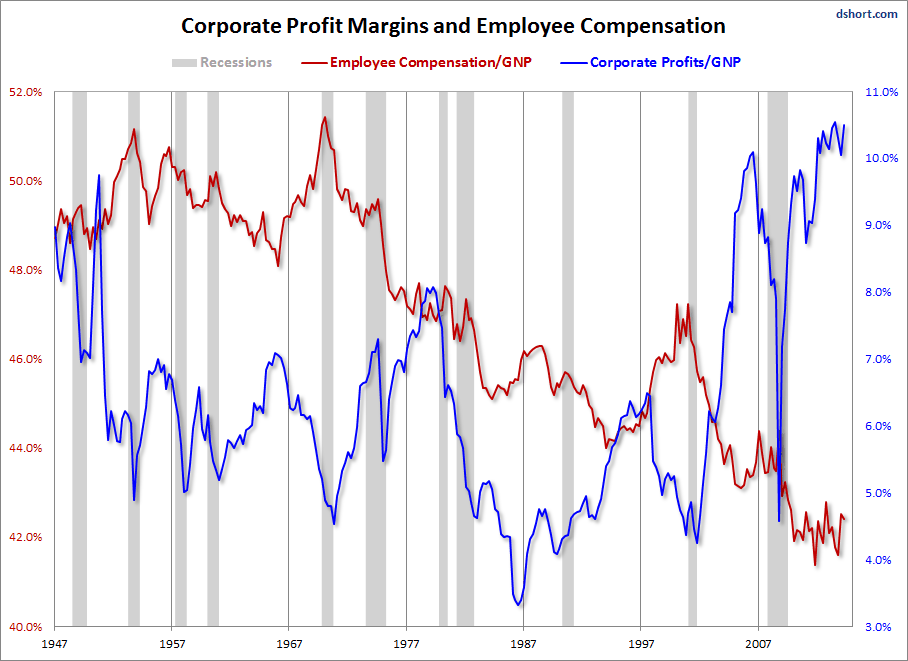
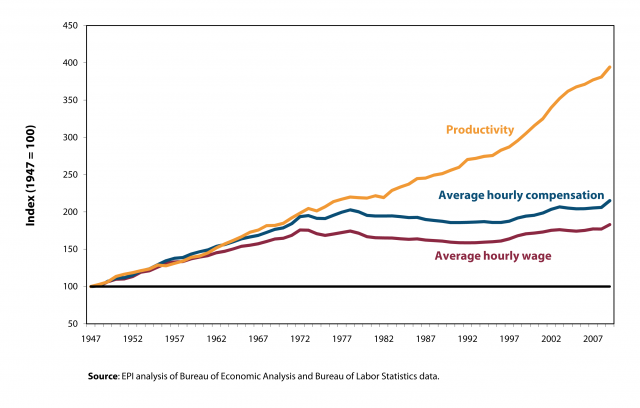
And when every firm behaves the same way, the long slow decay of the middle class (see charts below) starts to boil over into the political space. It's a serious problem.
All of that sounds fine, but to the extent it's fixable at all, the solution to problems like that is organized labor and not specific whines about "Google is bad".
It also said that Google doesn't have enough higher level work for people if it promoted them (because the promo rate is so much higher than industry average, and Google has shifted right in levels) but just about everyone ignored that.
You can't create larger scope/etc roles out of thin air (you actually have to need the work done), and levels always seem to right shift over time.
Then maybe Google needs to stop advertising that it needs and has the most intelligent engineers in the industry. If they don't have enough work to feed them, they don't need to have them.
This is the key insight that many people ignore, straight out of The Monopoly Operating Manual. When you are Google size, many of your investments are, and should be, wisely targeted at buying insurance against risks to future revenues and cash flows, not just growing them.
I don’t remember who talked about this on one of the YC podcasts but they brought up that google hires the smartest people for 3 reasons: to kee them from going to competitors, keep them from starting something that may challenge google, use them when they need to build something incredible.
This is my biggest issue with their hiring process. They clearly need grunts like me to do shit work and fix bugs in products like Android, but they won't hire me because I don't reflexively vomit whiteboard code and lack knowledge of website design. They are so intelligent in so many ways yet they fail to have enough self-introspection to adapt to their current situation.
Haha. It’s the first time I hear Google finally admitting to this under duress. Normally, in the recruiting propaganda there’s always room for “Doing Things That Matter”, and the lobbying for immigration expansion message always echos the need for additional “best and brightest” folks, who when hired get assigned to do the most basic gruntwork (affectionately known as “moving protos”).
> It also said that Google doesn't have enough higher level work for people if it promoted them
That's job title inflation! Banking is the poster boy for that. Any junior has the title of "Vice President", and a typical large bank has a few thousands "Directors". Zimbabwe-style job title inflation!
It’s partly that sure, but it is also that to enter into financial contracts on behalf of the company you need to be an officer of the company, and VP is the lowest reasonable title for such an officer, and entering into such contracts is a bank’s core business.
VP is mid-level too, you would expect a VP to have 8-10 years experience usually. More experience than many who call themselves senior software engineers!
You mean the company that is known for some of the best working conditions, benefits, and salaries in the corporate world?
This is the natural progression of an organization worth over half-a-trillion. Growth slows and they have too many people competing for too few high-level slots. Most companies at this stage just keep adding more mid-level titles so you end up as a "senior executive vice president II" on a meaningless ladder focused on politics over product.
Welcome to the world of HR. If you thought Google would be different I wonder why you thought so?
Unless a company is small, maybe below 20-50, where everyone knows each other transparency is something HR will always lack, because they are there for the company, not the individual. That's why apps like Blind are so popular amongst some employees that like these rumor mills. My advise is to stay out of it and focus on your job, do what you like and dont be jealous about other coworkers when they get promoted but you don't. There are much more important things in life then status and earning anything beyond 100K is already an amazing achievement (luck?) that majority of citizens dont have.
I started at Google right around when this deck was made. I never got a holiday gift. I got three "badges" for this (one for not getting a 2016 gift, one for, at the time presumably, never receiving one, and one for being in the first year of employees to have such a distinction). In a very characteristic example of Googliness all three were silently rm'd from the central server in between when I got my morning badge summary email and when I got to my desk. To be explicit, that means it became company policy sometime in that hour for those badges not to exist.
They re-architected the promo process for 95% of promos (according to another comment itt, but for sure closer to 80% than 20%), making it more conventional. Allegedly to prevent orgs from promoting wildly (for... Some reason I guess), "promo budgets" were floated. This rightfully pissed people off because Google only promotes you after you demonstrate consistency at the next level, meaning you would be working at LN getting paid as an LN-1 for at least another cycle if not longer. It also really upset the orgs that are structured by function rather than area. Allegedly these budgets never existed, but personally, after my management chain bluntly and directly lied about the Maven contract, I never believed anything they said. I'm sure they're all excellent people, but capitalism gives us all incentive to do things we otherwise wouldn't. Lying about Maven, and restructuring promo to make it your managers decision, were certainly company policies. Budgets might not have been, but then, even if there's no evidence now, it took us decades to find out the truth about Tonkin Bay.
So, for a brainstorming deck, a lot of stuff from it actually happened. Given that, you have to start questioning how accurate other parts are.
I left Google recently, though I knew what a "company" was going in and didn't expect anything different. I was very sad to leave my immediate team, but not at all sad to leave Google, mostly because of how glaring the difference is between what they say they value and what they actually value. I wouldn't even begrudge them the honesty; every other "conventional" company somehow manages to keep employees.
(trying to) Forcing bad products (g+), adding a top bar everywhere (look! we are a portal!), and cheaping out on labour which leads to missing out the only people capable of innovating.
To be fair, it sounds like it was some group brainstorming ways to reduce costs and throwing ideas out there, not something the senior leadership were actively planning. Probably one of those brainstorming sessions where they say “there are no bad ideas, just throw everything out there!”


That last sentence is quite telling about Google's attitude toward its employees.