From the article: "In a world where SSDs have become more and more common, one might ask what the point of even developing newer and bigger HDDs is."
Solid state drives still cost about 10 times more per gigabyte. I'm just a web developer, but a spinning-disk drive looks 100 times more complicated to me to manufacture. I know at the beginning that hard drives would be cheaper, simply because SSDs were newer, and there was R & D to amortize. But by now I would have thought that SSDs might have matched hard drives or even undercut them. Not only has it been over a decade, but hard drives themselves are using new R & D too. For example this article mentions that this new hard drive uses a new technique, called HAMR. Can the old factory machinery from 2005 be used to manufacture these new HAMR disks?
NAND demand is insanely high. You aren't just building computer SSDs, you have phones, in particular, and hundreds of other devices that use it competing for the manufacturing capacity.
Another issue with demand is IOPS. Enterprise is rarely limited by storage capacity, but instead by reliable operations per second. Pretty much every enterprise wants every SSD it can get at the right price point, which is much higher than consumers will pay. For the time being it will be worthwhile for NAND makers to sell drives to companies at a much higher price point.
The whole NAND industry is suspected to be engaging in price fixing/collusion[1]. They've already been caught doing it in the past and paid out a $300 million settlement over it back in 2006.
That article is about DRAM, not NAND. Any article that talks about SK Hynix as a major player but doesn't mention Toshiba is clearly not about flash memory.
Ah yes, my bad. The lawsuit in that article is indeed specifically about DRAM. A lot of the reporting on this mixes them up for some reason. But the DRAM and NAND industries are largely the same companies and both have been under investigation for price fixing recently.
The DRAM and NAND markets are similar, but there are important differences. The NAND market has several more major players and is significantly more competitive.
And the Chinese accusations of price fixing need to be understood in the context that they're trying very hard to get their own NAND fabs up and running, almost certainly using at least some stolen tech. Even without Chinese influence, NAND prices have fallen dramatically since that article was written, due to ordinary healthy market forces.
What a weird article. The latest brouhaha is about memory, not storage. The website shows a NAND SSD though as the main picture... strange... and incorrect.
>To put it another way, why wouldn't someone undercut the current suppliers and sell at just above their marginal cost and take over the whole market.
Moat. Or the Entry Barrier. You can't built a Fab, ignore the yield and expect it to be profitable. TSMC famously said they will never enter the NAND and DRAM market and thought of those as commodities. In 2017 that look utterly stupid when NAND and DRAM prices were sky high, while not widely reported, making Samsung Electronics the most profitable company in the world ( They own ~60% of the world's DRAM and NAND market ), even more so than Apple. By 2018, a 5% drop in World Wide Smartphone shipment trigger a knock on effect, the prices has seen been plummeting. Still profitable, just not as much as they were.
It was once thought the $100B USD from China would have solve this problem. Even if they make 50% less yield, and earned net zero margin, along with forcing Chinese Smartphone companies to use a percentage of those components, should have been enough to sustain those Chinese based NAND fab. Turns out it wasn't quite as easy as they thought. Most of the DRAM and NAND were far too inferior. 3D NAND, or Multilayer Stacked NAND along with leading edge node is a huge barrier of entry.
One reason why you keep hearing there are lots of IP theft going on.
Note: All the Apple product sold in China are using Chinese bases NAND.
> This is... exactly what everyone expects, and the assumption of every economic graph in the world?
There are actually markets where the opposite holds. Basically anything with high fixed costs, because the more units sold, the less of the fixed costs each unit has to cover.
But fabs don't really work like that because, while very expensive, they have finite capacity. A fab that can produce a million units costs a billion dollars. If you want two million units, that'll be two billion dollars and be available a few years from now. And if you build more capacity than there is demand, you're bankrupt. So they purposely build somewhat less than expected, which when demand is higher than expected results in much more demand than supply.
You need excess supply before you can try that. The question is can anyone raise prices and still sell out. This is a complex question (and often the answer is yes in the short term but you shouldn't because your customers might invest in an alternative and not buy at all in a couple years)
This is the Eco 101 way of thinking about it. Reality is more complicated, and more advanced economics models reality closer. Basically put, what you are describing is whats called a Perfect Market. A Perfect Market is one in which there are no barriers to enter or leave the market as a producer or consumer. However the vast majority of markets are not like this.
For example, the sheer complexity and amount of money needed to start a new NAND factory is itself a giant barrier to entry. Most markets that have a high barrier of entry take on a market structure called an Oligopoly. An Oligopoly is when there are only a few producers in the market, and it is difficult to enter the market. The difficulty need not be because of anything nefarious from the producers, it might only be because the production process is complex and/or requires a lot of technical expertise.
In Oligopoly markets, because there are only a few producers, the producers have more leverage over their buyers and are therefore able to charge prices higher than the marginal cost of production.
To your suggesstion, lets say I realize this and I want to start a NAND factory that undercuts my competitors by a little bit but leave me plenty of profit, I have to first build a factory large enough to reach the economy of scales that my competitors have. Reason for that is for a period of time, the marginal cost of production decreases as sheer production increases because the process gets more streamlined and automated. However to do that I need to hire engineers who know how to make a NAND, and maybe I need permission from the Chinese communist party. Then I need to get a bank to agree to give me a loan so I can have enough money to build my factory and hire my engineers. Banks probably are not going to be too keen on lending an unknown quantity and will likely charge me a higher interest rate to compensate for that risk. Only then can I enter the market.
So as you can see while its not impossible to enter the market, its not easy either. Since thats the case, the few existing producers can, without any nefarious activity (which is not to say there isn't any, but its not required), charge prices higher than the marginal cost of production.
> the producers have more leverage over their buyers and are therefore able to charge prices higher than the marginal cost of production.
pretty nefarious if you ask me. we gotta own the means of production! take-over these oligopolies and turn them into worker-owned-and-directed cooperatives!
On the other hand it means the technology is established and people prefer to buy SSDs over HDs. Speaking of myself, I wouldn't consider buying an HD laptop ever again.
This means companies can invest in very long-term endeavours to transform their HDD production businesses into SSD production businesses. The costs are high but the risk is low, lower or at best equally high of continuing with HDDs if you ask me.
The article below has a graph showing the number of "Client SSD vs HDD units" shipped by Samsung over the last 6 years. Given current trends, the SSD shipments will very likely exceed HDD in the next 12 months.
It seems you are much smarter than the rest of us when it comes to understanding supply and demand curves, but why don't you help us walk through an example, okay?
Suppose it costs -- and I am making this up -- $10 to produce the first 1000 units, but only $1 after that.
Suppose people are charging a lot of money, say $50 for a unit.
Won't you increase production to try to capture that demand.
After that, because you have increased production you enjoy economies of scale, and the price comes down.
If you are the only producer, you have no incentive to come down, but if there are other producers you will want to undercut them. In this case, you will bring down your price to gain more market share.
Please help us understand what we are missing with your shrewd understanding of supply and demand curves.
Because supply and demand curves aren't smooth - Increasing production scales linearly up to a point, and then you need to build a new factory. Samsung is pumping out all the SSDs it can produce. It is probably also building new factories, but the capital investment and lead-time on that are significant, and until those factories come online, they're simply sunk cost.
Customer demand is not smooth. I will buy precisely 0 SSDs at prices > $125 per 1T drive, and I will suddenly buy 4 as soon as the price drops below there. There are thousands to millions of other customers will scattered plot points around that area, but while you can draw a smoothed graph over them and be reasonably correct, they do not actually represent a mathematical law.
Further - Information is imperfect and markets, for all their elasticity, are only trending towards efficiency.
This all assumes you're arguing in good faith. This in itself is an unreasonable assumption - Your last, mocking line seems to belie it. As does this line.
It seems that you assume that if one producer sells its product for slightly less than its competition, then it will get all the customers, à la Bertrand competition.
But if it is not the case, and lowering your price only wins you _some_ but not all customers, then there is no reason to expect that the price point that balance gaining new customers vs selling each product for less will be equal to the marginal cost and not above.
Hard drives are cheap because, regardless of capacity, you make a bunch of moving bits and electronics, and then cover a disk with iron oxide and that holds all the data. When manufacturing SSDs, you need to make circuitry for each bit.
I agree with the other comments. I'd add that just because the end product can be easily seen to be a complex mechanical artifact, doesn't make it inherently more complex to manufacture than something solid state. A lot of complexity goes into making the solid state device too; it just happens out of sight in the fab.
It's (somewhat) the same situation as with EV and ICE automobiles. The engine and drivetrain in a modern ICE vehicle is extremely complex. Much more so at a macro level than EVs. But we're actually pretty good at building reliable complex mechanical systems. More things shift to solid state over time but it's a long process.
> but a spinning-disk drive looks 100 times more complicated to me to manufacture.
Fun-fact: The "head fly height", i.e. the distance from the underside of the R/W head to the platter surface, is less than a handful nanometers in most hard drives; this makes the gap not just smaller than any production transistor, but also smaller than any production feature size.
If two surfaces are flat enough and moving fast enough, the tiny amount of air (or helium these days) causes them to act hydrodynamically and float across each other which is great cause there's zero friction which means they never wear out.
The spindle in a hard drive is also an air bearing.
The big difference is that the overall performance of spinning disks is not much different than what it was 10 years ago. However, a best-in-class 2018 SSD is an entirely different beast than a 2008 model. They are somewhere around 5-30x faster now with significantly better write endurance, wear leveling, and capacity (you can get up to 4TB in consumer models for reasonable prices). The market hasn't pushed for solid state drives replacing bulk hard drive storage, instead it's pushed for much, much faster drives (yielding 1-2 orders of magnitude improvement over just the last decade alone) along with small form factor portable storage (SD cards and USB drives). The technology is there for someone to manufacture slow SSDs with the same capacity as hard drives at around the same cost, but the market demand isn't.
> 2008 ...They are somewhere around 5-30x faster now with significantly better write endurance,
Thats because 2008 to SSDs was like 1982 to HDDs. If you look at 2011 both of your promises are false. SATA SSD in 2011 was as fast as SATA SSD in 2018, but with about 10x more endurance.
The technology to produce crappy SSD is there, but it will "forget" its contents in couple of months when kept unplugged, or burn thru erase cycles in a year while sitting idle, just keeping content alive.
> SATA SSD in 2011 was as fast as SATA SSD in 2018
That's a meaningless distinction, M.2 SSDs are incredibly popular and are nearly 10x faster than anything you could get in 2011 (for example, an OCZ Vertex 3 would max out at 550/500 MB/s sequential read/write speeds while a Samsung 960 EVO can do 3.2/1.8 GB/s).
Semiconductor lithography is a lot more expensive than plain old manufacturing. Fabs cost tens of billions of dollars to build or expand and have limited capacity, coating a glass disc in rust is cheap.
Also, fabs have investors who want returns on their money, so they're not super keen on crashing the market either. There are not-so-secret cartels between all the major players that conspire to keep DRAM and NAND prices high.
We could certainly have the government dump a half-trillion dollars and bring up a bunch of fabs though. That's exactly what China is doing. Their economy runs on assembling the goods, not lithographing the chips (which is largely done in Taiwan or South Korea or sometimes Malaysia).
AFAIK, HAMR is just about using heat to allow for more targeted writes. Write density increases but the actual disk composition doesn't change, just the write head.
Me and some other teammates switched our dev machines from SSD to HDD arrays. 2-3 years of heavy usage - huge C++ - and SSD start silently fail in various ways - from slow down at 60-70% capacity to final outright failure even to read from. Note: the hardware is top line enterprise, pretty expensive. The perf difference between sdd and hdd is imperceptible for our use case as we are cores hungry and have enough RAM.
By "dev machines" do you mean workstations or CI servers? There's no way you could have been burning out top of the line enterprise SSDs in 2-3 years with developer workstation usage patterns.
(I could maybe believe that you ran into trouble if you used low-end enterprise SSDs that also force themselves to go read-only as soon as the warrantied write endurance is exhausted, rather than continuing until the flash itself is actually starting to fail.)
i wasn't precise here. It isn't top of the line enterprise SSDs (like the ones you'd use for databases and which cost accordingly). I meant the top-tier corporate enterprise vendor with top-tier hardware in the corresponding categories ( we're a BigCo ).
> I meant the top-tier corporate enterprise vendor with top-tier hardware in the corresponding categories ( we're a BigCo ).
So what you're probably getting is ordinary cheap consumer-grade SSDs, but perhaps with encryption capabilities actually turned on. I'd be surprised if you were getting something like the Samsung 850 PRO without specifically ordering premium SSDs.
>So what you're probably getting is ordinary cheap consumer-grade SSDs, but perhaps with encryption capabilities actually turned on. I'd be surprised if you were getting something like the Samsung 850 PRO without specifically ordering premium SSDs.
we've got various models through the years, yet still a notch higher - the 850 PRO has TBW at 300x-500x capacity where is the ones we've been getting got TBW around 1000x, and i think the earlier hardware was even close to 2000-3000x.
I agree that for 0.5-1 TB disk there really is no reason to not to get an SSD. However the price difference jumps significantly once you're looking at larger disks though. The cheapest 4TB SSD costs about to 8 times more than the cheapest 4TB HDD for example.
>When a WD Blue 1TB SATA 6 Gb/s 7200 RPM 64MB is $46 on Amazon and a Crucial MX500 1TB 3D NAND SATA 2.5 Inch is $134.
those are cherrypicked numbers because 1TB is at the very low end for HDD sizes. compare with a more typical HDD size (3TB or 4TB) and you'll see the differences become more obvious.
Wasn't the parent discussion about a new high-capacity HDD and the per-capacity cost of HDD vs SSD? I don't think that people satisfied with under 1TB are relevant to that topic.
In that market, people are comparing a pile of disks in an array to a pile of solid state storage needed to replace its capacity. The bulk price of storage inverts when it is cheaper to store hundreds of TB on huge SSDs rather than on huge HDDs. That would be the death of HDD, since nobody really wants spinning disks in their datacenter.
> a pile of disks in an array to a pile of solid state storage
It doesn't even need to be a pile of disks. Even for a PC the differences are big.
My computer has a 1 TB SSD which is a decent size for an SSD. It's still a bit tight for me, so I complement with a spinny rust NAS. If I had an HDD instead it would have been like 8 TB and I wouldn't necessarily need the NAS. I think that's what GP is hinting at when he says "me SSD needs". I think he's also complementing with HDD somewhere for bulk storage (be it external drive, NAS or even cloud storage)
If I'm GP, yeah; I use 250-500GB SSDs as primary disk and have a small NAS with a RAID1 of two 5 TB disks for slow archival storage. For that slow archive, though, I don't care what factor SSD price is to HDD price (as long as it's still >1.0).
Cost isn't linear with storage. On Newegg a 1 TB drive is $37, a 2 TB is $61, a 4TB is $84, a 6 TB is $158 for $26/TB. The metal shell of the HD costs a certain amount no matter how much storage is inside. Still not a full factor of 10 but certainly more significant.
You can't compare 1TB hard disks, they are comparatively expensive. The cheapest per TB I can find right now is 20 euros for HDD, and 120euro for SSD. So factor 6 if you buy the cheapest, respectively.
Regarding SSD technology, its just demand still being greater than the supply at this point.
Companies are overbidding at the fabrication lines to get their latest phones built. Data centers want SSD offerings for customers with insatiable demand for SSD servers at a premium.
The whole thing is just demand demand demand and the chips cant come out fast enough.
It will. SSDs counter intuitively scale down in price much better than hard drives at small sizes; there's no cost advantage to making a HDD with less storage than a single platter, or about 1/5 to 1/8 (in the case of helium drives) of the largest on the market.
Eventually, an SSD with cost parity with a low end HDD will be big enough, after which there's no reason for the low end consumer market not to switch over. The high end will have already as well (I certainly will never buy another laptop containing a HDD).
At that point, HDDs will essentially only be found in external drives and data centers. The writing will be on the wall, and R&D will slow down, starting a cycle that will lead to collapse.
This is already playing out. SSDs are cheaper than hard drives at 120GB, and that crossover point is moving upward. Sub-500GB hard drives will probably disappear from the market next year, now that 240GB SSDs are dropping below $30.
SSD controllers are cheaper than the fixed costs of hard drive motors, actuators and clean-room assembly. Adding an extra platter gets you more incremental GB per dollar, but getting that first platter working is much more expensive than the minimum viable SSD.
Interestingly enough SSDs have already outpaced the density of HDDs in the 2.5" form factor, presumably due to exactly the effect you describe. You literally can't buy a 2.5" hard drive bigger than 2 TB last time I checked. All of the thin-and-light stuff like ultrabooks is SSD only too, HDDs can't even match the dimensions you can do with NVMe (maybe something like Microdrive could) let alone capacity.
Cost is still up there but only about 2.5x as expensive as 2.5" HDDs... a 2 TB HDD is about $80 while a 1 TB SSD is ~$100-120. And there are (kinda shitty) 2 TB SSDs that are hitting $250 these days (eg Micron 1100).
I'm not sure if this was meant to refute my point somehow, but hard drives haven't come down that much in price since 2010...
Sorting by price on Newegg, if you're looking for a cheap laptop drive you can choose right now between a 320gb HDD for $28.55, a 60gb SSD for $19.99, or a 240gb SSD for $31.99.
For a 1TB drive, you're looking at $38.50 HDD vs $109.99 SSD.
Large SSDs remain fairly expensive for now, but the low end is being eaten.
"Eventually, an SSD with cost parity with a low end HDD will be big enough, after which there's no reason for the low end consumer market not to switch over. The high end will have already as well (I certainly will never buy another laptop containing a HDD)."
Reliability and mean time between failures figure in to the equation as well -- at both the low end and the high end.
Data centers don't want to be swapping out bad drives all the time, and low-end consumers can't afford to buy new drives all the time. Both want to stretch the drives they have as long as they can, and at least in the past SSDs were less reliable and failed a lot sooner than mechanical drives did.
I personally do like to buy laptops with mechanical drives in them, because I can get a lot of storage without paying insane prices, and because I want the drive to last as long as possible. And just in general, I don't trust SSDs. They have yet to prove themselves to me.
> Both want to stretch the drives they have as long as they can, and at least in the past SSDs were less reliable and failed a lot sooner than mechanical drives did.
> And just in general, I don't trust SSDs. They have yet to prove themselves to me.
I'm pretty sure you're cherry-picking the data you're willing to look at. It's definitely not true that any datacenter ever avoids SSDs due to worries about drive failure rates. These days, high-end consumer or enterprise SSDs are warrantied to survive more writes than it is physically possible to send to a hard drive during the same 5-year span. Flash memory write endurance stopped being a serious concern by the time consumer SSDs reached capacities that made them sufficient for use as the sole storage device in a mainstream laptop.
Controller/firmware bugs are the only source of SSD failure that you have a non-negligible chance of encountering in the wild, but the rate of such failures is very small, especially if you stick to the major reputable SSD brands. And that's in the consumer market where the vendors aren't specifically validating each SSD model with your specific servers before you put anything into production.
Maybe an SSD under a heavy datacenter I/O load is indeed less reliable than an HDD.
But in a laptop, a device that you lug around, move around while working, and sometimes even drop, a precise mechanical device has a much larger chance to misbehave, to my mind. Its I/O load is way lower than in the datacenter, too.
Used to be that whole series of SSDs had data corruption problems (which in one case ultimately lead to the demise of the manufacturer). Still happens. Recent example: Apple.
Power failure behavior of most consumer oriented SSDs is also data corrupting.
Big data also needs to be stored somewhere, especially all the environmental data, video data, and photographic data we are creating all the time with our smart phones and youtube uploads.
nobody (especially not all the ultra capitalist pigs here) would like to admit this but in reality the reason this is the case is price fixing. There are very few companies that do manufacture and hold the necessary patents to do so. You can thank the free market for it.


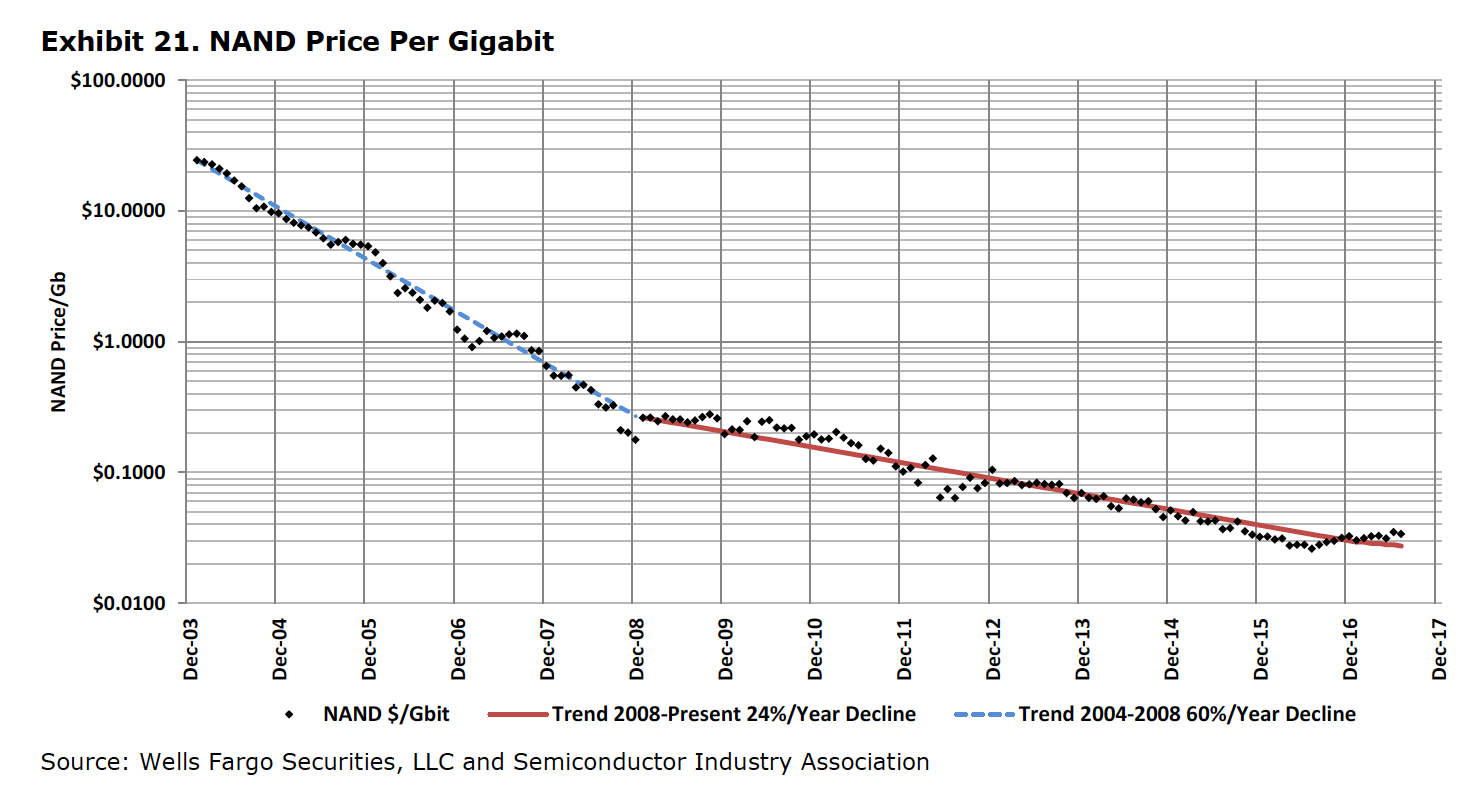
Solid state drives still cost about 10 times more per gigabyte. I'm just a web developer, but a spinning-disk drive looks 100 times more complicated to me to manufacture. I know at the beginning that hard drives would be cheaper, simply because SSDs were newer, and there was R & D to amortize. But by now I would have thought that SSDs might have matched hard drives or even undercut them. Not only has it been over a decade, but hard drives themselves are using new R & D too. For example this article mentions that this new hard drive uses a new technique, called HAMR. Can the old factory machinery from 2005 be used to manufacture these new HAMR disks?