Note that is for the cherry blossoms of Kyoto. So I'd say that the graph means next to nothing in terms of global or even national climate trends. This is about a very small city-dominated local climate. Any variation from a norm could have more to do with the heating/cooling of buildings and local traffic rather than global warming. The trend towards the use of glass in new buildings could have as much an impact as global carbon.
Despite the down votes this is a perfectly valid point. In the last 100 years Kyoto has turned from a quiet backwater into a city of over 1 million, liberally slathered in concrete like every other Japanese city. This will have an impact on the local climate, above and beyond global warming as a whole.
Not a political or historical backwater, but also not the booming metropolis that was Tokyo. It was a backwater in terms of urbanization and urban heat island impacts.
I can't speak for how it affects the data, but note that Kyoto city (京都市, the administrative area to which this data seems to apply) is about two-thirds mountains and small rural towns.
This is an interesting figure. Naturally, the sharp decline in the last 100 years or so captures one's attention, and would fit in with globally rising temperatures.
However, one other thing differentiates the older and newer epochs: The variance is much larger for older data. On the one hand it could be that increased variance is due to natural phenomenon (cooler weather?) or random error of less reliable measurements. However if that larger variance is due to systematic error (e.g., different methodologies/sources which were not accounted in the model (e.g., using hierarchical modeling), then there is a possibility that the difference between older and newer data are not that dramatic.
What an interesting (and alarming) figure.
It looks like the confidence interval is larger in earlier years because there are fewer data points.
Whats interesting to me is how big the spread is until the 1900s where not only is the blossom date trend increasing, but the individual blossom dates are grouping much closer together as well. I wonder if this is an error in measurement or if there is natural explanation for this variance reduction in the last 100 years.
Interesting. I live on the West coast and I cannot remember the fall foliage ever being as spectacular as it has been this year. I was just wondering the other day why it was so much better than ever before.
In the pnw it's because of a remarkable storm free October. The trees are progressing the same as always, but the leaves aren't getting knocked off. I think.
The storms are from the jet stream moving from north of Seattle, to south of the region. When the jet stream is directly above us, we get storms.
Summer is when the jet stream is to the north, and we get included in the band of warm air that California always enjoys. Winter is when it moves to the south, putting the Seattle area in the cold band that Alaska always endures.
Do you mean West Coast USA? I'm in Oregon and I'll say that fall foliage has been nice the last few days, but we also didn't get much rain this summer, and the last few winters have been lacking in moisture as well. My parents tell me it used to rain and snow quite a lot more than it has been these last few decades.
I moved from the Seattle area to eastern Washington about ten years ago. When I first moved here, people said "oh, this isn't a normal winter." Summer came "Oh, this isn't a normal summer." Several more years went by, with some winters having no snow, others piled up to six feet. Some summers it was 100F for a month straight, others just a week. I finally came to the conclusion that there was no such thing as a normal year to my non-meteorologist experience, because the normal was spread over a decade or more. I've also come to the conclusion that there are a lot of micro-climates in the northwest, having observed that with mountains, water, prairie, rolling hills, etc all over the place the weather can change significantly within just a short drive.
You can see it on TV if you are a scifi fan. Look at the x-files, Outer Limits, and early Stargate episodes filmed in 1990s Vancouver. Vancouver's wet climate gave them a very specific tone that became an industry standard. 1990's scifi was generally dark, as opposed to the more colorful productions filmed in California (Trek) or Australia (farscape). But today Vancouver suffers droughts every summer. The Flash is a colourful production. The foggy grey backdrop is now a blue sky. Rainfall numbers might not be very different, but the perpetual cloud that coloured scifi for a generation is gone.
The real joke of 'seacouver' is the an old adage for filming TV in Canada: Film in Vancouver, but never admit so in the script. If you want to tap the US market (who doesn't?) then the story cannot ever be set outside the US. The few shows that did (The Crow series etc) died quick deaths. X-Men went out on a limb by repeatedly saying Wolverine lived in Canada (Rouge finds him there). That was a risk. Everyone assumed they would have put him in Alaska. X-Files set a short arc on a train heading to Vancouver, but even there the bad guys were Japanese. None of the main story could ever happen in Canada.
Sell also Scrubs, filmed in LA but set in "San Frangeles" although never admitted in the script. They wanted to avoid the LA/SF/NY trend of mentioning place names and expecting the whole world to know what you are talking about. For the longest time I thought scrubs was set in Florida.
Thanks for that link. It didn’t make the rounds here in the Midwest since it features East and West coasts as it’s subjects, but we’ve had an incredibly wet and warm summer as well, and here too the fall foliage has been a disappointment.
The trees that held out the longest without turning are coloring minimally ok, but the earlier foliage was non-existent. This coincides with the last month of summer featuring no rain after an incredibly wet start and middle.
Similarly (and as an anecdote), I have seen cherry blossom trees blooming in the wrong weeks of the year where I live in southern Brazil. I live across a garden-ish square with dozens of them right across the street. The city is sprayed with https://en.wikipedia.org/wiki/Handroanthus_albus too — as I have one in my front yard — and every year I notice the blooming season shifting a bit, to the point that we are now in late October and the yellow blooming is either quite late AND timid or even inexistent because the tree decided to flip the bird (pun intended) to the weather changes.
This has happened before in my hometown (Livermore CA) with our beautiful cherry trees. One year about 8-10 years ago we had a few very warm weeks in January and the blossoms were out by Valentines Day - quite pretty, but probably not ideal for the tree’s reproductive cycle...
I’m assuming you’re trying to claim this is not related to global warming (“ it has happened before”).
Global warming is a large scale and long term problem, and the first thing you would expect is an increase in frequency of previously uncommon events - take warm weather: historically there may have been a few year where the temp got to X degrees, from an average of Y degrees. But now the average Temperature has increased by a small amount. That shifts the entire normal curve of temperatures up. So now instead of X degrees being the 99th percentile (say) it becomes the 90th. The wonders of normal curves and statistics ensures that as small changes accrue the current extremes will rapidly become more common - a 1% increase in average temperature (random
Number here) results in a frequency shift of more than 1% for the extremes.
Then we get to the localized vs global issue. Global warming in an average increase in temperature across the world. The world is big, and so there will always be area that are substantially higher or lower temperature than other places, but by virtue of the above statistics over time the high temperature pockets will become larger and more common. The high temperature pockets and the increased energy in the atmosphere increase movement of the atmosphere around the globe - so yes you may also get occasional pockets of uncommon low temperature. that is likely cause by uncommonly “high” temperatures in the cold parts of the world pushing the higher than average cold air into new locations. Over time the average temperature of the cold areas will become “warm”.
Finally, many biological and physical behaviors are purely a function of very specific temperatures. A lot of the biological behaviors (in plants especially) are direct products of physical laws - gas and fluid expansion being most common. Plenty of amphibians have gender determined entirely by temperature - something like 23.4c being the exact cutoff. Water freezes/thaws at exactly 0c - it doesn’t matter how small the difference is.
For any looking for more info on non warm blooded life being dependent on ambient temperatures to accumulate the energy to perform protein reactions, see the concept of Growing_degree-day
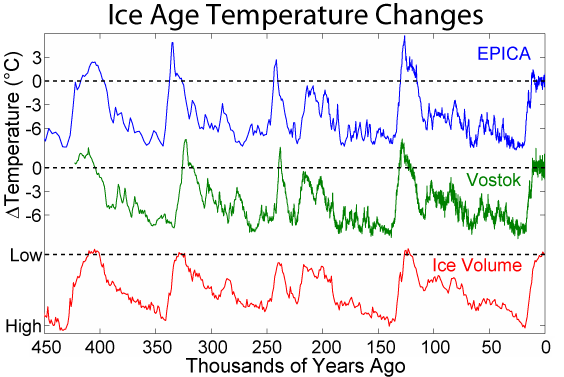
These [1] are the ice core data from the past ~400k years. Not only has the temperature gotten substantially hotter before, but this cycle of rising and lowering global temperatures has been happening before humans even existed. And these are not small temperature deviations. The range between the lows and the highs is around 9 degrees celsius.
I don't entirely understand why people are so averse to these data. Do people think they're just fake or something? This does not mean that humanity is not contributing to the current warming trend. But the data show beyond any doubt that warming cycles do, and would happen, even if humanity did not exist.
There were not periods where 'over a few years we saw a bit of warming' - there have been centuries of major warming that increased the ambient temperature of the Earth by ~9 degrees celcius. The most recent warmining cycle, before the one we're currently in, lasted some 20,000 years.
All of those changes took place over extended periods of time, as opposed to the human generated climate change that is labeled “global warming”.
The importance of timescales is very simple: evolution requires many generations to adapt, and the larger the change the more generations are needed.
Literally no one argues that there have been no changes in global temperature. That is a straw man.
The problem with human created global warming is that it is much much faster than any prior cycle, and that the mechanisms that are causing it (increased CO and CO2) have compounding ramifications - like ocean acidification - that are causing direct damage to major ecosystems, including the organisms that do absorb CO2. I don’t recall any studies of prior occurrences of this - I would expect that the impact would be gaps in things like the cliffs of Devon, etc where you’d see large scale (global) die offs of more or less all mollusks.
I assure you I'm not trying to strawman you. These conversations somehow always get so emotional so quickly, so I'm trying to be as forthright as possible. What I am reading from this post is that you're suggesting that since previous changes in temperature took place over extended periods of time, nature had time to evolve thus helping to minimize effects. That seems like a reasonable hypothesis.
How long of a time do you think would be the minimum to allow for the presumably substantial evolutionary changes that would be required for adaptation? How does this contrast against the warming, potentially upwards of 10 degrees celsius, that occurred some 330k years ago - to say nothing of the sharp increases in CO2 that also followed? In particular, how rapidly do you suppose that warming occurred?
And this is 100% correct. And, it has happened before. The world has had warming and cooling cycles for as long as there has been earth. The idea that all of this is a “new” thing isn’t supported by evidence.
Seriously, it isn't we have ice cores, and direct records for the last 200 years that show that the periodic changes in planet temperature are nothing like what has been happening for the last hundred years.
That said, I'm going to assume that based on your comment, you aren't actually interested in science or anything beyond talking points provided by others.
If you were actually interested in the science of this you would be able to provide studies that haven't been subsequently refuted, or been demonstrated to not actually compensate for the measured effect of global warming.
Solar cycles have been demonstrated to not explain the current changes in global temperature. The impact is not anywhere near fast enough to match current the last hundred years of change.
Random variance doesn't explain it - models for global warming predict increases in extremes of basically all events. Random variance is random so does not explain any changes with a measurable bias.
Conspiracy theories don't explain anything. 1) they're conspiracy theories, not science; 2) they depend on everyone lying about the temperature over time, except everyone agrees on what the temperatures are.
No hypothesis put forward, matches the core predictive ability of global warming theory: global temperature is increasing, as a result of increased CO2 and other pollutants introduced into the atmosphere by human, and human driven industries. This theory predicts increased global average temperature as long as greenhouse emissions continue, it explains ocean acidification, and it explains increased frequency "extreme" weather.
If you have some alternative hypothesis that matches prior atmospheric behavior over the last 200 years, and can also explain the things that global warming does, I'm all ears.
But I suspect you're just either a troll, or a talking point driven internet commenter.
While there are people putting out papers that suggest that what we are seeing is the result solar cycles, and perhaps the overlaying of multiple solar maxiuma, eg:
* though note that ISTR this paper only revises anthropogenic climate change down to 0.6°C which is still pretty high, and sorry, I can't find a free PDF of this paper anywhere.
I'm not sure refuting is the correct term. I think the most fundamental problem for climate science is that everything is based on models, and so nothing is falsifiable. This means that nothing is refutable. Everything is based on models which are retrofitted the past data. This means they, generally, do an effective job of mapping to old data (as that is what they're created on), and then extrapolate from those old data into the future. But the big problem is that those future results are generally plagued by very poor rates of predictability. But since there's no falsifiability, it doesn't matter.
There are major examples in both directions here. In the overstating direction, between 2001 and 2010 the warming slowed to 0.11C per decade. [1] For the 17 years before then was 0.17C. Because the models just map past data to future, nobody predicted this. There is of course a matter of long term vs short term. But at the same time, I think it's important to ensure we don't use this as never-fail defensive tool. Everybody missing a decadal long period of dramatic change is something that should not be ignored and I think we've been disconcertingly quick to marginalize.
In the other direction many climate models underestimated the rate of antarctic sea ice melting. This is, paradoxically, then used as a defense of the models. 'See? We were just being conservative. The sea levels are rising even faster than we said!' But this is again a very disconcerting form of handwaving, that also seems to indicate severe bias. Something happening faster than a model predicts is no better than it happening slower than the model predicts. What it means is the same in both cases - the model is broken.
But this isn't a warming or cooling cycle caused by any external event, but rather one caused by humans. It's not going to "switch back" to cooling, and this is indeed very new, entirely unprecedented in Earth's existence, and supported by mountains of evidence. The massive amount of pollution we've dumped into the atmosphere is causing irrevocable, widespread, vast changes to the Earth.
All of the above is stuff any kindergartener knows.
You lose people when you don't include any evidence and say "supported by mountains of evidence". (I agree with your point but please supplement your claim with evidence.)
Only if we allow sealioning to take over - global climate change is in the realm of accepted science, its 100% on people claiming the opposite to prove their claims at this point.
You're not necessarily arguing directly against the other person, you're also playing the room. Every time you talk to someone who denies climate change is another chance to convince them and everyone who is reading of what you believe.
So in my opinion it's best to cite your own evidence regardless of how accepted your beliefs are by an establishment, rather than just saying the other side has the burden of proof. Whether or not this comes from a pre-curated set of talking points is up to you.
Feel free to - but asking people to show their evidence for generally accepted stuff is a great way for trolls to waste your time with useless questions - literally why the term sealioning was invented.
If you want to bring up new evidence and arguments that are not settled then go for it, but asking everyone to post their pedigree to talk about evolution or climate change is just catering to an american audience who is purposefully putting their fingers in their ears - we have no reason to cater to willfully ignorant people.
Your argument is essentially: It is ok that my house is burning down today because my house has a heater that gets lit every winter.
You see, there is a difference in magnitude and velocity of the warming over the last century that differentiates the current warming to past warming cycles.
The article is funny, it says blossoms were sighted in "an area stretching from Kyushu... to Hokkaido." Unless there's some other Kyushu that I don't know about, that's the whole country. Look at a map, Ms. Brigit Katz of Smithsonian.com. Kyushu is at one end, Hokkaido is at the other. It's like if you said "an area stretching from California to Maine."
Japan's not big, but I mean this is as "widespread" as you can get while still having the word "Japan's" in the title.
Assuming that it's because of global warming, you wouldn't suddenly expect them all to start blooming in september one year. You'd gradually see it happening more and more often, to more and more trees.
That we've seen it before or that it isn't widespread doesn't mean that it's not a problem or a sign of a problem.
In what appears to be the source article: https://www3.nhk.or.jp/nhkworld/en/news/20181018_04/ the arborist clarifies, "this year trees have lost their leaves, stripped off by violent winds or left to wither from salt exposure."
Assuming it's because of global warming simply because it's an unusual environmental occurrence seems to be a popular pattern. Several news sources extrapolate to that as well, along with references to the pattern of earlier spring blooming in DC and Kyoto (more likely attributable to the urban heat island effect, as it started well before CO2-induced warming would have been significant).
The buds that are flourishing now in Japan won’t open again in the spring, but fortunately, the proportion of blossoms that have opened in recent days is relatively small. So, Wada tells NHK, the unseasonal bloom is not likely to affect the splendor of the cherry blossoms next spring.
It seems like you're leading to an opposite conclusion to whatever conclusion you've applied to the comment. Did you want to be specific about what your conclusion is?
TL;DR: The unusual bloom seems to be a direct consequence of the natural disasters hitting Japan over the course of this year. "Direct" as in "typhoons ripped off a lot of the cherry trees' leaves, but missing leaves are also a biological signal that start the blooming process".
Unrelated to that, the regular cherry blossom event has been happening progressively earlier due to climate change. The typhoons and heatwave that caused the irregular bloom were likely influenced by it as well.
We have some ducks in our backyard, who aren't the same pairs I usually see during the Spring. This group showed up a few weeks ago, and haven't left... I imagine they're coming from somewhere in Canada far north, but it's unusual to see them linger for so long. Seems like the current climate is confusing to the animals and the trees.