Coincidentally, I am just 15 minutes away from finishing listening the 350 minutes podcast episode of Dan Carlin's Hard History: The Destroyer of Worlds(1), which is all about how the advent of nuclear weapons changed everything regarding international politics and the war itself.
The podcast covers the political and military landscape and events between 1945 and 1962, culminating at the Cuban Missile Crisis, focusing on the American side of the Cold War.
If you know Dan Carlin's work, and take a hint from the episode's length, you know that it is a profound analysis, thoroughly studied from a variety of sources and with a real, intelligent effort to understand all sides, all parties, all individuals, and all context of the events. A real historian work.
Of particular interest is the glimpse on what was passing through all those brilliant scientists minds throughout and after the development of the tech. This is concentrated in the first half of the podcast if you are interested.
EDIT: just finished it, I think the final words of the episode are worth sharing:
"As I said, human beings are 70+ years into an on-going experiment to see if they can adapt or evolve to handle their weapon's technology. So far, so good. But let's remember that we are a long way from the edge of this tightrope. These might not even be the most powerful weapons we are creative enough to invent. And the systems we have in place still have human beings involved, which is one of those variables that makes it tough to think that we can go another 100, 30 or so years, and have the human story end with the words '...and we lived happily, ever after.'" Dan Carlin
> And the systems we have in place still have human beings involved
While I agree very strongly[1] wist the rest of that comment, it is very important to require some human involvement.
This isn't theoretical. Without Stanislav Petrov's good judgment[2] that the automated warning about an incoming missile attack was a false alarm, WW3 might have started in 1983.
[1] How strongly? My username is a reference to a fictional drug in Schismatrix that forces the user to adapt to a new perspective/mode-of-thought. Tech only increases, so our need to learn how to live together also becomes increasingly urgent.
I agree. Despite how this final comment looks, through the rest of the episode, he does not advocate in any way that we should find a way to automatize completely this kind of the decision. I agree that this final comment hints this way, but I think it is just the consequence of being out of the context.
What seems to be his opinion is the danger of giving so much power in the hands of only one man (in this case the John Kennedy as the President of the USA and Nikita Khrushchev as First Secretary of the Communist Party of the Soviet Union). Never before the nuclear weapons one human being has had such a destructive power. In his other podcasts, he alerts about this danger in the current political environment as Obama worked to concentrate even more power in the presidency during his time and we never know who might end up being president in the future, it is a very risky thing to do. For some, Trump is the personification of this exact risk; but for others, who support Trump now, it worth thinking that they don't know either who might end up next at the presidency with all this power.
The heads of state don't have a button linked directly to the weapons, though. They have to command others to launch it, and commands can be disobeyed. Sure, the consequences of treason are dire, but a nuclear counterattack is also highly unpleasant.
There is very little scope to disobey a direct order from the president. Disobeying the order and committing treason will only briefly delay the execution of the order as it's passed down to the next in line fallback.
Specifically where nuclear strikes are concerned, a lot of planning has gone into maximising the probability of compliance. Missile combat crew carry a sidearm to threaten their counterpart with death if they refuse to act on an authenticated launch order. They wear 4 point harnesses during launch sequence, primarily as a psychological device to prevent them from getting up and walking away mid sequence if their conscience gets the better of them, etc.
If trump or any other president said launch, there would be a launch.
Correct me if I'm wrong, but they also do "dry run" launches where the crew themselves don't know whether or not it's a drill, right? So they could safely assume that the real thing is also one of the regular, unscheduled drills.
It's not about conscience, though. It's about you or at least many of your friends and family either burning or starving to death. That's the thing about MAD: It's mutual.
They don't all have to go along. See the "execution" section- only a couple of senior officers have to authenticate the President, and issue the order electronically. At that point only one chain between them and a launch crew have to obey the orders to launch. The whole process is meant to only take a few minutes.
Everyone involved in the chain is part of the Personnel Reliability Program. It's mostly to make sure someone doesn't launch without an order but also probably to make sure that they will follow orders, including launch orders.
Dan Carlin is great, but you should take his warning that he's not a historian to heart: he enthusiastically speculates and characterizes the people in a way a historian would not, and can be very guilty of picking and choosing events to support the narrative he paints. You will almost certainly get a better understanding of the topics from looking at the academic materials from which he bases his own podcasts.
That said, enjoy him—he really does make the topics come alive, and I haven't been satisfied with JUST his podcast after he's piqued my interest. That's a great thing.
I do have the impression of being informed when he is painting a non consensuous picture, but I might be extra cautious in the future. Good warning, thanks!
Dan Carlin is excellent. Both his Hardcore History and Common Sense podcasts are always insightful. He's a great model of a practical skeptic - he's always skeptical, but he allows himself to think through both the skeptical and non-skeptical interpretation of a piece of information without giving preference to one or another based on his personal biases.
Oh cool! I loved his WWI series but I couldn't really get into the ancient history (King of Kings) series given the time commitment involved. So it's great to have a new episode.
I was the opposite. I've always preferred ancient history, and wasn't interested in WW1 or WW2. Ghosts of the Ostfront and Blueprint for Armageddon completely changed that for me.
Blueprint for Armageddon, in particular, I cannot strongly enough recommend. Nothing else I've encountered has so thoroughly brought home the fashion in which World War I and surrounding events have determined the subsequent course of history.
All six episodes are still on the free feed, and will be for at least a little while longer. Anyone reading this could do a lot worse than to at least download them for later listening, if not to go ahead and get into the series now.
I agree. Funnily, I saw that the current Humble Bundle includes a game called Verdun, which is as you would expect, a game about WWI's battle of Verdun (as far as I know). Carlin painted such a bleak portrait of that battle, my first reaction was "Why the hell would anyone want to play that?"
In my imagination, you play the game by huddling in a trench or bunker for extended periods as massive explosions go off around you, and if you try to leave you are almost immediately blown up or sink and drown in the mud.
I suspect they went for something a bit less bleak. ;)
Looks like a CoD-style tactical FPS, but in Great War drag. Might be fun for people who enjoy those sort of games, but I can't really say; on the one hand, I'm no longer that person, and on the other, I only got far enough into its Humble Bundle page to see
> Gore Settings: Players can now experience the real horrors of WW1.
before I started laughing, and I still haven't stopped.
The funny thing is that my parents bought this for me way back when but then, upon opening it, no one wanted to actually play it. I spent quite a few hours futzing with it though :-)
Oh, I listened to all of his episodes and King of Kings was one of my favourites (together with WWI and Eastern Front series). Goes to show everyone has their preferences :-)
I do as well and know several other people that have admitted to falling asleep to Hardcore History. I wonder what it is about, drifting off to graphic accounts of historical genocides.
Lol no! I always use 1x on podcasts. In this case specially because i am no native english speaker and the content is very dense (on the more interesting parts I would even rewind to listen twice). On top, I agree with the other comment that his storytelling skills are great and worth savoring.
But even on brazilian, humorous podcasts i dont speed up. I listen while doing chores and the ocasional commute. No hurry. I took about a month to finish this one.
Agreed with several points in this thread. Your English is good!
I can understand how keeping it at a normal rate is beneficial as deep as he goes on the material.
I've found the audio has to be clean and clear to take advantage of higher speeds of listening. Takes practice, but almost every podcast I enjoy I do 1.5x+.
I normally listen to all podcasts on 2x speed, but I usually slow Dan Carlin down to 1.5x. He has such a great storytelling style that gets degraded at higher speeds, IMO.
How do you get his podcasts into overcast, since they're paid? I couldn't figure it out. Only thing stopping me from subscribing. (I can't bear 1x audio, since I read so much faster)
I tried listening to your podcast episode, but the windiness of your intro didn't get me hooked after 10 mins of listening and I had to stop listening.
Dan is definitely a bit long-winded at times, but for me, podcasts work best when the person behind the mic has a real persona that you can relate to. I tune in to Dan Carlin because he's a smart, insightful guy, but I also just love to listen to him talk and feel that I am connecting to someone when I do. To that end, I actually enjoy the intros and asides as much as the historical content of the episode!
I feel that Ira Glass (This American Life), Jad Abumrad (Radiolab) and Roman Mars (99 Percent Invisible) all have this same effect.
That's why I can't listen to Dan Carlin. I really enjoy the overall content, but I don't agree that his podcasts are long because they're in-depth, I think they're long because he digresses and just takes a long time to say things. Even at 1.5x speed the rate was unbearable.
It is not "mine" podcast, I just listened to it. I edited my original comment to include "finishing listening" - I am not sure it is correct English, but at least I think clears this misunderstanding.
"Finishing listening" is arguably grammatical and certainly clear as to meaning, but a double verb like that is relatively rarely encountered in modern colloquial English, and falls somewhat oddly on the ear as a result. In a case like this, the lexical context generally supplies sufficient clue; one might instead, for example, say "...15 minutes away from the end of the...", or just "...from finishing the...", and have only a negligible fraction of readers fail to derive "listening" from the context of talking about a podcast. When that context might not be clear, it's worth expanding on the nature of the action described, but such cases are unlikely to be common and should be fairly obvious when they do occur.
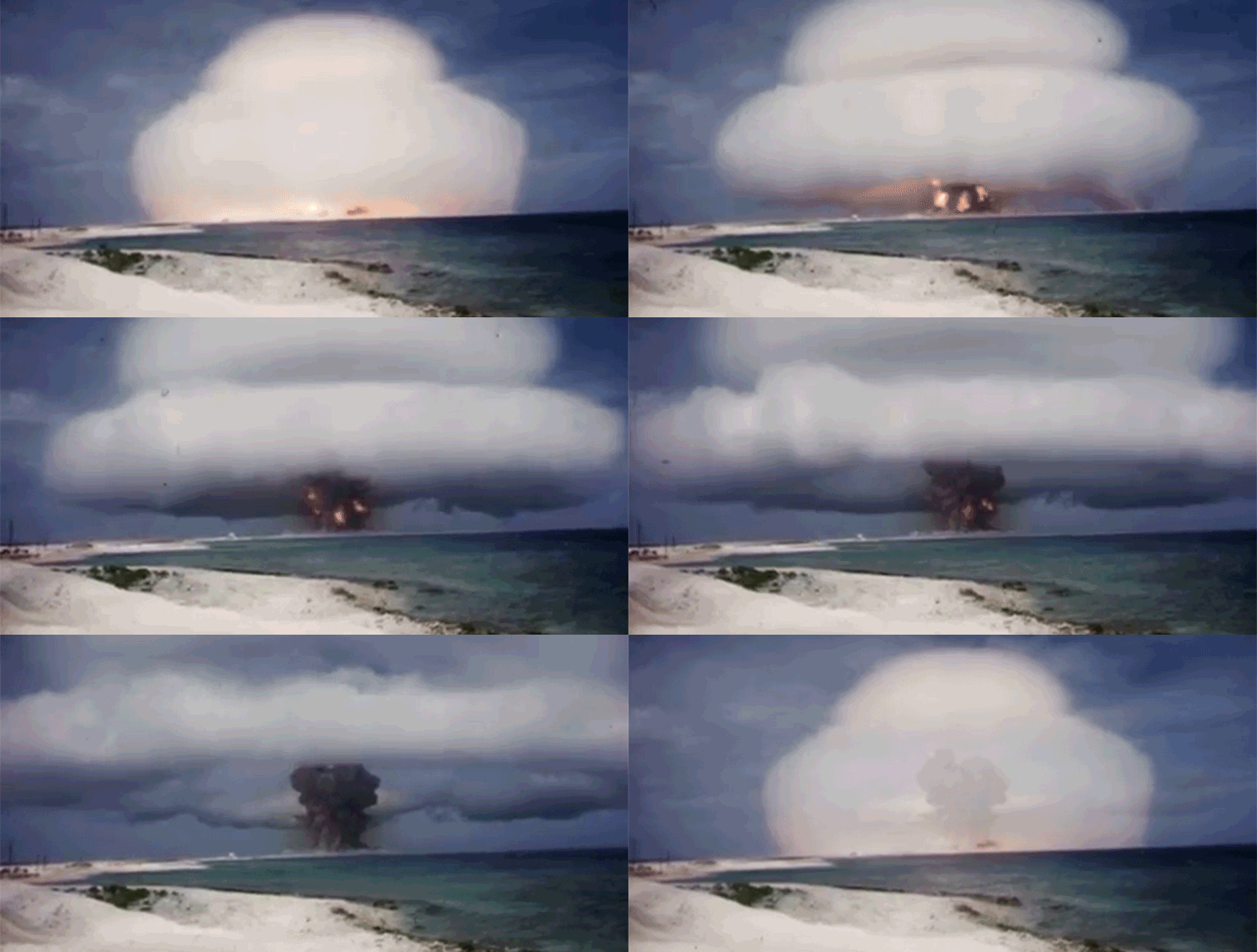
"You can smell vinegar when you open the cans, which is one of the byproducts of the decomposition process of these films," Spriggs said. "We know that these films are on the brink of decomposing to the point where they'll become useless. The data that we're collecting now must be preserved in a digital form because no matter how well you treat the films, no matter how well you preserve or store them, they will decompose. They're made out of organic material, and organic material decomposes. So this is it. We got to this project just in time to save the data."
That's... incredible. Then it sounds like they used a DNN or something similar to analyze the rate of fireball expansion in the films to refine their earlier estimates of yield.
> Then it sounds like they used a DNN or something similar to analyze the rate of fireball expansion in the films to refine their earlier estimates of yield.
It's actually quite amazing that even with such a simple model, G.I. Taylor was able to estimate yield's to within 10% of the official figure for the Trinity device.
Just because DNN's are terribly trendy doesn't mean that every image analysis task is done with them. :) I think that at least with such a crude model as the Taylor one, the model itself will introduce errors that DNN's per se won't fix. DNN's might help the manual drudgery of analyzing each frame of the videos manually though..
That quote makes it so clear how weak film is as an archival method.
Yet I still hear people talking about how digitally shot films have an archival problem. I really can't see how any well thought out digital archive wouldn't be significantly safer than film in a can.
One reason for film's superiority as an archival medium is that you can hold a piece of film up to the light and see what it contains, whereas to see a digital archive you need to invent all the technology that leads up to decoding that particular file type.
Disclaimer: I'm not a film archivist, but my partner is, so this is mostly second-hand knowledge backed up with quick google searches.
There have been several different major types of film used throughout the year.
Nitrate film was used from the late 1800s up until about the 1950s. It's highly flammable, and nowadays there are very few cinemas which are equipped to screen it. You need a very secure projection booth which can be well sealed in case of fire. It also burns without needing air, as it produces oxygen as part of it's reaction, which means that it's extremely difficult to douse with water. As it ages, the combustion temperature also lowers, and badly stored films may spontaneously combust. Despite all that, a properly preserved nitrate film looks phenomenal when projected.
That was replaced with acetate film, initially known as "safety stock". It was initially thought to be pretty stable, but within a few years the decay (known as "vinegaring" due to the smell) started to set in. As with nitrate, proper storage can slow down the decay dramatically. This was used from the 50s until the 80s/90s.
So there are these two historic film stocks, which were used in the production, archival, and distribution of every film for most of the last century, and they're both not fit for long term purpose.
In the 80s, a more stable polyester film started to be used. This is the best film archival method available to my knowledge. It's shelf stable, and has proven itself in lab tests. This is what people are comparing digital archives to.
Apart from the glib example at the beginning, I'm not going to try to argue the relative virtues of preserving the content of a film on film vs digital. However, the field appears to have a general acknowledgement of the importance of the medium of creation. So a digitally shot film would probably be preserved digitally (as well as possible) alongside any other medium.
> One reason for film's superiority as an archival medium is that you can hold a piece of film up to the light and see what it contains, whereas to see a digital archive you need to invent all the technology that leads up to decoding that particular file type.
Realistically, unless these nukes are put to intensive use, we are not going to disinvent computers. But your point is certainly valid for codecs. The videos will require to be transcoded multiple times as old codecs become obsolete (who can read real media's .rm files today?)
It's a bit of a glib argument but it does hold water.
The main points are that a timeframe of 30 years is actually quite short. While the moving image on film has only been around for about 120 years, ideally archivists would have film copies that would last far longer than that. Our idea of a computer in 120 years may be very different from what we currently use. More mundanely, what about when the last optical drive is manufactured? We'll suddenly have a finite number of reads left in the world. Or the hard drive connector breaks and it hasn't been manufactured for 30 years. Sure, a special one-off manufacturing run is certainly possible, but could a struggling and under-staffed archive afford to do that for every one of it's thousand hard drives, especially when it may not know exactly what's on every one of them?
I'm know I'm being a devil's advocate here, but I did want to illustrate that every unknown part of this equation is exactly what scares working archivists.
> what about when the last optical drive is manufactured? [...]
There are two types of digital archiving. One, which you're describing in this line of reasoning, is keeping a digital storage device in cold storage, booting up later, and trying to read the data. I agree that this has significant issues, as digital devices are physical devices, in addition to being digital ones, and not necessarily that reliable at that.
There is also digital archiving in the sense of understanding what the bits represent. I would argue that this sense of the phrase is actually more compelling, because fundamentally digital data is just a bag of bits. While this would be more effort than I'd go to personally, I'd expect any competent digital archivist to store their data in a ZFS-based disk array, SAN, or cloud service like S3, or ideally multiple of the above. (Or futures equivalents of these techniques.) Yes, any given service, technology, or device may come and go. But this is missing the point. The way you achieve continuity is by periodically refreshing the storage so that at any given point in time the data is stored in a modern (for the time) storage device.
There are still important issues to be solved, but the important ones are no longer questions of maintain physical devices, which is key. (E.g. the codec problem.)
The main situation in which this approach does not work out is if you're trying to do archeological-type recovery of a digital storage device that has not been actively maintained. Then you're back in scenario #1. But if we're asking about a situation where someone actively cares about preserving their own data, the situation is not nearly as bad as these arguments make out.
On the flip side, it wouldn't be extremely hard to create something to deal with .rm files either, which was demonstrated back then on several occasions. Seeing as the files are digital, and assuming proper storage, you have vast amounts of time to resolve the issue of reading .rm files, including directly requesting support from the engineers responsible for building out RealMedia's technology.
The transcoding is trivial as far as problems go. We've been dealing with that non-problem for decades persistently and will continue to. The engineering skills needed will continue to exist to deal with it.
If there is reasonably common non-DRMed software that can play it today (e.g. VLC), running on a operating system common today, you probably won't have too many issues just emulating said OS and using said software.
DOS 5.0 was released in 1991, over 25 years ago. There is a rather astonishing number of JavaScript based emulators that will let you run it in a browser. Even if the next 5 years of browser development break all of those emulators, getting a 5 year old portable version of Firefox that will run on current hardware isn't difficult.
I don't think decoding video that can be played with VLC today will be a problem in 30 years, and I also think that 30 years after that, all you might need to do is another level of nested virtualization. If we assume that there will be sufficiently well working emulators capable of emulating a 2017 machine in 2047, just like there are such emulators for 1987 machines in 2017, and that at least the most common binaries will somehow be preserved, you should be able to recover most reasonably popular video formats in perpetuity.
Compare that to analog material that rots and requires incredibly delicate handling by experts, while with digital media, you can let anyone try since they can't break anything. And finding a copy of a popular OS and player binary might prove easier than finding a projector/VCR that can handle the ancient format.
Even if you were to recompress every 30 years, the loss will likely be less than from physical degradation of physical media. However, if you have a lot of video in one canonical format (down to using the same encoder and settings, so you don't have to worry about weird edge cases), you can just preserve a copy of the player and every 30 years, you make sure you can either port it to a current OS, or virtualize it efficiently.
>The videos will require to be transcoded multiple times as old codecs become obsolete (...)
-My chief worry in that regard would be DRM; I have next to no idea how digital content is distributed to theatres, but presumably it is locked down all over.
The transcoding itself is trivial. Decrypting the source material may not be.
I don't think DRM is that big of a problem for future archive access. I assume that in 50-100 years, we would simply brute-force the DRM keys in milliseconds.
EDIT - Note that this assumes knowledge of the DRM algorithm. I admit the brute force approach might fail if the algorithm was secret and no players existed any more.
You can't extrapolate future computing improvements based on the past, we are hitting physical limits now and in 50 years may not have computers dramatically faster than today.
I don't believe we are anywhere near the physical limits of computing at all; the laws of mathematics, physics and information theory give us an enormous upper bound on capacity. There are technologies like quantum computing we haven't even started to scratch the surface of, and our knowledge of nano-scale engineering is still very much in its infancy. I would be very surprised if in only five years computers were not dramatically faster, let alone 50.
Oh absolutely. I don't think even the film die-hards would suggest otherwise for most video produced today. I honestly don't know who actually does archive on film these days. I presume larger studios still do. I know film projection prints are still made for a lot of films, so perhaps an extra projection copy is made and stored in a studio vault.
You'd need 300*60 = 18000 film cameras to keep up with preserving it all, plus some spare capacity for when you're changing film reels. If a film reel lasts an hour, it'll generate 18000 reels every hour, which should fit in a semi trailer. Not cheap, but entirely feasible.
Well, like anything it totally depends on the specifics.
A modern B+W film, properly fixed and washed, is essentially forever. Metallic silver doesn't really degrade by itself (50+ year lifespan) - and you can use a toner like selenium to convert the metallic silver into silver selenide which is even more stable, easily 100-200 years+ (note that this is generally done with prints but it also works with film).
Color films are generally considerably less permanent because you can't capture color using metallic silver unless you have one negative each for red, green, and blue. You can do that though, the TechniColor "3-strip" process did this and it's actually extremely stable for its time. It was also used for the color series of Magic Lantern glass plates from the Prokudin-Gorsky survey of 1905 [0].
Modern negative films are decent if stored properly, but early color negative films were pretty disastrous in terms of long-term stability.
Color slide films in particular are actually quite decent as long as you store them properly (cold, and out of light). Kodachrome (K-14 process), in particular, was remarkably stable because there is actually no dye in the film itself - it's created by reaction during the (incredibly complex) processing, so (again, if properly washed) there is nothing left to continue reacting and "fade" the image out. Properly processed, Kodachrome does actually approach the stability of B+W film. The only thing that really degrades it is exposure to light (i.e. projecting it or leaving it in a window).
Many early film bases were problematic though, because it was essentially a parallel effort with basic materials-science research in plastics. Nitrocellulose is super flammable and many early theaters burned down as a result, it was replaced with acetate "safety film" which tends to go vinegary, finally everyone settled on polyester. Nowadays you can have a pretty good expectation of the storage properties of our plastics.
Anyway, to make a short story long - you are assuming the question by adding "a well-thought-out digital archive". You can't pick a random instance of film storage and pretend that's representative of a modern, well-thought-out effort at archival. People did all kinds of dumb things in the past - South Carolina's constitution is falling apart because they laminated them back in the 60s and now they're turning to vinegar too [1]. The equivalent in digital terms is a random paper tape from the 60s pulled from someone's attic, or a DVD that was scribbled on with an alcohol-based marker and left on a spindle somewhere. Or someone's VCR bootleg of the first rough-cuts and rotoscope layers of Star Wars (see "Deleted Magic" [2], it's amazing but wow is the quality terrible in some of them).
It's always going to be possible to store some relatively stable physical media, that's the easy part. The problem with digital is you then add additional tasks of loading and interpretation on top. Even if it's stable, how do you get that Quadruplex video tape into your computer? Is there a driver that interprets the filesystem? A codec (ideally open-source)? Is there a sync signal in the medium that might degrade (like VHS)? etc etc. Yes, these are not insoluble problems, but they do add a huge threshold to get over. It might be worth doing to save Star Wars but it's not going to happen for Uncle John's photo collection.
Consider something like the task of encoding a message to an alien race. You have to provide something like a Rosetta Stone to help make sense of your format. Or you could just send a phonograph which can be read by many different methods (laser measurement is the coolest). It's a pretty solid assumption that there will always be basic instruments for physical measurement like lasers and reflectometers, and that's all you need to interpret a basic medium like B+W film or a phonograph. Although I suppose how dare I assume the visual wavelength of an alien species! /s
On the other hand - if you are going at it thoughtfully, i.e. periodically rotating your digital storage medium to whatever the standard is at the time, and you retain sufficient backups - the chances of there ever being a total discontinuity in migration path, or a total loss of knowledge on how to interpret the format is relatively low. The going at it thoughtfully part is the key though. Again, nobody apart from a handful of archival specialists or enthusiasts can really read a random minicomputer tape from the 80s, and that's only 30 years.
I personally started noticing bit-rot on a significant fraction of DVDs that I burned within 5 years (at least 20% of discs). Now I use DVDisaster to encode extra parity/recovery data on a rolling basis - disc X contains a 20% parity file for disc X-1, with the most recent kept on my HDDs, so that I can "chain" backwards through them.
Still though - imagine the kind of digital files that were made in 1995 with MOV files or whatever. Now compare them to the high-resolution 4K scans that are made from the same films. That's really another problem with digital, not just archival - the bits are what they are, you can't go back and try again when technology is better.
[2] https://www.youtube.com/watch?v=f2r4Nffrc6Y (there is also a Deleted Magic Revisited DVD with better quality and some more footage - finding it is left as an exercise to the reader)
> A modern B+W film, properly fixed and washed, is essentially forever
> easily 100-200 years+
I don't understand, is it forever or 200 years?
The videos I uploaded to YouTube 10 years ago of me singing crappy songs into a webcam are plausibly going to exist until the heat death of the universe, whereas it sounds like the best case scenario for B&W film is 200 years.
> I personally started noticing bit-rot on a significant fraction of DVDs
DVDs aren't digital, they are an analog format that we use to store digital data. They are made of plastic and foil. The fact that they degrade is a shot against analog storage. Digital storage is electrical. Like S3. A good digital storage device is a living, self-repairing organism.
> The problem with digital is you then add additional tasks of loading and interpretation on top.
That's where your thinking is being constrained. You're thinking of digital archiving as something you do on top of analog media. That's backwards.
With digital, the only task is loading and interpretation. And dozens of file formats have totally stabilized. A CD packaged with an .ISO image for a Linux computer that can read it is pretty much self-hosted. You could've encoded those images 20 years ago, and they'd still be runnable on EC2 today. And they'll still be runnable on EC2 100 years from now. The fact that some very old formats are difficult to read does not mean we're going to forget how to decode ISO images, or boot Pentium-class virtual machines.
I get it that archivists are obsessed with DVDs and film, and I have a massive amount of respect for people who want to try to protect those physical objects. But the idea that preservation of digital files is somehow equivalent—or even more difficult!— is laughable.
Off topic here, but there is no such thing as the heat death of the Universe. The second princile of thermodynamics (entropy cannot decrease in a closed system) does not hold at cosmic scales. That's because that principle assumes the gravity is negligible compared to the other forces that move the molecules around, which is a perfectly valid approximation for all human-scale systems (such as engines). At cosmic scales gravity becomes dominant and the entropy of closed systems can and does spontaneously decrease. For example a giant gas cloud evolves to become a spinning disc and then a planetary system.
For sure there are cases (plenty of them) where the second principle continues to hold (entropy goes up). I was just pointing out that there are very natural example where that principle breaks down at cosmic scales. Such an example is exactly how our planetary system was born.
People know vaguely that in a few billion years our Sun will collapse and it will either become a supernova or become a star where the fusion reaction is a higher one (instead of hydrogen+hydrogen->hellium, something like hellium+hellium->carbon). At some point possibly after trillions of years, all the nuclear reaction converge to produce only iron, and from that point on there's no more fusion and fission, and later on the heat death of the universe occurs. Well, even if there are no more nuclear reactions, the universe will not die from reaching a maximum state of entropy (heat death), but may continue to evolve forever, going periodically through states of higher and lower entropy.
>That's really the core problem with digital in a lot of respects - the bits are what they are, you can't go back and try again when technology is better.
Heh. I've been digitizing a couple handfuls of old VHS tapes that have nostalgia or sentimental value to myself or a friend of mine. You really forget just how poor video from a few decades back was compared to what's available today.
Yes. Even with high-end studio equipment the difference is astounding. Let alone with random consumer stuff that was poorly stored or whatever.
My favorite example here is Star Trek TNG. It was shot on film but immediately transferred to VHS for editing and transmission. The BluRay releases were remastered from the film and the difference in quality is just astounding. Immensely greater color range and resolution. And since everything was done with motion-capture and practical special effects, all that looks amaze-balls too. There are like 2 actual CGI sequences in the entire series (the Crystalline Entity and something else).
It was a massive effort to re-master the whole thing because again, it was cut on VHS. They had a map to the general area where a reel of film was stored but nothing specific ("3rd row of shelves, 4th from the top, halfway across"), and no real list of which takes or shots from the reels were actually used. Only a list of what shots were taken on what day, in most instances, and the shot lists weren't always followed. They literally re-cut the entire thing from scratch. Pretty amazing.
On the flip side - it's going to be a lot tougher to re-master DS9 or Babylon 5, because they were actually shot on tape (VHS?) instead of film, and the effects were done digitally. The model files and stuff are long gone. You could re-create it from scratch, but nobody wants that (see: the Star Trek TOS remasters). Practically speaking, DVD quality is the best it's gonna get there.
I think the codec is a problem, but for everything else I disagree. Today a consumer disk stores 8-10TB for a very modest price. Write your data on 5 of these disks (for redundancy) stored in decent conditions. In 5 years, read these disks and transfer them into 5 newer disks, which size will have increased in between. The filesystem can change but a file is a file. Repeat every 5 year.
Right, that's what you have to do. Lots of redundancy, and a plan to move it forward to whatever the technology-du-jour is in 5 years.
But do remember - a hard drive that's sat for 5 years may not even spin up. Spinups and spindowns are rough on hard drives. So is just letting them sit and seize up. A mechanism that depends on moving parts is inherently failure-prone.
SSDs are going to be better in that respect, probably. Although again, you have cases like the Samsung 840 Evo series where the flash cells lose their charge over time and need to be periodically rewritten or else they go corrupt (never fixed, just had a firmware patch to rewrite it in the background).
The funny thing is, I actually think optical media are a pretty good approach for long term stability. It's a lot like film, all you really need is a good image of the disc. Plastic and foil just happen to not be that awesome for long-term storage, if it was diamond or something that would be pretty much perfect. But, I suppose since you need a laser with a particular wavelength it's not really universal...
Anyone know how those "M-Disc" things made of some kind of stone or whatever end up turning out? Any good? Sounded nice from the marketing pitch but of course the salesman's going to tell you it's awesome...
Yes, digital is probably orders of magnitude safer than film in a can. However, digital is not 100%. There's still data corruption, and loss of systems and programs that will play the data. It's still not set it and forget it, you have to actively preserve the digital media, and now, the surrounding playing mechanisms.
It's a different set of risks. Digital is easier to make fireproof (store copies offsite) but vulnerable to new threats such as automated bulk deletion (e.g. a backup script gone wrong).
It really goes beyond that. Th proverbial prints in the shoebox are subject to fire, flood, analog deteriorations, and just being lost in a move or when cleaning out the attic while digital can be backed up six ways from Sunday.
Of course, in practice how many people are one head crash away from losing most of their photos stored on a consumer-grade USB drive? And of course, many people are also subject to cloud companies going out of business, computer equipment being stolen, losing access to a site online, etc. And the situation with gaining access to photos and other things if a family member dies or whatever is another whole issue.
There are untold thousands of unlabelled canisters in film archives all around the world. Some of them are undoubtedly very important, but until they're catalogued we won't even know.
Unfortunately, most film archives are enormously under-funded. Here in the UK, arts funding (which is where this normally comes from) has dropped dramatically since the financial crisis. When Jeremy Hunt axed the UK Film Council[1], most regional film archives totally lost their funding. When their money disappeared, so did any chance of employing cataloguers.
A proper archive will at least be storing their film in environments with the proper humidity and temperature to reduce decomposition as much as possible.
The other side of it is that the more decomposition that's happened, the more time you need to invest into restoration. See the 11 year restoration of the 18 minute Voyage dans la Lune for an extreme example[2]. That kind of effort is only possible for a film of enormous historical importance and at least some commercial value.
Source: My partner's a film archivist and moving image historian.
Exactly. There is, from the perspective of being able to digitally preserve it, an essentially infinite quantity of film, audio, and paper in all forms sitting in vaults, archives, libraries, etc. around the world in various states of deterioration. We collectively can (and should) make an effort to preserve significant properties but it's almost certainly unreasonable to think that even a small portion of existing physical artifacts can be digitized.
Absolutely. If we had a functional government I'd say they should form a branch of the LoC to digitally preserve it all, post hast. It's hard to know what we'll be losing until it's lost otherwise.
It's the Library of Congress's job to do just this. They are doing it. People submit huge volumes of film to them and they sort through it, digitize it, and preserve it, just like books and media.
I wonder how much the Archive team could do on their own, with donations from us and cooperation of the "better to ask forgiveness" kind from the LoC librarians.
That would be an excellent outcome, but given the climate around IP in this country I wouldn't want to be the one the government decided to make an example out of.
I'm not surprised these were kept classified for so long. No one could watch these and not be
moved. That beautiful beach with a mushroom cloud on the horizon. The birds fleeing. What a juxtaposition! Nuclear weapons are humanity's shame. That we used our best minds and science to build these things.
I am very much moved by pictures of nuclear tests. Though for me, the description would go like this: "that typical boring beach like every other beach out there, with that beautiful nuclear fireball and mushroom cloud on the horizon".
Call me weird, but I'm absolutely mesmerized by videos of nuclear detonations. I appreciate that dropping nukes on people is evil and wrong, but it doesn't change that so much raw power extracted out of what's basically cleverly mixed soil, unleashed on human command, feels like a big achievement.
That we learned to control it and put into productive use in nuclear reactors is even better, but nowhere near as beautiful to watch.
https://en.wikipedia.org/wiki/Cherenkov_radiation is equally beautiful/awe-inspiring to my eyes. It's like we made those glowing starship engine cores out of science fiction, except they exist in real life. Nuclear detonations feel a bit more like power we can't control - and arguably, that's true.
Indeed. Nuclear detonations are more about just how much power we can deliver to a place on demand, but we don't really control much of it. Nuclear reactors are about us controlling smaller, though still huge amounts of that power.
Related, while I'm at all into cars, I love the ingenuity behind internal combustion engines - we took a substance that just burns very well and figured that if we can explode very small amounts of it in a container very quickly, we can produce lots of reliable, portable power. We built a whole civilization on top of it.
Very carefully selected soil, where conditions are correct to achieve exponential growth in reactions.
Not all elements are fissile.
I didn't really understand this till recently- so I thought I'd share. Propaganda films from the 50s celebrating the Power of the Atom are a little broad in their claims.
You might appreciate the film Crossroads by the artist Bruce Conner. It's a montage of unmanipulated high-speed film of a nuclear test at Bikini Atoll. The soundtrack is synthesized, partly realistic noises, partly minimalist drone music, one section being by Terry Riley.
And an evocative, kind of Lovecraftian, extract from the official report:
"Things happened so fast in the next five seconds that few eyewitnesses could afterwards recall the full scope and sequence of the phenomena. By studying slow-motion films...the scientists eventually pieced together the full story. Without question one reason why observers had so much trouble in retaining a clear impression of the explosion phenomena was the lack of appropriate words and concepts. The explosion phenomena abounded in absolutely unprecedented inventions in solid geometry. No adequate vocabulary existed for these novelies. The vocabulary bottleneck continued for months even among scientific groups. Finally after two months of verbal groping, a conference was held and over thirty special terms, with carefully drawn definitions, were agreed upon. Among these terms were the following: dome, fillet, side jets, bright tracks, cauliflower cloud, fallout, air shock disc, water shock disc, base surge, water mound, uprush, aftercloud."
You can be opposed to the use of nuclear weapons but still be academically interested and curious in them. Regardless of what you think of them I think we can all agree they are impressive and awesome (not in the colloquial use of the word).
Yet somehow all the other horrible weapons in history get a free pass? Fireboming of populated cities and watching tens of thousands of people burn? Being stabbed in the belly with bayonet and dying painfully over the next 12 hours? Bombs that take away the sight and hearing of children? Napalm, phosphorus, etc that stick to skin and burn down to the bone? .50 caliber shells that tear people apart? Mustard gas the burns through your lungs? Biological agents that can spread in a population quickly and kill off a city?
My take is that if it builds detente that stops conflicts then it must have a net good. Humanity built these things and uses them either explicitly (Japan) or as a threat (MAD). They are artifacts of human culture. They reflect our warring nature and we cant just shame them away. In a non-nuclear world we would have the same, if not, more conflicts and many more dead. Assad has killed around 500,000 civilians with his small military and just conventional arms. No nukes needed. That's more than twice the number killed by nuclear weapons use in WWII.
There's also a moral hazard here of excusing guys like Assad because "hey at least he isn't using nukes." The more we vilify nukes and excuse conventional warfare, which is just as if not more brutal, the farther we'll be from proper peace. Nothing really changes if we get rid of nukes. You're making the mistake of confusing the symptom with the problem.
Nukes should go away, but only at a time where the threat of another world war doesn't exist. What that means politically is unknown, but arguably nukes, as horrible as they are, have stopped a proper WWIII. The more I study WWII and think about how much better our conventional weapons and manufacturing ability were during the cold war compared to the 40s, I can't imagine a conventional WWIII not ending the world. Not as dramatic as nukes, but certainly the end result would be similar. I sometimes wonder if nukes are a required stage for a species like ours. Its something that stops the possibility of a catastrophic world war while we aim to developer better social and political mechanisms to end war on this level. At that point we would naturally get rid of our nukes, the same way people in very safe neighborhoods don't sleep with guns under their pillows. I think "umm kay nukes are bad" narrative is short-sighted and ignores the real possibility of a conventional WWIII ending the world.
None of the other weapons were world-killers. There is a difference in quality and quantity. Mustard gas is nasty, but it's ultimately not very effective. Napalm, phosphorus are cruel, but not generally more useful than a large explosive.
A nuke is everything. Nukes are too effective, allowing you to make a whole planet uninhabitable if you really felt like achieving that goal. Maybe we should be especially repelled by the fact that we've stockpiled the means to utterly erase our existence.
>> we've stockpiled the means to utterly erase our existence.
Here's a thought. Remember the deepwater horizon oil spill? Imagine the consequences if they had been unable to cap that well. Imagine it still flooding the Atlantic ocean (via the gulf stream) with oil today. Now imagine that all those capped wells all over the place eventually crack and start spewing oil in 100 years due to some unforeseen failure mechanism in the concrete. Where would we end up? Weapons aren't the only tech that can go wildly wrong.
While it doesn't take much away from the argument, it's worth noting that nuclear weapons, when they don't work the way they're intended, don't kill everything. Nuclear weapons are fail-safe[0], and it's very hard to make them detonate. A slight problem, and you have a very expensive dud.
--
[0] - for "irradiated half the city, but at least it's still standing" values of safe.
Yes, that's one strong benefit they have over chemical weapons, which are basically always going to leak given time, or biological agents, which can be smuggled in a human incubator. The downside of nukes almost exclusively has to do with when they work as intended... otherwise they really are impressive products of engineering.
One of the scariest things about nukes is the secondary effects. After the cities burn and civilization falls apart. Imagine all the industries that deal with dangerous materials. Imagine what will happen after they are all simultaneously damaged and/or abandoned by the war. You would have tens of thousands of major industrial accidents occurring all at once.
Vats containing chemicals more dangerous than in Bhopal would leak. Nuclear reactors all over the world would melt down with no one to contain them. Oil wells would rust and burst.
I once commented that a tactical nuke might be a solution to the Fukushima disaster. Just place it correctly and blow the entire mess into the ocean and let it sink. I'm not sure if spent fuel is better sitting on the bottom of the ocean than where it is, but at least it would be kept cool ;-)
Also when I searched for the Russian clip, most results where about using a nuke to end the Deepwater Horizon desaster, for example here. [1] Although it was obviously, at least I hope so, never seriously considered.
Chemical weapons are world-killers, absolutely. You could gas out every human city and end civilization as we know it.
Biological weapons can probably do this 10x faster and via weaponized viruses meaning no ICBM's needed, just a good enough virus to be carried by human and animal hosts that infect the world. Or infect common crops and watch the world burn as everyone starves.
A total war between the US/NATO and USSR sans nuclear weapons would also probably have ended western civilization and probably drawn in everyone else too. World-killer? Maybe, maybe not, but the world left over would have been one no one wold want to live in. The same way a post-nuclear world would be.
If anything nukes kept US/NATO and the USSR from going hot. That conflict could very much been a world-ender and was itching to happen for decades.
Chemical weapons are shit, sorry. They're expensive to produce, dangerous to store, and their mortal enemy is... weather. Biological weapons could, if they were properly designed and released, didn't mutate, etc... etc...
Nukes just... work. You twist a couple of keys, flip a switch and 45 minutes later human civilization ends.
I think this is the key difference. Conventional wars, regardless of the weapons, are awful, but they take time, and resources, and constant decision making. Things can change, one side withdraws or surrenders and the killing stops.
A weaponised virus doesn't have these constraints, and could destroy humanity, but at least it takes some time, and can probably be somewhat mitigated.
In nuclear war, a split second decision could annihilate every living human, erase all evidence of our existence, and maybe cause a big enough climate shift to permanently end life on this planet.
> In nuclear war, a split second decision could annihilate every living human, erase all evidence of our existence, and maybe cause a big enough climate shift to permanently end life on this planet.
Not to take too much from the argument, but that line is way overblown. I think it's hard to believe a nuclear war would kill all humans (it would certainly destroy civilization, but killing everybody is way harder) but nobody can be sure of that. Anyway, the Earth has survived meteor strikes larger than humanity's entire arsenal and life is still here.
You've taken nothing at all from the argument. If human civilization fails, then it's just a matter of time before the species does as well. More importantly, what value would there be in a handful of devastated humans scratching out a "bang the rocks together" life until the next extinction event finished the job?
This reminds me of a moment from the book "Against All Enemies," where Colin Powell, when asked behind closed doors about the dangers from chemical agents if the Iraqis had them, rolled his eyes a bit, and said that they were "goofy." He elaborated along the lines of: chemical weapons are completely at the mercy of the wind and dispersal patterns, and while they might be nasty in isolation, they simply weren't an operational concern.
Exactly. Chemical weapons are mostly good at terrifying and murdering civilians and the otherwise unequipped and untrained. Nuclear weapons just.. kill.
Technology has improved chemical weapons quite a bit from the stuff used in World War One though (and chemical weapons were pretty effective then.) Modern weapons can kill in terrifyingly small doses. I mean, sure, they aren't as dangerous as nuclear weapons. But that isn't saying a lot...
> Yet somehow all the other horrible weapons in history get a free pass?
Certainly not.
> Assad
Years of brutal civil war vs literally two moments. We have been seconds away from nuclear war several times due to computer bugs. And those are the times we know about!
If I am not mistaken that is a quote attributed to Sir Arthur ("Bomber") Harris [1] who led the bombing campaign of Germany as Commander-in-Chief of the British Bomber Command during World War II. In an interview he was asked if dropping bombs on cities full of civilians was moral. His response went something like this: "Name me one thing in war that is moral. Is sticking a bayonet in a man's belly moral?".
You forgot swords and maces and lances, going back to spears and arrows of crude stone and stick... We can go back, way back before the artificial horizon you place on it, and see that people have been killing - and in the most gruesome ways - since the beginning of humanity.
If you really want to engage in a philosophical discussion, do include all the history. It has always been about protecting resources that are deemed important. At some point, someone wants what someone else has. I suppose we could maybe stop the horizon at explosives.
Once it went from melee to ranged combat, things really changed. So, "who could make the bigger boom?" became the defacto leader. The problem is that nuclear weapons are as big as it gets, at the moment, with more and more organizations wishing they had them too. Being a strong arm in the weapons race is very important.
But using them is atrocious. The destruction is beyond the pale. And it affects those that used to be meaningless: us, the commoners. Killing uninvolved people is a hard pill to swallow, so it is hard to be the one to pull that trigger. I hope to hell it never happens. And I worry, a tiny bit, about people with the stupidity to think that their beliefs "command them" to use them to prove a point.
But it does not have to be like i think is that , humans can decide to end poverty, end money madness and make a peaceful world . I am sure it will happen one day may be after bigger disaster but we all intelligence to make that happen. We just dont try.
Maybe we did... The modern world is like a utopia compared to the horrors of our past. Every year the world is getting better statistically. Poverty is decreasing, wars are decreasing, life spans are increasing... You wouldn't know it if you just watched the news. Which only focuses on the bad events and the negative aspects of the world.
I mean, if the U.S. had not created the nuclear bomb, odds are high that Germany would have. At the same time, the U.S. was prepared to do a full invasion of Japan with 250,000 troops, expected casualties at 100,000 U.S. troops. My grandfather was on a boat off the coast of Japan when the bombs dropped. I may not be here now if we did not drop the bombs. I know it's all relative, as somebody would be here today that is not in Japan. But still.
I tend to blame human nature for the destruction of our own selves, not the weapons we do it with. One way another, humans will kill each other, nuclear or not.
Yes, and the war in Europe ended before the Germans built a bomb (they were trying, but had not made much progress), and like you said many of their best minds were in the US.
I think in a situation where the Americans didn't build an A bomb then no one would have for some time.
Would it have made a difference to our world now? It's hard to tell, but the Soviets certainly would have taken more Japanese territory than they did in our timeline.
My opinion was Stalin was too pragmatic to start WWIII, Before and after WWII he only provided limited support to Soviet-aligned groups (see: post-war France and the Spanish or Greek civil wars) in other part of the world to avoid antagonizing the west too much.
I think 100,000 allied casualties is a low estimate the generals told the president that the invasion would have 85% wastage for the first 5 or so waves ashore.
That's an often-repeated and far from conclusive statement used to justify dropping the bomb to gain a temporary (it's crumbling now) international advantage.
Check out Oliver Stone's Untold History [1], or many other history sources for various opinions. There is considerable debate about it.[2]
In reality, the Japanese were on the verge of surrender. The U.S. had badly firebombed Japan, burning hundreds of thousands of people.
Considering that we had to nuke two actual cities to get them to surrender, how many bombs would we have had to drop in the ocean to achieve the same effect?
I don't know about you, but I'd only have to be nuked once before I'd run up the proverbial white flag.
I live my life by that single insight: technology and progress do not change human nature. Behavior, sure, but not our nature. Human nature and nuclear weaponry are not compatible.
> Human nature and nuclear weaponry are not compatible.
Here's the problem though: most interesting and useful technologies of the future are not compatible with human nature. E.g. any interesting interplanetary drive that would give us reasonable transit times is at the same time a powerful WMD, simply because of the energies we'll be working with. Or bio/nanotech, dream of so many industries, is also potentially much worse than nukes.
Makes me worry if we grow up in time, or end up killing ourselves with our toys.
It's also why if we where rational as a species we'd be focusing on becoming a genuine space borne/multi-planetary civilisation.
Our best shot at surviving the great filter is been spread out enough that when someone goes "Ooops" and levels wherever they are there are other self-sufficient humans far enough away to survive.
Not sure if we'll ever achieve that (though I think in totality it's only just beyond our current technology) though since it would require a colossal investment that would make the Apollo program look tiny to bootstrap it.
> Our best shot at surviving the great filter is been spread out enough that when someone goes "Ooops" and levels wherever they are there are other self-sufficient humans far enough away to survive.
This idea of compartmentalization is a strong argument against globalism. "Oops"es in government, society, and culture can be just as deadly.
"Nuclear weapons are humanity's shame. That we used our best minds and science to build these things."
You can't blame the whole of humanity for the shamefulness of a few Western powers. Surely, there are cultures all across the world that chose not to use violence.
This is important work. I would also recommend any of the Peter Kuran documentaries (Trinity and Beyond, Nukes in Space, Hollywood's Top Secret Film Studio).
What's really interesting about these is that there is a visible frame count on some of the videos and that you get to see a few frames before the detonation. E.g. the Androscoggin test opens on frame "-8" with the first flash visible at frame 0. You can see this by pausing the youtube videos and advancing frame by frame with the "." key.
There are a whole bunch of really interesting but rarely-seen effects that occur in those first one or two frames.
There's a neat description of this in a paper from 1958 here:
"The glow is known begin immediately (well within a shake) after gamma irradiation of the air, and has an apparent brightness of the order of that of the sun."
It would be really interesting to see the first few high speed frames of a detonating multi-stage weapon. Presumably this would reveal details about the sequence of energy flow from the exploding fission stage to the compressed fusion stages. Indeed, there were diagnostic pipes like this fitted to some of the early H-bomb test devices, e.g. http://nuclearweaponarchive.org/Usa/Tests/IvyMikeDevB1600c20...
Sadly, all of the multi-stage tests I have seen in public sources begin a few frames after detonation, or, like these, they are shot from far enough away that you just see a single diffuse glow.
I second the recommendation. Peter Kuran, a film maker, was responsible for restoring a lot of atom bomb test footage that was rotting away and making the restored versions publically available.
Is it me, or does it piss anybody else off when stuff like this happens, especially with something of this magnitude?
I mean - as terrible and stupid as it still is - it is one thing to lose the original video footage of the first moon landing (GAH!).
But here we have data, about the most destructive weapons ever created, that just sits gathering dust, decomposing, becoming useless. Meanwhile, the computer models, being developed and designed by people who likely weren't even alive at the time of these tests, are relying on data and assumptions that don't match up with the data in those tests!
What does that mean? I don't know - but it doesn't sound good on the surface - not good at all. Would these weapons work if needed (let's hope that is never the case!)? Would they fail? Are they failing now?
And why wasn't this stuff digitized a long time ago? Why do we not seem to care about this crap?
Lastly - we are in an era that are so far away from that time period of testing. It bothers me and frightens me that so many people - most who either weren't alive at the time, or were children with no access - these people have no idea about the destructive power of these weapons, having not experienced first-hand the nuclear tests that did occur. These men and women who were "there" are dying or dead already. And those replacing them seem to be getting bolder about wanting to use these weapons, without having the gut affirmation of what they would unleash. I have an opinion - which may be unfounded and false - that one of things that have kept us (humanity) from nuclear annihilation thru war has been the fact that there are still people who remember those tests. Those who remember - at a gut level - that the power of these weapons, from witnessing (or having other close-knowledge of other witnesses) these tests - have stuck with them in a way that can only be akin to that of say, seeing the earth from the moon, or from space.
It's a primal thing - the knowledge from seeing these weapons and their capabilities - a single one which can destroy an entire city - and knowing we and "them" target many to many to cities and other places...
Yet - here we are, people wanting to use them. And the data that could help make these weapons "safer" rotting away. I'm not sure if that is a good or bad thing overall...
"It's just unbelievable how much energy's released," Spriggs said. "We hope that we would never have to use a nuclear weapon ever again. I think that if we capture the history of this and show what the force of these weapons are and how much devastation they can wreak, then maybe people will be reluctant to use them."
That's exactly why they likely will be used. So it serves as a deterrent right up to the point where it serves as an advertisement.
Interesting bit of un-intended poetry in there: The nitrate film used to store the images is itself rather explosive, so here is one explosive used to record the effects of another:
Oops. I tend not to watch much video. There's no sound on this VM host. Because there's too much risk of compartment leakage, with so many family smartphones lying about :(
I am very curious what you mean by "compartment leakage", and I don't know how to unambiguously interpret "so many family smartphones lying about". Are these smartphones you refer to compromised?
Many of these are remarkable and downright creepy. Some look like gaping skulls. IIRC the spikes you see coming out of the fireball are the guy wires securing the mast that the bomb was mounted on, which initially ignite faster than the fireball expands.
> The closing quote: "The legacy I'd like to leave behind is basically a set of benchmark data that can be used by future weapon physicists."
That's a misleading selective quotation: here's a fuller quote:
> When asked why this project is so important to him, he voiced the dominant perspective among weapon scientists at LLNL: He doesn't want nuclear weapons to be used and passionately believes the key to ensuring they aren't is to making sure the U.S. stockpile continues to be an effective deterrent.
> "We need to be able to validate our codes and trust that the answers that are being calculated are correct," Spriggs said. "The legacy that I'd like to leave behind is a set of benchmark data that can be used by future weapon physicists to make sure that our codes are correct so that the U.S. remains prepared."
hahah I know, right! I have such mixed feelings about this. There's no changing our actions during the cold war, and we should certainly better understand what happened, but doing so to help future makers of nukes? Very unsettling to say the least.
I went to the museum at LANL a few months ago and in a lot of the videos the scientists and engineers expressed similar sentiments. They feel that the work they are doing is instrumental in the relative peace humanity has had since the end of WWII. I don't know a ton about that subject but it is hard for me to to disagree that without nukes and MAD the world would have a net increase in bloodshed.
    Lawrence Livermore National Laboratory grants certain permissions to reuse content created by Lawrence Livermore. These permissions are governed by Creative Commons copyright license CC BY-NC-SA 4.0 (link is external), more commonly referred to as "Attribution-NonCommercial-ShareAlike." Under this license, Lawrence Livermore permits others to remix, tweak and build upon original works created by Lawrence Livermore, as long as appropriate credit is given to Lawrence Livermore National Laboratory, any reuse is not for commercial purposes, and any remixed works are shared under identical copyright terms.

    Attribution — You must give appropriate credit, provide a link to the license, and indicate if changes were made. You may do so in any reasonable manner, but not in any way that suggests the licensor endorses you or your use.
    NonCommercial — You may not use the material for commercial purposes.
    ShareAlike —  If you remix, transform, or build upon the material, you must distribute your contributions under the same license as the original.
It seems strange to me that a government organization would grant a CC license for their content, especially restricting it's use to non-commercial stuff (not that I have any intention to use there stuff commercially). Glad that it's at least available under a CC license though, thank you for asking!
I had the great good fortune of being able to take the Strobe Lab course when I was an undergrad. Edgerton explained some of the engineering that went into high speed filming and how the cameras were protected from the blast and radiation. It was a great look into a multidisciplinary engineering project. Everything was purpose built for a unique task.
I did as well. Great guy. Also the sort of hands-on tinkerer and practitioner that I suspect there are a whole lot fewer of at top research universities today.
This footage is always so scary, and beautiful at the same time. Amazing stuff. I can't imagine what it was like seeing the first test go off. The feeling those people must have had about the future.
It amazing to think how something so small can produce so much energy. Yet I look around where I live and try to imagine every last bit being vaporized and it's very sobering.
"In the late 1990's LANL (Los Alamos National Laboratory) had a public web server running on what later turned out to be a classified machine. I don't think any security breach occurred, but one day the machine simply disappeared. I wrote to the webmaster (back when you could do such a thing) who told me an audit discovered this alarming state and it was shut down.
Luckily I'm a packrat and occasionally use 'wget' to snarf down the contents of a website. This is one of those times. The images aren't anything exclusive, just a good set directly from the horse's mouth..."
Tom has a thing for cold war nuclear and computing machinery. He also created FidoNet and Homocore.
My dad was 10 miles away from the explosion at Bikini Atoll. He was on a ship. I wish I had spoken to him more about it. He just did not want to talk about his work on the Manhattan Project or as a civilian at Bikini Atoll. I did find out he measured radiation levels on the Atol 24 hours after the explosion. He did not get cancer and lived a healthy life to 82 years old. Many of the people he was with did get cancer at a relatively young age.
I realize that the article indicates that these old films were just lying around untouched for decades, but what you are missing is that this data is "declassified." That doesn't mean it wasn't analyzed between the 50's and today, or that it doesn't exist in other media forms in classified channels - which it does.
The US government does a lot of replication of effort because most agencies don't know what the other agencies are doing. The DOE/CIA/DOD/DOS NBC program is massive, and the simulations and modeling teams have all of the extracted RAW data that exists on past tests, including the ones shown here.
I think this is a great effort, but all the teeth gnashing about how all of this data would be otherwise lost if not for this effort is - at least in this case - misguided.
By the way, the spring Trinity test site open house is coming up on the first of April. You can only visit two days a year (1 April and 1 October). It's a really good trip.
Here's the web site all about the site (note: this site may be inaccessible from outside the USA): http://www.wsmr.army.mil/PAO/Trinity/Pages/Home.aspx . The national parks service has a page too -- I guess it's a national park encapsulated within a classified military base?
I highly recommend everyone watch the two part series on PBS on Uranium - Twisting the Dragons Tail [1].
I found it really interesting the amount of money we spent to develop the Atomic bomb, and I think about today, if we invested the same percentage of GDP budget and went all in with alternative energies...
I interned at LLNL and went to a few talks where they discussed small-scale physics first-principles about how the interior of a star works, and I was shocked to discover that these videos were basically all that they had to go off. (And NIF, though each firing of the laser is extremely expensive and contained to a tiny chamber)
Wow! Watch starting from 1:07 in slow motion (0.25) and as it goes you can see (I believe) the shockwave expanding starting at ~1:11 the ground gets gradually lighter colored and when it reaches the camera it shakes it.


The podcast covers the political and military landscape and events between 1945 and 1962, culminating at the Cuban Missile Crisis, focusing on the American side of the Cold War.
If you know Dan Carlin's work, and take a hint from the episode's length, you know that it is a profound analysis, thoroughly studied from a variety of sources and with a real, intelligent effort to understand all sides, all parties, all individuals, and all context of the events. A real historian work.
Of particular interest is the glimpse on what was passing through all those brilliant scientists minds throughout and after the development of the tech. This is concentrated in the first half of the podcast if you are interested.
(1): http://www.dancarlin.com/hardcore-history-59-the-destroyer-o...
EDIT: just finished it, I think the final words of the episode are worth sharing:
"As I said, human beings are 70+ years into an on-going experiment to see if they can adapt or evolve to handle their weapon's technology. So far, so good. But let's remember that we are a long way from the edge of this tightrope. These might not even be the most powerful weapons we are creative enough to invent. And the systems we have in place still have human beings involved, which is one of those variables that makes it tough to think that we can go another 100, 30 or so years, and have the human story end with the words '...and we lived happily, ever after.'" Dan Carlin