Eventually - maybe in 20 years - humans won't be even allowed to drive.
I'll bet they even ban hobbyist driving - like those who 'still have old cars' and want to drive on those 'old car roads'.
Statistically too dangerous. Far more dangerous than anything else we really do - certainly more than smoking. And when it's no longer a 'necessity' ...
Do you remember those movies before the 1960's when they get in cars and they don't even have seat-belts - and we 'gasp' ... 'OMG' ...
I think our grandchildren will gasp when we tell them we drove cars. They will think we were crazy and uncivilized, we'll call them wimps.
You'll want to teach your grandson to drive, your daughter in law will be upset and call you a crazy old man :)
"Eventually - maybe in 20 years - humans won't be even allowed to drive."
I don't see that happening for a century. Unless you subsidize the cost of purchase of a new car for everyone who has a car now, and associated costs of owning a new vehicle.
Where I'm from(Poland) the average age of a car is 16 years. Buying a new car, even if it's something very cheap like a Fiat Panda, is still a huge deal.
Why would you care about what purchasing power is like in Poland you ask? Well, because at the moment I can drive my car literally around the world, without modifying it an inch. If some countries start banning manual cars, then suddenly you can't cross certain borders anymore - that's almost idiotic. If the ban of manual cars is going to happen, it will need to happen almost worldwide at the same time, and that's absolutely, definitely, completely not happening in the next 20 years.
I actually think your example with cars without seatbelts is great, because it illustrates what will happen with manually-driven cars - instead of banning them, they will eventually become so rare there will be no need to ban them, just like you can still drive your 1950 car without seat belts or airbags.
Agreed. Where I'm from (USA) the average age of a car is still 11.4 years - and growing as cars become more reliable! The average age was 8.4 years in 1995. Not quite 16 years, but we're definitely not all buying cars on 2 year leases.
For 2014 (latest year with all data available) there were 260 million vehicles on the road. In this year, there were about 7.6 million new vehicles sold. Of these, about 0.5 million were hybrids, having grown from 0 in 1998 and 0.25 million in 2006. If self-driving cars follow a similar track to hybrids, it's going to be a long time before the majority of those 260 million cars are self-driving.
+ There will be EU wide standards for 'self driving' just as there will be a 'North American' one.
+ They will make them cheap. The AI is software, it's a commodity, and the parts (i.e. LIDAR) will be cheap by then.
+ In 20 years you won't likely be able to drive your old car in France, and no offence - they will probably mock the Polish for still having 'real cars' :).
But you're right - 20 years is too soon.
20 years to 'almost everyone in driverless cars'. 30 years to banning humans. 45 years to banning them even from driving hobby cars.
"45 years to banning them even from driving hobby cars."
Again, I don't think this will ever happen, just like we haven't banned horses on normal roads - there's just so few of them that it's not an issue. Likewise, if in 50 years 99% of cars are self-driving, it won't matter an inch if you want to drive yourself in your antique. If you find someone who will insure you in it, fine, go ahead, don't see why they would be banned - self driving cars will probably do a good enough job of avoiding manual cars anyway.
I am quite sure that once most of the cars will be autonomous, we will start building autonomous-only roads. With faster speed limits and so on. Manual cars will not be allowed on those, and then progressively more and more roads will become autonomous only. Hopefully the first to become as such would be all roads in cities.
Just like horses which you cannot bring to a highway.
You can't ride a horse on the motorway in the UK(speed limit 70mph) but you can happily ride one on a dual carriageway - which also has a normal speed limit of 70mph.
And cities autonomous only? So what about bicycles? Or tricycles? Or hand drawn carriages(rickshaws etc)? Would those roads have high walls around them ,stopping pedestrians from entering?
And finally - where would the money for that come from? Even very rich countries(I live in the UK) struggle to maintain their roads to a high standard, something simple like adding new pedestrian crossings can take years in planning and approvals, but somehow, we would modify all our roads to suit one specific type of vehicle?
I'm really sorry if I'm being cynical, but I really do have a feeling that this self-driving-car utopia is not going to happen.
I think bicycles and other lightweight vehicles are fine. My main problem is that myself, as a pedestrian and a cyclist I am sharing the road with several-ton metal beasts which are driven by annoyed, angry and tired people. I would feel much safer knowing that the pilot of a car next to me is concentrated on the one thing which it is supposed to do.
I think however that at least for several years (decades) the autonomous vehicles must be able to work on the roads we currently have.
As a disclaimer, I would say that I am actually pro-ban of personal vehicles in city centers today. I really do not see a point of anything that is not an ambulance, fire truck, bus, a taxi or a delivery truck on a road. Why people wake up soon in the morning only to then be stuck in an over than one hour commute when a subway ride would take 20 minutes tops is really beyond me.
Banning all cars first and then progressively let autonomous vehicles (as part of a fleet) in would be a win situation in my opinion.
Will pedestrians ever need to cross those autonomous-only roads?
If you are talking about elevated distribution roads that people will pass under, then maybe. But I don't see it working on a city like the ones we have now. Maybe there's a major urban restructuring to happen soon...
>Again, I don't think this will ever happen, just like we haven't banned horses on normal roads
Funny, the local SCCA group has autocross at an airstrip near an Amish community. The roads are swarming with horses and buggies the morning of the Sunday events. Interesting juxtaposition :)
You can probably fit a device on your car that will make it legal to drive on "safe" roads. Something that actively looks out to prevent crashes and doesn't let you drive over the speed limit, for example, but doesn't actually steer the car. Similar to how when new laws on exhaust emissions passed, you could just upgrade the exhaust system without buying a whole new car.
I was saying for a while now, that we could probably reduce 90% of accidents by mandating that every car is fitted with a device that almost every new car has as an option - an automatic breaking system, which stops the car in case of imminent collision, based on a forward facing radar. I imagine it would reduce accidents in cities to near zero, and outside of them by an order of magnitude.
> I'll bet they even ban hobbyist driving - like those who 'still have old cars' and want to drive on those 'old car roads'.
Absolutely not. That will never ever happen. F1, DTM, MotoGP, MonsterTrucks, NASCAR , Rallye Dakar are all well too amazing to allow for that.
I agree, your commute form SF to Palo Alto and similar boring activities will be automated away, but there are way too many enthusiasts to allow hobbyist driving to ever disappear completely. Maybe, but only maybe, have them confined to racetracks or leisure roads, but I doubt it.
Source: I love cars and bikes and would go berserk if someone would tell me I am not allowed to drive anymore and I know hundreds of people that would feel the same.
"Source: I love cars and bikes and would go berserk if someone would tell me I am not allowed to drive anymore"
I get it.
I know how you feel.
My grandparents grew up on farms - and there were always rifles around. My grandfather hunted.
They never, ever talked about 'guns' for self protection, I never saw a gun outside of it's locker (unless in the field).
My grandfather was an extremely normal and nice, down to earth person.
And yet often these people are treated as pariahs. 'City people' just think 'gun owners' are crazy red-neck killers. They would ban them in a hearbeat.
I feel you may be part of the 'NRA of the future' - ie a group that will be positioned by the press and pop-culture as 'angry old men out of touch' yada yada.
Everyone that dies in a car crash - it will make headlines like the random person who got shot in an accident or whatever - even though you car-enthusists are probably the safest and most responsible people imaginable.
Anyhow - I'm not saying I support the NRA or whatever - I'm just saying I think there will be a really weird social dynamic.
But you are right - drivers are pretty crazy and would fight pretty hard!
I kind of like your analogy, but I'll argue the other side of it.
I understand hobbies and sometimes work (professional hunter, race car driver, whatever) and am all for people getting to do whatever they want to do (to themselves), but I think it gets interesting when put in a society, where not everyone can do whatever they want, and we need to come to a consensus (where consensus means the majority gets as close to what they want as possible, but a lot of people don't get what they want).
If human drivers in public means me and my family/people I care about/random people are at risk, and a safe option - driverless cars - exists and serves the same function, then I think human drivers should be banned (again, in public), and I'd vote that way. If there's a way for human drivers to keep off main roads and still get their jollies and whatever necessity they want out of it, then great.
Sometimes we trade things for safety. Often it's not worth it, but sometimes it is. In government surveillance I don't think it's worth it, even if the safety benefit would be measurable (which it's not). In both cases of gun regulation and future human driver regulation I think that trade is worth it, as long as the benefit is quantifiable (which may or may not be the case, I'm merely arguing on the premise that it is).
The difference I see is that I'm not personally at risk from someone chomping down on fast food. But I may well be at risk from someone driving unsafely.
Remember though that in most states Driving is not a "right" (like free speech) and can be taken away by the government and they do so with legal standards much lower than other crimes (see: Traffic court)
We can only hope that your way of thinking, and people who think like you, will eventually die out.
If you want to drive, you should be forced to do it on a closed course. Driving on public roads is NOT for your fun and enjoyment, it is for SAFE TRANSPORTATION. Your enjoyment of the activity comes second to everyone else's safety.
It WILL be illegal for you to drive on public roads some day.
As for me, I have no illusions that those tyrannies exercised for the good of their victims will ever eventually die out; self-righteousness provides a powerful high, and to get their fix those addicts will need someone (or something) to scold.
This seems like an overly-rosy picture of the future and fully autonomous driving is starting to feel like HAL-like AI, which has been perpetually 20 years away since 1968.
I think the reality here is that we don't have the fuzzy logic and AI to handle snow covering up lane markers or heavy rain and other conditions humans handle with relative ease. I also think, politically, its just going to be a tough sell and any edge case crash that leads to fatalities will quickly change people's minds about the future of autonomous driving.
>they don't even have seat-belts - and we 'gasp' ... 'OMG'
Yet seatbelts were mandatory in 1959 and the usage rate in the 1980s was around 50%, which led to mandatory usage legislation in the late 80's and 90's. So the "20 year" metric of everything changing is questionable as half the population ignored the seatbelts in their cars 20+ years later. Its only via expensive ticketing and enforcement that we convinced most people to even wear them, when their safety benefits were obvious!
I think this overly-rosy view of the future gets ad impressions for the tech press and gets readers excited, but the technical issues with night, snow, rain, etc visibility aren't solved. I imagine until we get better AI, they won't be.
Driving just has way too many difficult edge cases that lead to fatal outcomes and because of that, its not going to be something quickly replaced by machines. Augmentation and assistance for human drivers is the most likely outcome here.
I wonder if this problem could be solved if governments participated by making roads friendlier to automated cars. Teaching a car to drive like a human seems to be something that will take centuries. But if governments installed transponders onto roads for self driving cars, it seems like the process would only take 20 or so years at the most.
Our roads and infrastructure evolved to accommodate cars, but that was at a time when governments were much better at encouraging and adapting to new technology. I wonder if governments will do anything to incorporate self driving technology into infrastructure.
> I think the reality here is that we don't have the fuzzy logic and AI to handle snow covering up lane markers...
True, but improved AI isn't the only way to address such problems. For instance, thermal cameras can see through light snow, so those may become standard. Also, something like RFID embedded an inch or two below the road surface could serve as marker enhancers. If all else fails, GPS and highly accurate maps can stand in for road markers in many areas. Besides, snow won't be as much of an issue if self-driving snowplows get started shortly after snowfall begins.
An intermediate step to a total ban would be to require greater testing to get a drivers license (say similar to a pilots license) and then make the penalties for driving infractions much higher.
Humans do immensely dangerous things for fun all the time[1]. That isn't going to stop. People will continue to drive on private roads pretty much forever.
Doing things that are dangerous to yourself is fine. The problem with driving is that it's dangerous to your surroundings. I'm all for a future where driving on public roads is banned and driving on closed courses and race tracks is the worlds new favorite past time.
Just this morning on my bicycle ride to work, I was nearly run down by a taxi making a blind entry into a large road and doored by a 10-year-old. The fear of cars is not "old school" but very much real. This is not to mention the aggression that drivers go and build up in their small bubbles. I am always prepared to get off my bike and take them up on their threatening offers. I look forward to less aggressive, more responsive computer-controlled vehicles.
Looks like you're just as aggressive, waiting for someone to finally "offer" threats.
Cyclist are no angels, either. I always find it fascinating how they clamor for at least a meter space next to them when cars are passing, but when traffic is slow (not standing still – that's a different story), mere centimeters to my side mirrors are enough to pass cars themselves.
I think a drastic re-education of traffic participants would be necessary: de-emphasize small, inadvertant and temporary infractions and punish vindictive and deliberately dangerous behaviour much more aggressively.
> Cyclist are no angels, either. I always find it fascinating how they clamor for at least a meter space next to them when cars are passing, but when traffic is slow (not standing still – that's a different story), mere centimeters to my side mirrors are enough to pass cars themselves.
Right, this is because a car that's moving faster than a cyclist and traveling close can drag the cyclist off their bike. A cyclist that is moving faster than a car cannot drag a driver out of their car.
You're not understanding the point, which has been elaborated many times now in this subthread: Nobody is talking about the cyclist being dangerous to the car driver.
But if the cyclist touches the car, he can be dragged off. No matter who was passing the other and who was faster. Only the contact matters.
I think they understand the point quite well. You're just ignoring that there's a huge difference between causing danger to yourself vs causing danger to others.
Being hit by a car is invariably worse than hitting a car, because the car is carrying orders of magnitude more kinetic energy. It's simple classical mechanics - (1/2)mv^2. A car has 15-30x more mass and is travelling 2-4x faster than a cyclist.
If I'm filtering through slow traffic at 10mph and clip the side of a car, I'll have a minor tumble - scuffed handlebars, grazed palms, dented pride.
If a motorist clips me at 40mph, I'm almost certain to suffer serious injuries. I might be hit on the back of the head by a wing mirror, I might be dragged under the wheels, I might be launched over the hood, I might be bounced into some street furniture.
> I think a drastic re-education of traffic participants would be necessary: de-emphasize small, inadvertant and temporary infractions and punish vindictive and deliberately dangerous behaviour much more aggressively.
No, this is completely backwards. Small, inadvertant and temporary infractions kill people just as dead as vindictive and deliberately dangerous behaviour. And whether it's the driver's fault or the cyclist's fault, either way it's the cyclist who dies. What we need to do is start holding drivers responsible for deaths that are their fault, "accident" or not. If you don't have the skill or concentration to avoid causing a collision, you shouldn't be controling a ton of metal in a public space.
If a cyclist hits anyone, that person is unlikely to suffer serious injury, and extremely unlikely to die.
If a car traveling 40 mph or faster hits a pedestrian or cyclist, the person hit will almost certainly die.
The two are really not comparable.
If we replaced all the drivers on the road with still-fallible but conscientious/polite human drivers who always followed traffic laws, always drove the speed limit, were effective at looking for and stopping for obstructions in the road (e.g. pedestrians crossing the street), followed at a safe distance, and adjusted their speed and following distance to match road conditions, the death rate from traffic collisions would drop dramatically.
If we replaced all the cyclists with perfect riders, the death rate from traffic collisions would change only marginally.
That's fantasy land. You're just trying to absolve cyclists from any wrongdoing.
A cyclist that passes a slow car with, say, 30 km/h and brushes into the car may very well die.
It's exactly symmetrical to the situation of a car passing a slow cyclist with 30 km/h.
Furthermore, dying isn't everything that should be avoided. Injuries and material damage are also bad.
Further-furthermore, aggressive and careless cyclists can also kill a pedestrian. Not as easily as a car can, but still. As a pedestrian my number one danger are cyclists. Cars and pedestrians are quite predictable in their movements. Cars especially don't sneak up on you without any noise and then pass you on a random side, while you're walking around.
> As a pedestrian my number one danger are cyclists
Annual pedestrian deaths from collisions with motor vehicles in the US: a little under 5000.
Do you seriously believe 5000 pedestrians a year are being killed by bicycles? I would be surprised if there were as many as 500 pedestrian fatalities a year that had anything to do with bicycles.
Cyclists are not your number one danger. They are nowhere near to being your number one danger.
Kinetic energy doesn't kill cyclists in the usual circumstances.
You need very little kinetic energy to make a cyclist topple and fall. The fall itself can lead to injury and death, lying on a street in the midst of all the traffic is even more dangerous.
Any touching of car and cyclist is very, very dangerous. That's why I brought up the example of cyclists passing cars with practically no space between them. They feel it's safe, but it's incredibly dangerous.
Which "normal circumstances" are you referring to?
Suggesting that a fall itself might kill a cyclist is pretty far fetched.
Lying on a street - yes. Because cars might roll over you, cause of the kinetic energy.
Getting squished between cars - yes. Because of the huge mass of the car.
Banging your head against an opening car door - yes. This time it is because of your own kinetic energy that hits a small surface area which is immobile cause of the mass of the car.
So it is quite dangerous to get near to cars, yes. But almost always because of the huge mass of the cars, especially if they are moving. That was the point of ggp.
Total kinetic enegy has little to do with it, a car can kill someone at 1MPH by running them over. At 30+MPH a cyclist can easily kill themselves by hitting something head first even with a helmet. Simple truth is only an idiot goes 30MPH in a bike lane where they can easily hit someone.
My point was that the car's mass at the point of impact doesn't matter, because the cyclist doesn't die of an immediate trauma from the collision. He could be tipped over by a pedestrian, or bad street conditions.
He dies – as you put correctly – because of all the cars around him. Of course kinetic energy is relevant there, but it doesn't matter to the argument, because the claim was that being touched by a car is much more dangerous than being touched by a cyclist. And that's wrong.
As soon as the cyclist falls he's in mortal danger.
> A cyclist that passes a slow car with, say, 30 km/h
No casual cyclist can sustain 30kph on a level road. My average speed when I was in top shape and biking 20km every day was 15kph. I don't think you understand just how fucking terrifying 30kph is when you're on a bicycle. I don't want to ride at that speed, it's really way faster than I can react, and I feel it very well. When you're in a car, 50kph feels like nothing at all, but on a bicycle you're acutely aware how you're propelling your body sitting on a few thin tubes of metal and two flimsy wheels at a speed at which you have no control over. I've reached 50kph only once in my life on a downhill stretch of good asphalt road on a Sunday with no traffic as far as the eye could see and I don't ever want to do it again. 30kph is scary. 50kph is terrifying.
plus cars heavily respect red lights, something most cyclists don't give a fraction of a f__k about.
And on top of that - their brakes are useless, they in many cases drive as fast as they can, downhill or not. Yeah, for me as a driver, cyclists are the biggest threat in the cities and outside (effectively anywhere but highways). As a pedestrian, cyclists are again the biggest thread in the towns mostly on pedestrian crossings.
On an average day walking about London, I will probably see 5 cars an hour jump a blatant red and 10-15 accelerate on yellow to beat the red. And that's ignoring all the other dangerous things that cars do.
Cyclists have a tendency to disregard traffic lights (and I feel that urge myself when cycling), because it's so darn strenuous to get back to normal speed.
As a pedestrian stopping and going again is effortless. As a car driver the same. Only cyclists dread stopping.
Stopping and starting a car may not require physical effort but it does burn more fuel, gives you a less even ride, and makes traffic flow less smoothly. When I'm driving I try quite hard to avoid having to stop at lights. (By slowing gradually as I approach them, not by going through them when red.) I warmly commend this policy to other drivers.
Yes there are crazy cyclists out there. Once a year I meet one.
Do you know how many careless car drivers I meet? At least one each time I bike more than 3km. Not crazy (those I find every 100km), just careless. But thats enough to threaten my life.
Either way, the cyclist is on the receiving end of the risk (we're not talking about bike vs pedestrians here). So no Symmetry. Mass matters. A lot.
> Is it really important if it is 20 or 30 km/h? Is 20 km/h or 10 km/h not dangerous?
Yes, it is. At 10km/h it's really not dangerous; at 30km/h an open door may kill the cyclist, and a hitting pedestrian may be severely hurt them. Speed is that a relevant factor.
What about computer-controlled bicycles? They can probably react faster than humans, meaning less accidents! You only have to do the pedalling, and the computer will handle the rest.
Better to let the propulsion be handled by small electric motor and use the (optional) peddling to charge the batteries. This way the human doesn't get in the way of hitting the optimal speed and acceleration.
Human drivers are still dangerous. Every year, around a million people worldwide are killed due to automobile accidents. [1]
Meanwhile, in the United States alone, there are around 5 million vehicle crashes annually.[2] Although automobile safety has increased, I am curious as to whether our accidents per-capita has stayed the same.
Also, we have to consider the interaction effects between decisions taken by human drivers and self-driving algorithms. I have a feeling that they might be deleterious initially, but should be able to improve after some iteration.
I'm a big fan of the 'look twice, save a life concept' but motorcyclists can be more adequately described as suicidal than the typical driver can be described homicidal.
I've been in a few situations where I had to work very hard to not kill/injure someone because a motor cyclist was being completely reckless. It is super annoying to have motorcyclist squeeze around you on both sides on a one lane ramp merging info traffic. Or a motorcycle sitting in my blind spot without even the decency to stay near the center of the lane.
Its not really different from any other driver, except the complete absurdity of driving among cars at car speed with literally no safety mechanism beside plastic wrapping your head should demand a heightened level of defensive driving.
I've frequently seen motorcyclists acting like they're suicidal (just not quite deliberately riding under the front of that lorry), drivers acting like they think they're invincible, cyclists acting like nobody else on the road is actually there so they don't need to bother trying to avoid being run over by them, and pedestrians who think the traffic will just magically avoid them when they run across the road in the dark while dressed all in black.
There are terrible people in control of all vehicles.
There are definitely the types that seem to think the streets are a racetrack and are very wreckless. I'm one of the 'other' types and I ride like a grandma and try to stick to open roads.
BTW, there are good reasons why motorcyclists don't always drive in the center of the lane. One main one is to position the bike so you are visible in the left mirror of a driver you are passing on the left, meaning you ride in the 'right track' of the lane. Another is oil and gas tend to be spilt in the center of the road, and most bikes don't have ABS. Riding in the left track will help prevent a driver passing you on the left from cutting their pass short into your braking zone. It all depends on the surroundings and riding defensively.
I'm a motorcyclist as well and I too tend to ride quite defensively. Another reason to avoid the centre of the lane is that the arrow markings tend to be slippery at times - especially on wet roads. The biggest factors, though, are the ones you mention - to be visible in the mirrors and to avoid fluids that have leaked from bigger vehicles - which usually is in the centre of the lane.
The problem is still human drivers, and it will remain so as long they're blended imperfectly with autonomous systems. I don't know how much clearer this issue can be, but humans suck at driving. We're just no good at maintain a constant vigil in those circumstances; we evolved to use time like that to power down the hungry brain.
I don’t think the main human behavioral problems are limited to cars.
The things that frustrate me most during driving are equally present when running on a trail, waiting for a subway train or observing cyclists, for instance. They are:
1. Not knowing where the heck you are and what you are doing. Many people seem utterly unaware of themselves and the effect that their actions have on others.
2. Refusing to either speed up or move out of the way (doesn’t really matter which of those you do but if you refuse to do both then you will become a huge obstacle, whether it’s a sidewalk or a road).
3. Believing you are better at multitasking than you really are.
If you’re blocking a sidewalk, you’re exhibiting poor “driving” in a walking scenario. If you’re blocking the entrance to the doors, you’re exhibiting poor “driving” in a train station. If you’re prioritizing your texting and interfering with me, you’re exhibiting poor “driving” in just about any situation (driving or walking or social for that matter).
Automation is not required to fix the biggest frustrations with driving: rather, human beings need to start paying a lot more attention EVERYWHERE in life and being a lot more reasonable to one another.
Walking is not often from-A-to-B traffic. Walking is part of human behaviour, a way to immerse and express with regard to themselves and their surroundings. Similarly to how humans pause to think while they're speaking―or writing, as I am now―they also tend to pause to wonder while they're walking. Humans aren't robots and a sidewalk, a cafe, or a department store are good places to exhibit this natural behaviour. That should not come as a surprise to anyone and people who need to rush fast through will simply dodge any such obstacles. And people blocking entryways get soon nudged to the side by the stream of people.
It's not much different from that when a human is driving. The conditions do dictate some limits to how the driver can wander about (you can only mostly go straight on a highway) but everyone will stop to think something at times and maybe happens to slow down or slowly steer left/right until they refocus on driving again.
However, on the road, this behaviour is very irritating for those who are in their from-A-to-B mode because, unlike in a busy railway station where they can just snake through the crowd, with the worst case of gently bumping into bypassers while at that, they can not easily go around the slower drivers in busy traffic. Driving is basically monotonic robot work, or should be. It's not a natural way of being that lends to distracted behaviour as walking about does.
The real problem is people who think that being slightly inconvenienced, say, by someone moving slower than they are on a sidewalk is somehow comparable to a driver who takes risks with the lives of everyone else around them in order to get to work a few minutes sooner.
I disagree, and I identify with the parent's comment quite a bit. The parent to your comment wrote a cogent "unifying theory" for explaining how humans are simply poor at situational awareness in general. Whether it's parking your shopping cart in an inconvenient place for passerby while you pick out a few oranges or driving significantly more slowly than you're expected to in the fast lane, the parent's narrative is compelling for connecting these behaviors.
Now, "unifying theories" tend to be rather simplistic, and the parent did exactly publish a replicable study, but you didn't really rebut the thrust of the argument. Instead, you claimed the parent is the problem for expressing the argument in the first place. Even if the behaviors are not comparable in final effect (and I agree with you, they aren't), they are comparable in cause. On the face of it, there do appear to be strong, outward similarities in the frustrating obliviousness (or willful apathy) of people who inconvenience others while walking and people who inconvenience others while driving. One might result in death and the other might not, but that's really just a matter of nuance. The behaviors are fully comparable, it just happens that one takes place in an environment which is fundamentally more lethal.
As an aside, I find my reactions are comparable as well. One of the most bloody frustrating things I frequently encounter is someone who suddenly stops their shopping cart in such a way that it blocks traffic, then walks away from it to roam for produce.
the problem I had is that I interpenetrated this as OP considering things that are merely annoying as just as important (or more important) than things that are really quite dangerous.
That could, of course, be an incorrect interpretation of what was being said; I certainly agree that the immediate emotional response tends to more negatively weight things that are annoying and slowing me down more than things that are actually dangerous, which is part of why I think it's so important to say something about this sort of thing, and to make sure you change that weight.
Guns get a lot of press and a lot of emotion; really, a lot of emotion that I think would be better focused against cars. If there's not a gun in your house, you are dramatically more likely to be killed in an auto accident than by a gun. (or, if you want to put it another way, as an American, if you remove suicides, you are a lot more likely to be killed by a car than by a gun.)
That assumes that it's down to human nature, which is a dangerous assumption to make given we have no conclusive definition of what "human nature" consists of.
Having traveled over the world , I tend to chalk most human behavior up to cultural or personal quirks these days. If an issue is cultural in nature, the culture can be changed.
I'm not so sure that I'd say humans suck at driving. When driving on a busy freeway, with cars merging on and off and variance in flow speed, I find it pretty incredible that there aren't more accidents. Similarly, when in a place like Manhattan, I'm amazed that there aren't more accidents given the flow of cars, bikes, and pedestrians.
My point here isn't to start an argument (clearly the definition of "sucking at driving" is relative), but just pointing out that I'm fascinated that our roads work as well as they do, all things considered.
> I'm not so sure that I'd say humans suck at driving.
Not only do they suck at driving, but they're also reckless. You'll find them doing all sorts of crazy things while driving:
- Search for something in the glove box.
- Do their make up.
- Read novels.
- Play Pokemon Go.
I'm not making up any of the above. The last one has even made the headlines in Japan recently because of 3 deadly accidents caused by drivers playing Pokemon Go, and because of video of a tourist bus driver playing Pokemon Go on the job.
It occurred to me some years back that it's kind of amazing that the only thing keeping people from driving all over the place is some lines painted on the street.
Oh, don't be so dour and patronizing. Of course nobody wants traffic deaths. I explicitly stated that I'm not trying to start an argument about the definition of "suck". I was simply observing that I find it amazing that our roads work as well as they do now, given human propensity for error.
This does not stand to scrutiny. How do humans suck at driving? Hundreds of millions of cars on roads for decades. Millions of cars in thousands of cities with extremely varied roads, environments and patterns going about life with minimal disruptions.
On the contrary it seems humans are very good at adjusting to varied and unpredictable traffic and road conditions without issue everyday.
I think ai proponents have got into the bad habit of underplaying the skills, instincts and adjustments involved or exaggerrating accidents out of context of total traffic. There is no data on how AI cars would do at this volume and level of varied conditions so the argument is dishonest.
An ai vehicle operating in constrained road and traffic conditions is a completely different propositon to the traffic patterns negotiated by human drivers everyday.
The punitive laws were a reaction to a clear and present danger. Cars were hitting and killing people (particularly children). The eventual solution was for pedestrians to stay off of the streets. Parents were made responsible for keeping their children off the streets.
It is interesting to note that at least one of these laws seems to be returning. Reducing residential speed limits to 30 km/h is a trend now and is done to increase pedestrian safty. Driverless cars will of course also be so restricted. If it turns out that driverless cars are actually safer for pedestrians then pedestrians will return to the streets. Then "The motor-car is not to be made as useful as it should be.." will be an issue again.
>> If it turns out that driverless cars are actually safer for pedestrians then pedestrians will return to the streets.
To the tiny residential streets, maybe, but they never really left those. I walk my dog on the street in my neighborhood (no sidewalks). The bane of our walks are the stealthy electric things. With those around you are much safer at night when you can see their lights around corners. We will never see pedestrians taking back the main roads. The separation of pedestrians and cars is more efficient for both. Our cities would grind to a halt if every truck and ambulance was suddenly stuck to a walking pace due to pedestrians out for a stroll.
Motorcycles and bicycles also aren't going anywhere, not for decades. Telling those groups to give roads back to pedestrians, to put away their favorite two-wheeled toys and stick to a walking pace ... Bring a helmet when you tell them it's all over.
now we're worried about people driving with the aid of a second (artificial) intelligence
To the contrary, I haven't heard anyone complain about collision-avoidance systems; the paranoia comes in when the possibility of cars being driven by a single (artificial) intelligence is discussed.
I know a little bit about AI and the things it needs to drive, and i know horses well.
There is no comparison, a horse is much smarter then any AI i seen [0].
Look at the traffic closely and observe all the edge cases and all the details that an AI couldn't handle properly. Like potholes, paint, animals and people coming from beyond cars parked on the street, works on the road, a dust cloud, a gravel road with big puddles, and idk what else. On top of that the thing is that going over 40kmh is not driving, it's ballistics.
So far i have seen that a car can be driven by an AI from A to B in good conditions, but i have not seen it drive in more difficult conditions (some are common in my city).
Because they have a) the tech is very specifically geared to do things related to driving and driving only b) it's not inclined to 'emotions' or 'spooking' and finally c) it has tech the horse cannot have - it will be able to see further out, communicate with other cars 'real time', it will be able to make crazy probabilistic calculations in real-time with respect to 'what best to do in a negative scenario'.
I think it will take a long, long time to get through those corner cases, and probably a few disasters between now and then, but in 20 years maybe it will be crazy safe.
Human drivers are still a fear for me. It seems that it's every other day that I read about people being killed in the streets by cars. Just this weekend a driver mowed down six cyclists. One is dead. http://www.cbc.ca/news/canada/british-columbia/richmond-cycl...
I think the concerns of these 19th century legislators were warranted and we made a massive mistake in promoting cars as the default form of transportation for everyone. We've unnecessarily exposed ourselves to an incredible amount of danger when there has always been other safer transportation solutions possible.
It's not too late to reign things in. Autonomous cars will help, but solutions exist today and there's no reason to not start working on making the streets safer right now. Cities need to limit speeds to 25 mph like NYC has so that crashes, when they do occur, are less likely to be fatal. Cities also need to provide more transportation alternatives such as public transit and protected bike lanes so that city staff can create smaller and safer roads without affecting people's ability to travel.
I put thousands of miles a year on a big, loud, Harley-Davidson motorcycle.
I've been in two wrecks. The last one left me with several broken bones and the inability to walk for a few months, although I did gain the amazing ability to set off metal detectors everywhere!
Your big loud bike can actually be pretty hard to hear when the windows are up and music is playing. It's gotten to the point where I keep my windows rolled down and my music low when traffic is heavy enough for lots of bikes to be lane splitting, because otherwise it's almost impossible to know they're coming.
Lane splitting is just crazy, in my opinion. It's not legal where I live (midwest US) but I see people doing it every time I'm in California. I don't think I'd do it even if it were legal.
It's actually a lot safer in places that are more congested and have a lot of stop-start traffic. For example, here in the UK, if you sit at the back of a queue of traffic on a motorcycle a truck might not see you and rear-end you. Getting rear-ended by a truck isn't great on a car, but on a bike? Not good.
Instead if you filter and split lanes and get to the front of the queue of traffic you're not only safer but also out of the way of that wave of traffic, since you're on two wheels and can accelerate away much faster than the rest of the traffic. This then allows you to have a buffer behind you.
You just need to get used to it. I live in Rome, Italy and everytime the light goes green there are usually a few bikes around you that will rush off, so you know to properly check around you before you move. Here even cars split lanes, and its mostly not a problem.
I think human drivers would do just fine if the streets didn't separate out pedestrians, bikes and cars. The problem is they fall into certain modes of thinking where they're only focused on the other cars. The only times I've been hit (and it's been three times), has been a driver making a left or right turn, seeing no cars coming from the relevant direction(s) and jamming down on the accelerator only to realize there was a pedestrian in their way.
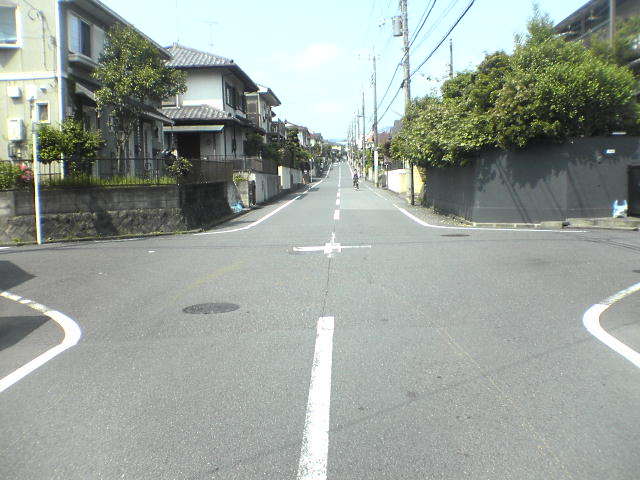
Many small streets in Japan mix pedestrians, bicycles and motor vehicles [1]. They may have a white line to indicate the difference between pavement(sidewalk) and road but it's really just a suggestion in practice. Cars on these roads tend to be more cautious and aware of all over road users. Pedestrians are also more aware of there surroundings because there is no illusion of safety that curbs can sometimes give.
The picture you linked is by no means a "small street" by Japanese standards. Small streets in Japan don't have a line in the middle, and most of them aren't large enough to have two cars crossing each other without effort.
Time and time again history has shown that you can't just retrofit old laws to stuff that's "similar enough". Because the new technology is never the exact same. Computers are not telegraphs. Email is not postal mail. Cars are not horse-drawn carriages... Law reuse is harmful because it loses nuanced differences in how these technologies operate and are used. I really think a lot of problems are linked to that, such as with drug laws. I would say we need a reform but that would require changing the DNA of the judicial systems, and like this article notes, ingrained prejudices.
The problem is that often this case law is created looking at similar cases as precedent. Instead we should be creating new laws from scratch or else like you said we'll always be playing catchup while areas with more reasonable/reactive laws prosper. However that's antithetical to how current American law works though so it would require changing the whole DNA of the system.
What I worry about is how can we define accountability. At least you could sue a person if you got into a car accident and got injured (happened to several people I know). Suing a huge corporation and getting bullied around, settling for less, etc. sounds possible, but can happen too with people vs people. How do you even make a case when you likely don't understand what actually happened or could even prove what happened (crypto, copyright laws)? I'm all for reducing risk, but machines will make mistakes and I don't know what happens next.
History seems to have shown the opposite, in transport.
Trains are engineered to absurdly high safety standards and every time there is a crash, it's widely publicized and an in-depth investigation is required along with suggestions for systemic changes to prevent repeat events, and the companies are required to pay large settlements:
At the same time, trains are vastly safer than personal cars. Yet when a driver kills someone, police can barely be bothered to attend the scene and rush to excuse the driver and let traffic flow again.
The safety standards on vehicles are such that billions are spent on engine development yet we tell people to watch out for the "blind spot" in that trucks mirror contraption. We're soon going to have autonomous driving AI yet trucks are roaming city streets that are unsafe by design and regularly claiming lifes. I don't see Volvo and MAN settling with anyone over that.
I worry this is a case of micro vs macro environments. In a macro environment, it would be of interest to the general public to not determine why 1000 people died in a train crash. It's worth an exhaustive multi-year study and the victims' families can join a class action lawsuit and be tried as a single case. It's also in the best interest for all parties to find out why that crash happened in such a controlled environment to improve the service (private use of railways, well-understood environments).
In car crashes, each case could be different and difficult to figure out what was the exact cause. Cars are becoming more complicated, as with farm equipment vs farmers or the "check engine light". Without transparency into the internals, I wouldn't know what broke or was it my fault or the car and I would probably have to rely on the honesty of the company to tell me or my family that.
That's the point. For their base (and empirical) level of risk, there are huge binders of safety regulations for trains. Yet cars, which pose a vastly higher risk, are basically unregulated and safety is commonly ignored for what are peripheral concerns.
I think in order for you to 'sue' someone - they have to be negligent.
For the same reason generally passengers don't sue airline companies when something goes wrong.
There is an unbelievable amount of energy and money that goes into safety ... so much so that flying would probably be 1/4 the cost if they simply didn't care that much about it, and so there's a degree of 'public goodwill' in the whole thing.
I think the 'moral' issues will come down to scenarios wherein the computer has to make a decision like: do I swerve and kill my 2 passengers, or hit the car in front of me head-on and kill it's 2 passengers: pick one of two outcomes. I think this is the moral dilemma that is already coming up.
I struggle to imagine what sort of wreck would result in the rear (chained) tire ending up under the front of the car like that? This wouldn't be the only staged aspect of this picture: why is some random dude sitting in the driver's seat?
Not everyone drives equally safely. For many drivers, switching from manual to a self-driving car will increase their probability of a collision. Maybe in the future this will not be the case, but until self driving cars are proven safer than the most cautionary drivers, some people will increase their risk by switching.


I'll bet they even ban hobbyist driving - like those who 'still have old cars' and want to drive on those 'old car roads'.
Statistically too dangerous. Far more dangerous than anything else we really do - certainly more than smoking. And when it's no longer a 'necessity' ...
Do you remember those movies before the 1960's when they get in cars and they don't even have seat-belts - and we 'gasp' ... 'OMG' ...
I think our grandchildren will gasp when we tell them we drove cars. They will think we were crazy and uncivilized, we'll call them wimps.
You'll want to teach your grandson to drive, your daughter in law will be upset and call you a crazy old man :)