Why is it that so many people (such as this author) use participation rates as an indicator of equity? I understand gender equity to refer to equal TREATMENT of different genders, which is quite different from having equal NUMBERS of both genders in the workplace. Some differences in participation rates MAY be due to gender inequity, but some may also be due to other factors such as innate differences between genders (a crude example: perceptions about the meaning of prerequisites as mentioned in the article).
The first proposed "solution" merely promotes participation rates as a measure of gender equity, and the 2nd proposal "Provide female entrepreneurs with..." just adds another form of inequity. Only the 4th proposal seems truly gender neutral and constructive.
Why wouldn't it? Kids are taught from childhood what their gender is supposed to like. If we got rid of that, surely far more non-men would be in tech.
IMO equity is not the only consideration -- there may be a value to workplace diversity itself, and #1 adds some transparency to the issue. The #2, if you look at it, actually suggests solutions where gender is invisible, rather than push for preference for women over equally-qualified men. #5 sounds non-neutral, but really could be implemented in neutral manner -- what it says is that women have a harder time finding mentors. Surely some men are in that category too.
The best way to improve gender equity in tech (and fight just about every other form of discrimination at the same time) is to put an end to Silicon Valley's ridiculous culture of overwork. I don't know how everyone fell into this trap - it leads to terrible code, developer burnout, and eventually drives out anyone who has or wants any semblance of a life outside of work, which in practice is anyone who isn't a male in their twenties.
I don't care what your personal politics on gender equality are - if you're making your employees work sixty-hour weeks you're functionally identical to Pat Buchanan.
#4 is super important for many things, not just gender equity.
One of the biggest ones is to make sure that you actually clearly communicate what you want out of an employee. If you expect someone to be doing more work than someone else, but they have the same title.. you may want different titles. Or clear (and public!) pay grades that signify seniority if you don't want MTS1 MTS2 MTS3 MTS4 MTS5 MTS++ style titles.
Companies, especially small ones, that skirt performance review policies as either unimportant or "too formal" can lead to a lot of incidental/accidental discrimination that goes unnoticed until it's too late.
We had expanded to a new country and decided to open an office there. Since we didn't know the market rates for developers over there the founder proposed to pay whatever people ask for plus 10%. We ended up hiring a light skinned person and a dark skinned person. The latter was more experienced and skilled than the former and had asked for 40% less salary. I only found out after we had hired them and spent a lot of goodwill convincing the founder to increase his salary to the same level. It was crazy we were going to pay one person more for less skills because the color of his skin made him have higher salary expectations! There was also the other issue of him acting as if he knew more than everyone when he didn't but I'm digressing...
>"It was crazy we were going to pay one person more for less skills because the color of his skin made him have higher salary expectations!"
Let's not bring race into this. Not unless said employee was making comments/opinions such as "I'm white, therefore I deserve more" or "I expect more because I'm white".
At the very least, you would have no idea to the motives behind his higher expectations (or the other person's lower expectations).
Yes, let's make it clear it isn't a first order effect but likely a third or fourth order effect. E.g. They grew up in different areas of the country, one part having higher living standard expectations, and if you get to the bottom of it, it had to do with race at some point decades ago.
All looks very reasonable; but I have some partial doubts on the #3, Improve Job Descriptions, more specifically on picking words that women prefer to see. It may be the case that women on average prefer job descriptions mentioning (quoting the link) "sociable" and "responsible" to "independent" and "analytical", but these are not entirely meaningless characteristics. There definitely are people, both men and women, who would be turned off by the former and attracted by the latter, and perhaps they would have been a better fit for the job, given the original description?
Well, actually my anecdotal experience kinda aligns with what the article says in that part: I know a few people -- all of them women -- who would look at an ad saying "X,Y,Z,and T", and say "sure I am comfortable with X, Y and T, but I don't know much Z, so it's clearly not for me".
Blind auditions. Do knowledge- and skills-based tests in such a way that the people administering them don't know the race, gender, or age of the candidate. Ditto for behavioral tests - you know, the trick questions and fake scenarios designed to ferret out whether you're honest, passionate, creative, etc. Have someone else evaluate experience and/or references.
Constructing the necessary exercises and evaluations is a lot more work than traditional interviewing, especially if you also want to avoid the "silly puzzle questions that only prove you read the same book" syndrome, but it is possible and would avoid most kinds of bias.
Your job postings are quite rightly designed to filter out people that lack the skills you are after. However they also serve as an unwitting barrier.
One thing I have seen that is successful is actively going out and recruiting people who are different from you. Universities are a great source of untapped talent. More importantly they haven't been beaten down by classism/sexism/*ism.
Being surrounded by people who look, act and sound like you is a boring boring life.
Realize that framing your daughters behavior by giving her babies, princesses, dolls, makeup, clothes and similar to play with, while your boy gets the newest action games, puzzles, balls, competitive and brain engaging fun, will definitely influence her future career choices.
When you take your daughter to look at some princess movies, or some toy story thingy, while you watch star wars and star trek with your son, long into the night, think of what kind of framing is done.
Of course, even if you try to keep all the options open. Someone from her school might make your daughter do "girls only" activities. Or maybe she'll be forbidden from accessing the Star Wars room at Legoland because she's a girl. Whole world is against your little girl becoming like a man. She needs babies so she knows she has to be a mother. She needs kitchen games so she knows she has to cook. She needs to play with dolls, to groom them, to dress them, so that she eventually does the same for herself. She needs to be pretty, and by pretty we mean makeup.
If someone is naive enough to believe that boys and girls have innately different interests, then so be it.
But girls ain't "gurls" because they don't like technology.
Before someone jumps in with the notion that monkeys have culture too, it should be noted that monkeys have not developed the wheel. Thus, they are unlikely to have defined gender roles for wheeled toys.
Please use care when dealing with the girls in your life. I know plenty of girls who want to build robots out of the pink legos. Or treat clothing with rules remarkably similar to programming. Please avoid preaching to these girls that they have to throw a ball or play action games to avoid limiting their career choices.
I've met a number of people who espouse views similar to yours. You believe you're sticking up for girls, but all the kids hear is that girly stuff is 'bad' and boy stuff is 'good'. Someday you might know a girl who really just wants to take care of babies. Do you think she is entitled to have that view? How would she take comments like yours? Will she think that because her goals are 'bad' that she is 'bad'. How would a boy who wants to take care of babies react when everyone sees baby toys as lesser? Do you think they will feel free to be more feminine? Or pressured to conform even further. You're reinforcing what you believe you oppose.
I'm just saying that there's crazy amount of conditioning here, and that people might unconsciously make choices for their daughters that will lead them to a very different life.
I am also saying that there's crazy amount of pressure from kindergarten teachers, and who knows what other environments.
> Do you think she is entitled to have that view? How would she take comments like yours?
My comment was pretty much black&white. I'm not advocating pressure. I'm painting my views this simple to evoke questioning of one's choices regarding raising children.
Realistically, women do not go into tech do to tech looking unattractive to women. Women find this men dominant field unattractive for reasons that are mostly based on early conditioning.
It's not that they are incompetent, they just do not try.
> people might unconsciously make choices for their daughters that will lead them to a very different life.
Do you think that life will be worse than if their upbringing was optimized to turn them into engineers? Playing devil's advocate... traditional gender roles must hold some value otherwise people wouldn't adhere to them. There are also many women who enjoy what would be considered a traditional role. I think this push to get women into tech at all costs is stealing quite a bit of agency from people who are exerting their free will (both in career choice and child raising technique).
If you believe I'm advocating for women being raised to become engineers then you and everyone else who downvotes me is silly.
I'm talking about gender roles. They are here, they aren't changing, and no, you cannot do anything about women equity in tech without changing the values that are ingrained in human culture.
> They are here, they aren't changing, and no, you cannot do anything about women equity in tech without changing the values that are ingrained in human culture.
It does sound like you are advocating for changing traditional gender roles. Maybe you think there are other benefits to doing that beyond increasing tech adoption for women? All I'm saying is that there are positives associated with existing gender roles and working so hard to change them while ignoring the negatives that will come about doesn't seem wise.
I'm not really sure how a study about monkeys has any relevance to whether humans have engrained gender roles. People are cognitively far more complex and nature vs. nurture when it comes to gender is not really as decided as it might seem.
Surprisingly that might work - "Several animal studies have shown that hormonal manipulation can reverse sex-typed behavior. When researchers exposed female rhesus monkeys to male hormones prenatally, these females later displayed male-like levels of rough-and-tumble play."
How does Star Wars prepare you do be a programmer, and watching a princess movies does not? I don't recall any programming scenes in Star Wars? And all those movies are made with computers. Girls tend to be encouraged to lots of creative activity which could also come in handy with computer jobs. They also do well in maths at schools (better than boys, apparently).
Race is an interesting one in IT. I have seen many indian programers but hardly any black ones. I never see any Asian techies in europe, but I hear there are a fair number in the states.
There you have one, and in the same city as you! At my previous workplace (in Barcelona) there was a Taiwanese programmer, and before that in London I met many Asian (mostly Chinese) programmers.
Perhaps one reason is that jobs in Computing are typically not all that attractive? My current freelance project sees me working in a room with 20 people, lined up on long desks (not even Cubicles). After a while, it can get a bit smelly. There are 4 women and 16 men working in the room, and to be honest I wonder why the women put up with it (they are not developers, either).
That kind of setup is not uncommon. I have been asked to work in windowless rooms, which I rejected. I have worked in ugly industrial areas and ugly buildings. I have worked in the basement that wasn't officially suitable for human use (only legal for storage).
After 6 hours, my eyes hurt from the strain of looking at HTML and Javascript all day, trying to find tiny mistakes in the source code. But I have at least 2 more hours to go.
Human interaction is minimal - yes there are meetings, but that is not the same as human interaction that for example a doctor sees.
Sure, jobs at Google or Facebook might be fancy. But even at big companies (including Google) I have seen those big open plan offices. They just had more colorful toys lying around at Google. And most devs won't work for Facebook or Google.
Why do I put up with it? Because I need the money to feed my family, and I can not easily switch to another profession. This is probably controversial and will give me downvotes, but most women don't need to work to feed their family - their husbands do that. So they are not forced to put up with smelly, crowded, windowless rooms for years and years on end. And women can easily switch profession, too: they can simply become mothers, which 40% choose to do (become fulltime moms, that is - more women become mothers of course).
I enjoy programming for my own projects, but most dev jobs I did for money were gruesome.
Note that this gruesomeness affects women and men in the same way. There are no offensive Star Wars posters or other Geeky things lining the walls. The environments just tend to be less comfy, because devs only stare into their computers anyway.
The notion always seems to be that the women who shy away from tech end up leading "wasted", brainless lives as housewives. Not so. They become doctors, or journalists, or liberal arts people (and btw., housewive and spending time with your kids is not all that bad either).
I understand if companies want to lure women into tech, because it gives them a greater talent pool and lower wages (because of greater supply). But it is not an issue of equality.
We don't tell girls not to, either. Quite the opposite in fact. The only people who tell women not to enter tech are feminists.
And I am honestly torn about recommending it to my son. I will (try to) teach him programming for sure and even hope to encourage him to earn money on the side while at school. But for real professions, there might be better options to consider. Oh, and I will also do the same for my daughter, of course, it's just that your claim was about what we recommend to boys. I will also teach my daughter not to listen to the feminists.
I will teach them because that is something I have knowledge about, and I think kids should benefit from their parent's specialties if possible. If I were a designer I would teach them design, if I were a musician I would teach them music, and so on...
There are a lot of little thing that remind women they don't belong. Apparently badges are one of the minor peeves. A guy can just clip them on their belt loops. That doesn't always work for women.
Why are there so few male manicures? Why so few male babysitters? Why so few female NASCAR drivers? Why so few female in the army? Why so few male in the wedding dress business?
We MUST to do something about this! People of a certain gender cannot prefer some activities over others!
My last wokplace was a genome sequencing centre. Half wet lab and half computer people (bioinformatics and software devs). The wet lab was almost exclusivley female, while the bioinformaticians were mainly male.
interesting how a strong necessity (like life and death necessity) overrules the gender inequality, even the one well embedded in the dominating religion in a pretty religious country - i mean females serving in Israel army.
I might get downvoted for sharing the following anecdote.
I've a niece whom I absolutely adore. I try to steer her now and then to software development as a career. She's 14 so I don't expect much focus out of her, but her curiosity for it just doesn't seem to be there. Her brother is 11, and it couldn't be more obvious to me that he is much more adept at tinkering, even though I've never broached the subject with him. My niece will usually agree with me so I'll stop talking, then go on facebook or netflix or look up kardashian news (not a stereotype, this is 100% what happens). I'm still trying to figure out a way to reach her, but so far every effort has been met with active disinterest. She says she likes the perks that I seem to get (flexible hours, work from home, decent pay, etc.), so at least there's hope she could still be drawn to that eventually
Some might advise you to keep pushing her and pushing her because "we need more women in STEM" and all that. I would advise you to just let her be. We like to teach our children that they can be anything they want to be when they grow up. So... maybe she doesn't want to be a software developer.
"We need more women in STEM... even if we have to drag them kicking and screaming", said no one ever.
What is needed is to stop pushing women out of STEM (believe it or not, many girls are attracted to it) and encourage them to get into it to the same degree we do for boys. You're absolutely right that force is not the way to go.
I used to ridicule my sister for liking Barbie dolls and books about ponies. She grew up to become a physician despite playing with dolls in her youth, so I think all is well.
Trouble is kids are taught from an early age what things they should like. Even if you don't tell them they shouldn't do certain things, their friends, society, the media will.
That's not to say you should force your kids to follow the career of your choosing. Nor is it to say it's necessarily because of the above that they have developed such interests.
You need to find a way to package your message in a more appealing manner.
My oldest son dragged me into playing Master of Magic by telling me "It is like SimCity (my favorite game)." and helping me play it to emphasize the civilization building aspects. :-)
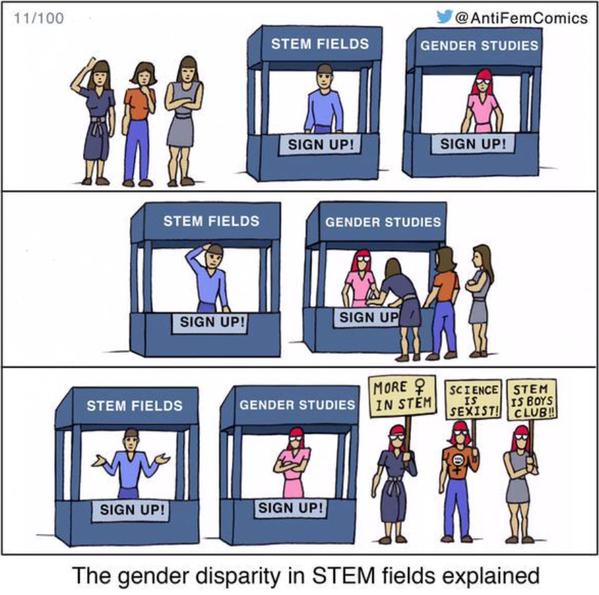
This looks like something a lot of people would want to believe, but is imo rather disingenuous -- I admittedly haven't followed the discussions too closely; but from what I've seen, a lot of women talking about these things are in fact employed, or formerly employed, in technical fields. One may or may not agree with what some of them say, I often don't, but this is really not the way to address the issue.
There are (ahem) literally zero "women's studies" experts referenced in the linked article, which is about a bunch of people in the tech industry. Your snark and comic link adds, ahem, literally nothing to this discussion.
Regardless of your opinion of the article, this isn't really relevant to the topic at hand, in fact it's an inflammatory suggestion unsupported by evidence that has nothing to do with creating discourse.
The evidence you are linking refers to women being less likely to go into those fields; but I don't think that is the point of the cartoon at all. It is trying to dismiss those who argue for trying to address the imbalance as having no field experience, and I don't think it's the case at all.
No, I hate Jezebel but the kind of BS that is present in that comic (and the attitude it pushes) IS exactly the reason why Tech has a exclusion problem.
It's one step away from unironically using the term "SJW".
How is the parent part of the problem?
You'd think the people part of the problems are those who discriminate. Many people being pointed out of being "part of the problem" when in reality they aren't will just alienate them.
With that fucked up world-view Vivek Wadhwa is a misogynist woman hater suddenly out of the blue.
You need to take a step back and realise that there might be some different views and solutions to the same problems instead of painting PEOPLE as problems.



The first proposed "solution" merely promotes participation rates as a measure of gender equity, and the 2nd proposal "Provide female entrepreneurs with..." just adds another form of inequity. Only the 4th proposal seems truly gender neutral and constructive.