The negative effects only happens if incorrectly supplemented.
75% of the population is suboptimal in Magnesium, without Mg - our ability to absorb D diminishes, even with supplementation.
Vitamin D must be supplemented with Vitamin K2 MK7 to ensure the extra calcium generated is deposited in the bones and not in the soft tissues (hypercalcemia)
>"hyper mobile joints are an uncommon finding in those who do not have attention deficit disorder/attention deficit hyperactivity disorder."
>Differences in the structural integrity of temporal and parietal cortices may underlie wider behavioural phenotypical expression of hypermobility: abnormalities in superior temporal cortex are also seen in autism.11 Inferior parietal cortex can affect proprioceptive awareness and hypermobility is itself linked to dyspraxia.1 Our findings suggest that processes compromising function in neuro-developmental conditions may occur in individuals with hypermobility, putatively enhancing vulnerability to stress and anxiety.
Autism, Joint Hypermobility-Related Disorders and Pain
ASD and HRDs, specially hEDS, are conditions with a strong genetic component, a polymorphic clinical presentation, appearing both in infancy, and sharing several phenotypical features (35). Although existing data does not allow to ascertain increase prevalence of ASD in HRDs, as well as shared underlying patho-mechanisms between both conditions, there is increasing evidence suggesting that these co-occur more often than expected by chance. This requires be confirmed by further investigation which should consider the recent nosological changes both in EDS and the hypermobility spectrum disorders [see (17, 38)], and in ASD (72).
https://www.ncbi.nlm.nih.gov/pmc/articles/PMC6292952
Joint hypermobility and the heritable disorders of connective tissue: clinical and empirical evidence of links with psychiatry
- In 1988, Hofman et al.[58], in a sample of 30 children with MFS,observed that 17% had attention deficit disorder with or without hyperactivity. A decade later, Harris[59] stated, based on his clinical experience with 200 patients with ADHD, that "hyper mobile joints are an uncommon finding in those who do not have attention deficit disorder/attention deficit hyperactivity disorder."
In Sweden,Hollertz[60,61] also pointed out the frequent co-occurrence of ADHD and JH in adults patients. He observed that an orientation to orthopedic and rehabilitation care was common in these patients due to joint problems. Thus, this author speculates about a possible genetic marker com-mon to ADHD and EDS.
Recently, Koldas Dogan et al.[62]explored JH using the Beighton score in 54 children with ADHD compared to 36healthy controls. In this study, JH was significantly more frequentamong patients than among controls (31.5% vs. 13.9%). In accor-dance with these results,
Shiari et al.[63]also found a higher prev-alence of JH, assessed with the same method of the previous study,among Iranian children with ADHD compared to controls (74.4%vs. 12.8%), confirming an association between ADHD and abnormal collagen conditions.
JOINT HYPERMOBILITY AND AUTONOMIC HYPERACTIVITY: RELEVANCE TO NEURODEVELOPMENTAL DISORDERS
> It is likely that the importance of hypermobility and autonomic dysfunction to the generation and maintenance of psychopathology in neurodevelopmental disorders is poorly appreciated. Work underway(autonomic testing, fMRI) will test the hypothesis that autonomic reactivity and interoceptive sensitivity predispose to the expression of psychiatric symptoms, particularly anxiety
- We demonstrate for the first time that rates of hypermobility and symptoms of autonomic dysfunction are particularly high in adults with neurodevelopmental diagnoses. It is likely that the importance of hypermobility and autonomic dysfunction to the generation and maintenance of psychopathology in neurodevelopmental disorders is poorly appreciated. Work underway(autonomic testing, fMRI) will test the hypothesis that autonomic reactivity and interoceptive sensitivity predispose to the expression of psychiatric symptoms, particularly anxiety. It is further hypothesized that inefficient neural co-ordination of efferent autonomic drive with imprecise interoceptive representations may be amplified in hypermobile individuals. In hypermobility, this mechanism might explain increased vulnerability to stress sensitive and developmental neuropsychiatric conditions.
- https://jnnp.bmj.com/content/85/8/e3.40?utm_source=trendmd&u...
[Searching for a biological marker common for both ADHD and EDS].
- https://www.ncbi.nlm.nih.gov/pubmed/22468413
- speculated about a common biological base shared by ADHD and EDS after observing the frequent cooccurrence of both pathologies in a clinical setting.
Connective tissue problems and attention deficit and hyperactivity
- To the Editor, The heritable disorders of the connective tissue are a group of genetic disorders affecting connective tissue matrix proteins that classically include Marfan syndrome (MFS), Ehlers–Danlos Syndrome (EDS), benign joint hypermobility syndrome and osteogenesis imperfecta (Grahame 2000). As connective tissue is found throughout the body, the clinical manifestations of these disorders are varied, including disturbances in different systems (skeletal, ocular, cardiovascular, etc.). A common feature of the heritable disorders of the connective tissue is joint hypermobility (JH), which is a highly heritable condition characterized by an increased range of motion of the joints as a consequence of connective tissue involvement.We encountered a 7-year-old boy addressed by teachers due to school problems. His mother suffer from MFS such as his maternal grandmother who died by cardiac complications. Considering familial antecedents, his morphotype (long bone overgrowth), JH and ocular ...
A connective tissue disorder may underlie ESSENCE problems in childhood
Attention-deficit/hyperactivity disorder, joint hypermobility-related disorders and pain: expanding body-mind connections to the developmental age.
>Recent research seems to indicate a degree of co-occurrence of JHS/hEDS and some neuro-developmental disorders including attention-deficit/hyperactivity disorders (ADHD) and developmental coordination disorder (DCD). In the area of ADHD, researchers found that adults with ADHD had higher rates of JH and problems with automatic control of body functions (dysautonomia) compared to healthy controls. Other researchers observed high co-occurrence of JH or EDS with ADHD. Concerning DCD, children with DCD have more symptoms associated with JHS/hEDS compared to typically developing children. The relationship between JH and DCD may be due to poor positional sensing in affected children.
A Cohort Study Comparing Women with Autism Spectrum Disorder with and without Generalized Joint Hypermobility
- This research supports a growing body of literature indicating that immune-mediated disorders are a common comorbid feature in hEDS and GJH. In addition, we have also shown that this dysfunction may be paired with endocrine dysregulation, leading to complex immune and hormonal exophenotypes, such as autoimmune disorders, allergic rhinitis, asthma, endometriosis, and dysmenorrhea. While we have not addressed autism and GJH comorbidity rates in this study, their co-occurrence in the adult ASD female population suggests links between the dysfunction of connective tissue and the immune and endocrine systems in this subpopulation.
- https://www.ncbi.nlm.nih.gov/pmc/articles/PMC5867488/
>ADHD might thus be a (non) allergic hypersensitivity disorder caused by an environmental trigger, based on a non-IgE dependent histamine release from mast cells and basophilic granulocytes, since the histamine H3 receptor is involved in hyperactivity and promotes dopamine release in the frontal cortex. Moreover, polymorphisms in the histamine N-methyl transferase (HNMT) gene, impairing histamine clearance, were found to affect the behavioral responses to food additives, which increase histamine levels #ADHD
I always noticed a pattern of 'see one, and the other is never far behind' with autism and ADHD but I never made the time (irony much) to pin studies to it. Thanks for collecting these.
>If you go low fat, you necessarily go low protein too, so you need to replace that with carbohydrates. Even more, you now need "fortified" carbohydrates to get the needed B vitamins and other nutrients usually found in fatty foods, and those will be refined carbohydrates; which is what the American Health Association now recommends. Yes, they actually recommend that people should eat enriched cereals and other bullshit like that.
'B vitamins' is very vague. Are you talking about B12? If so, farm animals are supplemented with that anyway - so it's just supplements with more steps. Also, once you hit 40-60 most people have problems absorbing enough B12 and should be supplementing regardless of what they eat.
>A high carbs diet made of "healthy, complex carbs" is a myth ;-)
Hmm, how so? The benefits of HCLF are well documented
I do 16/8 I.F fasting on a HCLF diet and have never experienced any of those issues.
There is plenty of evidence showing the benefits of ketosis on the body, and benefits from people switching from SAD to Keto reversing diabetes and the likes - but that's more down to calorie restriction. With regular keto you're raising your risk long-term for diabetes, heart-disease, cancer and stroke due to increased meat/dairy/egg consumption.
You're far better just eating a varied diet with as little animal produce as possible and doing I.F which releases 5x the amount of ketones than the keto diet.
That's not enough to trigger those symptoms for many people, as it depends on how much salt you have in your diet and your own metabolism of course. But do a 36 to a 72 hours fasting, which is otherwise a very healthy thing to do from time to time and you'll experience it head on.
>> "that's more down to calorie restriction"
Why did the plane crash? Due to gravity. What should the plane have done to not go down? It should've had more lift.
Now tell me, how does that help in establishing why the plane actually crashed and what to do to solve it? That's how "calorie restriction" sounds as an explanation, being a prima facie observation. Of course you're reducing calories. But HOW you're reducing those calories makes all the difference.
Another one: Why do people get rich? Because their spending are less than their earnings. What should people do to get rich? They should cut their spending or raise their earnings. Well duh! But it's a totally useless observation, isn't it?
>> "With regular keto you're raising your risk long-term for diabetes, heart-disease, cancer and stroke due to increased meat/dairy/egg consumption."
That's absolute bullshit.
Here's one of the largest studies on dietary fat, done on 50,000 women, spanning for 8 years, showing that going low fat did absolutely nothing to prevent heart disease: https://www.ncbi.nlm.nih.gov/pubmed/28515068
I also wish people would stop posting YouTube videos btw. I don't watch YouTube bullshit. Post links to studies that I can verify.
>Now tell me, how does that help in establishing why the plane actually crashed and what to do to solve it? That's how "calorie restriction" sounds as an explanation, being a prima facie observation. Of course you're reducing calories. But HOW you're reducing those calories makes all the difference.
A ketogenic diet can also reduce hyperglycemia in diabetes, but it is not the wisest choice for the long term, diabetes or not. Addressing the cause of the disease, excess unhealthy fats in the case of diabetes, is better than merely treating the symptoms (hyperglycemia), especially if you can do both with the same intervention (http://www.pcrm.org/health/diabetes-resources).
>Here's one of the largest studies on dietary fat, done on 50,000 women, spanning for 8 years, showing that going low fat did absolutely nothing to prevent heart disease: https://www.ncbi.nlm.nih.gov/pubmed/28515068
Whole-food plant-based diets are the only diets shown to reverse heart disease in a clinical setting:
http://www.ncbi.nlm.nih.gov/pubmed/17518696
CONCLUSIONS:
Long-term consumption of a low-calorie low-protein vegan diet or regular endurance exercise training is associated with low cardiometabolic risk. Moreover, our data suggest that specific components of a low-calorie low-protein vegan diet provide additional beneficial effects on blood pressure.
http://www.ncbi.nlm.nih.gov/pubmed/15172426
Randomized trial data suggest atherosclerosis progression and coronary heart disease events are minimized when LDL is lowered to <70 mg/dl
Dr. Kim Williams - the President of American College of Cardiology said, "There are two types of cardiologists: vegans and those who haven't read the data."
They're doing this because people were calling on tougher penalties and an independent watchdog for social media. They don't want oversight so they pay extra for moderation.
Sure people will buy self-driving cars. People want to own things for themself. If a car has a higher value with this feature even more people want to have a car. Consumers don't think economically.
I'm skeptical about the "no one will own" meme. That said, there's no reason cleaning would be any more of an issue than it is with Zipcar today. If you go to pickup a car and it needs cleaning, you refuse it and report the problem.
Then what? What if you have something pressing to get to? All these rideshare arguments fall flat on their face when it is anything other than "going out" without much of a timeline.
So this is about Twitter and not FB, but I went on a weird trip down the rabbit hole when looking into how certain accounts were becoming popular/growing so quickly.
There are a whole bunch of "networks" of fake accounts, often complete with very legitimate looking photos, names, and even posts. The main difference, however, is they follow and retweet a lot.
If you look at what they follow and retweet, however, well over half seems to be "legit" stuff that wouldn't be getting involved in such schemes. I think the reason is that if Twitter decides to crack down on bot networks, they might look at what the bots are following and promoting to work out who to penalize.. except they aren't going to start deleting CNN, Fox News or random celebrities.. so they really have no great way to tell who to punish. I suspect FB bots work in a similar way.
Not the legitimacy of the page being liked, of the bot's profile. Filling it with dummy information, including various liked pages, posts, etc, to use them for astroturfing.
I'm not sure they're bots, rather people cheaply paid to create fake accounts, or scammers. I've seen many of them, and some of them are quite amateurish. They would say they went to Florida University and come from Florida City, working in... oil.
Been using Apple since I was 10 (First computer was a PowerPC). Have owned most iPhones and all around been an Apple fanboy.
The latest macbook was the last straw, a 40% increase in price is not acceptable. I switched to a Nexus (and loving it). I bought a macbook for Uni (2015 model - The loss of ports and addition of a battery draining touchbar doesn't appeal) but only due to the fact that I needed something that would perform well and last all day. (Gaming laptops only last 2-5hrs).
Unless they unveil some version with ports reinstated and a huge battery (16+ hrs) I don't see myself ever going back.
I have grown to like the USB-C port on my new MacBook. I bought the matching LG ultra-def monitor that acts as a charging station and a hub, providing 3 extra USB-C ports, one of which I just keep a dongle for USB 2.
Depends on your use. The only ports I don't use on my mac are the Mini dvi. I use both USBs daily, HDMI when at friends, and the SD card slot for loading pictures from clients - and don't want to carry adapters around with me. The loss of MagSafe is another big one.
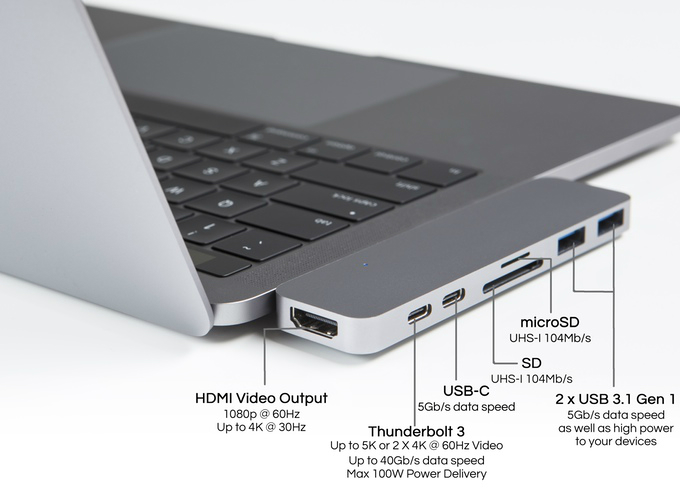
Kinda defeats the purpose having a nice sleek macbook only having to plug something like this into it
Apple has always been early on technology changes like USB-C, in a couple years we'll look back on this like when the iMac dropped the floppy drive. USB-C is obviously better, it's just a matter of time before everything uses it.
Doesn't really matter if it's better. TVs still use HDMI and most likely will for another 10+ yr. They're just reducing the functionality of the laptop.