> "If you say two different and contradictory things, and do not very explicitly resolve them, and say which one is the final answer, you will get blamed for both things you said, and you will not be entitled to complain about it, because you did it to yourself."
If I can be a bit bold and observe that this tic is also a very old rhetorical trick you see in our industry. Call it Schrodinger's Modest Proposal if you will.
In it someone writes something provocative, but casts it as both a joke and deadly serious at various points. Depending on how the audience reacts they can then double down on it being all-in-good-jest or yes-absolutely-totally. People who enjoy the author will explain the nonsensical tension as "nuance".
You see it in rationalist writing all the time. It's a tiresome rhetorical "trick" that doesn't fool anyone any more.
It's a version of a motte and bailey argument (named after a medieval castle defense system):
> "...philosopher Nicholas Shackel coined the term 'motte-and-bailey' to describe the rhetorical strategy in which a debater retreats to an uncontroversial claim when challenged on a controversial one."
In what rationalist writing? The LessWrong style is to be literal and unambiguous. They’re pretty explicit that this is a community value they’re striving for.
The whole trick is having your cake and eating it too. The LessWrong style exploits the gap between the strength of the claims ("this is a big deal that explains something fundamental about the world") and the evidence/foundation (abstract armchair reasoning, unfalsifiable)
That’s not the same issue, though. You’re claiming just plain overconfidence or that you find their arguments unconvincing. But the rhetorical trick we were discussing is oscillating between treating a claim as a joke or as deadly serious depending on the audience.
Are they actually running the Apple playbook in reverse? It seems to me that they're actually running Apple's playbook pretty squarely, just in another domain.
First-gen product that seemed to not know where it's going? Check.
Continued quiet iteration behind closed doors despite first-gen being a flop? Check.
Sticking with the product line over many years, where most other companies would have written off and thrown in the towel? Check.
Multi-pronged GTM strategy where other products prove out key bits of next product? Check. (see: SteamOS and Proton setting the stage for Steam Deck, which in turn sets the stage for Steam Machine 2)
Deep software-hardware integration in ways that are highly salient to users? Check (see: foviated streaming for Steam Frame, Steam Deck "just works")
The "in reverse" framing was largely in reference to the fact that Apple built the software ecosystem after getting loyal hardware consumers, whereas Valve got loyal software users first and is now selling hardware to them.
Otherwise, I do think a lot of what you say is true, and some of it is in the article (e.g. the software "just works").
I share your skepticism. This feels like an attempt to tap the trainloads of money piling into "AI", for a company that is in pretty desperate need of more cash to stay alive.
In a vacuum there are potentially some advantages to doing your own silicon, especially if your goal is to sell the platform to other automakers as an OEM.
But custom silicon is pricey as hell (if you're doing anything non-trivial, at least), and the payoffs have a long lead time. For a company that's bleeding cash aggressively, with a short runway, to engage in this seems iffy. This sort of move makes a lot more sense if Rivian was an established maker that's cash-flow positive and is looking to cement their long-term lead with free cash flow. Buuuuut they aren't that.
You really want to break a task like this down to constituent parts - especially because in this case the "end to end" way of doing it (i.e., raw audio to summary) doesn't actually get you anything.
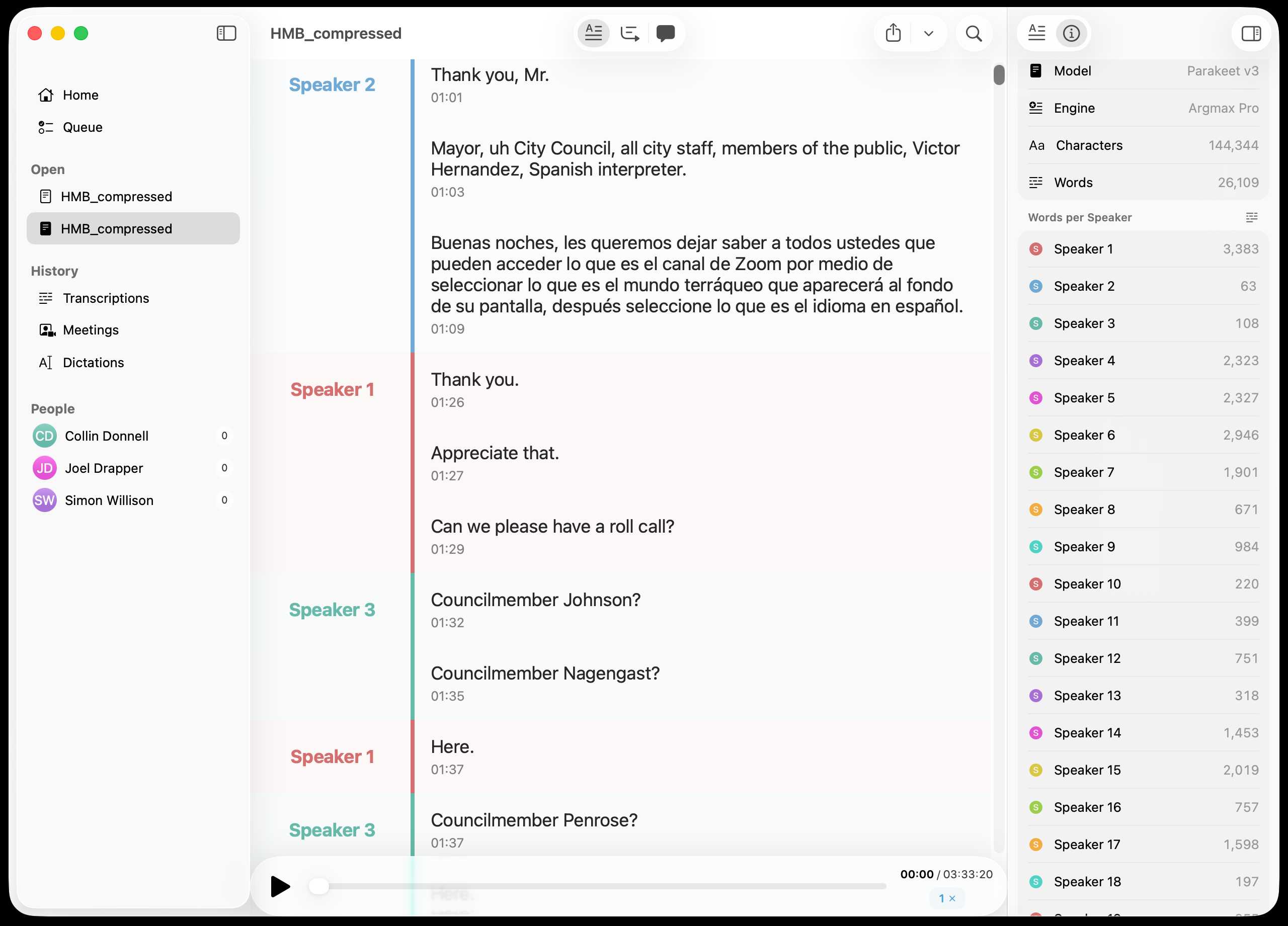
IMO the right way to do this is to feed the audio into a transcription model, specifically one that supports diarization (separation of multiple speakers). This will give you a high quality raw transcript that is pretty much exactly what was actually said.
It would be rough in places (i.e., Speaker 1, Speaker 2, etc. rather than actual speaker names)
Then you want to post-process with a LLM to re-annotate the transcript and clean it up (e.g., replace "Speaker 1" with "Mayor Bob"), and query against it.
I see another post here complaining that direct-to-LLM beats a transcription model like Whisper - I would challenge that. Any modern ASR model will do a very, very good job with 95%+ accuracy.
Multimodal models are only now starting to come into the space and even then I don’t know they really support diarization yet (and often multimodal is thinking+speech/images, not sure about audio).
I think they weren’t asking “why can’t Gemini 3, the model, just do good transcription,” they were asking “why can’t Gemini, the API/app, recognize the task as something best solved not by a single generic model call, but by breaking it down into an initial subtask for a specialized ASR model followed by LLM cleanup, automatically, rather than me having to manually break down the task to achieve that result.”
Exactly that. There is a layer (or more than one) between the user submitting the YT video and the actual model "reading" it and writing the digest. If the required outcome is to write a digest of a 3 hours video, and to achieve the best result it needs to pass first into a specialized transcription model and then in a generic one that can summarize, well, why Google/Gemini doesn't do it out of the box? I mean, I'm probably oversimplifying but if you read the presentation post by Pichar itself, well, I would not expect less than this.
Speech recognition, as described above, is an AI too :) These LLMs are huge AIs that I guess could eventually replace all other AIs, but that’s sort of speculation no one with knowledge of the field would endorse.
Separately, in my role as wizened 16 year old veteran of HN: it was jarring to read that. There’s a “rules” section, but don’t be turned off by the name, it is more like a nice collection of guidelines of how to interact in a way that encourages productive discussion that illuminates. One of the key rules is not to interpret things weakly. Here, someone spelled out exactly how to do it, and we shouldn’t then assume its not AI, then tie to a vague demeaning description of “AI hype”, then ask an unanswerable question of what’s the point of “AI hype”.
If you’re nontechnical, to be clear, it would be hard to be nontechnical and new to HN and know how to ask that a different way, I suppose.
> There’s a “rules” section, but don’t be turned off by the name, it is more like a nice collection of guidelines of how to interact in a way that encourages productive discussion that illuminates. One of the key rules is not to interpret things weakly. Here, someone spelled out exactly how to do it, and we shouldn’t then assume its not AI, then tie to a vague demeaning description of “AI hype”, then ask an unanswerable question of what’s the point of “AI hype”.
I'm curious when we started conflating transcription and summarization when discussing this LLM mess, or maybe I'm confused about the output simonw is quoting as "the transcript" which starts off not with the actual transcript but with a Meeting Outline and Summarization sections?
LLM summarization is utterly useless when you want 100% accuracy on the final binding decisions on things like council meeting decisions. My experience has been that LLMs cannot be trusted to follow convulted discussions, including revisting earlier agenda items later in the meeting etc.
With transcriptions, the catastrophic risk is far less since I'm doing the summarizing from a transcript myself. But in that case, for an auto-generated transcript, I'll take correct timestamps with gibberish sounding sentences over incorrect timestamps with "convincing" sounding but halluncinated sentences any day.
Any LLM summarization of a sufficiently important meeting requires second-by-second human verification of the audio recording. I have yet to see this convincingly refuted (ie, an LLM model that maintains 100% accuracy on summarizing meeting decisions consistently).
This is a high area of focus for me and I agree: following a complex convo, especially when it gets picked up again 20-30 min later, is difficult.
But not impossible. I’ve had success with prompts that ID all topics and then map all conversation tied to each topic (each seperate LLM queries) and then pulling together summary and conclusions by topic.
I’ve also had success with one shot prompts - especially with the right context on the event and phrasing shared. But honestly I end up spending about 5-10 min reviewing and cleaning up the output before solid.
But that’s worlds better than attending the event, and then manually pulling together notes from your fast in flight shorthand.
(Former BA, ran JADs etc, lived and died by accuracy and right color / expression / context in notes)
That's why I shared these results. Understanding the difference between LLM summarization and exact transcriptions is really important for this kind of activity.
Your 2K monitor occupies something like a 20-degree field of view from a normal sitting position/distance. The 2K resolution in a VR headset covers the entire field of view.
So effectively your 1080p monitor has ~6x the pixel density of the VR headset.
Yes but that can create major motion sickness issues - motion that does not correspond top the user's actual physical movements create a dissonance that is expressed as motion sickness for a large portion of the population.
This is the main reason many VR games don't let you just walk around and opt for teleportation-based movement systems - your avatar moving while your body doesn't can be quite physically uncomfortable.
There are ways of minimizing this - for example some VR games give you "tunnel vision" by blacking out peripheral vision while the movement is happening. But overall there's a lot of ergo considerations here and no perfect solution. The equivalent for a virtual desktop might be to limit the size of the window while the user is zooming/panning.
There's no precise criteria but the usual measure is ppd (pixels per degree) and it needs to be high enough such that detailed content (such as text) displayed at a reasonable size is clearly legible without eye strain.
> "Could you not just move your face closer to the virtual screen to see finer details?"
Sure, but then you have the problem of, say, using an IMAX screen as your computer monitor. The level of head motion required to consume screen content (i.e., a ton of large head movements) would make the device very uncomfortable quite quickly.
The Vision Pro has about ~35ppd and generally people seems to think it hits the bar for monitor replacement. Meta Quest 3 has ~25ppd and generally people seem to think it does not. The Steam Frame is specs-wise much closer to Quest 3 than Vision Pro.
There are some software things you can do to increase legibility of details like text, but ultimately you do need physical pixels.
Even the vision pro at 35ppd simply isn't close to the PPD you can get from a good desktop monitor (we can calculate PPD for desktop monitors too, using size and viewing distance).
Apple's "retina" HiDPI monitors typically have PPD well beyond 35 at ordinary viewing distances, even a 1080p 24 inch monitor on your desk can exceed this.
For me personally, 35ppd feels about the minimum I would accept for emulating a monitor for text work in a VR headset, but it's still not good enough for me to even begin thinking about using it to replace any of my monitors.
Oh yeah for sure. Most people seem to accept that 35ppd is "good enough" but not actually at-par with a high quality high-dpi monitor.
I agree with you - I would personally consider 35ppd to be the floor for usability for this purpose. It's good in a pinch (need a nice workstation setup in a hotel room?) but I would not currently consider any extant hardware as full-time replacements for a good monitor.
I keep hearing this argument, and it baffles me. I find that, as I age and my vision gets worse, I need progressively finer text rendering. Using same-size displays (27") at the same distance, with text the same physical size on screen, 1440p gives me a much worse reading experience than 4k with 2x scaling.
I think part of getting by with a lower PPD is the IRL pixels are fixed and have hard boundaries that OS affordances have co-evolved with.
(pixel alignment via lots of rectangular things - windows, buttons; text rendering w/ that in mind; "pixel perfect" historical design philosophy)
The VR PPD is in arbitrary orientations which will lead to more aliasing. MacOS kinda killed their low-dpi experience via bad aliasing as they moved to the hi-dpi regime. Now we have svg-like rendering instead of screen-pixel-aligned baked rasterized UIs.
I'm not sure most of us do anymore - see my 1080p/24 inch example.
No one who has bought almost any MacBook in the last 10 years or so has had PPD this low either.
One can get by with almost anything in a pinch, it doesn't mean its desirable.
Pixel density != PPD either, although increasing it can certainly help PPD. Lower density desktop displays routinely have higher PPD than most VR headsets - viewing distance matters!
I don't think a lot of people realize how big of a deal this is. You used to have to choose between wireless and slow or wired and fast. Now you can have both wireless and fast. It's insane.
Yep, that basically guarantees this as a purchase for me. It's basically a Quest 3 with some improvements, an open non-Meta OS, and the various WiFi and Streaming app issues fixed to make it nearly as good as a wired headset.
If you are lucky enough to have wired as an option anyway, especially in linux this has been shaky. But with Steam continuing to push into linux and VR I have no doubt this will change quickly.
The last part of OP's statement is the key. In a field that's rapidly advancing technologically, used prices are depressed because the new product is that much better than the used product.
Think back to the early smartphone days - every year phones multiplied in performance, in screen resolution, etc. In that environment a used item is less attractive because you feel like you're missing out on features/capability. This keeps used prices down. Nowadays used smartphones are more competitive because the rate of advancement (that buyers care about at least) has slowed.
For example there's another post later in this thread that points out that the Nissan Leaf has been the same price forever - except the current-gen Leaf has literally double the range of the last one. Effects like this depress used prices.
> ... because the new product is that much better than the used product.
This starts reading like a hallucination after a while. How much in a Tesla had changed over past 5 years or so that makes 2020 model completely obsolete and unappealing relative to 2025 model?
The range hasn't doubled, internal volume hasn't, acceleration or braking hasn't. They may have changed implementations under the hood, but none has been clearly communicated to potential customers, so they might as well be the exact same car.
Meanwhile, 2020 Prius is that ugly one with quirky dashboard, and 2025 is that mustard yellow thing with the HUD-like dash.
So what in an EV is so "rapidly advancing technologically" so much that it perfectly rule out much more simpler explanation that people just aren't interested in EVs, in favor of more hand-wavy one that the newer EVs are just constantly enormously more appealing to the customers that older ones tend to lose the appeal faster?
Look to BYD instead of Tesla if you want to find rapid advancement. Tesla has not been well managed for a few years, BYD recently passed them to become the biggest EV seller
I bought Hyundai, which charges 2x faster than the Tesla
Another thing to consider is the Tesla likely makes up the majority of the used EV inventory, and Tesla has become a toxic brand
Sweet Jesus 1000 miles of range per hour is incredible. It might not technically solve the road trip problem but that's fast enough to make a not even five minute pit stop to get you home. Any range anxiety for intra-city travel is just gone.
> BYD recently passed them to become the biggest EV seller
Well when your government subsides every sale, and your the cheapest product on the market this is a natural outcome.
Mass strikes by workers (in china). Fires (a lot of them). Recalls (several this year). And now massive tariffs for them in a lot of markets don't paint a picture that they have a sustainable business.
We all know that subsidized growth is a great way to build a business (see ridesharing, delivery, in the US) but it doesn't make consumers happy in the end when prices go up and service quality goes down.
Having ridden in a lot of BYDs when traveling overseas I think you paint too bleak a picture. They're everywhere and reliable enough to seemingly be the preferred cars for uber drivers. Some markets might tax them out of existence but I expect others will gladly take perfectly serviceable cars on the cheap.
Tesla is still kicking and they had all the same problems at one time or another. I mean until this year we also massively subsidized every EV sale so pot calling the kettle black.
I don't think that's true. Afaik Tesla (except Cybertruck) have 400V charging limited to 250kW while the other vehicles have 800V charging allowing 350kW or so.
I've seen more lamborghinis than privately owned BYDs at this point. Maybe it's just where I'm from, but consumers definitely aren't switching to BYD, around myself.
> The last part of OP's statement is the key. In a field that's rapidly advancing technologically, used prices are depressed because the new product is that much better than the used product.
And 2 years old EV is not twice as bad as current one
> For example there's another post later in this thread that points out that the Nissan Leaf has been the same price forever - except the current-gen Leaf has literally double the range of the last one. Effects like this depress used prices.
The previous gen is 8 years old. It took 8 years to "double" the quality, not 2
Listen, I'm literally just describing basic market dynamics here - my post is not intended as an endorsement of plainly observable phenomena.
The depreciation/utility curve has always been aggressive no matter what product you're buying. Is a 2 year-old ICE car twice as bad as a new one? Is a 2 year-old TV? Clearly not, yet they are all worth that in the open market.
For EVs the depreciation curve is especially aggressive because of perceived advancements. Are the advancements worth buying new? I dunno! You tell me - but this is clearly being reflected in the market.
From a strict utilitarian standpoint, optimizing your depreciation/utility function should mean you're buying almost every single thing used. But yet lots of people don't do that. Humans are empirically not very good utilitarians!
>For EVs the depreciation curve is especially aggressive because of perceived advancements.
And many comments disagree with this statement. There are few perceived advancements. Used EVs are not trusted, particularly because the used battery fear.
> And 2 years old EV is not twice as bad as current one
The new-vs-used price difference in equipment comes from multiple factors, of which "better features" is one part.
Consider what would happen if you gave someone this choice:
1. Keep your 10-year-old car. (No major upgrades from stock.)
2. Pay $X to trade it for its identical factory-sibling which was made the same day but was stored in a timeless stasis-bubble until today, so that it still has its original new-car smell.
I can't imagine anyone saying: "Well, there are zero new features, so I'll swap them for $0."
P.S.: The issues are even more obvious if the person is choosing between buying someone else's 10-year-old car versus paying an extra premium for the time-warp one, because there's uncertainty about the first vehicle's history and maintenance.
Yeah, because a car has tens of thousands of parts that age with both time and usage. The core drivetrain is just a tiny bit of that.
Everything is falling apart and that makes and old, used car... Used and old. Now queue the people who show up to say they haven't changed a tire or wind screen wiper blade on their 2012 Model S/Camry and can't perceive a single difference to when they were new from factory.
What part of EVs is "rapidly advancing technologically"? The battery is the only thing that comes to mind and they should be replaceable if that was the bottleneck. Self-driving is also advancing, but that hasn't stabilized as a feature yet. EV motors have been around for a long time and the rest seems like general car stuff that would be common with ICEs.
Following that logic it seems to come down to old batteries which aren't as good both due to technological advances and battery aging. If so, why aren't used dealers just including a battery swap in the price?
> If so, why aren't used dealers just including a battery swap in the price?
I think that is the main thing that needs to be figured out. I suspect the problem is that you need to get OEM battery replacements for older model cars and those aren't yet readily available or cheap. We are going to need aftermarket batteries to drive price competition in the market. The current car manufacturers aren't incentivised to support a secondary market when they are still focused on primary sales. Also not in the ICE market there is much more ability to scale capacity. The supply chain constraints for EVs, and batteries are much tighter, though that keeps getting better.
Battery swaps are never going to be a thing long term, even with Nio rolling it out in areas. It adds huge amounts of weight and complexity. You have to build electrical and coolant connectors which can handle large amounts of connects and disconnects, in areas that get mucky and interact with rain, salt, snow and ice. You have to build a chassis strong enough to take an impact but also support the additional weight and space that a removable battery takes up - think of how much bigger phones with removable batteries.
I have done 900 mile road trips in EVs with 150Kw charging (low by standards of newer EVs) and charging has been a complete non problem. In fact I have more problems with plugging my car in, going to the toilet and coming back finding that I've put more power into the car than I wanted.
Batteries are lasting 200k+ miles with 85-90% original capacity in so longevity is not a problem and charging is becoming a solved problems in an increasingly large portion of the world too.
You put this in the wrong place. "Battery swap" in this context should be read like "transmission swap". Hours of work replacing a permanent part. Nothing to do with detachable batteries.
Hybrids keep their value remarkably well. If each engine isn't spinning half the time they will obviously last longer. They could have a small enough battery that make hot swapping a lot more realistic.
> "What part of EVs is "rapidly advancing technologically"?"
Battery capacity, motor efficiency (getting more range out of the same battery), charging rate (800V architectures for example that let you charge > 150kW), battery chemistry (wider operating temp envelope, affects charging and driving efficiency depending on environment)... the list goes on.
The batteries are also getting cheaper - which is to say for the same $ you're now (generally) getting a larger battery.
> "If so, why aren't used dealers just including a battery swap in the price?"
Because the batteries are in fact not swappable from one gen to the next, because the power electronics around them are different, peak current draw is different (and that depends on the motor it's mated with!).
Like I know it's tempting and attractive to imagine EVs like regular cars with some giant-ass AA batteries installed on them, but that's not how they work! The battery is specced as a unit with the entire electrical system and drive motor options!
> Like I know it's tempting and attractive to imagine EVs like regular cars with some giant-ass AA batteries installed on them, but that's not how they work!
Come on, we all know the big Christmas toys would always use those fat C batteries that we never had enough of.
Because there's more to "actual user experience" than peak CPU/GPU/NPU workload.
Firstly, the M5 isn't 4-6x more powerful than M4 - the claim is only for GPU, only for one narrow workload, not overall performance uplift. Overall performance uplift looks like ~20% over M4, and probably +100% over M1 or so.
But there is absolutely a massive sea change in the MacBook since Intel 5 years ago: your peak workloads haven't changed much, but the hardware improvements give you radically different UX.
For one thing, the Intel laptops absolutely burned through the battery. Five years ago the notion of the all-day laptop was a fantasy. Even relatively light users were tethered to chargers most of the day. This is now almost fully a thing of the past. Unless your workloads are very heavy, it is now safe to charge the laptop once a day. I can go many hours in my workday without charging. I can go through a long flight without any battery anxiety. This is a massive change in how people use laptops.
Secondly is heat and comfort. The Intel Macs spun their fans up at even mild workloads, creating noise and heat - they were often very uncomfortably warm. Similar workloads are now completely silent with the device barely getting warmer than ambient temp.
Thirdly is allowing more advanced uses on lower-spec and less expensive machines. For example, the notion of rendering and editing video on a Intel MacBook Air was a total pipe dream. Now a base spec MacBook Air can do... a lot that once forced you into a much higher price point/size/weight.
A lot of these HN conversations feel like sports car fans complaining: "all this R&D and why doesn't my car go 500mph yet?" - there are other dimensions being optimized for!


If I can be a bit bold and observe that this tic is also a very old rhetorical trick you see in our industry. Call it Schrodinger's Modest Proposal if you will.
In it someone writes something provocative, but casts it as both a joke and deadly serious at various points. Depending on how the audience reacts they can then double down on it being all-in-good-jest or yes-absolutely-totally. People who enjoy the author will explain the nonsensical tension as "nuance".
You see it in rationalist writing all the time. It's a tiresome rhetorical "trick" that doesn't fool anyone any more.