IMO, basic income for parents is absolutely a policy that Japan should enact.
And the question of how much the payment should be has a straightforward answer: adjust until the birth rate reaches replacement.
If the payment ends up high enough that some mothers or fathers opt to leave the labor force to focus on raising their kids, then so be it; that's probably healthier for society in the long term.
It would be expensive, yes, but cheaper than the alternatives. And anyway, Japan's stagnant economy would likely benefit from the boost to consumer demand.
Those people can work for their income then; the policy I was discussing only relates to the government paying parents an income, ideally on a per-child basis (up to some maximum, maybe four; you need to have some people having bigger families to balance out the ones who don't have any children at all, but you also don't want people farming kids for money).
Yep. In a society with an aging population and a low birth rate, people who would prefer to be full-time parents staying home and raising their kids ought to instead be doing undesirable, monotonous, easily-automatable jobs that robots can do. Or at least two families could agree to pay each other to raise the other's children, so that it counts as employment, rather than raising their own. Yes, maximizing labor force participation... That's how things ought to be.
I have heard it said that the word "technology" shares its roots with the word "textiles". Maybe it's not so surprising that there would be a shared interest as well!
> Proto-Indo-European root meaning "to weave," also "to fabricate," especially with an ax, also "to make wicker or wattle fabric for (mud-covered) house walls."
> It might form all or part of: architect; context; dachshund; polytechnic; pretext; subtle; technical; techno-; technology; tectonic; tete; text; textile; tiller (n.1) "bar to turn the rudder of a boat;" tissue; toil (n.2) "net, snare."
> It might also be the source of: Sanskrit taksati "he fashions, constructs," taksan "carpenter;" Avestan taša "ax, hatchet," thwaxš- "be busy;" Old Persian taxš- "be active;" Latin texere "to weave, fabricate," tela "web, net, warp of a fabric;" Greek tekton "carpenter," tekhnē "art;" Old Church Slavonic tesla "ax, hatchet;" ...
According to William Dalrymple, India was once responsible for a third of the world's GDP, with the most advanced textile industry in the world before the East India Company dismantled it.
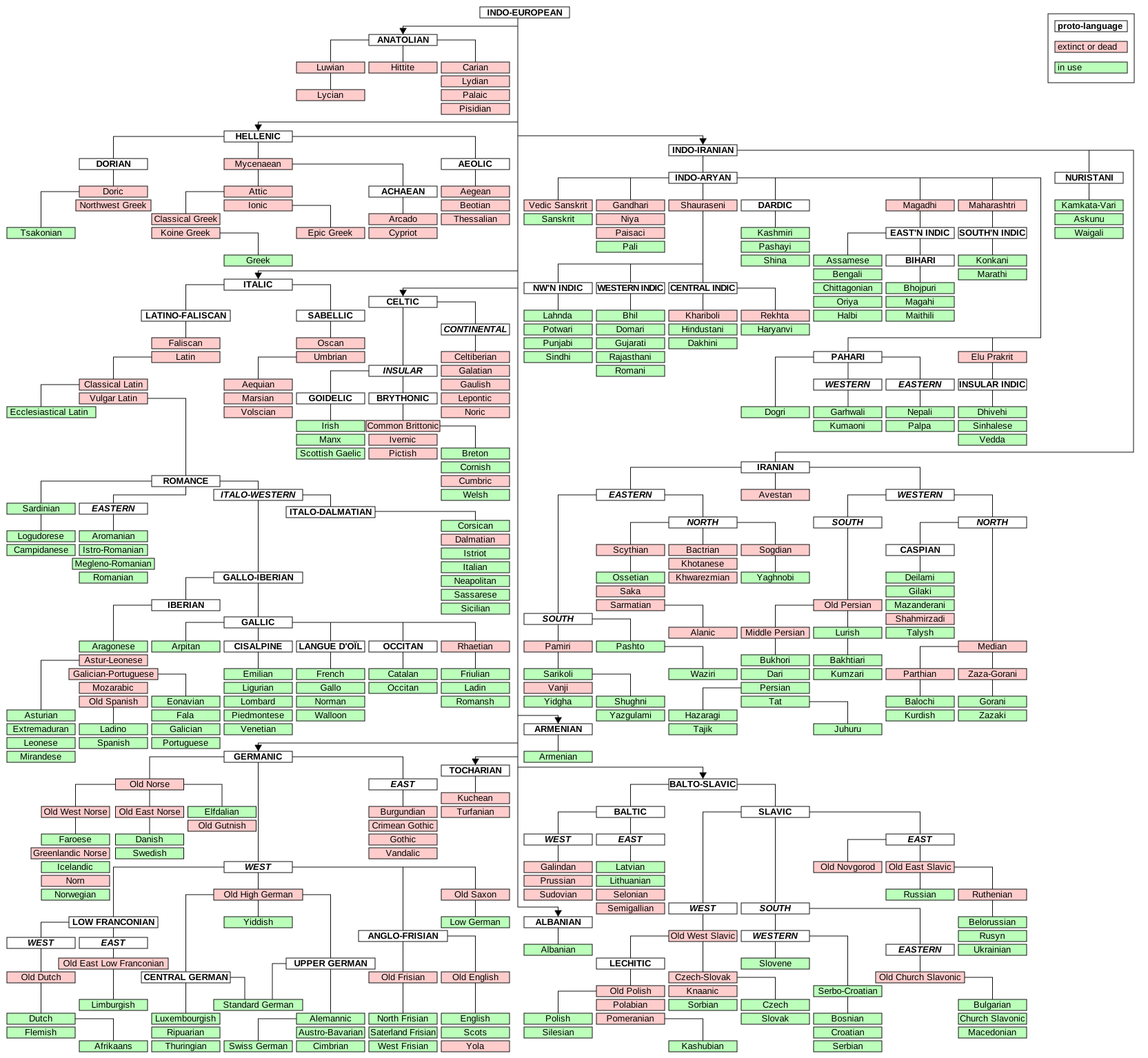
As a note, Sanskrit is a "sibling" or cousin of Latin or Greek in the family tree of languages ( https://upload.wikimedia.org/wikipedia/commons/4/4f/IndoEuro... ). Neither Latin nor Greek grew from Sanskrit but rather each (and many other languages) grew from Proto-Indo-European that was believed to exist somewhere in 4500 to 2500 BC.
As a novice in the history of languages and being k-lingual in a couple of Indian languages and English, the Farsi language is such a delightful stream of discoveries.
Regardless of which k of my languages I restrict myself to, I end up discovering words that are same between Farsi and that language.
I understand that this should not be surprising given their roots in Indo-Iranian languages, the largest branches of Indo-European.
Nonetheless it is delightful everytime I discover a new one by accident.
Basile Bouchon developed the control of a loom by punched holes in paper tape in 1725. The design was improved by his assistant Jean-Baptiste Falcon and by Jacques Vaucanson.[5] Although these improvements controlled the patterns woven, they still required an assistant to operate the mechanism.
In 1804 Joseph Marie Jacquard demonstrated a mechanism to automate loom operation. A number of punched cards were linked into a chain of any length. Each card held the instructions for shedding (raising and lowering the warp) and selecting the shuttle for a single pass.[6]
To help debug the occasional 'dropped all the cards on the floor' accident, was the diagonal stripe across the side, after the cards have been stacked right.
This was used for computers for sure, not sure about the Jacquard looms.
With complete freedom in addressing (raising) any subset of the warps, these looms were very expressive. My favorite are multi shaft looms.
In a k-shaft loom you can only define k elementary subsets of all the warps. Makes for more interesting problem solving instances and mathematical structure.
Maybe. Depends on how good the substitute is. Demand for number crunching went up as costs went down, but nobody is training human "computers" anymore.
I don’t know that those people were exactly out of a job though, they didn’t do that job, but I find it hard to believe that any of the people solving orbital mechanics by hand wound up with nothing to do but twiddle their thumbs for the remainder of their lives. Similarly, I don’t know that there’s any realistic prospect, even if ai winds up writing all the software, that there wont also be incentive to have people that also understand it.
They'd also be unhappy with a solar panel that only generated power when a car was plugged in. Fortunately it would still be connected to the grid, resolving both concerns.
To be fair, that could be said of many other medical conditions as well, especially chromosomal abnormalities such as Down Syndrome. Many humans, from the moment they are born and through no fault of their own, have virtually no hope of ever competing in the Olympics let alone winning, just because at such competitive extremes, any significant genetic disadvantage takes you out of the running.


And the question of how much the payment should be has a straightforward answer: adjust until the birth rate reaches replacement.
If the payment ends up high enough that some mothers or fathers opt to leave the labor force to focus on raising their kids, then so be it; that's probably healthier for society in the long term.
It would be expensive, yes, but cheaper than the alternatives. And anyway, Japan's stagnant economy would likely benefit from the boost to consumer demand.
reply