> "I think it's really struck a chord with how people are feeling in the world right now - the world is in quite a stressy place," Rigden said. "With the game you are able to focus in on one thing, which kind of blocks all the other distractions out - it's a pure form of meditation."
People love providing such explanations to various observed trends, but never consider looking back to check if trends are new in the first place. FWIW, I don't see how these games are allowing players to "focus in on one thing" (and put things in order) any more than Solitare or Farmville.
It is one thing to not use AI because you enjoy the process, or because you believe that art is inseparable from the act of creation.
But she claims that the fact that AI exists decreases her drive to create. That is a much stronger and less obvious argument, and something that doesn't apply to you if you're still building those models.
If she simply "enjoys the effort", as you claim, she would do the same as you - continue enjoying it. But she is not.
It's the instant gratification problem, and I suspect it's dependent on temperament. Some people are more sensitive to having their tolerance for distress eroded by instant gratification. Once I start looking up answers to crossword puzzle clues, I can't stop, and then I don't consider that I've really solved that crossword.
Maybe you aren't like this, but I suspect that the artist in question is. She is self-aware enough to know that she would have a hard time drawing boundaries, and eventually it would be all AI and very unsatisfying. That's why she specified that she would consider using the technology in a very circumscribed way.
I've spent some time looking into all these methods before, but all of them required substantial amounts of plastic in contact with plants/water and in full sun/heat. Are you worried about leachables?
To be clear, I'm not asking this in some new age way, and I'm sure it's better than the amount of pesti/herbicides used traditionally (and the whole movement behind hydro/aquaponics is fascinating to me), just wondering if this is something you ever tried minimising with such setups?
I've thought about it, but I'm not too worried. I wash containers before use and there's not a lot of sun or heat indoors. My regular pots are actually ceramic or stone. They look and feel better than plastic, but I also want to avoid unnecessary plastic when I can.
Prompt they use in `Figure 28.` is a complete mess, all the way from starting it with "Your are an expert" to the highly overlapping categories to the poorly specified JSON without clear direction on how to fill in those fields.
Similar mess with can be found in `Figure 34.`, with an added bonus of "DO NOT MAKE MISTAKES!" and "If you make a mistake you'll be fined $100".
Also, why are all of these research papers always using such weak LLMs to do anything? All of this makes their results very questionable, even if they mostly agree with "common intuition".
A very naive question: why are "dry and on the shelf" not worth buying, when so many of the food-related microorganisms obviously work fine through such distribution (baking yeasts, various yogurt starters, cheese molds, etc.)?
I'm facing the problem you describe daily. It's especially bad because it's very difficult for me to predict if the set of filters will reduce the dataset by ~1% (in which case following the original vector index is fine) or by 99.99% (in which case you just want to brute force the remaining vectors).
Tried a million different things, but haven't heard of Turbopuffer yet. Any references on how they perform with such additional filters?
Lucene and ES implement a shortcut for filters that are restrictive enough. Since it's already optimized for figuring out if something falls into your filter set, you first determine the size of that. You traverse the HNSW normally, then if you have traversed more nodes than your filter set's cardinality, you just switch to brute forcing your filter set distance comparisons. So worst case scenario is you do 2x your filter set size vector distance operations. Quite neat.
Oh that's nice! Any references on this shortcut? How do you activate that behavior? I was playing around with ES, but the only suggestion I found was to use `count` on filters before deciding (manually) which path to take.
I have a book which lists companies which sent out mail order catalogs back in the 70s --- I'm pretty sure it was listed in a Whole Earth Catalog (might even have been published by them).
> The first thing you notice when you land in Greenland is there are no trees or grass. There is snow and then there is exposed rock.
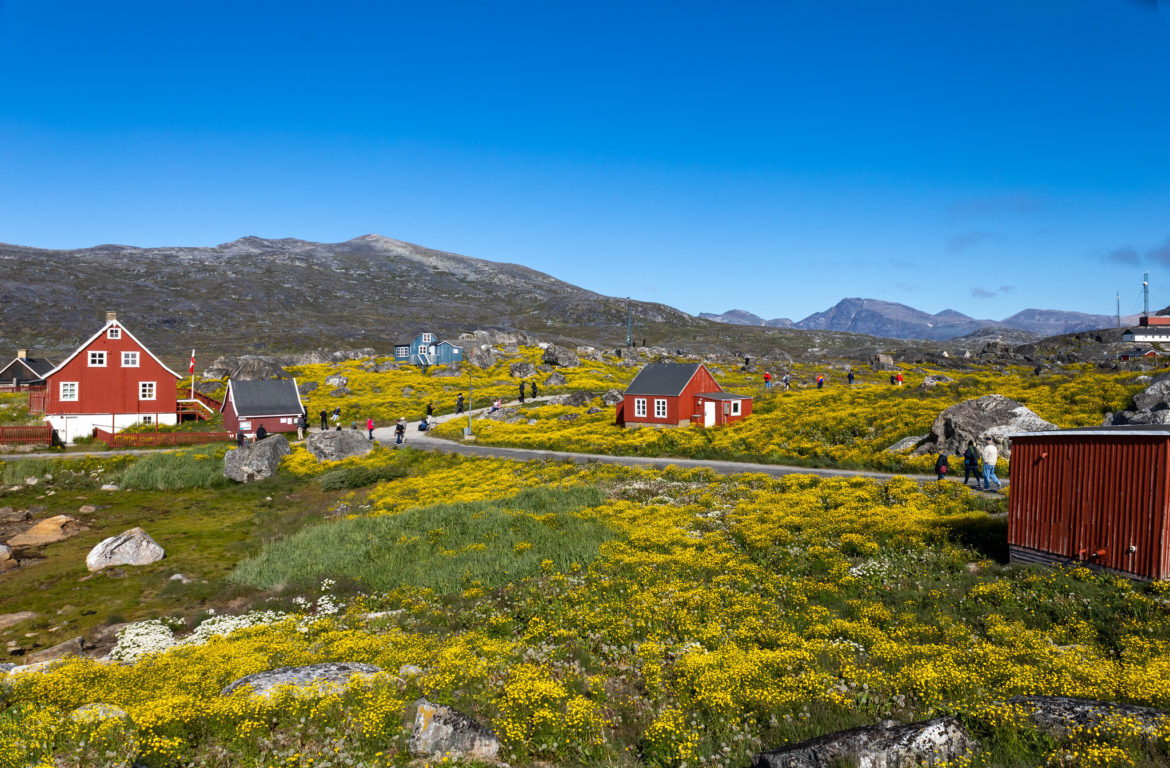
This is only true of the area around the airport. Even his pictures further into the article show how misleading this description is. I was actually very surprised how little snow/ice there was. Now when I think of Greenland, I think of something similar to [1].
Of course, in the winter, it's a completely different story (I was there in July). But he was there during the warm period as well (as is obvious from his photos).
> The city itself sits in a landscape so dramatically inhospitable it makes the surface of Mars look cozy.
If you look at a map, you will notice that Nuuk is at the same latitude as Reykjavik. There's a common meme about Iceland being green and Greenland being icy, and that's definitely true if you compare inland or northern Greenland with Iceland during summer (during winter, both are icy and dark), but hiking around Nuuk is a very "green" experience. Yes, there's a ton of mosquitoes, but nature itself is very inviting. I did not get any of the "inhospitable" vibes he mentions.
> But again even riding the bus around it is impossible to escape the feeling that this is a fundamentally hostile to human life place. The sun is bright and during the summer its pretty hot, with my skin feeling like it was starting the burn pretty much the second it was exposed to the light. It's hard to even dress for, with layers of sunscreen, bug spray and then something warm on top if you suddenly got cold.
This whole section is just overblown BS.
All in all, I enjoyed it a lot. Compared to Iceland, it's definitely a lot less "user friendly" and you need to prepare better, but I have never been to a place that is less affected by humans, and in our age, that is something worth experiencing.
>> The first thing you notice when you land in Greenland is there are no trees or grass. There is snow and then there is exposed rock.
> This is only true of the area around the airport. Even his pictures further into the article show how misleading this description is.
At least as far as trees go, Greenland is reasonably famously lacking in trees (if you are the kind of person who cares about such things). All chopped down by the Vikings and only now are a few sections of forest being regrown. Iceland is basically the same.
I tried explaining in the other comment here. In summary, it's beautiful, raw nature, that's different from anything else I've seen. It takes some preparation, but I haven't experience any of these "sun will kill you and ice will kill you too" vibes that the article suggests. It felt like one of the last places on Earth not affected by humans (at least directly through resource exploitation, as it definitely is affected by the warming - but that's another discussion).


People love providing such explanations to various observed trends, but never consider looking back to check if trends are new in the first place. FWIW, I don't see how these games are allowing players to "focus in on one thing" (and put things in order) any more than Solitare or Farmville.