I do wonder why I have to purchase good headphones and wear them to combat this problem?
What are the long term impacts of wearing headphones? bacteria growth and hearing loss? Can't be good for my health long term.
Flow is a state of concentration, breaking flow take a longtime to get back in, shouting questions across the room is a context switch and not an asynchronous choice for me if I'm in the middle of something important.
The one inconsiderate person is the worst. The person unaware that their constant sniffing of mucus is awful. Usually the least intelligent person in the office IMO.
Usually the loudest and most obnoxious member of every team I've worked for seems to have the most production problems....coincidence?
>What are the long term impacts of wearing headphones? bacteria growth and hearing loss? Can't be good for my health long term.
For the hearing loss, not necessarily. Get some good noise-canceling headphones that completely cover and enclose the ears, and then either play no music at all or something quiet, at very low volume. With the noise-canceling on and the noise-isolation from the muffs themselves, you'll find you don't need very much volume to hear the music extremely well (human hearing is logarithmic).
However, even the best headphones do have a little weight, which is on your head, and there's always going to be a comfort factor. Wearing them 8 hours straight, day in and day out, may be too much.
>The person unaware that their constant sniffing of mucus is awful.
How are they supposed to help that? It's not their fault that they're sick; people get sick sometimes. It's management's fault for providing you a workspace where there's no privacy at all, so you're forced to see and hear every little thing from your cow-orkers like that. And you can't guarantee that you'll never have a workplace without an annoying or less-intelligent coworker; again it's management's fault for not setting up a work environment that mitigates that factor by giving you some privacy and isolation.
You may find it hard to find audiophile headphones that suppress voices adequately. I had better results with ear muffs from the local hardware store intended for leaf-blowers. Get the biggest, ugliest ones you can find.
I have some of these that I use for lawn work, which are designed for shooting guns. They isolate sound pretty well, but they're also not terribly comfortable. They're OK for driving around on my lawn mower for 30 minutes, but there's no way in hell I'd wear them for 8 hours.
> Mildly ill; interminably coughs, sniffs, or sneezes
YES! One of my pet peeves. The worst, doing a phone screen/interview with someone who sniffs constantly while you're trying to problem solve.
There is a strong correlation between self awareness and intelligence, (I'd google for the white papers for those who will no doubt disagree).
Anyone who chronically sniffs is not very smart and not someone I want to work closely with or at all. How about that as a key indicator, lacks self awareness or consideration of others.
I swear I saw a paper on here a couple months back about some weird negative correlation between intelligence and tendency to breath through the mouth rather than nostrils. Like, somebody had managed to provide evidence that mouth-breathers are stupid.
All tech jobs are hard. Mental health is complex but a theme here is that terrible managers can wield unhealthy power over powerless employees without any recourse.
I worked there, I saw nice normal hard working people screwed over by terrible managers.
Maybe that's life. Maybe there's a problem where that can be improved. Depends on which side of the fence you're on.
I rarely say anything is black and white in this world but sugar is in my opinion. Without any doubt in my mind.
Recently in the last 3 months I gave up sugar, hard core, it's hard but the benefits are out of this world.
I was healthy and active. I ate healthy, or so I thought. Boy was I wrong and mis informed.
I had heard theories so I decided to check them out. I went all out to avoid sugar for a couple of weeks just to see. It was amazing.
I have lost 20 pounds that I didn't think was possible, I think better, I sleep better and I eat way less. I have way more energy, like I drank 5 cups of coffee all the time. I don't fade in the afternoon.
Those of you looking for a way to get more energy and focus at work, especially those working long hours in startups. I encourage you to go all out to reduce sugar intake to as little as possible. Of course eat whole fruits those are ok.
Best thing I have ever done in my life.
There's a saying "those on high sugar diets don't know what it feels like to be sugar free." It feels amazing. Try it. At least once in your life. You won't go back .
A really smart guy said to me once something like, “if you are smart and have money and you don't eat well then you are not smart”. I can't remember the exact quote but the sentiment really stuck with me.
Look I'm no expert but I'm telling you the results are outrageous. Please do your own research as I only really have a school boy understanding of how this affects the body.
My skin cleared up, my ailments all disappeared, I no longer snore, my wife says I radiate energy and my skin glows. People notice that my eyes are white and bright. My thinking is clear and alert.
I run up a big hill occasionally, a massive one, I did it yesterday, I broke a sweat but my body was working and I got to the top in record time with minimal effort. I had been training for years and never could match that performance. It's all SUGAR. I hit the wall because of sugar. I finally cracked the magic code, NO SUGAR.
What do I eat?
I will lose some people here, but honestly, whole fruit, salad, no dressing, chicken,steak,salmon and WATER. That's it. I said it was hard but I went 100% zero sugar. Real Food. Nothing in a box nothing processed. I now love this food more than anything.
Why is whole fruit ok?
My understanding is the fibre tells your body when to stop eating. It's a natural way to tell you that you've had enough. If the grapefruit it too sweet, don't eat it. Your body is telling you something. Listen to it
Sugar inflames your body, it gives you a rush, then a crash, then it makes you hungry. Sugar makes you eat more. It makes you swing up and down.
Getting off sugar is hard, you will have withdrawals. They are not pleasant.
My appetite and palette has changed for the better, I love food now, I can't even drink a soda, I spit it out as the most disgusting thing imaginable, that's a massive change for me. I eat way less I'm spending less money.
Medically all the little things I was thinking of going to the doctor about have completely gone.
3 months in, a lifetime ahead of positive changes.
sorry if this was long and ranty and a bit smug :-)
And just to show that the other way works as well:
Your diet would be havok for my insides. I simply cannot digest fat from meat very well. I'm mostly vegetarian, and eat a lot of legumes and dairy and grains and bread, vegetables and the occasional fruit. I eat fish (trout, usually) once a week for health purposes. I usually only drink water or black coffee. My main mode of transportation are my feet.
I also generally skip breakfast, possibly have a small snack or two during the day, and eat most of my food late in the day when I'm most hungry. I eat candy occasionally. I cook with butter and cream.
And it is strange that I find much of the same benefits as you. I still snore (obviously not due to weight loss). My skin had no change, but I lost weight. I feel physically better. I now like more 'healthy' foods. Soda is really syrupy most of the time - I can occasionally have some when eating, but not by itself (been like that for years).
I'm years into this lifestyle. It took years to tweak it to where it is now - and each tweak had weight loss. I found you can get over cravings for certain sorts of foods (outside of hormones, that is, but even that gets changed some), and you can learn to like new ones. It is basically exposure, though I still dislike eggplant.
I really like this response and I do truly believe that cutting out or minimizing sugar is a truly beneficial thing.
But when I got to this:
> I can't even drink a soda, I spit it out as the most disgusting thing imaginable
I had a hard time taking the rest of your comment seriously. I can understand it being too sweet to your now adjusted taste buds, but calling it the most disgusting thing imaginable is just plain wrong.
Sounds like you might have an unusual sensitivity to exaggeration. It is a symptom which affects a small percentage of the population, and is treatable. Talk to your comedian or an entertainment specialist about treatment options.
(In fairness, I strongly dislike soda. I can imagine worse things, of course, but in the universe of commonly consumed beverages, bubbly sugar water is pretty close to the bottom of the list for me. Another water, coffee and almost nothing else person.)
I can't believe how long I laughed at this comment. I literally rolled around laughing uncontrollably on the floor at this comment. All my coworkers are staring at me funny now. This is one of the most amazing comments I've ever seen on HN. Well played good sir, bravo.
This happened to me - and weirdly others that have dropped sugary drinks. I completely understand where he is coming from, and the adjustment is that contrasting.
I got to drinking water most times at a call center mostly because I didn't like warm nor watered-down soda. And one day, the soda tasted weird and syrupy. It was gross. And the longer I went without sugary beverages, the worse it tasted. I can occasionally tolerate it with food. The drinks that have soda water and fruit juice are much better.
Some time later, I had a friend cut down on soda. We went to the local McDonalds on a lunch break (small town), and she ordered soda. She took it back because it tasted funny, but it turned out that it was simply her taste buds had changed. I giggled, she wasn't so happy about buying the drink, though.
It seems like an exaggeration, but it's not. Your taste buds really do adjust over time.
I used to drink soda like water. That's just how we were raised(badly). A two liter a day of coke or mt dew. Tasted awesome to me. I loved it. In high school I decided I was tired of being sick and quit drinking soda.
I drank some of my boyfriend's coke recently just to see how it was. Just one sip. It was utterly disgusting. The weird thing is I can still clearly recall how I used to like it and think it was refreshing. In memory, it tastes good. But now that my taste buds have adjusted, ughhhh. Nasty.
I don't know, I think it is a mental thing. Ten years or so ago I smoked. I finally quit by telling myself that they smelled and tasted disgusting (which, they do but smokers don't seem to mind while they're smoking). After a few weeks of that, one day I told myself, that's it, I'm done, this is gross and I'm not doing it anymore. So, I've not had one sense.
But here's the kicker. Sometimes when I'm around smoke now, I want to vomit. I'm pretty sure it's because of the way I quit.
I used to drink soda a lot younger then. I no longer drink them aside from using a can every half a year to do cooking (for the effects, not taste), and that was in 2015.
In fact, if you quit soda (and drastically reduce sugar intake), you'll find sugar and those soda stuff very overwhelmingly. At most a sip. The claim is not hard to resonate with.
I can see where he is coming from. I don't avoid sugar and don't find soda particularly sweet, but I do find it to have an off-putting taste of some sort. I can down it if there is nothing else available, but it is definitely not my top choice.
Interestingly, I did love it in my childhood. I think I lost my taste for it around the time that I reached the legal drinking age. At that time I'd try some different drink choices in the circumstances where I would have previous had a soda, and then after not having it for a while it just didn't taste good to me anymore.
I can agree entirely with this. I used to drink Snapple iced teas like they were water. After cutting back on sugar, I can't stomach the stuff now. I like sweetness: I'll add a splash of lemonade to unsweetened iced tea. But the presweetened stuff is 10x sweeter than my palate tolerates now.
> I can understand it being too sweet to your now adjusted taste buds, but calling it the most disgusting thing imaginable is just plain wrong.
Try the 'ol "Grandma Test" on it:
If you had served your Grandma (or maybe great-Gramdma) with a glass of fizzy black liquid, that you poured out of a shiny metal container, do you think she would have drunk it?
I mean, honestly, that would be like putting a glass of used engine oil in front of me today and trying to convince me to drink it.
It's clearly not food, and you clearly shouldn't be eating (drinking) it. Your great-Grandma knew it, and your body does too.
People eat fermented shark meat and blue cheese neither of which 'seem like food to me'. I'm not sure the great grandma test is particularly useful other than to reinforce one's preexisting notions.
I resisted eating blue cheese for the longest time, based on the reasoning that why would anyone want to eat mold?
Then one time I actually tried some - and it was delicious! Now I love it, which was just another lesson in how stepping outside your pre-existing notions can be beneficial.
I don't intake much sugar and I do like the taste of orange soda. I think the difference between now and my former self is my body simply cannot process all the sugar in a can. The idea of drinking a whole can makes me feel a bit sick b/c I know by 2/3rds of the way through I'll be struggling to process it.
>>I can't even drink a soda, I spit it out as the most disgusting thing imaginable
>I had a hard time taking the rest of your comment seriously. I can understand it being too sweet to your now adjusted taste buds, but calling it the most disgusting thing imaginable is just plain wrong.
I said this in another comment, but he's just humblebragging. It's just like someone saying they don't have a TV. He's showing how cultured and refined he is compared to the rest of us who enjoy sweet foods.
I also cut out most sugars. I literally cannot drink Dr Pepper or Mr Pibb (the only two I can stomache) straight. I have to dilute it with plain soda water (unflavoured, unsweetened).
My wife, who still likes sweet drinks, cannot stand the mix I make, and I cannot stand the mix she likes (as in, as the manufacturer intended).
It isn't humblebragging. It's real. Cut out sugars for a couple of years and try it yourself.
Agreed. I used to really like Dr. Pepper and Cactus Cooler. I've not regularly drank soda for about a decade at this point. Every now and then, I get a hankering for Dr. Pepper. I can't finish more than 1/3rd of a can, and it is just not good. A couple times a year, I can drink a cup of Cactus Cooler still, but that is about it.
I'll wager there are more on HN, who cut down or take no sugar.
I left it about 10 months back. And recently in a movie hall, I had to take tea with sugar (as their machine could only serve with sugar, very strange!) . So I grudgingly took it. But when I tasted it, it felt yuck! I could barely finish that. So I can say that the GP was not exaggerating greatly, perhaps slightly.
Given that you call it 'soda', you're probably American... in which case, American sodas are disgusting, because they're made with HFCS instead of sugar. :)
It's still 'sugars', but it's not 'sugar' as the public calls it. I'm someone who eats too much sweet, sweet sugar, and I can't drink an American soda.
Well, that isn't really the thing. I started the dislike after cutting them out living in the US. A few years ago, I moved to Norway. Same thing. Even if they taste differently.
Not like I could afford to drink them as often here anyway, but that is besides the point.
+1 to this. I recently just started toying with the idea of going sugar free and ketogenic... so I started trying foods without many carbs but wasn't even committed to it. All of a sudden I noticed I had lost 5-7 pounds in 3-4 weeks. So I got excited and kept it up... I'm not losing weight at the same rate but now about 2-3 months in and I'm down about 25 pounds. It's ridiculous.
I haven't noticed the energy or clarity improvements in myself and my wife hasn't seen that in me either. That may be due to sleep as I'm going to school full-time, training for the Chicago Marathon, and working full-time. Given all that maybe it's just great that I can function. :)
Either way! The changes have been amazing and dramatic. My biggest problem now is that I need to buy a whole new wardrobe but I can't yet because I think I still have another 15 pounds I'll blow through by Christmas. I finally feel in control of my weight and it's the best.
No, man, it's important to share these ideas. My energy levels jumped when I changed my lunches from carbs&protein (pasta, potato etc) to salads with protein.
You can put vinegar, salt and a dash of olive oil as seasoning into a salads - still no sugars.
I have had some pretty nasty neurological symptoms due to invasive intracellular infections of the CNS, and been whole-food paleo-like keto diet for more than 1 year now with no exceptions, and I feel damn great, compared to before that is.
>It's all SUGAR. I hit the wall because of sugar. I finally cracked the magic code, NO SUGAR.
Can't say I agree with this part. If you're doing any kind of intensive cardio work sugars are essential if you want to keep doing it for any long period of time. The harder you're going the quicker you'll want to start eating carbs, be it in gels/fruit (Dates are fantastic for this).
You might actually just have got better, or maybe just might be well rested after a period of over training.
I weaned myself off sugar once too. It was hard. It took about two weeks before the intense cravings subsided, and then everything tasted sweeter. I was getting a sugar high from eating carrots. It was awesome.
Later, though, I started working at tech companies that had catered food, so I didn't control my diet anymore. It's funny how much better I feel when I can choose my own diet. I think I'll make a point of avoiding sugary foods again.
Why's that any different from eating say table sugar + celery? I just had a slice of a lovely honey dew melon. It was like drinking sugar syrup. I'm pretty sure it was bad for me. Surely the advice should be to not eat too many sugary fruits either, especially not the modern breeds that are much sweeter than more traditional varieties.
> Why's that any different from eating say table sugar + celery?
In principle it's not, except perhaps for a glass of water. Most sweet fruits tend to have much more moisture than celery.
An unstated assumption that may come with your question is that just like eating fruit is equivalent to eating sugar + celery, it would also be the same to eat sugar, then celery. This is not the case. The fiber and water in the fruit make for phisical barriers that slow down digestive enzimes from reaching the sugar molecules in it. This makes for a steadier release of energy over a longer period of time; the exact opposite of the well known 'sugar rush' phenomenon. [1]
Then there is the issue that most people, left to their own devices, will eat too much of sugar and too little of the other two.
[1] I don't have the appropriate literature at hand, but this was explained to me by a really close person who's been a Diabetes-I survivor for 21 years and counting. His report is that foodstuffs with identical glycemic indexes do cause different, noticeable physiologic responses based on the amount of fiber in them.
I've had type 1 diabetes since I was 12, I'm 21 now.
Food with identical glycemic indexes do cause different responses. Bread and food with fibers keep the blood sugar levels sustained.
When I have to skip a meal, I've learned that it's best to eat oatmeal crackers. They keep you full and you don't experience hypoglysemia. When I eat candy-bars/chocolate as a substitute for a meal, my blood sugar drops immensely after a couple of hours. I feel exhausted, my hands start to tremble and I forget words/things.
On the other hand, fruits also have the same effect on me as candy-bars. Fructose is no different for me.
For diabetics at least, sugar is poison. But I can't seem to live without it.
Sorry about your condition. Please do take care of yourself.
I am not going to pontificate about morals, but perhaps you should address sugar as if it was a drug (legal or otherwise). It is very easy to advocate for a "just say no" position, specially for the people that do not face themselves with the problem on a day to day basis. But once you have found that this is not an option for you, it'd be a good idea to manage your habit in such a way that it minimizes associated risks. i.e. Alcohol != Driving-under-influence.
So, definitively not skipping meals. And limit your dessert indulgences to occasions where you will expect to remain in a safe environment for a reasonable time.
I understand () about dietary fibre and glycemic indices.
Celery has more water than pretty much all fruits (www.herefordshireccg.nhs.uk/download.cfm?doc=docm93jijm4n7467.pdf)
Celery also has more fibre than honeydew melon - 1.6% vs 0.8% (the source this time was just googling "fibre celery" and "fibre honeydew melon", the data is on the results page and credited USDA).
I guess the sugars in melon are inside cells and therefore a little harder to get out and into my blood stream. However, I'm pretty sure chewing frees enough to make almost no difference by the time I swallow it (I can't find any data on that).
So, it seems that table sugar + celery is better for me than melon.
>Then there is the issue that most people, left to their own devices, will eat too much of sugar and too little of the other two.
Yep. I'm pretty sure the reason low carb diets work is because they eliminate most of the processed junk that people like to binge on. It doesn't really have anything to do with carbs.
It is more nuanced than that, but you've got the right idea.
Some years ago I tried the Zone Diet(TM), and was able to loose in the ballpark of 20 lbs. For the first month, all carb-rich food was strictly banned, and that did have physiological effects. Later, once the process had been kickstarted, non-junky carbs were gradually reintroduced with little effect on my pace of weight loss.
So... I tend to agree with you. People evolved to eat carbs, but not necessarily highly concentrated, processed carbs.
Generally, the advice is that fruit is good for you primarily because of the quantity of fibre it contains. I seem to recall Robert Lustig discussing this point. Fibre keeps sugar in your gut longer, which in turn means it's broken down by bacteria there rather than having to be broken down by your liver. It was in this talk he gave, at around 1hr 13min 52sec or so: https://www.youtube.com/watch?v=dBnniua6-oM
There's something to be said about eating whole foods rather than eating their refined components individually. Something about the reactions that occur when things are consumed in the form your body expects, together, rather than purified and separated. Some things we call "antioxidants" have the opposite effect when purified and eaten separately from the foods the occur in.
>It just seems like it's everywhere.
That is precisely the problem, actually. It isn't so much that folks are eating pounds or kilos of sweets daily, it is that we find sugar in everything - even if we wouldn't guessed there was added sugar. Food companies do this for a myriad of reasons, usually backed with research on taste. It is really hard to avoid.
I'm not as low-sugar as some of the people here. I figure if I'm eating chocolate, I'm eating chocolate occasionally and damn the sugar. I know there is sugar in that. Occasionally I'll have some daily, but it doesn't make up much of my diet, and that is what I'm much more concerned about. My base diet being fairly healthy.
I simply don't eat much flavored yogurt except as an occasional snack. Many people, however, solve this by buying plain, unsugared yogurt and simply adding in fruit.
Red sauces and other such things - make what you can at home and freeze some of it for later use. Or start reading ingredients lists carefully. It would be helpful if nutrition labels specified the amount of sugar added (regardless of source), but until then, labels and a lessened reliance on pre-made foods.
Natural yogurt should be relatively easy to find. Add some real fruit if it's too dull for you (after a while it's not).
Basically try not to eat processed stuff. Sure, you're not going to die if you eat a pizza here and there, but the baseline should be to eat as much real food as possible, as opposed to processed food. Even for pizza, you could find a place which uses fresh ingredients as oppose to a big franchise where everything is heavily processed and frozen. Finally, give it a try to make your own pizza/yogurt/etc. It can be a lot of fun.
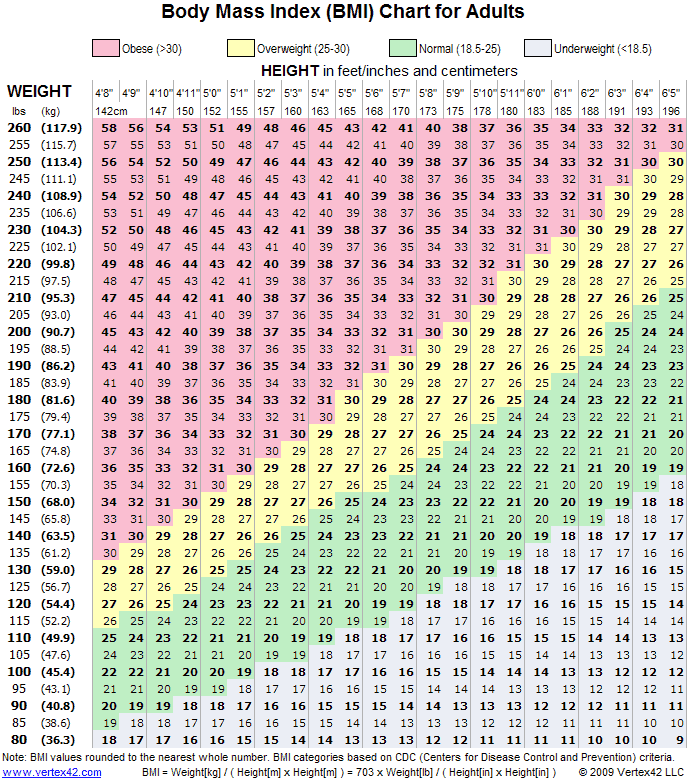
For an average height, the span between the lowest non-over-or-underweight weight and the highest is a lot more than 20 pounds, and being a bit into the overweight range doesn't automatically make you unhealthy either.
That's not quite correct. The CDC recommends a body fat percentage between 18% to 25%, and it's generally acknowledged that athletes can drop down to around 5%-6% without adverse effects. So, given those numbers, most healthy adults are carrying at least 20 pounds that they could safely lose.
CDC recommends BMI of 18 to 25. Completely different from body fat percentage. 25% body fat is pretty fat. It's a noticeably protruding belly, drooping love handles, and sometimes breast tissue that could be classified as an A-cup. BMI is a pretty poor standard anyway, since it would classify anyone who does body building even recreationally as obese.
So my original numbers were actually correct, but instead of the CDC it's the American Council on Exercise, whatever that is. The page before has the CDC recommendations on BMI. I was surprised too that 25% is considered acceptable. I am aware of the difference between BMI and body fat percentage, and that the former is an inaccurate gauge of fitness.
Considering the American Council on Exercise pushes the "Health at Every Size(C)" bullshit I'd never take them seriously. I can't be bothered to go find real studies on the issue but I would have to guess they'd tell you there's an increased risk of health issues at 25% body fat.
Ah ok, I suppose I expected WebMD to rely on better sources of information. I stay around 7-10% body fat and feel good in that range -- the few times I've gone below that I felt lethargic and performed poorly in sports.
I suspect you're not actually at 7-10% body fat, that is ridiculously low. Like just skin and muscle, nothing else. It is physically impossible for most people to go below 7% without some serious drug abuse or eating disorder. Google image search "7% body fat" and see for yourself.
Your numbers are good for males. Often women have issues if they drop to the 5-6% range... missed periods, decreased fertility, hormonal changes, and other such things. Weirdly, some of the same issues people have with anorexia, only to a healthier extreme. I'm pretty sure they recommend women to have at least 9-11% body fat if they are muscular.
Have you cut back on carbohydrates too? I'm just curious, since I've eliminated sugary drinks, but I find it harder to cut back on bread, pasta and so on.
Well, we do know that fructose is worse than glucose in terms of its effects on your body because it takes an extra processing step that can cause other complications.
This is anecdotal, but I personally feel better when I eat rice than when I eat wheat, though I don't have celiac disease. It would be nice if nutritionists looked into carbs as much as they've looked into fats.
What kind of sugar were you eating? Like cookies, cake, pop, ice cream? I don't have any of those foods in my home. I don't buy high sugar foods. So, I'm kind of confused what you consider to be a high sugar diet. How did you get that much sugar in?
Most likely pop. If you eat out a lot, cheap restaurants will shame you into buying huge unhealthy drinks, unless you want to drink water from a tiny dixie cup.
It's pretty easy to get a lot of sugar in your entre if you eat at Chili's or Panda Express or anywhere else that uses excessive BBQ sauce.
And then there's the fact that Snickers would like you to think it will satisfy your hunger. At least it has peanuts in it...
* Avoid processed anything. Most especially soft/fizzy drinks, baked goods, candy, fruit drinks, jams, jellies, syrups, most processed cereals.
* Eat fresh vegetables, some fruit, legumes. Whole grains for breakfast (rolled or steel-cut oats). Meat, eggs, and dairy if they're in your diet.
* Check breads and other products for added sugar, in all forms: sugar, molasses (often added to "rye" breads as colouring), caramel colour or flavour, honey, rice syrup, agave nectar (nearly pure fructose), corn syrup, HFCS, concentrated apple juice, etc., etc.
Generally, Michael Pollan's guidance in The Omnivor's Dilemma is good: Eat food, not too much, mostly plants.
Many strength training books have good guidance on nutrition (contrast with cardiovascular fitness, though there are exceptions). I'll recommend The New Rules of Lifting for Women (Schuler, Cosgrove, & Forsythe) specifically as it includes a large section on nutrition and meal planning. The fitness advice is also generally applicable to men, though there is a companion title on that topic specifically -- its nutritional advice is similar though briefer.
What does it precisely mean for a food to be "processed"? "Processed" in general just means "went through some kind of process", which covers pretty much anything (if a local farmer collects their apples in a bin and moves them across the field that's a process) but in relation to food it has a negative connotation, so it must be specific processes the food was involved in that are unwanted? What about these processes inherently make the food more sugary or otherwise unhealthy?
I'm not sure it is a science problem, i.e., processing food makes it unhealthy. I think it is more an economics problem; food processors don't have the incentives to care about the long-term health of the food consumers.
Food processors have incentives to improve their logistics (e.g., increase shelf life) and to make the food taste better (or even, hopefully, addictive). Some brands try to make their products appear to be healthy, but consumers generally have little information about what is going into processed food, so appearance might not mean much.
Of course, even unprocessed food like fruits and vegetables has been heavily engineered by breeding, especially in the last century---and again, not to make it healthier.
I think commonly, processed doesn't mean so much "flour you didnt grind at home", but more "these meats have been ground and mixed with spices and cured" or "they made the speghetti sauce at the factory" or "artificial flavorings and lots of added sugar!".
Not all processing is bad, per se: Factories can make red sauce pretty darn healthy if they want. But what usually happens is that the sauces are filled with a good deal of fat, salt, and sugar along with other things you'd never actually put in food at home (not all of which are bad, but some are misleading - food coloring, for example). They do this because... well, they researched this and found there are 'bonus taste points' if they have the right combination of flavors and feels.
And there is a lot of politics and lobbying to keep the labels more confusing and to use special ingredient names so people don't really know what is in it. Sometimes even when you are trying to avoid something, it is really difficult to figure it all out.
And really, what would probably be needed is some sort of push for healthier processed foods without the weird ingredients. Some things will probably always be bad in excess - cured meats, for example, but we can do better with the others.
Moving apples around is not really processing them because they are still the same. A better example of processing is when you homogenize or pasteurize milk, or mill and separate wheat into flour and bran. Of course you don't see anyone demonizing these processes because we've been doing them for a pretty long time. It's good to bet on traditional foods because the cultures that came up with them must have survived on them somehow. However, newer processes could modify foods into more dangerous forms. Partial hydrogenation, for example, turned out to be a pretty bad idea. Also, modern processing often comes with new additives that wouldn't occur in traditional diets.
>mill and separate wheat into flour and bran. Of course you don't see anyone demonizing these processes because
There is actually a movement to avoid modern milling techniques. Something about how the high pressure steel mills today affect the endosperm and then the readdition of the separately ground germ and bran produces a different whole wheat flour than grinding the wheat berries as one ingredient.
A reputable nutritional guide (and I've listed several, though there are many others) will be far more reliable and complete than me. Please refer to them.
If you care to share your findings, report them back to the discussion.
I've found some data on the subject prior, and I find that it doesn't contain sugar, but acts like sugar, but then that's nullified if you eat it with a fiber, etc. It's more than "what does this book say".
Vinegar + sweetener is the or a fundamental flavor in a number of things, including barbecue sauce, ketchup, coleslaw dressing, several salad dressings, some pasta sauce and chili-type sauces, cocktail sauce, some pickles, and so on.
By that I do not mean "those evil bastards are sticking sugar everywhere", I mean that this is a standard culinary technique. It may be overused and we may consume too much of it, but it is an old technique. It is also one of the answers to the question "how can so much sugar be everywhere but not everything tastes sweet?" Vinegar is one of the bigger answers to that question. (Even ignoring the fact that we can end up very adjusted to the sugar flavor, it is still amazing to me that some things can literally be half sugar by mass and not taste sweet.)
I also mention it because if you want to cut sugar out of your life, this is definitely one of the easiest places to miss a significant quantity. It's pretty easy to make yourself a great salad and accidentally slather it in vinegared sugar.
Yes, but the "traditional" sweetener in Italian pasta sauce is usually carrot, not processed white sugar. At least that's how I've always made pasta sauce.
If you look around, there's sauce on shelves now without lots of added sugar. It's been gradual over many years, but I'm starting to find more choices of various foods that have a shorter ingredients list, less salt, less sugar, etc.
I agree, especially industrial sugar is bad food, and artificial sweeteners and sugar substitutes are even worse.
Sugar and its derivatives are massively overused in todays cheaply processed food chains.
"Many organizations misuse the daily standup in order to accomplish ulterior motives. A big one that comes to mind is having a ‘start time’ for the work day."
My thoughts exactly. This to me indicates poor management style and a control mechanism for insecure tech managers. It's been a great way for me to quickly avoid joining terrible teams that use weird metrics to measure performance.
Why is there so much resistance to common sense approach to knowledge sharing? I always feel much resistance from the force in the move away from 9am stand-up.
At my last job, the 10:30am daily standup was very clearly intended to enforce the start time of the work day. Further, the company provided both lunch and dinner every day, and we were expected to be there for both, every day.
Needless to say, the founders of this company were previously finance guys (the startup itself had nothing to do with finance. honestly it didn't even really have a business plan other than raise VC money and improve vanity metrics to raise more VC money) and were very fond of the ass-in-chair metric of employee productivity.
I could write pages about all the things that were wrong with the culture at my last place of employment, but I won't. I do owe that job for actually plugging me into the network of startups and tech in NYC, so while it was a shitty 2 years, it was worth it (especially since I now know which companies and management styles to avoid).
I am very happy to have moved on from there to my current job, where the only metric that matters is the get-shit-done-whenever-wherever-however metric.
Yeah, I don't know. I work on a team where there are 1 or 2 people who can't ever be gotten ahold of because they're never in the office during normal hours. Our stand-up starts at 11:50AM, and they can't get to it on time. We have some people who commute from far away and leave earlier than standard to avoid traffic and be able to spend time with family. There has to be some time where they can find each other and talk. What's the solution? IF we can't all be there for at least 1 hour a day, how can we reasonably interact? I'm all for flexible schedules, but "come in and leave whenever you like" doesn't work in reality. People sometimes need to interact live with each other, even if it's via chat.
Great article. I think you have hit on something here that only comes with a lot of experience and looking back and what really worked. I rarely see an article that I think YES. TOTALLY. Well done!
I got really excited because I read the heading as Netflix migration costs paid for by AWS. I thought they worked out deal to get a free tier during migration. Wow...oh...nevermind... :-)
I have daily driver Porsche under warranty. I don't have hard numbers but it's been very reasonable. I had two certified pre-owned BMWs and never paid a cent for their entire lifetime. Porsche has cost me for tires but was brand new and under warranty. Fuel pump failed, replaced under warranty. I drive it everyday. It's brilliant. German engineering is great. Thinking S class Mercedes next. Is this helpful? or just bragging? haha :-)
Don't know about the current S class but the previous models were plagued with electronic issues. Source: father owned one and extended family owned every single one of them.
Amazon is great at A|B testing their way to a great user experience. You may not agree just by looking at the UI but the metrics don't lie. Ok sometimes they are misinterpreted or gamed. But an honest look at feedback will work every time.


What are the long term impacts of wearing headphones? bacteria growth and hearing loss? Can't be good for my health long term.
Flow is a state of concentration, breaking flow take a longtime to get back in, shouting questions across the room is a context switch and not an asynchronous choice for me if I'm in the middle of something important.
The one inconsiderate person is the worst. The person unaware that their constant sniffing of mucus is awful. Usually the least intelligent person in the office IMO.
Usually the loudest and most obnoxious member of every team I've worked for seems to have the most production problems....coincidence?