Modern insulation is really, really good, and modern heatpumps are very energy efficient and don't pollute your house with CO, CO2, and particulate matter like woodsmoke. Also, modern double- or triple-pane windows insulate much better than drafty Elizabethan windows. We live in a time of marvels.
You're talking about the best of what's available but that is rarely what builders use and retrofitting your already constructed house to use these could end up costing you 1/3 or more of your home's original value.
All that is to say that builders cheap out on new home construction so most people don't get to enjoy the benefits if these innovations.
I live in Edinburgh, and 100 year old buildings are the newest ones in the city. A good chunk of the city is what we call a “conservation area” - so you can’t modify the aesthetic of the building (windows included), but the vast vast vast majority of people outside that space have double glazed windows I’d wager.
Windows have a lifetime of only 15-30 years, though. If you have to replace them anyway, you might as well get double-pane (even if the rest of the house isn't well insulated).
I think this is the stated lifetime of insulated windows. But obviously single glazed windows were never insulated in the first place so there is no practical lifetime on them...
In my house and on my road a lot of the glass is 150+ years old.
Windows last hundreds of years because glass lasts hundreds of years.
Modern windows don't last very long, because the seals leak, and the argon gas or whatever leaks out. The glass is still good, but the insulative quality is gone.
The parent poster didn't realize that if you don't have double pane windows, you have single pane windows, which have no gas to leak.
Even if it's mostly air it insulates quite a bit better than single pane windows. Of course worse than with the original gas filling, as the windows are optimized for maximum distance between the glass panes without having the inner gas start to "circulate" - which starts to happen at a smaller distance for air than for the noble gasses.
Also in australia, the BCC/NCA is an absolute joke compared to basically every other industrialized country. There’s a reason for the annual “Austrlian houses dont meet WHO minimum standards” articles.
As an example single pane windows havent been effective or widely used since the 70-80s in north america and europe. And both places energy standards effectively preclude them since 2000ish. Or insulation in australia is effectively absent in pre 2000s, and maybe R-4ish on a new build now. Conversely NA was R-4 in the 70-80s and it would be about R-6 (or more) these days.
Our residential solar and heat pump uptake is great. But for building standards and quality were a joke.
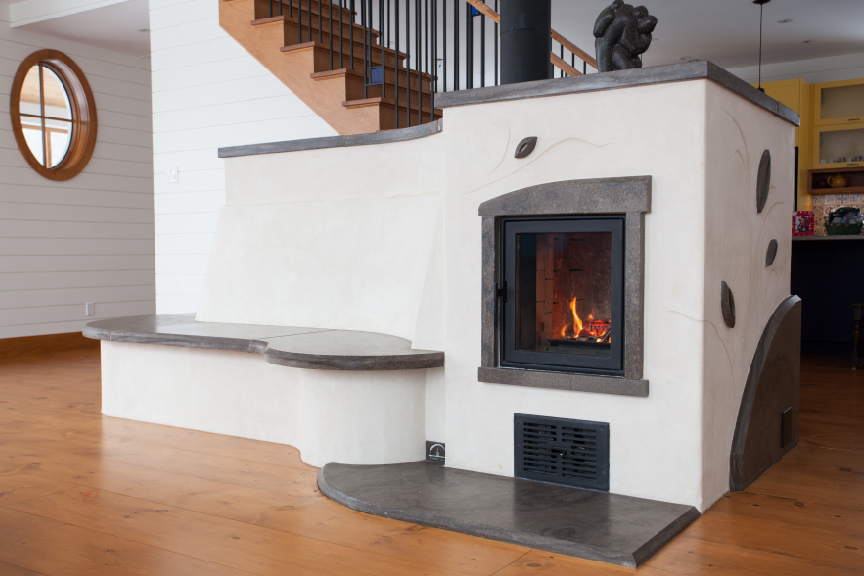
You're missing out if you don't have such thick mass of warm brick/stone. If you only knew how great it is to sleep on top of it (my grandmother had similar to that in her house :)
Modern fire codes require large space between a stove and walls which is usually goes unused where it could have been really filled with such a thick brick structure with the smoke passage snaking through it like in Russian and German stoves. Or like this:
the modern way of doing that is ICF - insulated concrete forms.
I remember talking to a builder once who was building a house this way. He said the mass wasn't allowed to be advertised with an R-value since it wasn't actually insulation, but he said it was comparable to an R-50 house.
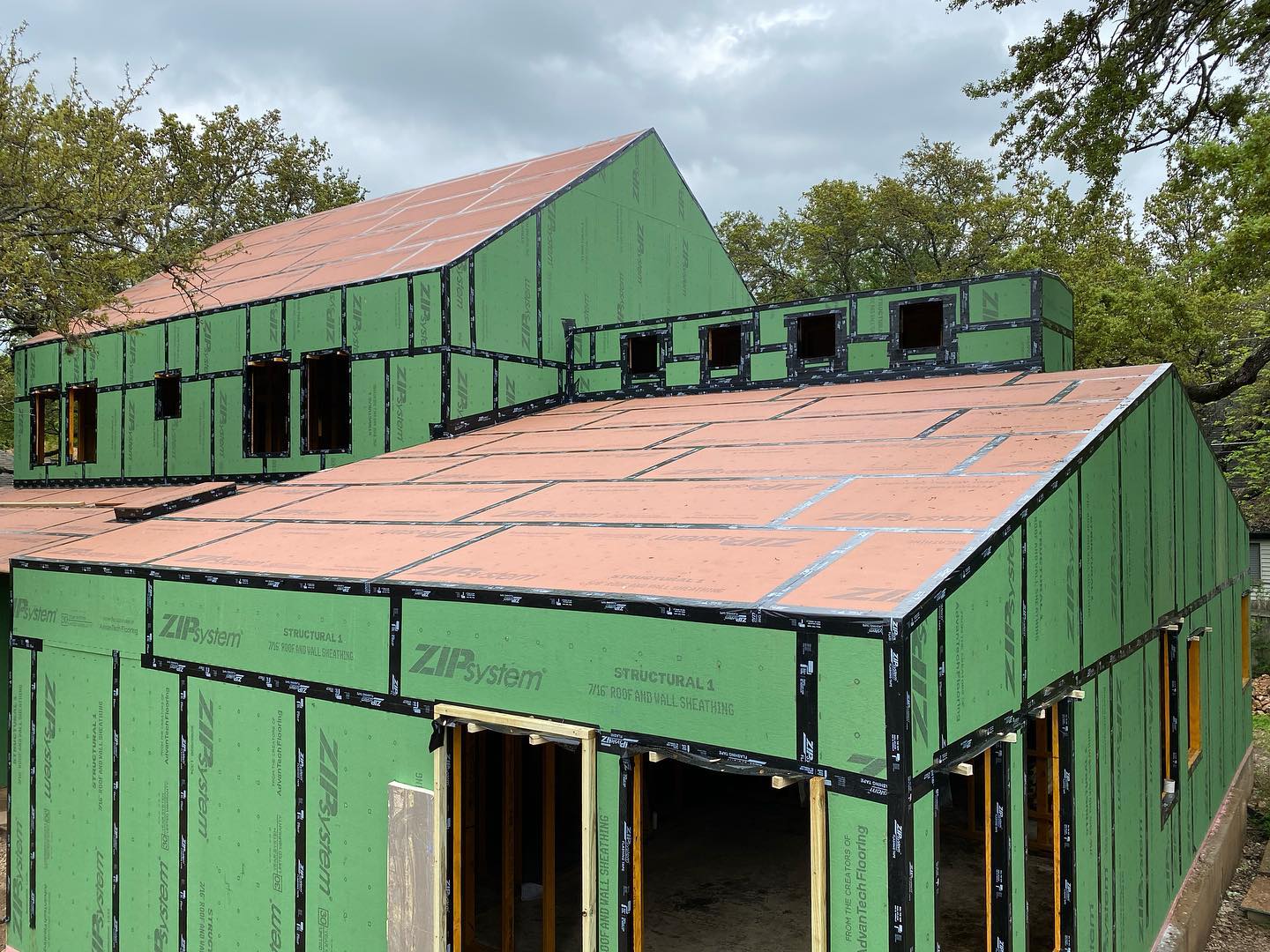
Most high quality modern homes are built to be air tight and bring air in with exchangers. Monopoly framing is how they are approaching this with stick frame houses. They essentially create what looks like a building from the game Monopoly (no overhangs) with air tight materials and tape every hole they can find. They will install a blower door and measure how much air leaks from the building envelope. The overhanging features are installed outside of the air tight monopoly frame.
All of the Zip boards are air and water tight and they use the tape on all of the seams to seal those. The roof will sit on top of the already water & air tight frame. Same with the siding.
I had trouble with my heating system and got a good long talk with the HVAC pro.
I think variable output heating/cooling has one interesting capability - it can adjust to things you've adjusted. For example, a one or two-stage heating system has trouble if you close heating vents in some rooms. It might overheat if too many are closed for example. With a variable-output system, it can support this. further with variable dampers it can support zoned heating and cooling. You can give the places that need it less or more airflow and have a more comfortable house without waste.
after seeing things like heatermeter (pid controlled smoker controller based on the raspberry pi), I wonder why this kind of convenient and efficient control isn't more common.
Consider what happened to painters after the invention of photography (~1830s). At first the technology was very limited and no threat at all to portrait and landscape painters.
By the 1860s artists were feeling the heat and responded by inventing all the "isms" - starting with impressionism. That's kept them employed so far, but who knows whether they'll be able to co-exist with whatever diffusion models become in 30 years.
But the 18th century artist who did portraits and wedding paintings is the today’s (wedding) photographer.
Does it take less money to commission a single wedding photo rather than a wedding painting? Yes. But many more people commission them and usually in tens to hundreds, together with videos, etc.
An 18th century wedding painter wasn’t in the business of paintings, but in the business of capturing memories and we do that today on much larger scale, more often and in a lot of different ways.
I’d also argue more landscape painters exist today than ever.
Personally it's the history for me. MySQL started with MyISAM, not innodb.
So if you wanted an actual transactional database back in the day, MySQL was definitely not it. You needed Postgres.
InnoDB was not MySQL. It was an add on. So if I had to use MySQL it was with innodb of course but why not just use Postgres. And after the Oracle acquisition... Yes I know MariaDB. But I'm already on Postgres so...
I'm also curious about this, especially if anyone has operated postgres at any kind of scale. At low scale, all databases are fine (assuming you understand what the particular database you're using does and doesn't guarantee).
Postgres has some really great features from a developer point of view, but my impression is that it is much tougher from an operations perspective. Not that other databases don't have ops requirements, but mysql doesn't seem to suffer from a lot of the tricky issues, corner cases and footguns that postgres has (eg. Issues mentioned in a sibling thread around necessary maintenance having no suitable window to run at any point in the day). Again I note this is about ops, not development. Mysql has well known dev footguns. Personally I find Dev footguns easier to countenance because they likely present less business risk than operational ones.
I would like to know if I am mistaken in this impression.
1. What is the resolution of timestamps (milli-, micro-, nano-seconds)?
2. Any plans for supporting large data BLOBs (e.g. PostgreSQL TOAST)? This would open up a lot of use cases and would be really interesting to make compatible with the in-memory emphasis for the atomic data types.
I certainly did the same in my first summer job as an intern. Spent the next three days reconstructing Clipper code from disk sectors. And ever since I take backups very seriously. And I double check del/rm commands.